Read More


Recognized for AI Excellence at 2026 Globee® Awards - Read More

Sarrah Pitaliya
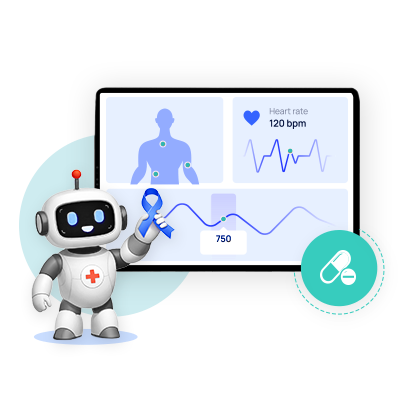
What's Inside: AI is transforming oncology from theory to daily practice. It is enabling earlier cancer detection, faster diagnoses, and personalized treatment plans. As the market rapidly expands, this blog explores real-world impacts of AI in cancer care through insights from precision-medicine expert Andria Parks.
AI has moved from the realm of ideas into real, everyday use in the healthcare industry. The market is expected to grow at a CAGR of 36.6% through 2030. It is changing the way clinicians detect disease, interpret complex medical images, and create treatments tailored to each patient. What used to feel impossible a few years ago is now becoming routine.
Oncology offers one of the clearest examples. AI-powered predictive analytics is helping doctors find tumors with remarkable accuracy and plan treatments that are personalized for each patient. Several research studies show AI's potential in accurately detecting cancer. In hospitals, integrating these tools has reduced diagnostic. That means patients get answers faster and receive care when it matters most.
The growth in this area is rapid. The global AI in oncology market, valued at around 1.5 billion dollars in 2024, is projected to exceed 16.4 billion by 2034. That's a ~30% CAGR in a 10-year span.
This is more than incremental improvement. It is a fundamental change in how oncology is practiced. To explore what this looks like in the real-world, beyond charts and forecasts, we spoke with Andria Parks, a subject-matter expert at the intersection of AI and functional precision medicine.
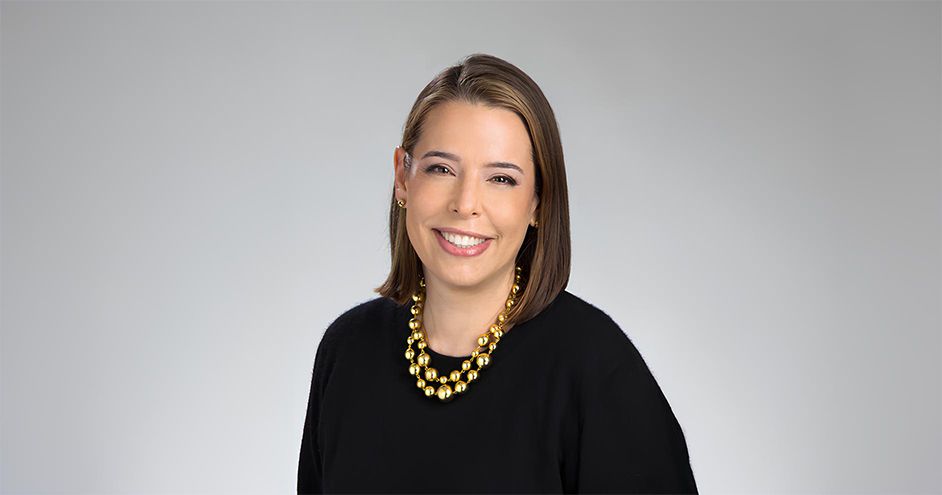
Andria Parks has over 30 years of experience in pharma and AI-driven diagnostics, leading commercial strategy, product launches, and business growth at Pfizer, Merck (Merck Sharp & Dohme), Grünenthal, OPKO, and Renalytix. For the last five years, she has focused on biotech startups where innovation must quickly translate into real clinical impact. A mother of a two-time cancer survivor, Andria is passionate about making precision medicine accessible, ensuring that the right patient gets the right drug at the right time.
In our discussion, we explored topics including:
Here are the insights Andria shared about AI in oncology and the next generation of precision medicine.
My journey in healthcare and medical innovation began more than 30 years ago, spanning large, mid-size, and small pharmaceutical organizations, with the last five years spent in the biotech startup environment. That experience has shaped how I think about precision medicine. For me, it only matters if it can be used, trusted, and scaled in everyday care.
This is where functional precision medicine represents the next evolution. Instead of relying on what worked for other patients, functional approaches test therapies directly on a patient’s own tumor. And the real power of AI emerges when it is fed individual patient data and used in harmony with biology and technology. For example, at First Ascent Biomedical, our focus is on making functional precision medicine in oncology operational. Our AI is built from individual patient biology, allowing us to preserve rare and meaningful signals that matter most in oncology.
My perspective has evolved from asking whether the technology is advanced to asking whether it truly enables better, more personalized decisions for each patient. That is where functional precision oncology delivers its greatest impact.
One of the biggest challenges is trust. There is a great deal of excitement around AI in healthcare, but also a lot of hype. In oncology, where decisions carry serious consequences, AI must be grounded in real patient data, transparent in how insights are generated, and proven in practice. But many AI systems rely on standardizing data across large groups of patients, which can obscure important biological differences. Even the most advanced predictive models cannot fully capture the lived biology of an individual patient.
At First Ascent Biomedical, we take a different approach. Our AI starts with each patient’s unique biology. Rather than averaging patients together, the system learns from the individual patient in front of us and refines insights based on that data. Combined with prospective validation and peer-reviewed research, this approach helps build trust and supports truly personalized care.
AI is a powerful tool, but it is not a silver bullet. On its own, AI is very good at organizing information and identifying patterns, but it has real limitations when it comes to personalization. Cancer is highly individual, and population-based predictions can only go so far.
The real impact happens when AI is fed data from the individual patient and works in harmony with biology and technology. In real clinical settings, this means AI supports faster, clearer decision-making, not by replacing physicians, but by giving them better, individualized information to work from. That is where AI delivers meaningful improvements in both efficiency and patient care.
A strong example is our functional precision oncology workflow, designed to support faster and more informed treatment decisions. We start with patient-derived live tumor cells, ensuring the biology we evaluate reflects the patient’s disease in real time. Clinicians select a drug panel based on clinical context and available evidence, which our AI helps organize and contextualize.
We then run drug sensitivity testing and multi-omics profiling in parallel. Our AI integrates these datasets to identify true drug sensitivity and resistance at the individual patient level. This shifts the conversation from predicting what might work to seeing how the patient’s own tumor actually responds. The output is a ranked list of drugs and combinations delivered in a clear, patient-specific report in approximately 10 days. Physicians retain full authority. AI informs the decision, but clinical judgment remains central.
AI raises the bar for security, accountability, and transparency. Organizations need to understand where their data comes from, how models are trained, how data is stored, and how AI outputs are used in clinical decision-making.
For organizations struggling in this area, the most important step is to build compliance into the healthcare software from the start. That includes being clear about intended use, validating performance in real settings, maintaining clear records, limiting data to what is necessary, and regularly reviewing outcomes for reliability and fairness. Responsible AI and strong data security are what make innovation sustainable.
Data analytics and integration are essential because precision oncology cannot scale if it relies on isolated test results or disconnected information.
Functional precision oncology takes precision medicine further by connecting how a patient’s tumor responds to treatment with diagnostic data and clinical context. The goal is not more data, but better learning from each patient. When those insights are applied forward, solutions can scale while remaining accurate, trusted, and focused on the individual rather than averages.
One common misconception is that AI replaces clinicians. In reality, AI works best as decision support, helping clinicians process complexity more efficiently.
Another misconception is that larger datasets automatically lead to better decisions. What matters more is whether the data is meaningful and relevant to the individual patient. Bridging this gap requires transparency, education, and demonstrating real-world clinical impact, not theoretical performance.
Patient safety always comes first, and physicians must remain the final decision-makers. AI should support clinicians, not override them.
In my experience, commercial success follows when AI is built carefully, validated rigorously, and used responsibly in real-world clinical settings. At First Ascent Biomedical, we set clear guardrails for how AI is developed and applied. That discipline builds trust with clinicians and enables responsible growth.
The biggest impact will not come from a single technology. It will come from advances in biology, combined with the right tools, and interpreted by AI, all working together to support personalized care.
When these elements work in sync, we can make better treatment decisions, develop new therapies more efficiently, and find new uses for existing drugs. This approach helps move care faster and makes personalization possible at scale, which is where the greatest impact will be felt.
Organizations should start by being clear about why they are using patient data and collect only what is necessary. Protecting privacy from the beginning and regularly reviewing how data is used are essential.
Maintaining transparency with clinicians and patients and keeping people involved in the process helps ensure data is used responsibly while still generating meaningful insights that support better care.
Precision medicine has been around for more than 20 years, starting with the mapping of the human genome and the ability to classify disease based on molecular features. That was an important step forward, but much of precision medicine still relies on population-based insights rather than direct evidence from the individual patient.
My vision is for precision medicine to fully evolve into functional precision medicine, where treatment decisions are grounded in how a patient’s disease actually behaves. By combining functional biology with genomic data and real-world clinical outcomes, care becomes truly personalized and specific to the individual.
Radixweb Take on AI in Oncology
When you look at AI in Healthcare, in practice, the focus is always on outcomes. It’s not about using technology for technology’s sake. It’s about asking the right questions, connecting the dots between patient data, and translating complex biological signals into insights that actually inform care.As Andria points out, the most successful implementations are those that respect the role of the clinician. Across our AI consulting and implementation experience, we’ve seen the most impactful projects are those where AI doesn’t replace judgment. Instead, it provides information and context that allows doctors to make decisions faster and with greater confidence. When the technology is designed to complement human expertise, the impact can be transformative.It’s also about systems that work at scale. Hospitals and clinics need platforms that can handle large volumes of data, integrate with existing workflows, and meet strict compliance requirements. Without that foundation, even the most sophisticated AI algorithms can’t deliver meaningful results.At the end of the day, functional precision medicine is more than a concept. It’s a roadmap for care that is precise, personalized, and actionable. And thoughtfully integrated AI is what turns that roadmap into reality. It helps clinicians deliver better care and give patients treatment that is informed, timely, and specific to their needs. If you’re exploring what this looks like in practice, at Radixweb, we support healthcare teams with AI expertise grounded in real clinical needs. Schedule a no-cost consultation with our experts to see how we can help.
Ready to brush up on something new? We've got more to read right this way.