Read More


Recognized for AI Excellence at 2026 Globee® Awards - Read More

Anand Trivedi
Every ML team knows the moment. The model looks excellent in the notebook, the demo lands, and someone asks when it can go live. Then the real work shows up. According to ML market data only 48% of AI projects make it into production, and the ones that do take around eight months to get there. So, while anyone can tell you how fast investment is growing, they can’t tell you why so many models stall between the demo and the deployment.
The reason is sequencing, not effort. The PoC gets built to impress a steering committee, and then everyone acts surprised when a notebook doesn’t survive live data, real users and a security review.
So, the choice between a machine learning proof of concept or production build is framed the wrong way round. The sharper question is which risk you need to remove first, and what your first build must prove so it can graduate. That is what ML proof of concept vs. production really comes down to, and it’s what this guide settles. Read on.
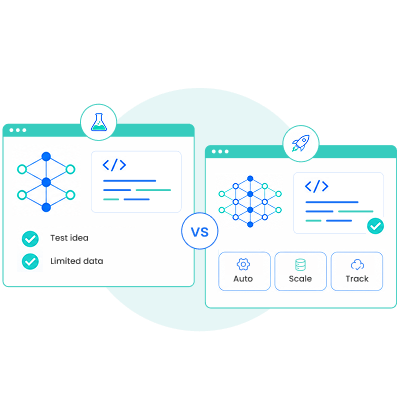
The machine learning proof of concept vs. production choice turns on uncertainty. A machine learning PoC validates feasibility, while production integrates models into business workflows with scalable infrastructure, security, monitoring and maintenance. Build a PoC first when technical feasibility or data suitability is unproven, keep it to 4–12 weeks, with a go/no-go gate. Build a pilot or MVP when feasibility is proven, but adoption isn’t. Then move to production only when thresholds are met, pipelines are hardened, and owners are named.
| Aspect | Details |
|---|---|
| What does this guide cover? | PoC vs production differences, when to build a PoC first, PoC success criteria, measuring PoC ROI, production readiness checks, deployment challenges, steps to move a PoC to production, cost and timeline, monitoring and maintenance, build-first decision framework |
| Who should read this guide? | CTOs, heads of data and AI, product leaders, engineering managers, CFOs, procurement teams approving ML budgets |

A machine learning proof of concept is a small, focused experiment that answers one question: can machine learning solve this specific business problem, using our data, well enough to matter? It isn’t a scaled-down version of the final product. It’s the evidence you gather before deciding whether to build one, and it’s one stage in the entire ML lifecycle, not the whole of it.
A PoC usually runs on a narrow, sampled or static dataset, with lightweight code in a notebook, a basic model or API, and manual evaluation. Speed matters more than polish at this stage, so hard-coded parameters, local data copies and thin version control are fine. What you hand over at the end is credible evidence and a go/no-go recommendation, not deployable software.
It helps to be just as clear about what a PoC isn’t:
The surrounding vocabulary needs the same care, because teams use these terms loosely and loose terms to cause budget arguments. A PoC proves feasibility. A prototype or MVP adds a usable interface connected to real workflows, so people can tell you whether it’s useful. A pilot runs that solution with a limited live group under real conditions. Production is the system running for everyone, with SLAs, owners, and a cost line.
Of these, the machine learning prototype vs. production gap is the one teams underestimate most. A prototype shows that people want the thing, while production is everything that keeps it running when nobody’s watching, including the data, the infrastructure and the people on call. That holds for any team building AI solutions, but it bites hardest in ML, where a model’s behavior changes with the data it sees.
Moving from a PoC to a production system isn’t a code migration. It means building technical capabilities and operational controls that don’t exist yet, from automated pipelines to access controls to someone who owns the pager. A fair place to start is what is the difference between an ML PoC and production?
In short, a PoC tests an algorithm, while production operates a software service. Every difference in the table below follows from that.
| Dimension | Proof of Concept | Production System |
|---|---|---|
| Primary goal | Validate feasibility (“Can this work?”) | Deliver reliable, secure business value (“Can we operate this safely?”) |
| Data and pipelines | Curated, static or sampled datasets, often CSVs loaded locally | Automated live ingestion, schema validation, feature engineering, feature stores |
| Code and architecture | Exploratory notebooks, linear scripts, hard-coded parameters | Modular code, containers, microservices or APIs, CI/CD |
| Testing and quality | Manual inspection of sample outputs and proxy metrics | Automated unit and integration tests, data assertions, canary releases, A/B tests, rollback rules |
| Governance and security | Developer access; privacy checks often deferred | Role-based access, audit logging, retention policies, DPIA compliance, encryption |
| Monitoring | A human watching cell outputs | Automated observability for data drift, concept drift, latency, errors and cost |
| Cost and ownership | Small, one-time spend owned by a project sponsor | Ongoing operating spend (tokens, compute, support) with named business and operational owners |
And when you compare machine learning PoC vs. production deployment, the biggest gap comes from what engineers call 'oversight debt'. In a notebook, the practitioner is the safety net who eyeballs outputs, spots a strange column, and reruns a cell.
Production has no such person, so every check they performed informally has to be rebuilt as automated data assertions, pipeline guardrails and monitoring. Until that debt is repaid, you don’t have a system. You have a talented person on call forever.
This is where enterprise machine learning development earns its keep. The modeling is often the smaller part of the work, while the larger part is the engineering that lets a model run safely when nobody is looking, which is why machine learning development services that stop at the model leave the hardest part undone. It also explains why accuracy in a PoC ≠ reliability in production. A model can score well on a clean file and still collapse on live data, because that file never contained tomorrow’s problems.
The short answer is that it depends on what you don’t know yet. Before approving a PoC, ask which uncertainty is holding the project back. If it’s technical or data-related, a PoC isolates that risk at minimal cost. If the core capability is already proven and the open question is adoption or workflow fit, you can go straight to an MVP or pilot.
So, the ML proof of concept vs. production call, in practice, is just deciding which risk to remove first.
A short feasibility assessment is often the cheapest way to get evidence before a build budget is committed. That is also why teams deciding whether to get ML consulting or ML development services usually start with the assessment. It costs far less than a build and shapes what the build should be, and that early, narrowly scoped work is exactly what machine learning consulting services are set up to do.
Build a PoC first when:
Skip the PoC, or treat it as premature, when:
Sequencing matters even more for organizations distributing AI investment across ML, NLP and CV, because every stage that retires risk before the next release of budget keeps one stream from starving the others. For most custom enterprise ML initiatives, the path that works is sequential:
Need to recreate the following image:
Each stage retires one kind of risk. Skipping stages doesn’t remove the risk. It moves it somewhere more expensive, which is why the machine learning proof of concept or production decision should rest on evidence, not enthusiasm.
Not a high score on a demo dataset.
A successful PoC produces decision-ready evidence, meaning the people funding the next phase can say yes, no or not yet, and defend the answer. In practice, four things separate the PoCs that deliver this from the ones that don’t.
A good PoC ends in a formal go/no-go with one of four outcomes: advance to a prototype or pilot, refine the model or data approach, pause until an external blocker is resolved, or stop. Stopping counts as success too. An unviable idea killed in eight weeks has just saved you a production budget.
Measure across three dimensions, not one. Business value covers cost reduction, time saved, revenue enabled or errors prevented against the current baseline. Model quality covers accuracy, precision, recall, latency and failure patterns across key data slices, and for tailored natural language processing solutions it also covers output quality. Operational viability covers data availability, privacy compliance, user trust, workflow fit, and integration constraints. A PoC scored on model quality alone is a research project.
Agree on the benchmark and the risk limits, such as a maximum acceptable latency or a false-positive cap, before anyone sees a result. Otherwise, teams pick the metric that flatters the output. (It happens more often than anyone admits.)
Include minimal versions of the data pipeline, model serving, and operational workflow, so you’re testing whether the system is viable and not just whether the algorithm is correct. A “system PoC” costs a little more up front and saves a lot of arguments later.
Get these four rights and you can call a PoC successful before the demo, not after it. The next question is how to put a number on that success.
Measuring ROI of Machine Learning PoCsOnce a PoC qualifies as successful, the question becomes what that success is worth. At this stage, ROI is a projection, so build it honestly. Measure business value against the existing process baseline, then put the full cost of getting there next to it: the PoC itself, the extra spend needed to prepare for production, and the recurring cost of running the system.A PoC that looks profitable only because it ignores operating costs hasn’t proved anything. Model-quality numbers feed the case, but they aren’t the case. And AI development costs tend to shift budget lines once a project moves past the experiment. Experts offering machine learning development services should be able to show that full cost up front, not just the PoC line.
A model isn’t ready because it wins a test-set benchmark, and certainly not because it wowed a steering committee.
So, when is a machine learning model ready for production?
When the surrounding software, data infrastructure and governance can guarantee it will run safely, reliably and economically under live conditions. Google’s ML Test Score offers a structured way to check it, with 28 tests across four pillars, and four operational conditions sit on top of those.
That checklist is where the ML proof of concept vs. production debate stops being theoretical, because readiness is the line between the two:
A model that clears all eight has earned its launch date. One that doesn’t is a model with fans and no keeper. Many teams run this audit with machine learning consulting services before committing to a date. Finding a gap on paper is far cheaper than finding it in an incident review, and the fixes are usually small while the model is still close to its PoC code. It also helps to work with AI/ML specialists who have watched these gaps surface in live systems and know which ones are cheap to close early.
Moving from prototype to live deployment hits technical, architectural and organizational walls, and none of them is visible while the model is still in a notebook. This is where most machine learning production plans quietly fall apart, and five of the walls show up almost every time:
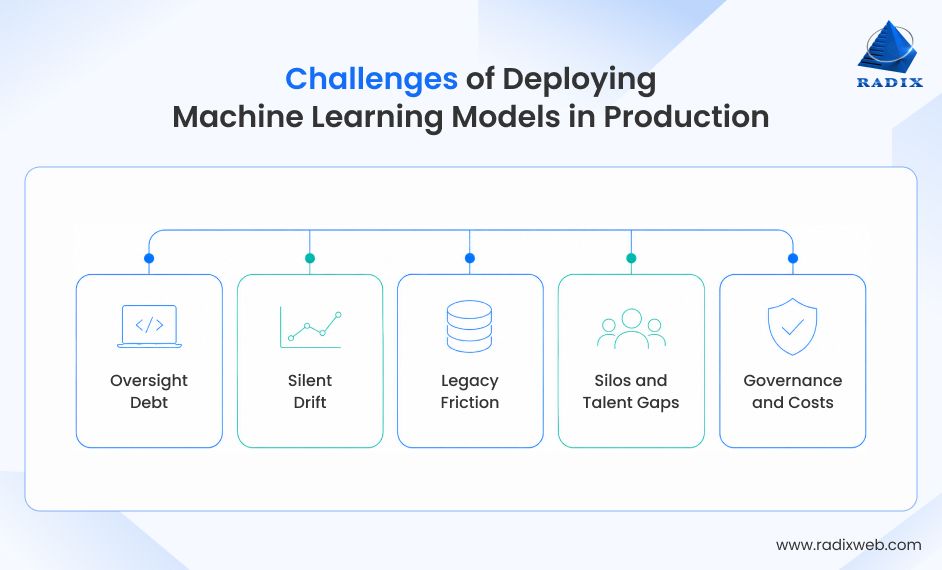
Notebooks rely on a human to inspect outputs and debug, and production needs that replaced with automated modules, guardrails and logging. ML systems also collect hidden debt of their own, including “pipeline jungles” of fragile scrapes, joins and sampling steps, unmaintained data dependencies and glue code nobody remembers writing. In enterprise machine learning development, that debt compounds quickly because many teams touch the same pipelines.
Incoming feature distributions shift (data drift), or the relationship between features and outcomes changes (concept drift). The model keeps answering. It just answers worse, and nothing throws an error.
Plugging modern ML frameworks into rigid legacy systems takes stack adaptation, security vetting and extensive A/B testing, and integrating AI with other solutions without breaking revenue-critical workflows is where schedules usually slip. That’s why we assess data and integration points early, since clean data for AI is rarely given in an older estate.
Data scientists optimize for experimentation, while software and MLOps engineers optimize for stability. Hand a model across that line without modular structure, containers or documentation, and it’s routinely undeployable as written. MLOps implementation services often bridge that gap by building the shared pipelines and handoffs both teams work from.
That’s only part of the story. The less visible challenge is...
Privacy constraints such as GDPR and DPIA reviews, audit requirements, vendor due diligence, and ongoing GPU or API spend. None of it shows up in a PoC budget, which is exactly why it ambushes teams afterward.
Our proprietary research report on why AI initiatives stall, titled, Radixweb’s AI failure report, covers broad failure patterns and these deployment failures are just one slice of that picture.
Moving a model out of a notebook is an engineering project in its own right, and building an artificial intelligence-powered business system means repeating that project for every model that earns its way into production.
It tends to go wrong when it is treated as the last week of the PoC, and it goes right when it follows a plan. The steps to take an ML model from PoC to production follow a structured MLOps workflow, and order matters, because each step makes the next one safer, and skipping ahead usually means redoing work later. Seven steps cover it:
Start with production readiness for machine learning, re-validate the PoC on live-like data and run it against the criteria above. Fix gaps now, not after launch.
Refactor notebooks into testable Python scripts and classes, separating ingestion, feature engineering, training and serving, so each stage can be tested and reused on its own.
Formalize training and data pipelines in tools such as Kubeflow, MLflow, Kedro or SageMaker, and move from single-machine Pandas loads to distributed processing like PySpark, or to optimized, indexed database operations, so the pipeline can handle production volumes.
Package inference apps and dependencies in Docker, so local and cloud environments stop disagreeing.
Continuous integration, deployment and training pipelines run unit tests, validate schemas, build containers, train models and manage releases without anyone doing it by hand.
Use shadow mode (the model runs on live traffic without serving outputs), canary releases (traffic shifts from 1% to 100%) or blue/green deployments with A/B testing, so runtime failures surface before full cutover.
Store model artifacts, hyperparameters, code versions and dataset lineage in a model registry such as MLflow for auditability and fast rollback.
Scaling isn’t rewriting everything bigger. Scaling machine learning models from prototype to production means making the pieces repeatable, so the same pipeline, container and release pattern carries the first model and the fifth. Teams that treat each deployment as a one-off end up with the pipeline jungle described earlier, while teams that standardize node interfaces, environments and parameter handling get faster with every model.
That is why the ML proof of concept vs. production transition deserves its own plan, budget, and owner.
Teams without platform skills in-house usually get MLOps implementation services from experts for steps three to five, because pipelines, containers and CI/CD need engineering depth more than data science depth. The refactor in step two is similar: it’s software engineering first, which is why many teams hand it to machine learning development service providers with production experience.
A PoC is a low-cost, short-term experiment. Production is a long-term capital and operating commitment. In machine learning proof of concept vs. production budgeting, the most common mistake is treating the second number as a multiple of the first. It isn’t. The work is different in kind, and the table below shows where.
| Aspect | PoC | Production |
|---|---|---|
| Timeline | 4–12 weeks | 8–24+ weeks (6–12 months traditionally; 8–12 weeks with structured MLOps) |
| Scope | Single use case, sampled data | Full live integration, SLA-backed |
| Budget | Roughly $10,000–$15,000 for an illustrative internal-assistant PoC | Typically 30–50% or more of the initial spend added for production preparation |
| Cost focus | Experimentation and speed | Governance, security and running costs |
| Compute | On-demand instances for experimentation | Reserved capacity for steady-state inference, spot instances for batch retraining |
A tightly scoped PoC should take 4 to 12 weeks, and one that runs longer without producing a decision was probably scoped too broadly. The time it takes to develop ML solutions beyond that point depends on how much production work was planned early.
Getting to production has traditionally taken 6 to 12 months, though structured MLOps, automated testing and infrastructure-as-code can compress preparation to 8 to 12 weeks. On budget, the extra 30% to 50% or more covers application architecture, security and permissions, pipeline hardening, testing and deployment setup. It’s the line item most estimates of the cost of building an ML solution leave out.
Once a model is live, the bill looks very different from the PoC’s, and most of it has little to do with the model itself:
When looking at ML development partners, ask them to price the production phase and the run phase separately from the PoC. If a quote lumps them together, expect a change order.
Comparing quotes this way is also how you choose an ML development company on a level field, because the cheapest PoC line says little about the cost of keeping the model alive. A PoC budget is not a production budget.
A model can be fully online by IT standards (CPU fine, memory fine, uptime perfect) and still produce wrong predictions, which is why monitoring has to go beyond infrastructure metrics. This is where machine learning proof of concept and production differ most sharply. It helps to separate what you watch from what you keep up.
What needs monitoring:
For example, when building a computer vision-driven automation solution, a new camera, lighting setup or product line is a typical trigger.
What needs maintenance:
A model with a beautiful F1 score and no link to a KPI is hard to defend at budget review, which is why the two lists belong together. Teams without this capability in-house tend to lean on MLOps implementation services to stand up the monitoring and retraining loop, since it’s the part of the lifecycle that never ends. Whoever does the work, the sensible order is to settle ownership, alert thresholds and retraining rules before launch. Strategizing ML operations with experts at that stage, rather than after the first drift incident, keeps the fixes small.
To avoid misallocating capital, match the phase to the uncertainty you need to reduce. In machine learning proof of concept vs. production terms, that means deciding what you don’t know before deciding what to build. Build a PoC first only when the uncertainty is technical or data-related.
If feasibility is already proven and the open question is user experience, the prototype comes first. A pilot comes before wide rollout when the solution is usable but untested under real operating conditions.
| Primary uncertainty | Build first | What you get |
|---|---|---|
| Technical or data feasibility | A PoC with sample data | Feasibility evidence and a formal go, iterate, pause or stop decision |
| Solution and user workflow | A prototype or MVP with a functional interface | Feedback on workflow fit and adoption |
| Real-world operational fit | A pilot with one limited live group or department | Measured process impact and integration stability |
| Scaled business ROI | MVP or production with full MLOps pipelines | Sustained value, adoption and long-term scalability |
If the build is going to an outside team, a short readiness assessment along with machine learning consulting services also gives you a neutral baseline for comparing proposals. Whichever phase comes first, the move to production needs a clear trigger rather than a feeling.
Advance only when all five of these hold:
Used well, machine learning proof of concept and production aren’t rivals. They’re two points on one risk-reduction path, and the five checks above are what move you from one to the other.
If you remember one thing, make it this: a PoC isn’t the first phase of a production system. It’s evidence about whether to build one. Treat it that way and the rest of enterprise machine learning development gets much easier to plan.
Start with the First ML Build That Can Graduate
The right answer to the PoC-or-production question is rarely one or the other. It’s a sequence, and building, monitoring, and maintaining an ML system is a long game, not a single launch. Every stage in this guide, from feasibility evidence to readiness checks to monitoring, exists because the teams that win that game settle the order before writing code. Start with a PoC if the data or the approach is unproven, start with a pilot if the capability is already proven, and move to production only when the evidence, the pipelines and the owners are in place.At Radixweb, we have spent 26+ years building and modernizing enterprise systems, and ML PoCs and production-grade ML systems are both part of that work. Our consultants, ML engineers and MLOps specialists help you decide which one to start with, run the PoC, harden it for production and keep it healthy once it’s live. Schedule a consultation with our ML experts and get a feasibility snapshot of your use case, a clear answer on ML proof of concept vs. production for your situation, and a cost and timeline estimate.
Ready to brush up on something new? We've got more to read right this way.