Read More


Recognized for AI Excellence at 2026 Globee® Awards - Read More

Nihar Raval
Most healthcare teams start AI agent projects without considering HIPAA compliance. They think compliance is a security checklist. Something for the final review before launch.
That assumption costs millions because HIPAA compliance has an impact on architectural decisions too. Treating HIPAA compliance as a post-architecture concern cost 2–3x more than building it in from day one. Organizations that plan compliance from the beginning spend 30% more upfront. But they also eliminate rework entirely, saving thousands of dollars per project and gaining 4–6 months faster time-to-market.
But here's the harder truth: the cost difference isn't just about money. One of the biggest challenges of deploying AI agents is designing an architecture that satisfies HIPAA from day one. Without it, launches get delayed by 6+ months while teams rebuild data flows, logging infrastructure, and access control systems.
This guide shows you exactly what HIPAA compliant AI agent development costs in both scenarios.
HIPAA-compliant AI agent development costs significantly more than traditional AI projects because compliance requires architectural-level decisions, not feature-level additions. Organizations that address HIPAA late spend $520,000–$700,000 on rework and redesign. Organizations that plan for it from day one spend $340,000–$640,000 total (including the compliance costs) but avoid catastrophic redesigns and regulatory findings. The difference isn't how much you spend on compliance. It's whether you'll spend once and ship on time or spend twice and ship late.
| Aspect | Detail |
|---|---|
| What this guide covers ? | The real cost of HIPAA compliance in AI agent architecture, the operational overhead that continues post-launch, how much retrofitting costs vs. building-in costs, realistic budget breakdowns by phase, and ROI calculations that justify the upfront investment. |
| Who should read this ? | CTOs, engineering leaders, product managers, and healthcare CIOs planning AI agent development who need accurate budgets and timelines before committing to architecture decisions. |

Organizations skip HIPAA compliance planning while planning and deploying AI agents, because it doesn't feel urgent in month one. The engineering team scopes the use case, picks an LLM provider, and starts building. When someone mentions HIPAA, the response is typically, "We'll handle that later."
That's the moment the project's budget breaks. HIPAA compliance isn't a feature you add. It's an architectural decision that affects:
Once you've committed to a database, logging approach, API pattern, and network design, changing them is extremely expensive. The organizations that plan for HIPAA from day one avoid this rework entirely and launch on schedule, within budget.
HIPAA requires specific controls that shape architecture decisions. For an AI agent handling patient data, HIPAA compliance requires three categories of safeguards: Technical, Administrative, and Physical. For AI agent development, technical safeguards are where architecture costs live.
These safeguards influence decisions across the entire AI agent development lifecycle, from architecture and infrastructure to testing, deployment, and ongoing operations.
All electronic PHI (ePHI) must be encrypted with AES-256 or equivalent at rest. In transit, TLS 1.2 minimum. No exceptions.
Transport encryption (TLS) is standard, but field-level encryption at rest is not. So, to be compliant with HIPAA, your agent's database needs to encrypt sensitive fields like patient names, MRNs, diagnosis codes, and medication information, and do it in a way that doesn't destroy query performance or make data retrieval impossible.
This forces early decisions about database technology, encryption libraries, and key management. Some databases support transparent field-level encryption natively (with performance costs). Others require application-level encryption (more development work, slower queries). Either way, you need to decide this before you commit to a database technology. Changing it later means migrating massive amounts of patient data.
Cost impact: $15,000–$40,000 in setup (architect time, encryption implementation, testing), plus $5,000–$10,000 annually in key management overhead.
Only authorized users can access PHI. Access must be limited to what's needed for the specific task.
The healthcare AI agent itself needs to be a user in your system with specific permissions. It can access certain patient data, for certain purposes, for certain patients. You can't give an agent access to your entire patient database just because it sometimes needs to answer questions. That violates the "minimum necessary" principle.
That's why RBAC needs to exist at three layers:
This requires designing permission models early. Bolt it on later, and you'll discover your entire API was built without authorization checks.
Cost impact: $20,000–$50,000 in setup (designing permission models, implementing RBAC at each layer, integration testing).
Every access to ePHI must be logged. You must be able to prove who accessed what, when, and why. Logs must be tamper-resistant and retained for 6+ years.
For an AI agent, audit logging isn't just about user actions. You also need to log what prompts were sent to the model, what data was retrieved from your systems, what the model returned, who invoked the agent, and what happened to the output. This is dramatically more logging than a typical business application requires.
So, for agent-first audit logging, you need centralized, tamper-resistant log storage from day one. That means integrating with services like Splunk, Datadog, or ELK. You need to design your logging schema to capture the right data. And you need to plan for log retention (storing 6 years of logs for an AI agent making thousands of requests daily gets expensive fast).
Cost impact: $30,000–$80,000 annually for logging infrastructure and retention. Initial setup: $15,000–$30,000.
Encryption keys must be managed separately from the data they encrypt. Keys can't be hardcoded, stored in databases, or checked into source code.
If your encryption keys are in your codebase, they're not secure. If they're in your database, a breach of the database compromises both data and keys. You need a dedicated key management service (KMS) that controls key access, enables key rotation, and audits key usage.
Architecturally, it means that every time your AI agent needs to decrypt patient data, it calls the KMS. This adds latency and has cost implications (cloud providers charge per key operation) that you can mitigate by choosing an experienced healthcare software service provider who designs your architecture to minimize key calls while maintaining security.
Cost impact: $10,000–$30,000 setup (designing key architecture, integration work, testing). $5,000–$15,000 annually in KMS service costs and operational overhead.
You must identify where PHI is stored, what risks exist, and what controls are in place. The updated HIPAA Security Rule (2025) explicitly requires documenting AI system risks.
HIPAA was written before large language models existed. Regulators now expect you to explicitly address AI-specific risks like hallucination (the model generating false patient information), prompt injection attacks, data leakage through model outputs, and bias (Section 1557 prohibits discrimination in healthcare AI).
The architectural impact of this need for risk analysis is that it forces early decisions about model validation, output validation, and monitoring. You need to design the system to detect and prevent hallucinations. You need to sanitize prompts to prevent injection attacks. You need to monitor model outputs to prevent data leakage.
Cost impact: $10,000–$20,000 in risk analysis and documentation. $15,000–$30,000 in development work to implement guardrails, validation, and monitoring.
Any vendor that touches PHI must sign a BAA. This includes cloud providers, LLM APIs, logging services, monitoring tools, and encryption key management services.
If you're using an external LLM provider to process patient data, that vendor needs a BAA. If you're using a third-party logging service, using a cloud provider, or building a document processing AI agent that integrates with an EHR, you need a BAA. Many teams discover mid-project that their chosen LLM provider doesn't offer HIPAA-compliant access or won't sign a BAA. Switching providers late in development is expensive. expensive.
So, you need to evaluate vendors early for HIPAA compatibility. This might limit your vendor choices. Also, some best-in-class tools don't offer HIPAA-compliant versions. So, you'll need to build workarounds or accept suboptimal tooling.
Cost impact: No direct cost, but vendor limitations can force expensive workarounds ($20,000–$50,000+).
Building a compliant AI agent starts with architecture, but achieving HIPAA compliance also depends on implementing the HIPAA-mandated controls throughout software development.
These requirements aren't optional or negotiable. They're structural. Get them right from the start, and you avoid rework. Get them wrong, and you're rebuilding a live system.
Building a HIPAA-compliant AI solution requires engineering work. But that's not the end of it. Operating an AI agent also requires ongoing operational work. And the operational work costs money that doesn't show up in development budgets.
Here are the operational costs of running a HIPAA-compliance healthcare AI agent:
Someone needs to actively monitor audit logs every day, look for unusual access patterns, investigate anomalies, and respond to alerts. Regulators expect this. If there's a breach and your logs show no one was watching, that's a separate violation.
Cost estimate: 0.5–1 FTE (full-time equivalent) per 1–2 AI agents. In major US metros, that's $60,000–$100,000 annually per person. Health systems with 5+ agents need 2–3 dedicated people for monitoring.
HIPAA requires you to limit access to authorized individuals. If a person leaves your organization and still has system access six months later, that's a violation. If the AI agent's access scope expanded without reauthorization, that's also a violation.
So, every quarter, you need someone who can review access, remove terminated employees, adjust permissions as roles change and also audit the AI agent's access to ensure it hasn't drifted from what was approved.
Cost estimate: 20–40 hours per quarter per AI agent. For a health system with 3–5 agents, that's 1–2 weeks of security team time. When outsourced, it can cost $5,000–$15,000 annually per agent.
HIPAA requires breach notification within 60 days. So, when something goes wrong (data is accessed abnormally, the AI agent retrieves wrong information, a vendor is compromised), you need to investigate quickly. Was there a breach? What data was exposed? Who needs to be notified? If you can't investigate quickly, you can't meet the notification timeline.
Cost estimate: $10,000–$30,000 annually in incident response tools and training. When an actual incident occurs (hopefully rare), expect $50,000–$200,000+ in investigation, notification, and remediation costs.
A compliant AI agent today might not be compliant six months from now if it's not actively monitored. An AI agent's behavior can change over time. Training data becomes stale. The LLM provider updates the model. Business rules shift. You need to detect these changes and determine if the agent is still compliant. This includes checking for bias (Section 1557), hallucinations, and out-of-scope decisions.
Cost estimate: $15,000–$40,000 annually per agent for monitoring infrastructure, analysis, and retraining when necessary.
HIPAA isn't static. The HHS Office for Civil Rights publishes enforcement actions, guidance evolves, and what's compliant this year might not be next year. You need someone tracking this landscape and flagging when your systems need updates. Compliance failures due to "we didn't know the guidance changed" don't hold up well.
Cost estimate: A compliance officer or external consultant can cost $15,000–$40,000 annually.
Healthcare organizations undergo regular compliance audits (internal or external). You need to prepare documentation, demonstrate controls, and address findings. If you're not prepared, audit costs spike and findings create more work.
Cost estimate: $10,000–$30,000 annually in preparation and remediation. When an audit uncovers issues, add $50,000–$150,000+ in remediation work.
This is where healthcare organizations get surprised. Development costs are front-loaded and obvious. Operational costs are ongoing and easy to underestimate. But regulators expect you to budget for this. If you're not actively managing compliance post-launch, you are at risk.
According to our experience and publicly available industry averages, the cost of building and deploying AI agents with one business workflow, medium complexity, and 2–3 system integrations is $200,000–$350,000 without compliance requirements.
Add HIPAA, and here's what a healthcare AI agent actually costs:
| Phase | Non-Regulated AI Agent | HIPAA-Compliant AI Agent | HIPAA Compliance Overhead |
|---|---|---|---|
| Architecture & Planning | $30,000–$60,000 | $45,000–$90,000 | +$15,000–$30,000 |
| Infrastructure Setup | $20,000–$40,000 | $55,000–$90,000 | +$35,000–$50,000 |
| AI Agent Development | $80,000–$150,000 | $100,000–$190,000 | +$20,000–$40,000 |
| Testing & Validation | $20,000–$40,000 | $55,000–$100,000 | +$35,000–$60,000 |
| Deployment & Year 1 Ops | $30,000–$50,000 | $85,000–$170,000 | +$55,000–$120,000 |
| TOTAL YEAR 1 | $180,000–$340,000 | $340,000–$640,000 | +$160,000–$300,000 |
| Ongoing Annual Operations | $20,000–$50,000 | $100,000–$200,000 | +$80,000–$150,000/year |
In general, HIPAA compliance adds 50–85% to development costs and 4–5x to operational costs. But here's what matters: that's the cost when you plan from day one.
Organizations retrofitting HIPAA compliance after initial architecture spend an additional $300,000–$500,000 in rework, redesign, and retesting. The retrofit cost is almost always 2–3x the cost of building compliance in from the start.
HIPAA compliance is often viewed as an added expense during AI agent development. In reality, it is one of the biggest investments in ensuring AI agent readiness, reducing operational, regulatory, and architectural risks throughout the system's lifecycle.
The upfront investment for ensuring HIPAA-compliance AI agent development is predictable and can be budgeted for. The cost of fixing compliance gaps after deployment, or responding to a breach, is not. And for most healthcare organizations, the financial impact of non-compliance can exceed the original development budget several times over.
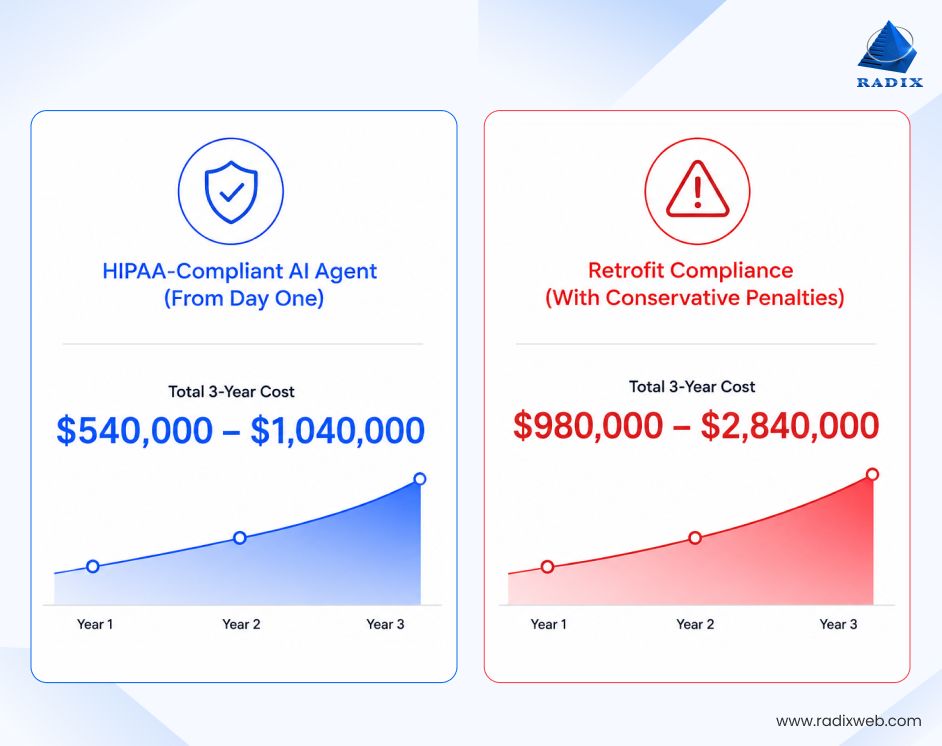
Here's how much a non-compliant healthcare AI agent can cost:
The numbers prove that building HIPAA compliance in your AI agent architecture from day one (despite the higher upfront cost) is the financially sound decision.
Getting Started with HIPAA-Compliant AI Agent Development
HIPAA compliance decisions made in week one determine costs and timelines for your entire project. That's why you need teams with healthcare AI development and healthcare compliance expertise. They know which technology choices create compliance problems later, which decisions matter in week one, and how to avoid the mistakes that add $300,000–$600,000 in rework. This expertise saves hundreds of thousands of dollars and months of delay.At Radixweb, we've architected and deployed healthcare AI agents across EHR integration, claims processing, patient engagement, and clinical documentation. We understand AI agent architecture and HIPAA compliance from production experience. Most importantly, we know where AI and HIPAA intersect and create complications. So, if you're planning a healthcare AI agent, schedule a consultation with our AI architects to map your compliance architecture before development starts. The conversation takes 45 minutes and clarifies whether your architecture plan accounts for HIPAA properly, what week-one decisions matter, realistic budgets and timelines, and where you'll likely hit unexpected costs.
Ready to brush up on something new? We've got more to read right this way.