Read More


Recognized for AI Excellence at 2026 Globee® Awards - Read More

Anand Trivedi
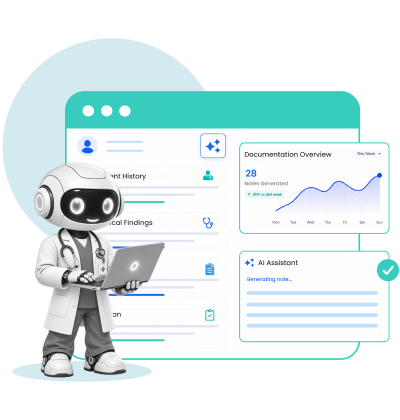
Clinical documentation AI has shown measurable results in early-stage research. A major US study published in JAMA reported that ambient scribing technology reduced clinician burnout from 51.9% to 38.8% after just thirty days of use. For healthcare systems drowning in administrative burden, such outcomes make AI genuinely attractive for clinical documentation.
Yet behind these headline metrics lies a more complicated story. The same organizations deploying AI scribes are discovering that time saved on typing doesn't always translate to burnout reduction. Sometimes it redistributes the burden into different forms. Sometimes it introduces new problems that offset the gains. Sometimes, despite impressive efficiency improvements, physicians report feeling more disconnected from their work, not less.
So, before you invest in healthcare-specific artificial intelligence solutions, understand what actually reduces physician burnout versus what only appears to be on a thirty-day study.
Clinical documentation AI reduces burnout only when it integrates deeply into existing physician workflows. Time saved on documentation is not the same as burnout reduction. The systems that moved the burnout needle shared three traits: blend into existing workflow, achieve 90%+ accuracy, and build-in compliance. Building effective clinical documentation AI requires understanding what causes burnout in your organization, validating assumptions at production scale before launch, and treating integration as a technical problem equal to model accuracy.
| Aspect | Details |
|---|---|
| What This Guide Covers? | The gap between time savings and burnout reduction, why some AI implementations succeed while others shift burden into different forms, what makes AI clinical documentation reduce burnout and what doesn't, technical and organizational requirements for building AI that genuinely reduces physician burnout. |
| Who Should Read This? | CIOs and CTOs at healthcare organizations evaluating or deploying clinical documentation AI, Medical directors and practice leaders planning AI implementation, Healthcare AI vendors wanting to understand why some deployments succeed and others don't and anyone else building clinical AI who wants to understand what separation exists between efficiency metrics and burnout outcomes. |

Healthcare has invested heavily in documentation technology for two decades. EHRs promised efficiency but added complexity. Voice-to-text promised speed but required structured dictation. Predictive workflows promised anticipation but created alert fatigue. Then came generative AI - the technology that produces original text, which was supposed to finally deliver on the promise.
And it was delivered, in a technical sense. AI scribes demonstrably reduce time spent typing and formatting notes. They capture clinical information accurately. They integrate with EHR systems. By the efficiency measures we've historically tracked, they work.
But efficiency and burnout are not the same thing.
Burnout comes from cognitive overload, loss of autonomy, and the feeling of working systems rather than patients. An AI system that saves thirty minutes a day but adds uncertainty about accountability, introduces new review tasks, or fragments of attention during patient encounters doesn't reduce burnout. It concentrates on it in a different form.
After reviewing implementations across healthcare organizations, the systems that moved the burnout needle reliably shared three traits. These aren't nice-to-have features. They're structural requirements.
Systems that reduced burnout are the ones that operate invisibly with features like:
If the note is 80-85% complete by the time the physician sits down to review and a thirty-minute documentation task becomes a five-minute review task, that's a true reduction in cognitive burden.
This is where most implementations fail silently. A system that produces 70% accurate clinical notes technically saves time. But that savings vanishes when the physician spends reviewing errors. If 30% of AI-generated text is inaccurate, physicians don't experience time savings. They experience additional things when they are hunting for problems the AI created instead of preventing them.
High-performing systems got to 92-95% accuracy before going live. That threshold matters psychologically and operationally. At 92%, a physician scanning a note spots issues quickly, and it feels like editing. Below 85%, they're reading sentence by sentence, which feels like the system created burden instead of relieving it. The cognitive experience is completely different.
The proper way to move from AI pilots to production is to train the system on real-world complexities.
Burnout includes a psychological component: the anxiety of potential mistakes and liability. An AI system that introduces uncertainty about who is responsible for documentation (because audit trails are unclear, oversight is inconsistent, or regulatory compliance is ambiguous) adds psychological burden regardless of time saved. Physicians internalize the risk.
In our experience, healthcare systems that successfully reduced burnout answered compliance questions before deployment, not after. Before the first model was trained: Who is responsible for the note if AI generated it? When does a physician override the system? What gets logged and who audits it? Who actually owns the AI outcomes?
These aren't legal formalities. They build trust and boost adoption. And the best implementations treat accountability as an architecture decision, from day one. With that comes clarity, which reduces the psychological burden of using unfamiliar AI in clinical work.
The three success patterns make it clear that reducing physician burnout takes more than AI-generated notes. It requires workflow integration, reliable output, and clear accountability working together.
The same technology intended to reduce documentation burden can have the opposite effect when deployed poorly. These five patterns consistently add workload, cognitive effort, and frustration.
The worst AI implementations are the ones that create a new step.
For example: A physician finishes a patient's interaction and when they look at the screen, they see: "Please review this drafted note" or "These fields need completion." That's not automation, just a different task wearing an AI label. It hasn't eliminated work, just changed what the work looks like.
When review work is concentrated at the end of a shift, after a physician is already mentally exhausted, even small review tasks feel disproportionately draining. The timing of AI work matters as much as the amount of work.
One day the AI captures everything correctly. The next day it misses medication changes, struggles with accents, or forgets portions of a complex encounter. Physicians quickly learn they can't predict when they can trust it.
Inconsistent performance is often more frustrating than consistently average performance. When clinicians don't know whether today's note will require two minutes or twenty minutes of correction, they stay mentally prepared for the worst. That constant vigilance becomes its own source of cognitive load. Reliable systems create predictable workflows. Unpredictable systems force physicians to remain on guard.
Even highly accurate AI becomes frustrating when it slows physicians down.
Waiting fifteen or twenty seconds for notes to generate, watching progress bars after every encounter, or experiencing delays because the AI depends on cloud processing interrupts clinical momentum. These pauses seem minor individually but compound across twenty or thirty patients.
Burnout isn't only created by more work. It's also created by friction. Every unnecessary delay breaks concentration and reminds clinicians they're waiting on software instead of caring for patients.
Many AI systems try to be helpful by constantly suggesting documentation improvements, coding opportunities, quality measures, or workflow reminders. Individually, these prompts may be useful. Collectively, they compete for attention during one of the most cognitively demanding jobs in healthcare.
Eventually physicians begin dismissing notifications automatically or mentally tuning out the system altogether. AI becomes another source of digital noise rather than meaningful assistance.
Organizations sometimes roll out AI with minimal preparation. "Here's a new tool. It works like the old one but better." That's not changing management.
Physicians need time to understand when AI performs well, where it struggles, how to handle exceptions, and how workflows have changed. Without that confidence, many create personal workarounds or continue documenting manually. Technology exists, but adoption never happens. Successful AI deployment depends as much on implementation strategy as model performance.
The difference between helpful and harmful AI isn't the model. It's how the system fits into clinical workflows. Below we explore how AI integration in existing systems and workflows impacts success.
Burnout reduction isn't determined by AI accuracy or speed alone. It's determined by the depth of integration into existing physician workflows and the clarity of the operating model around AI.
Think of integration on a spectrum.
AI is a separate tool physicians use after their primary clinical work ends. The AI assists, but it requires conscious switching. That introduces a context-switching burden, which offsets time savings.
This level is common when organizations are developing healthcare MVPs or standalone AI documentation applications. The priority is validating the AI rather than deeply integrating it into existing clinical systems.
AI helps during parts of the workflow but still requires physician action to activate or finalize. Moderate cognitive load remains because clinicians continue moving between AI assistance and traditional documentation.
This is where many established healthcare software platforms sit today. AI is integrated into parts of the EHR/EMR or clinical application, but workflows still rely on physician intervention at multiple points, limiting the overall reduction in administrative burden.
AI operates invisibly within the workflow, surfacing only when action is required. Physicians interact with it as an extension of their work, not an interruption. Reaching this level of integration is the hardest part of implementation.
It becomes even more challenging in organizations running legacy healthcare platforms. Older systems often lack modern APIs or standardized data structures. This increases the cost of integrating AI with legacy systems, while also making it more time-consuming.
Most healthcare organizations still operate in the low-to-medium integration range. But true burnout reduction requires systems that reduce cognitive fragmentation, clarify accountability, and integrate so seamlessly that physicians forget they're using AI and just experience work flowing more smoothly.
This is where choosing an experienced healthcare AI partner makes all the difference. Beyond building accurate models, they understand clinical workflows, EHR and EMR integration, interoperability standards, compliance requirements, and legacy modernization.

Where AI for Clinical Documentation is Headed Next: The Agentic EraOnce organizations have reliable workflows, high documentation accuracy, and clear governance in place, developing single AI agent or multi-agent AI systems becomes the next logical step. Instead of only generating notes, AI agents can coordinate documentation tasks, retrieve patient context, prepare follow-up actions, and work across EHR workflows with minimal clinician input.Without those foundations, however, agentic systems simply automate existing inefficiencies. They deliver the greatest value as an extension of a well-integrated clinical documentation platform, not as a replacement for one.
If your goal is to reduce physician burnout, not just improve documentation metrics, these decisions must come first. They're technical decisions that determine implementation success.
Before selecting an AI system or onboarding artificial intelligence developers understand how physicians actually document. Not the documentation policies, but the actual workflows with the workarounds, shortcuts, and patterns based on the realities of their environment.
An AI system trained on ideal workflow fails in real workflow. Instead, shadow physicians for a week (with consent), and identify where they spend disproportionate time, where they make errors, where they wish they had support.
Many organizations discover too late that they optimized for metrics that don't matter while the underlying burnout drivers remained untouched. So, don't assume efficiency improvements reduce burnout. Measure burnout directly before deployment using validated tools like the Maslach Burnout Inventory or similar instruments.
Define what success looks like in burnout terms and track the same metrics post-deployment.
A 92% accuracy rate in a controlled pilot doesn't guarantee 92% accuracy when encountering your actual case mix. Simple cases and complex cases are not equally distributed. Test against:
If accuracy drops below 90% for any meaningful subset of your population, the system isn't ready.
Before deployment, define accountability clearly:
Make these decisions at the architecture stage. If compliance is uncertain, physicians assume the worst. That assumption becomes a psychological burden that no time savings overcomes.
Designing, building, and deploying an AI software or feature is just the first step. Actual adoption also requires training, feedback loops, and time for trust to develop. Physicians need to understand what the system does, when to trust it, when to override it, and what happens if they disagree with its recommendations. Without that understanding, they'll either ignore the system or distrust it. Neither reduces burnout.
After deployment, track both system metrics (accuracy, speed, utilization) and physician metrics (reported burnout, time on documentation, patient satisfaction with care quality, clinical confidence). If system performance improves but burnout worsens, something in implementation is wrong. The fix isn't a better model. It's a workflow redesign or a recalibration of how AI integrates into the work.
Organizations that get these foundations right are far more likely to see AI reduce administrative burden instead of becoming another source of it.

Build Clinical AI That Actually Reduces Burnout
AI can reduce physician burnout. But only when smart intelligence is integrated seamlessly with daily workflows, validated at production scale against real case complexity, and backed by clear governance. Half measures don't solve the problem, they redistribute it.At Radixweb, we've deployed AI across fintech, healthcare, supply chain, and other complex enterprise environments for 26+ years. In healthcare specifically, we know the separation between systems that reduce burnout and systems that shift it. We understand HIPAA compliance at the architecture level, not as a checkbox. So, whether you're customizing an AI documentation system, building in-house, or redesigning an existing implementation that isn't delivering, we've solved these problems. Schedule a consultation with our healthcare AI team and map a path to measurable impact.
Ready to brush up on something new? We've got more to read right this way.