Read More


Recognized for AI Excellence at 2026 Globee® Awards - Read More

Pratik Mistry

Most CFOs approach custom AI integration with a simple question: 'What's the cost?' The answer they get is almost never useful. It ranges from '$50,000' to '$500,000+,' depending on who they ask and what assumptions they're making.
The reason the range is so wide isn't because AI is unpredictable. It's because nobody is asking the right upstream question. The actual cost of integrating a custom AI system depends less on the AI capability you want and far more on the state of the infrastructure you're starting from.
A company with clean, documented data and modern APIs can implement custom AI integration in 8-12 weeks for $50,000–$100,000. A company with siloed, undocumented data across legacy systems in the same industry, with the same AI goals, will spend $200,000–$300,000 and take 20-30 weeks. Same outcome. Radically different cost.
The difference isn't in the AI model. It's in everything that happens before the model gets a chance to work.
Custom AI integration for mid-market companies costs $50,000–$350,000 in Year 1, depending primarily on data readiness, system maturity, and integration depth. Integration and data work account for 60-75% of total cost; the AI model itself is rarely the dominant line item. Three-year total cost of ownership typically runs 2-2.5x the Year 1 investment. Hidden costs—data preparation, compliance, change management, and post-launch operations—add 30-50% to initial budgets when not accounted for upfront.
| Aspect | Details |
|---|---|
| What This Guide Covers | Cost by system maturity, five cost drivers, hidden budget line items, compliance overhead, Year 1 vs Year 3 total cost of ownership, realistic mid-market scenarios, and a decision framework to prevent budget overruns |
| Who Should Read This Guide | CTOs, IT Directors, CFOs, Engineering Leads, and business decision-makers at mid-market companies ($25M–$250M revenue) planning, budgeting, or evaluating custom AI integration projects |

The AI hype is everywhere. Boards and customers alike expect AI features to get rolled out this quarter. But not every system should be integrated with AI. Not every workflow benefit from AI-driven decision-making. Most importantly, not every organization is ready for the operational discipline that AI requires. Attempting AI integration when the preconditions aren't met is one of the fastest ways to waste budget and erode confidence in AI across the organization.
That's why before committing AI integration costs and timelines, you need to assess whether your organization is actually ready, and whether AI is the right solution for your specific problem.
AI integration is the right move in these situations:
AI integration isn't the right solution in these situations (explore alternatives instead):
In such cases, you should: build a rules engine or decision support system where humans retain control.
The organizations that see the best ROI from AI are those that choose artificial intelligence deployments that match enterprise goals, not because it is fashionable. That clarity makes the difference between a $200,000 investment that pays back in 18 months and one that never delivers.
Understanding the cost of custom AI integration requires looking at multiple dimensions that interact, compound, and impact each other.
Below we map all the factors that influence your budget in the order they apply.
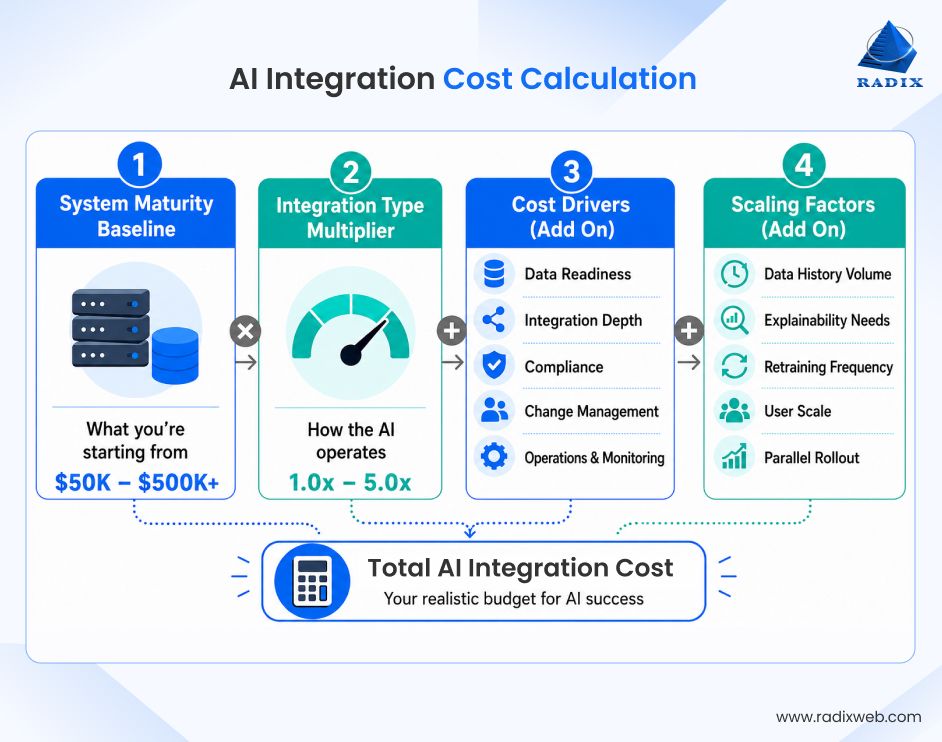
Every AI integration starts with a baseline cost determined by the infrastructure you're working with. This baseline is non-negotiable. It's simply the reality of your current systems. A modern system with documented APIs and clean data is a different integration problem than a 20-year-old undocumented system. The cost difference between these starting points can be $200,000 or more, and understanding where you stand is the first step to building an accurate budget.
| Infrastructure Profile | Cost Baseline | What This Means | Example |
|---|---|---|---|
| Modern (REST APIs, clean data, <8 years) | $50K–$100K | Low data prep overhead; APIs reduce integration complexity | Cloud-native SaaS systems |
| Transitional (Partial APIs, mixed data, 8-15 years) | $100K–$180K | Moderate data prep; some API development needed | On-prem systems with basic integrations |
| Legacy (No APIs, fragmented data, 15+ years) | $180K–$350K | Heavy data archaeology; middleware and custom connectors required | Mainframe systems, undocumented legacy platforms |
| Legacy + Regulated | $250K–$500K+ | All legacy challenges plus compliance architecture baked in | Healthcare or banking legacy systems |
Your system maturity baseline is where you start. It's not the final cost, it's the foundation. Everything that follows (integration type, cost drivers, scaling factors) applies on top of this baseline. Understanding where you sit on this maturity spectrum is critical because it determines how much additional complexity you'll encounter as you move forward.

Once you know your system maturity baseline, the next layer is the type of integration you're building. This determines how much governance, testing, and operational complexity you'll need. Read-only analysis (AI reads data, humans decide) is very different from workflow automation (AI decides and executes autonomously). Real-time decision-making is different from batch processing. Each integration type has its own cost multiplier that applies to your baseline.
| Integration Type | Cost Multiplier | What Drives Higher Cost | Example |
|---|---|---|---|
| Read-Only Analysis | 1.0x | No autonomous decisions; humans review all outputs | Dashboards, predictive analytics |
| Recommendation Engine | 1.3x–1.5x | Requires workflow integration + user adoption | Lead prioritization, next-best-action |
| Workflow Automation | 2.0x–2.5x | Autonomous decisions + governance + approval workflows | Auto-approval, fraud blocking, routing |
| Multi-System Orchestration | 3.0x–4.0x | Coordinates across multiple systems; complex testing | Onboarding workflows, loan approvals |
| Real-Time Decisions | 3.5x–5.0x | Millisecond latency + sophisticated monitoring | Payment fraud, dynamic pricing |
Your integration type multiplier is applied to your system maturity baseline. A modern system with read-only analysis, for example, stays at roughly $50K–$100K. The same modern system with workflow automation costs $100K–$250K. For the same type of integration in a legacy system costs climb up to $180K–$350K. A legacy system with workflow automation or orchestration can easily exceed $500K–$800K.
Now that you have your system maturity baseline and integration type multiplier, the five cost drivers apply to that foundation. These are the major budget line items that appear in nearly every custom AI integration. They're not one-time decisions but structural components you must account for and fund. Understanding each one helps you anticipate where budget surprises occur.
Organizations rarely have clean, documented, accessible data. Most inherit siloed data across 5+ systems with duplicates, inconsistent formats, missing values, and undocumented fields. Remediating these issues costs $15,000–$40,000 per integration and is the single most commonly underestimated budget line.
Why it matters: Every dollar spent on data assessment before the project starts ($8,000–$15,000) prevents three dollars of mid-project rework. Poor data quality delays timelines and also reduces model accuracy while increasing post-launch operational costs.
Each system the AI must connect to is a separate integration workstream with its own API development, data mapping, error handling, and testing. Single-system integrations are predictable. Multi-system integrations compound complexity exponentially.
Why it matters: Connecting to your CRM costs $X. Connecting to your CRM, ERP, and service platform costs roughly $3X, not $1.3X. This is why phasing the rollout often makes financial sense. Start Phase 1 with 2-3 systems, prove ROI, then expand the scope with Phase 2.
Healthcare, finance, insurance, and government organizations cannot treat compliance as optional. HIPAA, GDPR, SOX, and PCI-DSS require architectural decisions like audit trails, data residency, approval workflows, and explainability to be built-in from the start, not retrofitted later.
Why it matters: Retrofitting compliance post-launch is three to four times more expensive than building it in from the beginning. If your organization is regulated, treat compliance as a foundational design decision, not an add-on.
Most organizations budget 3-5% for training and change management. That's why most AI systems that function correctly are used incorrectly or avoided by end users. Actual change management (preparing teams, managing resistance, establishing governance) requires 10-15% of total project cost.
Why it matters: A perfectly functional AI system that nobody uses produces zero ROI. Change management isn't a soft cost, it directly determines whether your investment delivers business value.
Production AI systems require ongoing monitoring, model retraining, infrastructure management, and support. This is almost universally absent from Year 1 budgets and becomes a surprise in Year 2.
Why it matters: A $150,000 Year 1 integration carries $22,500–$30,000 in annual operational costs thereafter. Organizations that don't budget for this often find systems that work for six months then degrade, drift, or become unmaintained.
These five drivers apply to whatever baseline and integration type you've chosen. The question isn't whether to budget for them. The question is how to manage them intelligently, so they don't compound unnecessarily.

Beyond system maturity, integration type, and the five cost drivers, there are five additional factors that act as multipliers on your overall cost. These aren't universal to every project, but each can significantly increase (or in some cases decrease) your final budget. Understanding them helps you spot opportunities to reduce costs or prepare for budget increases.
Abundant historical data (3+ years) keeps the cost at 1.0x. Sparse historical data (6-12 months) however, adds $15,000–$30,000 for synthetic data generation and extended validation.
Impact: +15–25% if data is limited. The less history you have, the more time you need to validate model behavior in pre-production before confidently deploying to production.
If black-box models acceptable (for use cases like fraud detection or churn prediction), there's no additional cost. But explainability is required (for lending decisions, hiring or compliance-sensitive use cases), budget an additional $20,000–$50,000.
Impact: +15–30% if explainability is mandatory. Regulatory or ethical constraints force you to instrument the model and validate that explanations match decisions.
Static models (retrained quarterly or less) demand minimal ongoing cost ($5,000–$10,000 annually). Weekly retraining however can easily add $40,000–$80,000 annually. Daily retraining further adds $80,000–$150,000+ annually.
Impact: +0–100% on Year 2+ operational costs. Fast-changing environments require sophisticated ML ops infrastructure. This doesn't affect Year 1 but dramatically impacts long-term total cost of AI system ownership.
If your AI integration operates at a low scale (<1,000 users/month), there is minimal infrastructure cost attached to it. Medium scale (1,000–100,000 users/month) adds $20,000–$50,000 to Year 1 and then $15,000–$30,000 annually. High scale (100,000+ users/month) use cases add $50,000–$150,000 to Year 1 and subsequently cost $30,000–$80,000 annually.
Impact: +0–60% on Year 1 and ongoing. Scale requirements drive infrastructure, load balancing, and monitoring complexity.
If you are working with single AI integration the cost stays the same. But two parallel integrations can 1.4x–1.6x cost. The cost doesn't double because efficiency gains offset overhead). However, three+ parallel integrations can 2.3x–3.0x cost coordination overhead accelerates.
Impact: +0–150% depending on parallelization. Building everything at once costs more than phasing, but economies of scale from shared infrastructure can be significant if managed carefully.
These multipliers are often within your control or at least predictable. Unlike system maturity (which you inherit) or the five cost drivers (which are structural), scaling multipliers are decisions you make.
Understanding them helps you make smarter trade-off decisions like phased vs. parallel rollout, quarterly vs. weekly model updates, and lower or higher scale assumptions.
Your actual AI integration cost is calculated by moving through all four stages sequentially. Each stage builds on the previous one. This sequential model helps you see where costs come from and where you can influence outcomes.
Actual Cost = System Maturity Baseline × Integration Type Multiplier + Five Cost Drivers + (Scaling Multipliers)
Here are some practical examples that make the calculations clear:
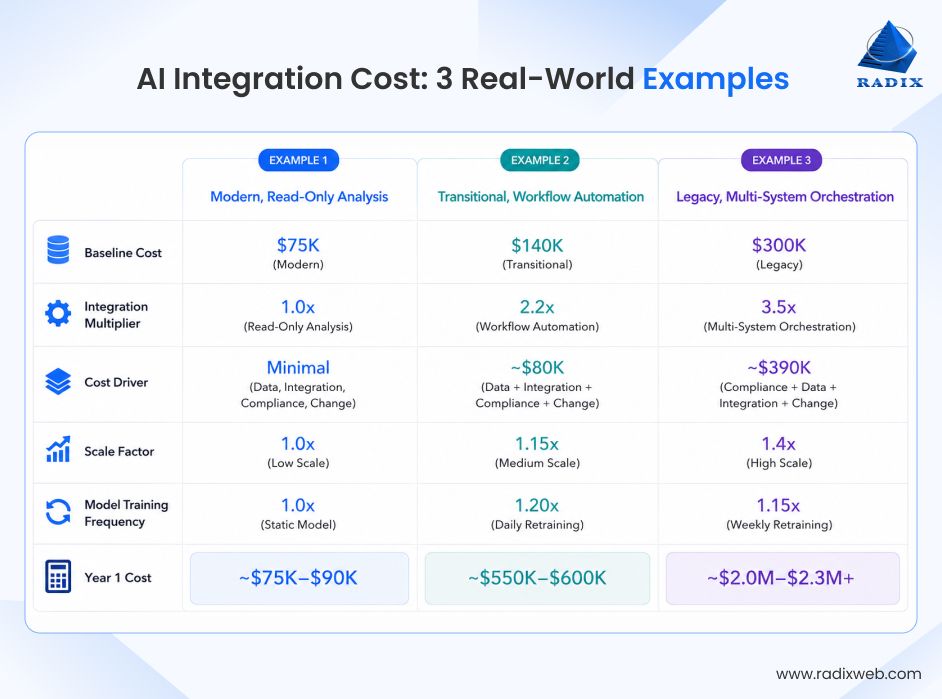
Note: These are simplified AI integration cost examples. Actual projects have interactions between factors. But this framework shows you the levers you can pull to control costs.
Using this complete framework, you can map your specific situation, see exactly what's driving cost at each stage, and make deliberate trade-off decisions. That clarity is the difference between a budget that surprises you mid-project and one you actually control.
The total cost of ownership matters far more than Year 1 spend. Here's what a realistic three-year picture looks like:
| Cost Component | Year 1 | Year 2 | Year 3 | 3-Year Total |
|---|---|---|---|---|
| Custom Integration & Development | $120,000 | $0 | $0 | $120,000 |
| Data Preparation & Cleansing | $35,000 | $12,000 | $8,000 | $55,000 |
| Model APIs & Infrastructure | $25,000 | $35,000 | $50,000 | $110,000 |
| Operations, Monitoring, Retraining | $20,000 | $40,000 | $50,000 | $110,000 |
| Total Annual Cost | $200,000 | $87,000 | $108,000 | $395,000 |
The key insight here is that integration development costs are front-loaded. Years 2 and 3 are far cheaper because you're not repeating the engineering work. However, operational costs increase as usage grows and models need more frequent updates.
When you plan for this reality you can ensure your budget actually aligns with the cost curve. Organizations that don't do this often find themselves in Year 2 scrambling to fund operations that were never provisioned.
Knowing the cost of custom AI integration is only half the equation. The other half is whether the cost produces measurable business value. A $200,000 investment that generates $0 in return is a sunk cost, no matter how well-executed the integration. A $200,000 investment that returns $500,000 in operational savings or revenue improvement within 18 months is a business decision that CFOs will approve repeatedly. Plus, there's always the cost of delaying the adoption of AI in your systems that needs to be factored in.
Here's what we know about AI integration outcomes based on industry data:
Companies that achieve high AI adoption see revenue growth that's 1.7x higher than laggards, alongside 1.6x higher EBIT margins.
For mid-market organizations, that translates to concrete outcomes. For example:
But not every AI integration delivers such a ROI. The difference between success and failure often comes down to how integration was implemented. Measurement is another important aspect of understanding the ROI of AI integrations.
Instead of just measuring the metrics once at launch, establish baselines before the AI system goes live, then measure continuously for 12-24 months. That continuous measurement reveals whether the system is delivering value, degrading over time, or simply not being used as intended.
Without this measurement framework, your $200,000 investment becomes a guess. With it, ROI becomes predictable, measurable, and repeatable for future AI projects.
Budget Right for AI Integrations That Create Business Impact
Custom AI integration costs what it costs because the hard part isn't building the AI. It is integrating artificial intelligence into business-specific systems, many of which were never designed for it, with data that's never been fully mapped, under governance requirements that often weren't clear until mid-project. So, make sure you start with a pre-integration assessment that helps you budget for the actual state of your systems, not the best case scenario.At Radixweb, we have helped organizations across industries integrate AI into their existing tech ecosystem with a practical, engineering-first approach. Our integration specialists focus on making AI work within your current systems while planning for long-term scalability, security, and performance. Ready to understand your actual AI integration cost? Schedule a consultation with our AI experts who'll start by evaluating your AI readiness and then provide a realistic scope, timeline, and budget before any engineering commitment.
Ready to brush up on something new? We've got more to read right this way.