
Recognized for AI Excellence at 2026 Globee® Awards - Read More
About the Client
The client is a retail and distribution company for electronics and consumer goods. With a supply chain network and regional distribution centers, the company manages high product turnover and demand patterns through its retail and wholesale channels.

Country
United Kingdom

Industry
Retail

Time Invested
3000+ Man Hours

Project Duration
5 Months
Business Problem

Generating accurate demand forecasts was a challenge for our client because their data came from many sources with constantly changing buying patterns. They used a single forecasting model, which worked in some cases but failed in others. As a result, planning teams found it difficult to plan inventory effectively, sometimes overstocking, other times running out of key items. This impacted both operations and financial decisions.
Project Overview

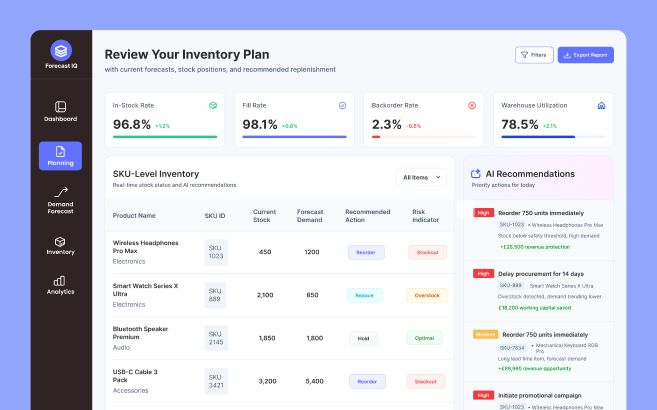
Our consultants and AI engineers began with the proposal of moving away from rigid, single-model forecasting and instead introducing a flexible prediction framework that could adjust to different demand patterns. The enterprise retail inventory forecasting solution was designed to evaluate multiple forecasting approaches in parallel and apply the most appropriate model at a granular product and location level.
Execution focused on aligning this intelligence layer with existing data pipelines and planning systems. What we finally delivered was a fully operational machine learning-powered forecasting platform that generates more precise forecasts, optimizes stock levels, and delivers faster, data-backed insights. Overall, the reactive process of inventory planning changed into a proactive, insight-led workflow that supported both operational and strategic goals.
Client Quotes

Our forecasts were hit or miss depending on the product. Now, we have far more consistency and confidence in the numbers, which has made inventory planning and financial decisions much easier across teams and reduced internal back-and-forth.
“This was one of those projects where the use case was still evolving while we were building. It required close coordination and a lot of iteration in a short span of time. The team handled the pace well and delivered a solution that was stable, usable, and ready for real planning scenarios.”

Mounil Shah
Project Challenges

- Demand data varied widely in different products, locations, and time periods. It was difficult to apply consistent forecasting logic without overfitting or losing accuracy in specific categories.
- Existing tools were not built to handle advanced machine learning workflows, limiting the ability to test, compare, and operationalize multiple forecasting models at scale.
- Business teams needed forecasts they could understand and trust, so model transparency and explainability were just as important as improving raw accuracy.
- Integrating the new AI-powered inventory forecasting solution with legacy ERP and inventory systems had to avoid disruptions while still enabling near real-time data and insight flow.
Solution Scope

Model Orchestration and Lifecycle Management
We implemented an advanced model orchestration layer using MLflow to manage experimentation, versioning, and deployment. Models could be tested, compared, and promoted to production without disrupting planning cycles or operational stability.

Baseline Time Series Forecasting
ARIMA and Prophet were used to establish baseline forecasts by capturing seasonality, trends, and historical demand behavior. These models provided a consistent reference point for evaluating performance in products and time horizons.

Advanced Machine Learning Forecasting
We applied XGBoost to demand and operational data to improve accuracy. This allowed the retail distribution forecasting platform to account for complex relationships between demand, pricing, promotions, and external factors.

Deep Learning for Temporal Patterns
LSTM models were introduced to handle products with highly irregular or long-range demand dependencies. We used these models to capture subtle temporal patterns that the previous forecasting model could not consistently detect.

Adaptive Model Selection Framework
The enterprise machine learning solution for demand forecasting continuously evaluated model performance and selected the most reliable forecasting approach for each scenario so that client team could avoid relying on a single model and improve forecast consistency in diverse demand profiles.

Explainable Forecasting Outputs
Our team integrated SHAP and LIME to explain forecast drivers in clear, business-friendly terms. This transparency helped planning and finance teams understand predictions, build trust in the AI-based inventory planning system, and act on forecast outputs.
End-to-end delivery covering data pipelines, model orchestration, explainability, and deployment with AI engineers ready across Azure/AWS.
Core Tech Stack
MLflow
MLflow machine learning platform was used to manage the full forecasting lifecycle, including experiment tracking, model comparison, version control, and controlled deployments. Teams could test multiple models in parallel, monitor performance over time, and promote the most effective models into production.
ARIMA
Our developers chose the ARIMA forecasting model for time series forecasting, capturing trends, seasonality, and cyclical patterns in stable product demand data. We applied it to historical sales across categories, automatically differencing non-stationary series and selecting optimal parameters via auto-ARIMA.
Prophet
Prophet powers flexible forecasting for volatile retail demand. It automatically handles seasonality, holidays, promotions, and trend shifts without extensive tuning. We fit it to daily sales data with custom regressors like pricing and events to generate probabilistic forecasts with uncertainty intervals.
Qdrant Vector Store
For a vector database, we worked with Qdrant to store embeddings of past sessions and user preferences so the system can recall context and personalize future conversations.
Final Outcomes

Improved Forecast Accuracy
The scalable AI forecasting platform boosted forecast reliability by cutting mean absolute percentage error (MAPE) from 28% to less than 12% across 15,000 SKUs. As our ensemble approach dynamically selected the best predictions for each product category, the client could plan around volatile demand patterns month after month.

Optimized Inventory Allocation
Teams reduced excess stock by 22% while eliminating 95% of previous stockouts through precise, location-specific forecasts. Efficient resource allocation freed up working capital that was previously tied in overstocked warehouses.

Enhanced Financial Planning
Financial forecasts gained precision with tighter variance between predicted and actual revenue from inventory turns. This clarity enabled accurate budgeting for the next fiscal quarter, minimized write-offs values, and improved cash flow projections for executive board reviews.

Accelerated Decision Making
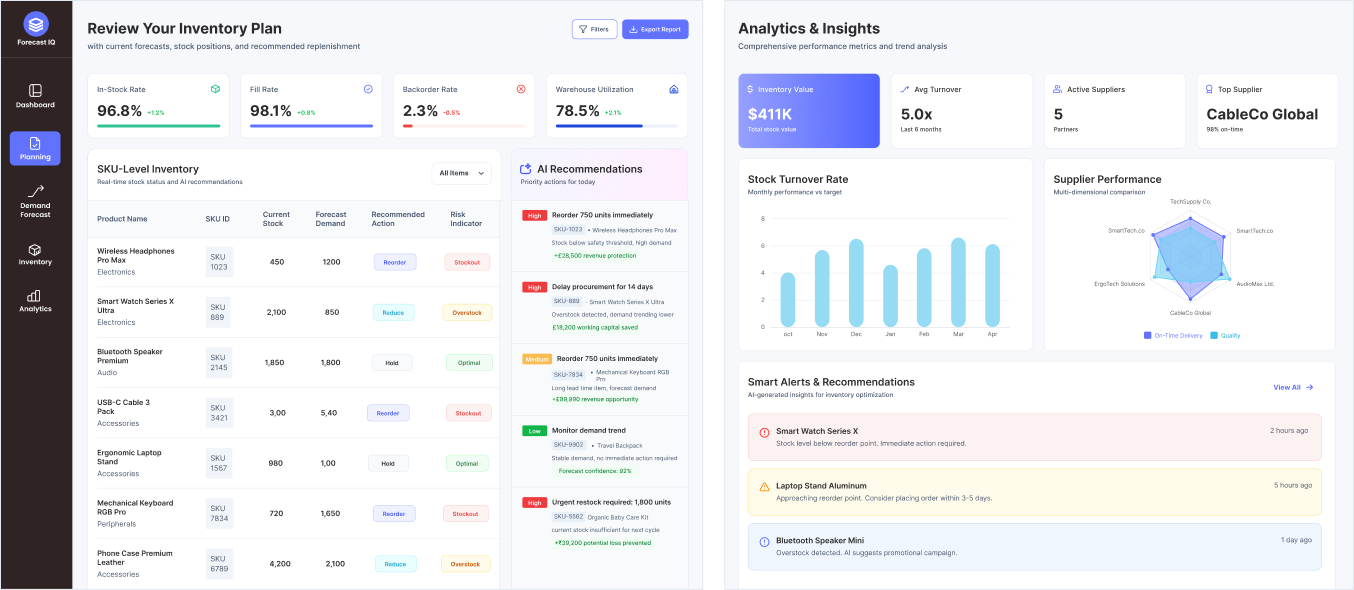
Strategic decisions that once took 10+ days now happen in under 72 hours (3.3x faster) because of the real-time dashboards showing forecast confidence scores. Their leadership team gained agility to adjust for market shifts, like sudden supplier delays, without waiting on manual reports.
Add experienced ML engineers, data scientists, or MLOps specialists with flexible engagement options, defined output ownership, and direct access to senior architects.