What Generative AI is in 2026 and How It Actually Works: The Implementation Reality for Tech Leaders
Read More


Recognized for AI Excellence at 2026 Globee® Awards - Read More

Maitray Gadhavi
Two businesses can ask the same question, "How much does an AI chatbot cost?", receive quotes of $15,000 and $180,000, and both vendors can be entirely right.
That gap isn't vendor opportunism. It reflects two very different products. One business may only need a chatbot that answers frequently asked questions using predefined conversation flows. The other may require a generative AI assistant that understands context, retrieves customer information from a CRM, checks inventory in real time, schedules appointments, and works consistently across web, WhatsApp, and mobile applications.
The global chatbot market is projected to reach $41.2 billion by 2033, growing at a CAGR of 19.6%. As adoption accelerates, businesses are evaluating AI chatbot projects across an increasingly wide cost spectrum. The organizations that budget successfully are rarely the ones that spend the least. They are the ones that understand what contributes to chatbot development costs before they begin comparing vendor proposals.
This guide breaks down AI chatbot development costs from every practical angle. Plus, we walk you through the process of building your own cost estimate and assessing AI chatbot ROI.
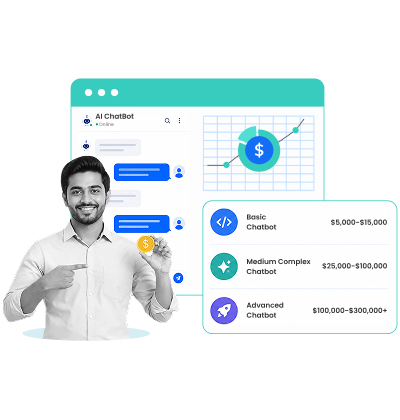
AI chatbot development costs typically range from $5,000 to $300,000+, depending on complexity and business requirements. The biggest cost drivers include chatbot architecture, integrations, AI models, compliance requirements, and data readiness. But development costs are only part of the investment. Infrastructure, model usage, maintenance, and continuous optimization contribute significantly to Year 1 ownership costs.
| Aspect | Detail |
|---|---|
| What this guide covers? | AI chatbot development cost benchmarks, Cost estimates by chatbot type and complexity, Technology and integration costs, Industry and use-case pricing, Hidden development and operational costs, ROI and budget estimation framework |
| Who should read this? | CTOs and CIOs, Product leaders, Engineering managers, Business owners, IT decision-makers, Organizations planning AI adoption |

AI chatbot development costs in 2026 range from $5,000 for a basic rule-based chatbot to more than $300,000 for enterprise-grade AI assistants with advanced integrations, compliance architecture, and multi-channel deployment.
However, these numbers only tell part of the story.
Many businesses assume that building an AI chatbot is just like any other software project with a single implementation cost. In reality, an enterprise chatbot is a combination of multiple disciplines working together. The development budget covers far more than writing application code. It includes solution discovery, conversational design, AI model implementation, integration with business systems, testing, deployment, and production readiness.
A chatbot that answers frequently asked questions using predefined responses can often be delivered within a few weeks. By comparison, a customer support assistant capable of retrieving CRM records, searching an internal knowledge base using Retrieval-Augmented Generation (RAG), escalating conversations intelligently, and maintaining context across multiple interactions requires considerably more engineering effort.
As a result, development costs typically fall into three broad investment ranges.
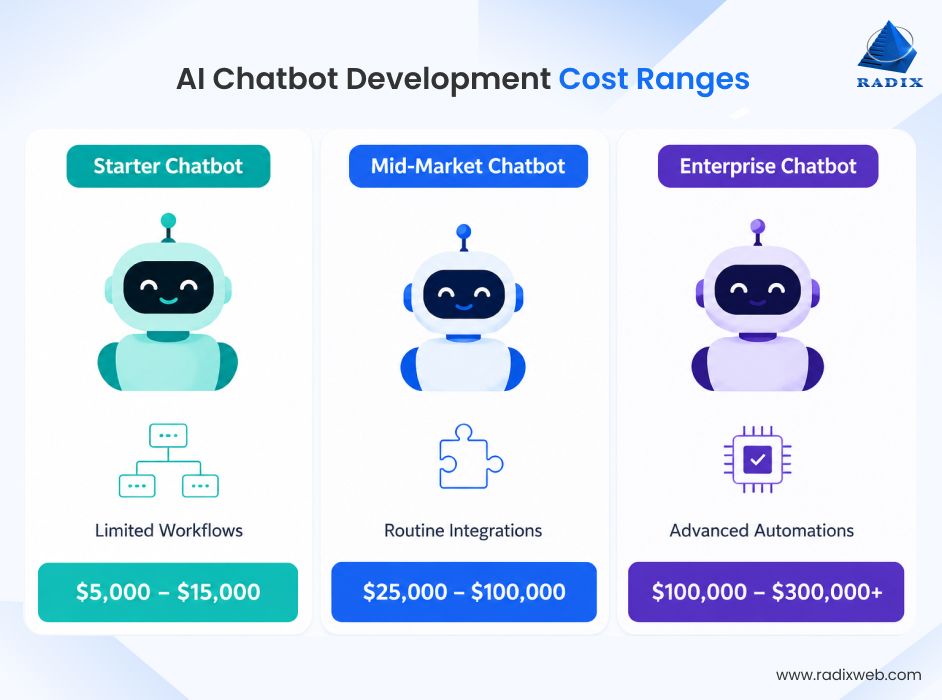
It's equally important to understand that development cost represents only the initial investment. Organizations should also budget for infrastructure, AI model usage, cloud hosting, monitoring, conversation improvements, and ongoing maintenance.
For example, a chatbot costing $40,000 to build can easily require $55,000–$70,000 during its first year once operational expenses are included.
The next sections explain why those numbers vary so dramatically and how to estimate the right budget for your own project.
The AI model, integrations, deployment architecture, data quality, compliance requirements, and development approach all influence the amount of engineering effort required.
Understanding these factors during the initial AI consulting and strategy phase makes it easier to evaluate vendor proposals, set realistic budgets, and identify where additional investment will create meaningful business value.
The intelligence level you need is the single biggest cost driver. A scripted bot that follows fixed paths costs a fraction of a context-aware assistant that understands intent, holds multi-turn memory, reasons about ambiguous inputs, and hands off to a human at exactly the right moment. Generative AI models cost 3-5X more to build around than rule-based systems. The gap widens further when you add fine-tuning, RAG pipeline setup, and the guardrails that keep an LLM on-topic in production.
Every system a chatbot connects to adds engineering scope. Each integration requires authentication setup, API documentation review, error handling, rate limit management, testing, and ongoing maintenance as the connected system updates. For example,
So, just adding three to four additional integrations can add more to the budget than the chatbot logic itself.
A chatbot deployed as a web widget is the simplest and cheapest deployment. Everything else adds engineering scope:
Multi-channel deployments need an abstraction layer that decouples conversation logic from delivery channel, and that adds architectural complexity and testing scope for every additional channel.
A managed API (OpenAI, Anthropic, Google) is faster to integrate and requires no infrastructure management. However, it comes with per-token pricing and limited control over data residency. Self-hosting an open-source model eliminates per-token fees but adds 30 to 50% to infrastructure costs in GPU hardware, DevOps management, and scaling capacity.
For most businesses at moderate conversation volumes, managed APIs are more cost-efficient. The crossover point where self-hosting becomes economically justified typically sits above 50 to 100 million tokens a month, a volume most business chatbots don't reach until significant scale.
Your chatbot is only as good as the data it reasons over. Clean, well-structured, up-to-date knowledge base content is the foundation of a chatbot that gives accurate, useful answers. Getting data AI-ready typically adds $5,000 to $40,000 to a project depending on the volume and state of your existing content.
Businesses with well-maintained documentation, clean CRM data, and structured product content spend at the low end. Businesses that need to process PDFs, reconcile conflicting information across systems, or build a knowledge base from scratch spend significantly more. While it does add upfront cost, data preparation is an investment that protects everything built on top of it.
Security, compliance, and governance need to be a part of the foundation of your AI chatbot. And ensuring data security, governance, and clear ownership of AI outcomes come with development effort and subsequent costs.
Operating in a regulated industry further adds compliance overhead that touches every layer of the architecture.
These aren't optional additions. They're architectural requirements that need to be designed in from the start.
Conversation design is the discipline that separates chatbots people use from chatbots people close immediately. It covers dialogue flow mapping, tone and voice guidelines, edge case handling, graceful escalation to human agents, and error recovery when the bot doesn't understand. It requires research into how your users actually phrase questions, not how you expect them to.
Most chatbots that underperform in production are missing it. So, it is important that you budget $5,000 to $20,000 for proper conversation design work before a line of code is written. The cost of redesigning conversation flows after deployment is consistently higher.
The rate difference between regions is significant:
Over a 16-week project at 1,200 hours, that difference represents $72,000 to $174,000 in engineering costs.
The caveat that matters here is that hourly rate is a poor proxy for total project cost. A senior India-based team with 50 shipped chatbot projects completes a given scope faster, with fewer revision cycles, than a junior team at any location. So, make sure you evaluate delivery track record, chatbot portfolio depth, and project management quality before comparing rates.
There is no universal price for AI chatbot development because every implementation is shaped by different technical and business requirements. The easiest way to benchmark your project is to evaluate costs across the categories that influence development the most.

The type of chatbot you build determines the technology stack, implementation approach, engineering effort, and ongoing operational costs. Choosing the right architecture is often the single biggest budgeting decision you'll make.
Typical development cost: $5,000–$20,000
Typical timeline: 2–6 weeks
Rule-based chatbots follow predefined decision trees. Every user input maps to a scripted response or workflow, making them suitable for predictable interactions such as FAQs, appointment booking, or order tracking.
Since these chatbots don't require AI models or conversational reasoning, they're the quickest and least expensive option to build. While they're cost-effective for narrowly defined use cases, businesses often outgrow them once customer conversations become more varied or require contextual understanding.
Typical development cost: $15,000–$60,000
Typical timeline: 6–12 weeks
NLP-powered chatbots use Natural Language Processing to understand user intent instead of relying solely on predefined keywords. They can interpret different ways of asking the same question, maintain limited conversational context, and route requests more intelligently than rule-based systems.
For many mid-market businesses, these chatbots offer the right balance between capability and cost. They're widely used for customer support, internal knowledge bases, employee self-service, and appointment scheduling.
The additional investment comes from intent modeling, entity extraction, conversation training, and ongoing optimization as user behavior evolves.
Typical development cost: $25,000–$150,000+
Typical timeline: 8–20 weeks
Generative AI chatbots use large language models (LLMs) such as GPT-4o, Claude, or Gemini to generate dynamic, context-aware responses. Instead of selecting from predefined answers, they apply generative AI to use cases like understanding natural language, reason through complex requests, and adapt responses based on context.
These are the chatbots businesses increasingly deploy for customer support, sales assistance, internal knowledge management, and enterprise productivity.
The higher cost isn't driven by the language model alone. It comes from designing Retrieval-Augmented Generation (RAG) pipelines, integrating enterprise data sources, implementing prompt engineering, adding hallucination guardrails, and connecting the chatbot with business systems.
Typical development cost: $50,000–$200,000+
Typical timeline: 10–24 weeks
Most enterprise chatbot deployments today are hybrid architectures.
Rather than relying entirely on an LLM, hybrid chatbots combine generative AI for conversations with deterministic workflows for business-critical actions such as booking appointments, checking inventory, processing refunds, or updating customer records.
This approach delivers the conversational quality users expect while maintaining the predictability, compliance, and auditability businesses require.
Although hybrid chatbots involve additional engineering effort, they are often the preferred choice for organizations integrating AI into customer-facing or operational workflows.
Note: Need a solution that goes beyond answering questions and can autonomously complete multi-step tasks across business systems? Instead of chatbot development, you need AI agent development services for enterprise workflow automation. AI agents can reason, use multiple tools, and execute end-to-end workflows with minimal human intervention. See how much it costs to build an AI agent here.
Beyond chatbot type, vendors usually estimate projects based on overall implementation complexity. The number of integrations supported user journeys, deployment channels, compliance requirements, and AI capabilities collectively determine where your project falls.
| Complexity | Typical Scope | Development Cost | Timeline |
|---|---|---|---|
| Simple | Single use case, one channel, no integrations | $5,000–$20,000 | 2–6 weeks |
| Medium | Multiple intents, one or two integrations, custom interface | $20,000–$80,000 | 6–16 weeks |
| Complex | Multiple business workflows, several integrations, compliance requirements | $80,000–$200,000 | 16–32 weeks |
| Enterprise | Multi-agent workflows, enterprise integrations, advanced governance, multi-channel deployment | $200,000–$300,000+ | 6–12 months |
Complexity is often determined less by the chatbot itself and more by the surrounding business environment. For example, a healthcare chatbot and an eCommerce chatbot may support a similar number of user intents, yet the healthcare implementation requires HIPAA compliance, audit trails, and stronger security controls that significantly increase engineering effort.
The technology stack you choose affects both development costs and long-term operating expenses. Some platforms reduce implementation time, while others provide greater flexibility and lower ownership costs over several years.
| Technology | Development Cost | Monthly API / Platform Cost | Best For |
|---|---|---|---|
| GPT-4o | $25K–$120K | $60 – $5,000+ | General-purpose enterprise assistants |
| Claude | $30K–$130K | $60 – $5,000+ | Document-heavy and compliance-focused applications |
| Gemini | $25K–$110K | $60 – $4,000+ | Multimodal AI and Google ecosystem |
| Dialogflow | $15K–$60K | $100 – $1,500 | Structured conversational experiences |
| Rasa | $30K–$100K | Infrastructure only | Organizations requiring full infrastructure control |
| No-code Platforms | $3K–$15K setup | $19 – $500/month | Small businesses and rapid deployment |
Let’s see how these technologies differ and where they fit best:
Development cost: $25,000 to $120,000
The most widely used foundation for custom chatbot builds, GPT-4o comes with strong reasoning, broad knowledge, excellent multilingual performance, and a mature ecosystem of supporting tools.
API costs run approximately $2.50 per million input tokens and $10 per million output tokens at current pricing. Assuming the chatbot handles roughly 500–1,000 input tokens and a similar number of output tokens per conversation, API costs typically fall between $60 and $150 per month for 10,000 monthly conversations.
Development cost: $30,000 to $130,000.
Anthropic’s Clause is increasingly chosen for enterprise deployments where response quality, instruction-following reliability, and longer context windows matter. It is particularly strong for document-heavy use cases like legal, financial, and technical support chatbots, with an API cost structure that is similar to that of GPT-4o.
Development cost: $25,000 to $110,000.
Gemini offers strong multimodal capabilities, text, image, audio, and tight integration with Google Workspace tools. It is the best fit for businesses already in the Google ecosystem or that need vision capabilities.
Development cost: $15,000 to $60,000.
Dialogflow is a managed NLP platform sitting below full LLM implementations in both capability and cost. It handles intent classification and entity extraction well and fits structured customer service and internal tool automation where open-ended conversation isn't the requirement. Dialogflow’s per-conversation operating costs also run lower than LLM APIs.
Development cost: $30,000 to $100,000
Rasa gives full control over the NLP pipeline with no per-conversation API fees. The trade-off, however, is engineering overhead of hosting, training, and maintaining it, which falls on the business. It is often the right choice for organizations with strong in-house ML capability, strict data sovereignty requirements, or very high conversation volumes where API costs would otherwise dominate. Overall, it has higher upfront, lower ongoing costs.
Development cost: $3,000 to $15,000
No-code platforms such as Botpress, Tidio, ManyChat, and Intercom allow businesses to launch simple chatbots quickly with minimal development effort. Their monthly subscription fee runs between $0 (for small trial plans) to $500. While they are faster to deploy and reduce initial investment, customization, ownership, and scalability are typically constrained by the platform's capabilities. They also expose your business to vendor pricing changes and lock-in, making it the right choice only for simple use cases where speed to market matters more than customization.
The way you build your chatbot has just as much influence on cost as the technology itself.
Subscription-based chatbot platforms (like Tidio, Botpress, Intercom, ManyChat, and Drift ) provide the fastest route to deployment. Most include visual workflow builders, hosting, analytics, and basic integrations, making them suitable for businesses with relatively straightforward requirements.
Typical costs include:
These platforms are an excellent choice when speed matters more than flexibility. However, organizations should also consider long-term risks before locking in.
Some of these platforms also charge per resolution rather than a flat subscription. So a business handling 3,000 AI-resolved conversations a month could pay $2,970 a month in resolution fees before seat licenses even factor in. At that volume, the platform cost can exceed the annualized cost of a custom build within 18 months. Make sure your run the 3-year numbers before committing, if volume is high or you are growing fast.
The other risk is that the technology isn't owned: pricing changes, feature updates, or an acquisition on the vendor's side changes the deployment underneath the business, whether it likes it or not.
For businesses where the chatbot is a supporting feature, these trade-offs are usually acceptable. Where the chatbot is a primary customer interaction channel, long-term operating cost and vendor dependence deserve the same scrutiny as the initial implementation cost.
Custom development requires a higher upfront investment but offers complete control over architecture, integrations, user experience, security, and intellectual property.
It is generally the preferred option when businesses need deep integration with proprietary software, strict compliance, unique workflows, or anticipate high conversation volumes where platform subscription costs eventually become more expensive than owning the solution.
Although custom development typically costs more initially, it often delivers a lower total cost of ownership over 3 to 5 years for enterprise deployments.
Some of the common pricing models that you can choose from when getting AI development services for your business include:
You may also choose to get custom AI chatbot development done in-house. While this eliminates external development costs, it introduces the expense of hiring artificial intelligence experts, longer delivery timelines, AI infrastructure management, and opportunity costs associated with diverting internal teams from core business initiatives.
Unless AI development is already a strategic capability, many businesses find that partnering with experienced AI development companies is what accelerates delivery while reducing implementation risk.
The same technology can vary significantly in cost depending on the artificial intelligence business use case it supports. The required integrations, conversation complexity, compliance needs, and expected business outcomes all influence the final investment.
Customer support chatbots handle tier-1 query deflection like answering FAQs, checking order status, processing simple requests, and routing complex issues to human agents. The goal is reducing ticket volume and cutting cost-per-interaction. The average cost of human-handled support ticket sits at $15 to $25. An AI chatbot automating 50% of that volume at a $0.50 – $2 per-interaction cost is a strong ROI case.
Development cost: $20,000 to $100,000
Cost drivers: Number of supported intents, CRM and helpdesk integrations, and the use of generative AI for open-ended conversations
Typical outcome: Businesses implementing AI-powered support automation often achieve 40 to 60% ticket deflection within the first three months of deployment
Sales chatbots qualify inbound leads, gather prospect information, answer product questions, recommend solutions based on inputs, and book sales meetings at 2 AM on a Tuesday when your sales team is offline. They require CRM integration (to write lead data and pull existing contact history), calendar integration (for meeting booking), and often product catalog access for recommendation logic.
Typical integrations required:
Development cost: $30,000 to $120,000
The largest cost driver for lead gen and sales chatbots is the level of personalization. A chatbot that qualifies leads using a predefined form is considerably less complex than one that analyzes CRM history, tailors conversations by industry or company size, and responds intelligently to pricing or product-related questions.
eCommerce chatbots handle product discovery, personalized recommendations, order tracking, return initiation, cart recovery, and 24/7 support across a product catalog that may span thousands of SKUs. The integration complexity is high as they need to work with live inventory system, order management system, payment gateway, and often a CRM or marketing platform.
What’s important to know is that cart recovery chatbots consistently show measurable ROI by helping recover 15 to 25% of abandoned carts against a cost-per-recovery that's a fraction of a human sales interaction.
Build cost: $40,000 to $150,000
Multi-channel deployment (web, WhatsApp, mobile app) for an eCommerce chatbot adds $30,000 to $60,000 to the base scope.
Internal chatbots handle employee queries about IT systems, HR policies, onboarding, benefits, and tool access. They deflect repetitive helpdesk volume and give employees instant answers without waiting for a ticket to be processed. The integration requirements are typically moderate and include internal knowledge base, HRIS, and IT ticketing system (ServiceNow, Jira). But access control and data privacy requirements are strict.
Build cost: $25,000 to $80,000.
These chatbots tend to have faster ROI timelines than customer-facing deployments because the labor cost baseline (IT and HR staff time on repetitive queries) is directly measurable and the chatbot deflection rate is verifiable.
Industry-specific requirements often influence chatbot costs more than the chatbot itself. Regulatory obligations, data sensitivity, integration complexity, and security standards all contribute to the overall investment.
| Industry | Cost | Cost Multiplier vs. Baseline | Primary Cost Driver |
|---|---|---|---|
| Healthcare | $50,000–$250,000+ | +25 – 35% | HIPAA, PHI handling, clinical validation, audit trails |
| Financial services | $60,000–$250,000+ | +25 – 35% | FINRA, GDPR, SOC 2, fraud detection logic, transaction audit |
| Legal | $40,000–$180,000 | +20 – 30% | Data confidentiality, document handling, EU AI Act exposure |
| Insurance | $50,000–$200,000 | +20 – 30% | Underwriting logic explainability, claims audit, state regulations |
| Retail/eCommerce/SaaS | $20,000–$100,000 | Baseline | Standard integrations, moderate compliance |
| Education | $15,000–$70,000 | +10 – 20% | FERPA (US), COPPA for under-13 users, data residency |
| Manufacturing | $30,000–$120,000 | +10–20% | ERP/MES integration, IoT and sensor data, factory workflow integration |
| Logistics & Supply Chain | $40,000–$150,000 | +15–25% | TMS/WMS integration, real-time tracking, route optimization, multi-system connectivity |
Healthcare and financial services generally have the highest implementation costs due to regulatory compliance, stronger security controls, audit requirements, and complex legacy system integrations. Retail, education, and internal enterprise applications can often be deployed faster because they operate under fewer regulatory constraints.
Adding a chatbot to software you already have is a different problem from building a standalone chatbot from scratch. The cost of artificial intelligence integration with existing business systems and organizational workflows sits on top of the chatbot build cost, and it's frequently the larger of the two numbers for businesses with established tech stacks.
Modern SaaS platforms with documented REST APIs, (like Salesforce, HubSpot, Zendesk, Shopify, Stripe) are the most straightforward integrations. Each connection costs $3,000 to $8,000 in development time and takes 1 to 3 weeks, covering authentication, webhook setup, error handling, rate limit management, and test coverage across edge cases.
Older enterprise systems without modern API layers are a different category entirely. These include on-premises ERP, legacy CRM, mainframe databases, custom-built internal tools from the early 2000s. These often need middleware development, data transformation pipelines, or custom connector builds before any chatbot logic can even interact with the underlying data.
| Integration Target | Typical Cost | Timeline |
|---|---|---|
| Modern SaaS (Salesforce, HubSpot, Zendesk) | $3,000 – $8,000 per platform | 1 – 3 weeks |
| E-commerce platforms (Shopify, Magento, WooCommerce) | $4,000 – $10,000 | 2 – 4 weeks |
| Payment gateways (Stripe, PayPal, Apple Pay) | $4,000 – $10,000 | 2 – 4 weeks |
| Legacy ERP (SAP, Oracle EBS) | $15,000 – $50,000 | 4 – 12 weeks |
| Proprietary internal systems (with API) | $5,000 – $20,000 | 2 – 6 weeks |
| Proprietary internal systems (no API layer) | $20,000 – $80,000 | 6 – 16 weeks |
| Multi-system orchestration (4+ integrations) | $30,000 – $120,000 | 8 – 20 weeks |
One budget item to carry forward: integrations create ongoing maintenance obligations. Each connected system can push API updates, deprecate endpoints, or change authentication methods. Plan 10 to 15% of your integration build cost annually for integration maintenance.
Many businesses budget only for implementation and overlook the recurring expenses required to keep an AI chatbot accurate, secure, and useful.
These ongoing costs are rarely unexpected, they're simply underestimated.
Every conversation generates token usage, and as chatbot adoption grows, API costs grow with it. A chatbot handling 5,000 conversations a month at an average of 800 tokens per exchange consumes roughly 4 million tokens monthly. At current GPT-4o pricing, that translates to $10 to $40 a month for simple interactions and $200 to $800 a month for complex, multi-turn conversations.
A chatbot is only as accurate as the information it can access. As products, policies, pricing, and documentation change, the knowledge base has to be kept current. Plan to allocate 5 to 10% of the initial development cost annually for content reviews and knowledge base updates.
Production usage inevitably exposes conversation paths and edge cases that testing didn't catch. A typical first-year budget is $3,000 to $8,000 per quarter, covering conversation flow improvements, new intent training, and response quality optimization.
Usage-based pricing is common on SaaS chatbot platforms, and costs increase as conversation volumes grow, particularly on platforms that charge per conversation or per successful resolution. Review the billing model carefully before selecting a platform, so cost scaling with adoption doesn't come as a surprise later.
Custom-built chatbots need ongoing maintenance to stay secure, compatible, and reliable. A practical budget is 15 to 25% of the initial development cost per year. For an $80,000 chatbot, that's roughly $12,000 to $20,000 annually for dependency updates, security patches, model API upgrades, and integration maintenance.
The real cost of a chatbot extends well beyond its initial development, making long-term operating expenses just as important to include in your overall artificial intelligence budget planning.
Here’s what the budget really looks like:
| Cost Component | Typical Share |
|---|---|
| Development & Deployment | 60–75% |
| Infrastructure & AI Usage | 10–20% |
| Maintenance & Optimization | 10–15% |
| Knowledge Base & Content Updates | 5–10% |
Looking only at development costs often results in unrealistic budgets. Evaluating the total first-year investment provides a much clearer picture of long-term ownership.
While every project is unique, you can create a realistic budget by estimating the major cost components individually.
The formula:
Total Build Cost = (Development Hours × Regional Hourly Rate) + Conversation Design Cost + Data Preparation Cost + Integration Cost (per system) + Compliance Premium + Infrastructure Setup
Step 1: Estimate development hours by chatbot type
Step 2: Apply your regional rate
Step 3: Add conversation design
Step 4: Add data preparation
Step 5: Add integration cost Use the integration table from the earlier section. Each modern SaaS platform adds $3,000 to $8,000. Legacy systems add $15,000 to $50,000.
Step 6: Apply compliance premium
Step 7: Add Year 1 operational cost Multiply your build cost by 0.3 to 0.5 to estimate Year 1 operational overhead (tokens, hosting, monitoring, maintenance). A $60,000 build costs $78,000 to $90,000 in Year 1 all-in.
Here’s an example of how it can look like in practice.
A mid-market SaaS company building a generative AI customer support chatbot, integrated with Zendesk and Salesforce, no regulated data and an India-based development team.
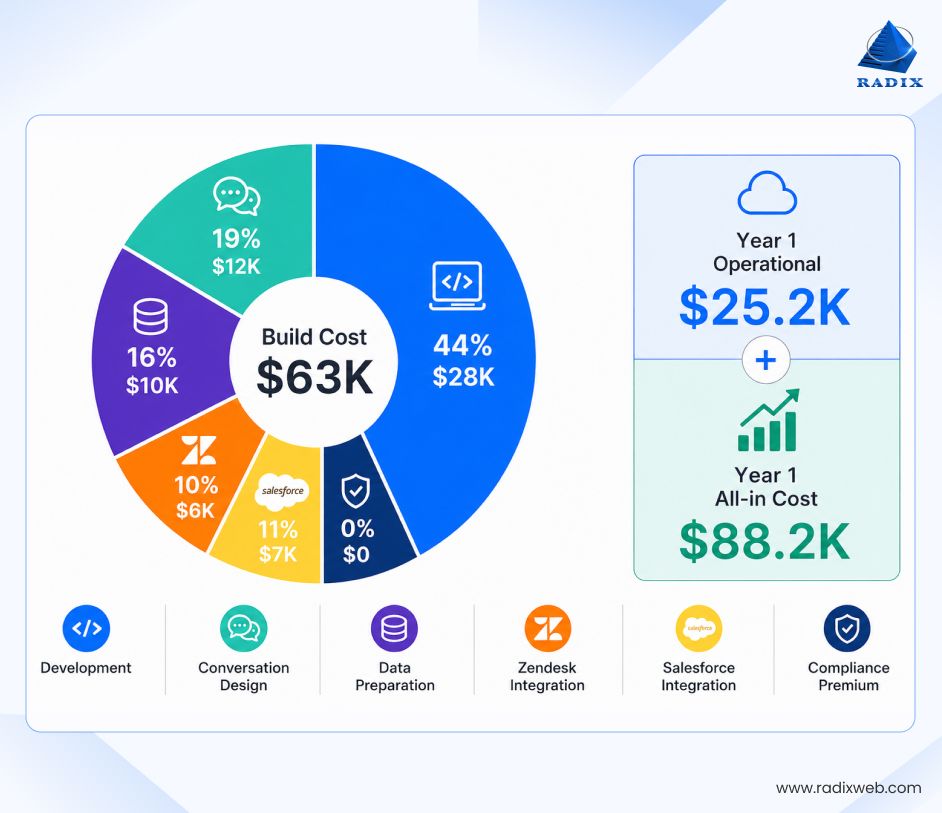
Rather than focusing on obtaining the lowest quote, use this framework to compare vendor proposals and understand where each dollar is being invested.
Most business teams start their AI chatbot development initiatives by asking, "How much will an AI chatbot cost? " The right question, however, is, "What business outcome will it create?"
The upfront development cost is only one part of the investment. A chatbot that costs $80,000 but saves $20,000 every month delivers far greater value than a $30,000 chatbot that sees little adoption. Businesses should also consider the opportunity cost of delaying AI adoption. Every month spent postponing deployment can mean higher support costs, missed leads, slower employee workflows, and lost productivity that could have been automated. That's why the smartest buying decisions are based on total return and time-to-value, not development cost alone.
Industry data shows why businesses continue investing in AI chatbots:
Organizations typically achieve ROI through one or more of the following:
ROI by business function:
| Use Case | Typical Monthly Saving | Break-even on $60K Build |
|---|---|---|
| Customer support deflection (50% automation) | $8,000 – $20,000 | 3 – 8 months |
| Lead qualification (after-hours coverage) | $5,000 – $15,000 | 4 – 12 months |
| E-commerce cart recovery (15-25% recovery rate) | $6,000 – $25,000 | 3 – 10 months |
| Internal IT/HR helpdesk deflection | $4,000 – $12,000 | 5 – 15 months |
The size of the initial investment isn't what determines ROI. Three factors have a much bigger impact on whether an AI chatbot delivers meaningful business results:
If you're planning a chatbot deployment and need to validate the business case before committing to a build, run a structured scoping engagement for AI chatbot development to get realistic cost estimates and break-even timelines before development begins.
Build the Right AI Chatbot, Not Just the Cheapest One
The cost of an AI chatbot is ultimately determined by the business problem it's solving. The businesses that get strong ROI from chatbot investments aren't the ones who spent the most. They're the ones who evaluate the total cost of ownership, account for integrations and operational expenses, and understand the realities of building and deploying enterprise AI chatbot solutions for long-term business value instead of simply selecting the lowest development quote.At Radixweb, we’ve deployed 50+ AI chatbots across industries and niches. In all these projects we don’t just bring technical prowess but also bring our deep experience in enterprise AI, cloud, and product engineering. That’s how we help businesses design and build AI chatbots that deliver measurable business outcomes rather than short-term automation. Looking to add an AI chatbot to your business workflows? Schedule a quick chat with our AI engineers who can help you scope right, estimate costs accurately, and build a goal-aligned roadmap.
Ready to brush up on something new? We've got more to read right this way.