
Read More


Recognized for AI Excellence at 2026 Globee® Awards - Read More

Vinit Kariatukaran
$225 million. That's the amount Bank of America had to pay in regulatory penalties after its automated fraud detection system for unemployment benefit cards froze legitimate accounts and blocked people from accessing their money at the height of the COVID-19 pandemic. The penalty likely exceeded what the system was expected to save by preventing fraud.
Now, this isn't a one-off example. Similar failures have played out across the payments industry. In controlled environments, AI-powered fraud detection models impress with high accuracy and polished dashboards. Production is different. Fraud patterns evolve daily. Transactions must be scored in milliseconds. Every false positive carries a real business cost.
At Radixweb, we know that production-ready AI solutions for fintech aren't about building smarter models. It's about building payment systems that balance fraud prevention, customer experience, and operational resilience. In this article, we explore what separates fraud detection that performs well in a demo from fraud detection systems that payments companies can rely on at scale.
Fraud detection is a business optimization problem, not a machine learning problem. Production-grade payment systems must balance fraud prevention, customer experience, and latency constraints. Demos hide data quality issues, concept drift, and the explainability requirements that drive real-world complexity. Success depends on layered architecture (rules + ML + behavioral intelligence + graph analytics), sophisticated monitoring, and continuous adaptation. Model accuracy matters less than approval rates, false positive costs, and the ability to keep pace with adversarial fraud evolution.
| Aspect | Details |
|---|---|
| What This Guide Covers ? | The production challenges that differ from demos, the layered architecture approach that works at scale, why model accuracy is necessary but insufficient, practical guidance for payment companies for moving from demo success to production viability. |
| Who Should Read This ? | Risk and compliance officers evaluating fraud solutions, technology leaders building or scaling fraud detection systems, product teams planning AI rollouts for payment platforms, organizations that have seen demo success but struggled with production outcomes. |

Most organizations frame fraud detection as a classification problem: maximize accuracy, minimize false negatives, find the best model architecture. This framing is wrong.
Fraud detection is a business optimization problem. Every decision has a cost. Blocking a fraudulent transaction is good. But if you block a legitimate transaction, you've just triggered customer churn, support tickets, and reduced lifetime value. Miss fraud and there's direct loss. Miss fraud while blocking legitimate transactions and you're paying twice.
Production systems must simultaneously optimize for:
A demo optimizes for one metric: accuracy on a holdout test set.
Production optimizes for profit.
These are not the same thing. Here's how they differ:
| Aspect | ML Demo | Production Payments |
|---|---|---|
| Primary Objective | Maximize accuracy | Maximize profit (fraud prevented minus false positive cost) |
| Evaluation Method | Offline on labeled dataset | Real-time on live transactions |
| Data Characteristics | Static, clean, balanced | Continuously changing, messy, imbalanced (99%+ legitimate) |
| Latency Requirement | Ignored or unconstrained | <100 milliseconds (often <50ms) |
| Fraud Evolution | Static patterns (historical) | Constantly adapting (adversarial) |
The problem here is that organizations choose models to win the demo, but when they are deployed in production, the result is systems optimized for the wrong outcome.
Also, the payments industry operates on principles that extend far beyond simple fraud prevention. So, to build effective systems, teams must understand all the latest trend dominating the fintech industry and how security layers into broader market dynamics.
A polished fraud detection demo tells you how well a model performs under ideal conditions. Production tells you how well an entire system performs under uncertainty. The gap between those two environments is where most enterprise fraud initiatives succeed or fail.
These are the realities that rarely show up in vendor demos but dominate production deployments:
A demo dataset is curated. Transactions are labeled clearly. Customer profiles are complete. Merchant categories are consistent. Device fingerprints are clean. No missing values. This is the dataset that doesn't exist in the real world.
Production data is a disaster:
This forces a revelation: production models spend 60-70% of their effort handling uncertainty, not predicting fraud. The companies that win have built systems build with clean, AI-ready data, but also prepared for handling imperfect data in production.
A demo tests against historical fraud. The model learns "customers from this country never commit fraud" or "transactions of this size combined with this merchant category are risky." It performs beautifully on holdout data because the fraud hasn't changed.
In production, fraudsters are watching. They probe your rules, find patterns you missed, and adapt instantly. Card testing (multiple small transactions in seconds) was devastating until systems started flagging velocity. Now fraudsters spread tests over time. Account takeover tactics mutate. Mule accounts appear with perfect customer behavior except for one anomaly.
This is concept drift. Yesterday's model slowly becomes tomorrow's blind spot. A model that achieved 97% accuracy on 2026 data can drop to 84% by mid-2027 if fraud patterns shifted and you didn't retrain. This never appears in demos, because demos don't cover time.
Here's a production realization that breaks supervised learning: you don't actually know which transactions were fraud until 30-60 days later. Chargebacks come in slowly. Dispute investigations take time. Manual reviews queue up. By the time you label a transaction as fraud, your model has already processed 2 million similar transactions in production.
This creates a gap. You're making real-time decisions with a model trained on old data using labels that arrived in the past. Supervised learning alone isn't enough because you don't have real-time supervision.
Together, these realities expose the biggest weakness of fraud detection demos, which is that they evaluate models in a world that doesn't exist. Companies that recognize these constraints early build fintech app with architectures designed for continuous change. Those that don't often discover the gap only after their models reach production.

Once a fraud detection model reaches production, accuracy stops being the primary measure of success. Payment companies quickly discover that operational realities matter far more than benchmark scores.
These are the five challenges that separate production-ready fraud detection for payment companies from models that only perform well in demonstrations.
A demo balances fraud detection with a false positive rate. A production system learns that false positives destroy customer relationships.
One false decline means:
If a payment processor handles $1 billion in daily volume and unnecessarily declines even 1% of legitimate transaction value, the resulting $10 million in lost transaction value per day adds up to $3.65 billion annually. That single 1% matters more than improving fraud detection from 94% to 97%.
A payment authorization must complete in under 500 milliseconds, often under 100ms. This is your latency budget. It includes payment gateway processing, rules checking, ML inference, issuer communication, and response. Your fraud model doesn't get the whole budget. It gets maybe 50ms.
A smart model that takes 500ms to score a transaction is dead on arrival. You can't use complex ensemble methods; you can't make synchronous API calls, you can't recompute features at decision time. The constraints are real and non-negotiable.
This forces practical decisions: gradient boosting models (XGBoost, LightGBM) that serve in <10ms are deployed over deep learning approaches that need 200ms. Feature caching becomes mandatory. Pre-computation of behavioral profiles replaces on-the-fly calculation.
A lot of software companies specializing in fintech solutions obsess over algorithms: neural networks vs random forests vs boosting. Successful practitioners know better. The difference between a 92% accurate model and a 94% accurate model usually comes from better features, not a better algorithm.
What actually predicts fraud at scale:
Switching from XGBoost to a neural network probably yields 1-2% improvement. Better merchant history features yield 5-8% improvement.
A model outputs a risk score. An analyst now has to decide: do we block this transaction? Do we send a challenge? Do we approve? The analyst needs to understand why the model flagged it.
Black box models create organizational problems. Analysts distrust the model, override decisions manually, reduce automation benefits. Regulators expect explanations (especially in disputes and chargebacks). Compliance teams need documented decision rationale.
Production fraud detection favors interpretable models with decision trees, gradient boosting with SHAP values, rule-based systems with clear logic. The explainability loss from a black box model is a real cost that never appears in demo metrics.
In the demo, you train a model once and evaluate it once. In production, you monitor continuously:
For this, you need a technical and a business-side stakeholder who owns the AI outcomes. And this monitoring infrastructure often costs more than model training. But without it, you're flying blind. A model can be statistically performing as designed and still be catastrophically wrong if the fraud landscape shifted overnight.
Notice that none of these challenges are fundamentally about choosing a better machine learning algorithm. They're about engineering fintech systems that perform reliably, even under real-world constraints.

Production fraud detection for payment companies isn't a single model making a binary decision. It's a layered system where each layer handles what it handles best.
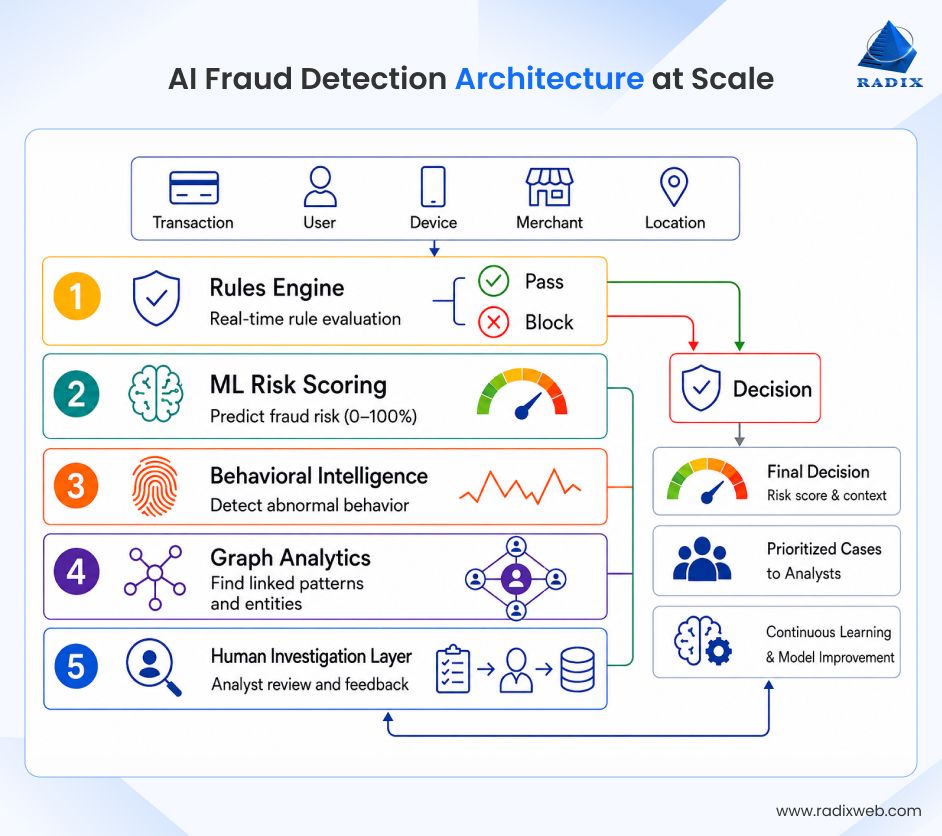
Best for obvious fraud and regulatory requirements.
Hard rules never disappear in production systems. If a card is reported stolen, block it immediately. If a transaction originates from a sanctioned geography, decline it. If card testing is detected (15 transactions of $1 in 90 seconds), stop it. These rules are fast (<1ms), explainable, and legally defensible.
Demos often hide rules because pure ML looks better. Production systems embrace them because they solve problems that ML shouldn't try to solve.
ML assigns probability, not final decision.
After rules pass a transaction through, gradient boosting models (XGBoost, LightGBM) score risk based on transaction, merchant, and customer features. The output is a probability that the transaction is fraudulent. This probability feeds downstream decisions. The model isn't saying "block this." It's saying "this has a 23% fraud probability and here's why."
Building compliance-ready, low latency machine learning models handles the complexity that rules can't, like subtle patterns in customer behavior, anomaly detection, adaptation to new fraud tactics. But it's only one layer.
Identity matters more than credentials.
Who is typing on this device? Typing speed, mouse movement, navigation patterns, and mobile gesture dynamic are hard to fake and reveal account takeover faster than credentials alone. A known customer suddenly typing at a different speed is suspicious, regardless of whether they entered the correct password.
Behavioral intelligence catches account compromise (unauthorized access to legitimate accounts) which rules and ML often miss because the transaction itself looks legitimate.
Fraud doesn't exist in isolation, it networks.
A fraud ring connects multiple cards, emails, devices, IP addresses, phone numbers, and merchants. One account appears clean. But query the network and you find that this device is shared with 17 other accounts. That email is linked to 40 stolen cards. That IP address originates from a known mule operation. Graph analytics reveal coordinated fraud that node-level analysis misses.
Production systems maintain real-time graphs of these connections, enabling pattern recognition at scale.
AI prioritizes investigations, but it doesn't replace investigators.
A transaction flagged as high-risk might need human review, which involves challenging a customer, investigating a suspicious merchant, freezing accounts pending verification. The AI system should surface the most important cases to analysts, provide clear reasoning, and integrate investigator feedback back into the model. Continuous learning happens here and when an analyst overrides the model's decision, that feedback should inform future models.
This layer turns fraud detection from a one-way system (model → decision) into an adaptive one (model → analyst → model).
All these layers are extremely useful, even in isolation. But when they come together in a unified system, that's when they help solve the most pressing challenges of fintech software development and make AI fraud detection ready for at-scale deployment.

Moving From Demo to Production-Grade Payment Fraud Detection
A fraud model that performs well in a demo has only solved the easiest part of the problem. Successful production-grade AI deployments depend on architecture, data engineering, real-time infrastructure, layered decision-making, monitoring, governance, and continuous adaptation. The companies achieving the best fraud outcomes aren't necessarily using the most sophisticated models. They're building systems designed to evolve as quickly as the fraud they're defending against.At Radixweb, we've helped payments companies bridge this gap for over 26 years. We know the difference between what vendors demo and what production demands. We've built fraud detection systems that scale to billions of transactions, maintain sub-100ms latency, reduce false positives by 75%+, and evolve faster than fraud itself. Ready to move beyond the demo? Schedule a consultation with our AI experts who will assess your current system, identify production gaps, and build a roadmap for scaling AI fraud detection that actually protects revenue while maintaining customer experience.
Ready to brush up on something new? We've got more to read right this way.