

Read More


Recognized for AI Excellence at 2026 Globee® Awards - Read More

Nihar Raval

Why You Should Read This Article: In addition to a conceptual overview of ReactJS development outsourcing, this article is curated to help enterprise teams make informed decisions with practical clarity. From cost benchmarks to engagement models and risk considerations, it brings together the inputs needed to evaluate, plan, and execute React.js outsourcing with tried-and-tested insights.
TL:DR
● Outsourcing ReactJS development offers strategic access to experts and cost savings.● Outsource when hiring delays >60 days or roadmaps slip.● Benefits: faster MVPs, global talent, scalable teams. ●Ideal projects: SPAs, SaaS, dashboards, enterprise tools.● Ideal projects: SPAs, SaaS, dashboards, enterprise tools.● Costs range from $25 to $60 per hour offshore; MVPs $20K-50K. ●Models: dedicated (long-term), fixed (MVPs), augmentation (gaps).● Choose partners by React expertise, portfolios, communication.●Mitigate risks: PoC first, strong SOW, quality gates.●Radixweb: React specialists, flexible models, proven process.
Outsourcing ReactJS development means partnering with specialized external teams or agencies to build, modernize, or scale web applications or any frontend solutions using ReactJS.
React.js is a JavaScript library with the highest usage (30.7%) by developers for professional frontend projects. In 2026, this strategic move matters more than ever as demand for scalable, high-performance SPAs surges year-over-year amid AI-driven UIs and complex microfrontends.
Yet, companies face 4-6 month hiring delays, higher in-house costs, and acute skill gaps in React 18+, Next.js 15, and TypeScript ecosystems. The problem intensifies with cost pressures. For example, US-based React developers average $120-180/hr.
Outsourcing React development flips this equation as it delivers unmatched cost savings and instant access to React pods without recruitment overhead.
This guide is for CTOs, product owners, and founders looking for decision maturity. We've explained precise cost benchmarks, a proven 6-step outsourcing process, risk mitigation checklists, and real-world use cases.
Walk away ready to select partners, estimate outsourcing budgets accurately, and launch high-converting React apps that dominate search and user expectations.

Outsourcing ReactJS development is the process of delegating your frontend application development to specialized external developers who specialize in React. It allows organizations to access experienced React talent, reduce hiring timelines, manage costs more strategically, and accelerate product delivery.
ReactJS outsourcing partners take full ownership of your frontend stack and deliver production-ready applications as per your product and business goals. Their scope typically includes:
Outsourcing ReactJS projects, particularly in modern product environments, is very different from legacy outsourcing models:
Instead of delivering isolated tasks, teams align with product needs, business requirements, and long-term goals.
Work is executed in iterative sprints with continuous feedback, rather than rigid, predefined project scopes of traditional outsourcing models.
Development is ongoing, with regular updates, enhancements, and performance improvements rather than a single release cycle.
Outsource ReactJS development when hiring takes too long (45-60+ days), your project timeline is slipping, or you need to launch fast but lack the right team skills. It's a smart way to save on costs and get your app to live quicker.
Here are the main signs it's time to bring in outside help:
Quick Check: If 2 or more of these sound familiar, outsourcing could be your best move.
It's not always the answer. Consider staying in-house if:
Outsourcing ReactJS development enables organizations to control costs, accelerate delivery timelines, and access experienced frontend engineers without long hiring cycles. It also provides the flexibility to scale teams based on demand, so businesses can maintain execution speed and manage operational complexity more effectively.
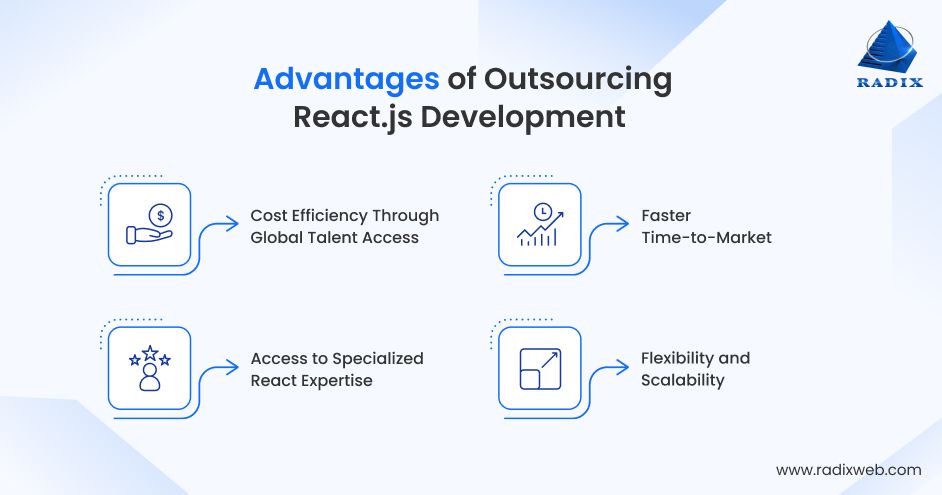
Outsourcing is an effective strategy for businesses to optimize development costs by accessing global talent markets with zero compromise on quality. You can access skilled React developers from regions where hourly rates are significantly lower than in domestic markets.
As you shift to a more variable cost structure, you eliminate expenses related to recruitment, onboarding, employee benefits, and workspace setup.
Speed is often the primary driver behind outsourcing frontend development. Enterprises can onboard pre-vetted developers in as early as 5-7 days – a direct approach to avoiding the typical three-month recruitment period.
Multiple developers working in parallel create efficiencies that in-house teams simply cannot match. Consequently, MVPs become ready in just 6-8 weeks, compared to 4-6 months for internal development efforts.
Outsourcing provides businesses with developers who use React every day and possess deep knowledge of its most effective features. These experts excel in various tuning techniques that enhance application speed. They would also have the capability to apply proven frontend architecture patterns, such as reusable components and scalable layouts.
This eliminates the trial-and-error phase that often slows down internal teams learning new React capabilities.
There are times when you must scale your project up and down, and when you must insist that your engineers keep working on it. In any case, be sure you can easily manage the constantly changing task. Now, handling the same with the help of an internal team becomes pretty challenging, as you won't have any assurance that the team will be able to handle the same or not, and again, you'll have to make monthly salary payments.
However, scaling the teams up or down is not a problem when outsourcing. A large skill pool and well-established project maintenance procedures of outside vendors make all of this possible.
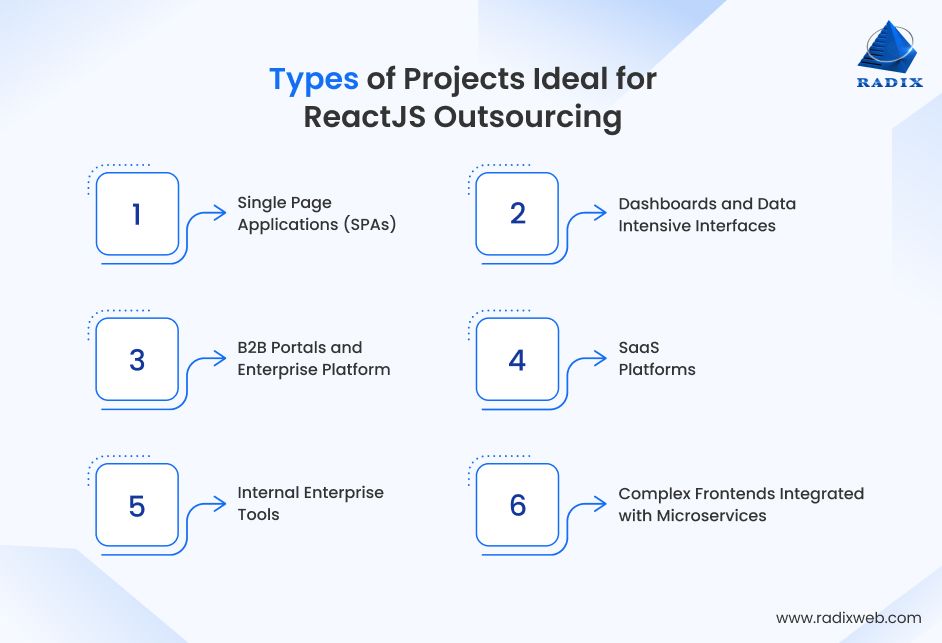
Outsource React development for projects where frontend complexity, tight deadlines, and specialized skills are priorities. Outsourcing delivers these solutions faster and more cost-effectively than building internal teams.

Cost remains the most researched aspect of outsourcing ReactJS partners. But it is often misunderstood. Pricing cannot be a fixed benchmark since it varies based on scope, team composition, and delivery expectations.
ReactJS outsourcing costs usually range from $20 to $150+ per hour, depending on region and expertise. MVP builds might cost between $15,000 and $50,000, while enterprise-grade applications can exceed $100,000 based on complexity, integrations, and performance requirements.
Four key variables drive your final price
| Region | Junior Dev | Mid-Level | Senior/Architect | Best For |
|---|---|---|---|---|
| India | $25-35 | $35-45 | $45-60 | Cost-effective scale |
| Eastern Europe | $40-50 | $50-65 | $65-90 | Technical depth |
| Latin America | $35-45 | $45-55 | $55-75 | Timezone alignment |
| Western Europe | $70-85 | $85-100 | $100-130 | EU compliance |
| US/Canada | $120-140 | $140-160 | $160-200+ | Local collaboration |
Value beats lowest price: India could arguably be one of the best countries to outsource, especially ReactJS projects as it offers unmatched scale. Eastern Europe excels in complex fintech/healthcare apps, and Latin America balances cost with North American time zone overlap. Choose based on your technical needs and communication priorities, not just hourly rates.
Use this simple formula:
(Features × Complexity × Team Size × Duration in weeks) × Hourly Rate.
Example: 20 screens (features), high complexity (1.5x), 4-person team, 12 weeks, $40/hour = ~$38K.
Tip: Write 10-15 user stories ("As a user, I want...") and prioritize MVP scope. This reveals true effort better than feature lists.
Choosing the right outsourcing model depends on how much control you want, how predictable your scope is, and whether you need short-term delivery or a long-term product partner.
The three most common options are a dedicated team, a project-based model, and staff augmentation, and each works best in a different business scenario.
| Model | Ideal For | Cost Predictability | Control Level | Scalability | Typical Use Cases |
|---|---|---|---|---|---|
| Dedicated Team | Long-term product development and steady roadmap updates | Medium to high | High | High | SaaS platforms, evolving products, continuous feature releases |
| Project-Based / Fixed-Scope | Clearly defined work with limited changes | High | Medium | Low to medium | MVPs, one-time feature builds, redesigns |
| Staff Augmentation | Filling skill gaps in an existing team | Medium | Very high | Medium to high | Internal product teams, urgent deadlines, specialized frontend support |
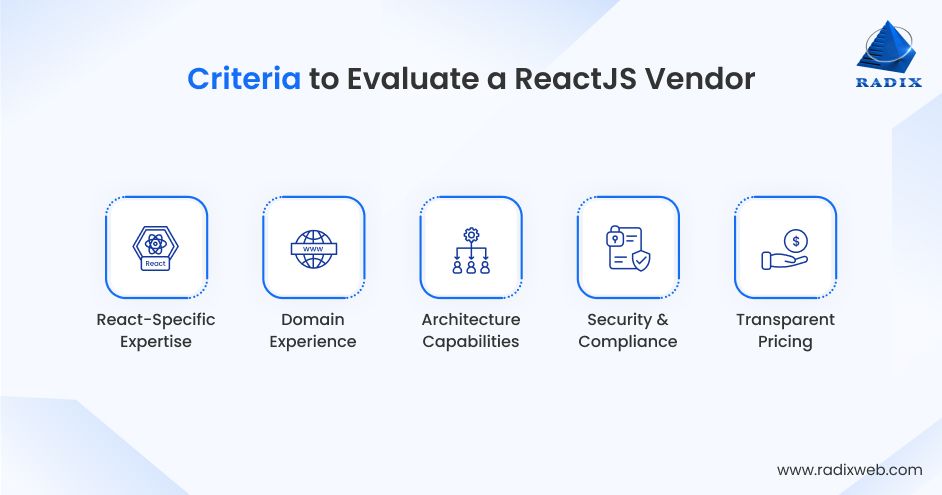
The best vendors combine deep technical expertise with proven business results, easy communication, and alignment with your goals. Focus on these key areas when choosing the right ReactJS development partner who delivers scalable, high-performing apps.
Look for partners who demonstrate both breadth and depth in React development:
Worth Noting: Ask for a live code walkthrough of their recent React work.
Don't stop at pretty UI screenshots. You must dig for measurable impact:
Always request 2-3 client references and ask: "What surprised you (good or bad) about working with this vendor?"
Technical skills get you started, whereas communication determines success:
Onboarding Best Practice: Week 1 knowledge transfer with architecture diagrams, API docs, and sprint zero planning.
ReactJS outsourcing delivers incredible value, but like any partnership, it comes with risks that can derail projects if ignored. Common pitfalls include misaligned expectations, poor communication, and technical mismatches.
Even experienced teams face these frequent challenges:
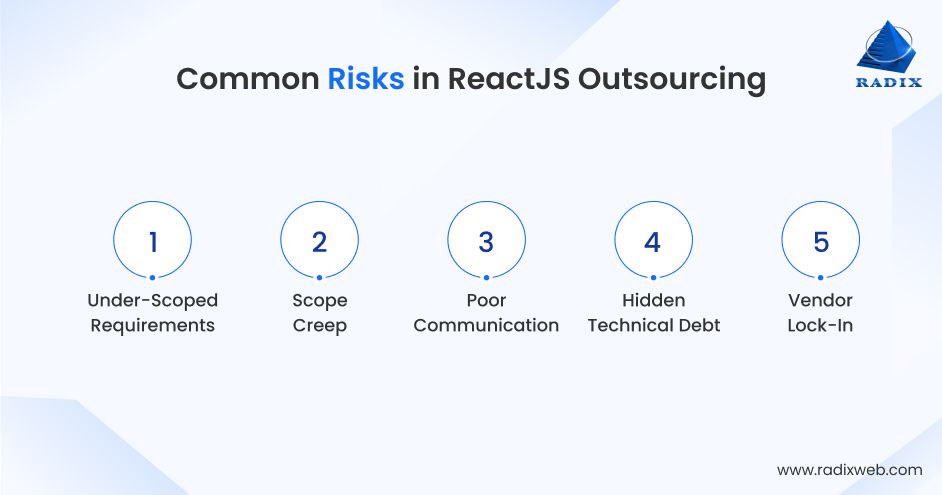
1. Under-scoped Requirements: Initial estimates miss complexity, leading to budget overruns when "simple" features reveal hidden integrations or performance needs.
2. Scope Creep: New requests pile up without change control, doubling timelines and costs without delivering proportional value.
3. Poor Communication: Time zone gaps, unclear updates, or misaligned priorities create frustration and delays.
4. Hidden Technical Debt: Cutting corners on testing, accessibility, or architecture creates maintenance nightmares post-launch. It leads to unexpected rework cycles and hidden outsourcing costs in software development projects.
5. Vendor Lock-In: Custom codebases or processes make switching partners expensive and disruptive.
Reality Check: 30% of outsourcing projects overrun budgets by 50%+ due to these issues, but proactive planning cuts that risk dramatically.
Implement these proven safeguards from day one:
Protecting intellectual property and sensitive data requires both legal safeguards and technical controls.
With frontend engineering as a core capability, React has become a focused area of specialization within our delivery model. Over the last 26+ years, we have built an upskilled team of React consultants and developers who have both the technical depth of React and the operational rigor required to ideate, design, build, and deploy production-grade React applications.
Our technical foundation includes React 18+ with concurrent features, Next.js 15 for hybrid rendering, TypeScript for type-safe development, Redux Toolkit/Zustand for state management, and Tailwind CSS with Headless UI for pixel-perfect UIs. The team specializes in industry-specific builds, including SaaS platforms, fintech applications, healthcare portals, and eCommerce frontends.
Radixweb provides all three core models customized to your needs:
Every model includes Sprint Zero planning, shared GitHub repos with your full code ownership, Vercel/Netlify deployments, and bi-weekly executive demos.
If you are planning to outsource ReactJS development services or looking to optimize an existing setup, the next step is to align your requirements with a practical execution plan.

Making the Right Call on ReactJS Outsourcing
ReactJS outsourcing is not only limited to tactical cost arbitrage now. It's a strategic lever for market dominance in today’s frontend-first economy. Forward-thinking C-suites partner with certified React specialists to capture P&L efficiencies, accelerated go-to-market velocity, and customer acquisition funnels converting at enterprise scale.The difference between success and failure in outsourcing often comes down to structure. Clear scope definition, the right engagement model, disciplined vendor evaluation, and strong governance frameworks significantly reduce execution risks and ensure predictable outcomes.If you are evaluating outsourcing for your ReactJS initiatives, the next step is to map your requirements into a practical execution plan. You can reach out to us to begin with a focused consultation or a short pilot engagement to validate technical fit, delivery approach, and collaboration model before scaling further.
Ready to brush up on something new? We've got more to read right this way.

