Read More


Recognized for AI Excellence at 2026 Globee® Awards - Read More

Nihar Raval
Python is free. No license fees, no per-seat charges, and a library for almost anything you can think of. Building software with it is where the money goes. Realistic python software development cost estimates run from $5,000 for a basic automation script to $150,000–$300,000+ for an enterprise platform or advanced AI system. That is a 60x spread, which is why multiple vendor quotes for even “the same app” almost never match.
So how much does Python development cost actually for your project? With no licensing in the picture, every dollar goes to engineering hours, design, testing, cloud infrastructure, and compliance. That makes the number far more predictable once you know which levers move it.
At Radixweb, we have built Python projects ranging from ML-powered forecasting tools to AI-powered intelligence platforms. Based on that practical Python development expertise, below we break down the cost of Python development in 2027 by project, rate, team, and lifecycle.
Python is an open source technology, so there are no licensing fees. The total spend is driven by scope, engineer location, and engagement model, from about $5,000 for scripts to $300,000+ for enterprise and AI systems. Budget 1.5x the initial quote and set aside 15% to 25% of the build cost every year for maintenance, because the python software development cost on a proposal is rarely the one you end up paying.
| Aspect | Details |
|---|---|
| What does this guide cover? | Cost ranges by build type, developer rates across five regions, team and engagement models, budget breakdown, maintenance, and an estimation method |
| Who should read this guide? | CTOs, product leaders, founders, and procurement teams budgeting a Python build or comparing vendor quotes |
Python software development cost ranges from $1,500 to $300,000+, depending on project scope, integrations, developer rates, security, and maintenance needs. Everything else is a question of where you fall on that scale, and how far your scope stretches beyond the basics.
The table below shows Python development cost by project type, with typical timelines.
| Project type | Typical cost | Timeline |
|---|---|---|
| Automation scripts and internal tools | $1,500 – $20,000 | 1–6 weeks |
| Web apps and APIs (Django, FastAPI, Flask) | $15,000 – $80,000+ | 2–6 months |
| SaaS platforms, MVP to growth stage | $25,000 – $150,000+ | 3–8 months |
| AI and machine learning applications | $20,000 – $250,000+ | 2–12 months |
| FinTech and healthcare platforms | $40,000 – $300,000+ | 4–18 months |
Treat these as starting ranges, not quotes. A vendor who prices your project after a 20-minute call is guessing, and Python development pricing that ignores integrations, compliance, and team model is just guessing with confidence.
Three rules of thumb keep Python project budgets honest.
That is why there are two answers to how much it costs to develop software solutions with Python. One is the price you pay to actually build the Python software and then second is the price of owning what you built. Teams that budget only for the first tend to come back for more money around month nine. A realistic and practical estimate of the cost of python software development is the one that includes both.
Custom Python Software vs Off-the-Shelf ToolsOnce teams understand how much it actually costs to build with Python, they often wonder if an off-the-shelf Python-powered SaaS product would make sense.And here’s the honest advice we share with anyone comparing custom versus off-the-shelf builds: If a SaaS product already does 80% of what you need, buy it. If needed, get the rest 20% of functionality custom built or integrated with the off-the-shelf tool.Custom Python software cost only earns its keep when the workflow is your competitive edge or no product in the market fits. And the cheapest way to find out is to get started with low-code prototype development, which runs between $3,000 to $15,000. Then, validate demand there and only spend on custom code, if it guarantees returns.
The first step to estimate the cost of any software project is to know what you are building. So even though you are using the same language to build a scraping script and a regulated healthcare platform, they have almost nothing else in common, and so each follows its own price logic.
Here is how Python development cost by project type breaks down past the headline ranges.
When you build a Python web application in Django, FastAPI, or Flask, you can expect to pay anywhere between $15,000 to $150,000. A straightforward business application or an API runs $15,000 to $35,000. A medium-complexity portal with authentication, dashboards, and a proper database runs $40,000 to $80,000. SaaS products push higher, at $25,000 to $150,000+, because multi-tenant architecture, role management, Stripe billing, and usage analytics land on one roadmap.
Enterprise solutions require a different category of development effort altogether. FinTech and healthcare builds carry a 20% to 35% compliance premium for HIPAA, PCI-DSS, GDPR, and SOC 2 controls, audit logging, and EHR integrations, and in healthcare that premium can reach 50%. Beyond compliance, the cost to develop an enterprise Python application typically starts around $100,000 and climbs past $250,000 once real-time analytics, ETL pipelines, and high concurrency join the scope.
In most AI projects, Python is the headliner technology. Python integrates AI models, data, and enterprise systems, where FastAPI serves model inference, ETL pipelines move and clean the data, and Django or similar frameworks carry the business logic and integrations.
So, if you are using Python for AI, here is what that costs:
| AI project type | Typical cost |
|---|---|
| LLM API integration (summarization, classification, document processing) | $10,000 – $40,000 |
| Simple FAQ chatbot | $2,000 – $15,000 |
| LLM + RAG knowledge assistant | $15,000 – $40,000 |
| Context-aware or multilingual chatbot | $30,000 – $120,000 |
| AI agents and autonomous workflows | $25,000 – $150,000+ |
| Custom machine learning or computer vision | $40,000 – $250,000+ |
| Enterprise conversational AI (multi-agent) | $100,000 – $300,000+ |
| Enterprise AI platform | $250,000 – $1,000,000+ |
The spread comes from what sits around the model, not the model itself. Hosted APIs from OpenAI, Gemini, or Claude keep the entry price low. Custom models trained on proprietary data, and agents that act across your tools with human-in-the-loop checks, are where budgets climb.
Data work is the line item that surprises people. Collection, cleaning, labeling, and ETL setup take 50% to 70% of project time and 25% to 35% of direct cost, which is why data preparation and data cleaning for AI application can claim 10% to 30% of the budget on its own. Specialists in AI, ML, and data engineering also bill a 15% to 40% premium over standard backend rates, and in the US their hourly rates start around $120.
Then there is the cost that never stops. Traditional ML models carry mostly upfront build costs. Generative AI adds token charges that scale with every user, every prompt, and every response, so usage growth is a budget line, not just a success metric.
Architecture choices matter here too. A RAG approach typically costs about 60% less than fine-tuning in year one, at $18,400 against $30,600 for a typical customer support assistant, which makes it the sensible default for knowledge bases that change often. Add compliance requirements in FinTech or healthcare and the 20% to 35% premium applies on top.
The practical takeaway: price the complete artificial intelligence software solution getting built, not just the model. The integrations, pipelines, and enterprise connections around the AI are where Python earns its place and where most of the real cost lives.
If you are looking at Python software development companies for your project and the quotes include itemized feature count, that could be misleading. A product with five features and a payments engine can cost more than one with fifteen CRUD screens. So, instead of just looking at feature lists, consider project complexity too.
| Complexity | What it usually includes | Cost |
|---|---|---|
| Basic | MVP or proof of concept, 3 to 5 core features, basic authentication | $10,000 – $40,000 |
| Medium | Custom UI/UX, subscription payments, admin dashboards, role-based access | $40,000 – $100,000 |
| Complex / enterprise | Scalable SaaS, real-time analytics, ETL pipelines, embedded AI/ML, strict compliance | $100,000 – $250,000+ |
The Python development cost based on project complexity climbs steepest at the third tier. And that jump is rarely about screen counts. It is about everything a demo never shows: concurrency, audit trails, failure handling, and the integrations nobody drew on the whiteboard.
This is also where the average cost of Python development stops being useful. Two apps in the same band can differ widely once integrations, data volume, and compliance enter the picture, and no average can price that. If your roadmap includes them, budget for the cost to develop an enterprise Python application from day one, because retrofitting costs more than building it in.
Location is the largest lever on any software development project’s budget. Hourly rates run from about $12 in parts of South Asia to $200+ for senior engineers in the US. Specialists in AI/ML, data engineering, or security add a 15% to 40% premium over standard backend rates, wherever they sit.
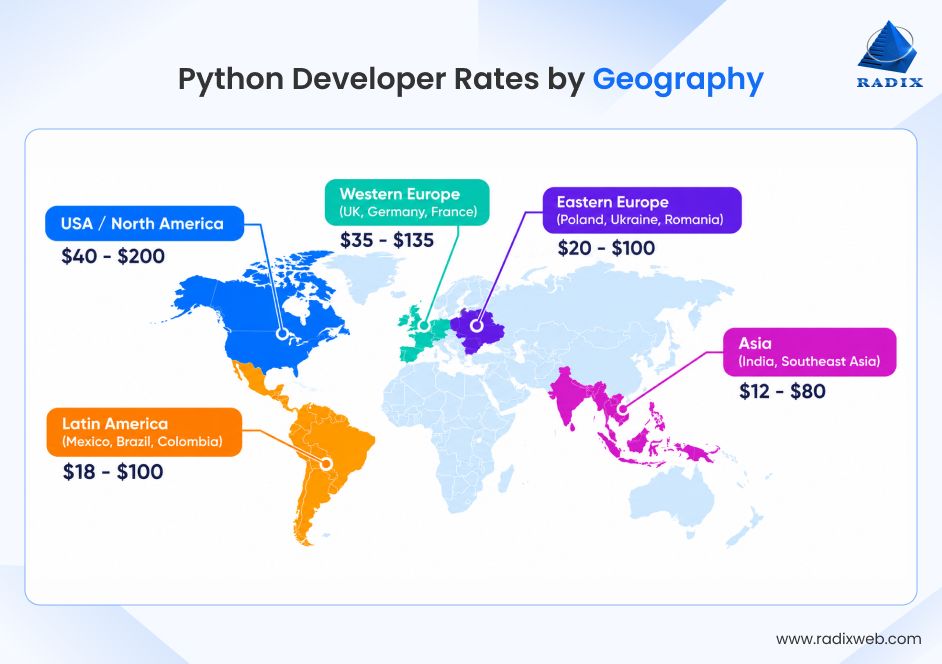
Here are the current Python development hourly rates by region and seniority.
| Region | Junior (1–3 yrs) | Mid-level (3–6 yrs) | Senior (6+ yrs) |
|---|---|---|---|
| USA / North America | $40 – $70 | $58 – $130 | $95 – $200+ |
| Western Europe (UK, Germany, France) | $35 – $80 | $50 – $100 | $70 – $130 |
| Eastern Europe (Poland, Ukraine, Romania) | $20 – $45 | $35 – $70 | $55 – $100 |
| Latin America (Mexico, Brazil, Colombia) | $18 – $45 | $35 – $75 | $45 – $100 |
| Asia (India, Southeast Asia) | $12 – $30 | $20 – $50 | $22 – $80 |
Python developer rates by region fall into three bands:
Put simply, Python development cost by location can swing a project’s labor budget by 40% to 60% before you change anything else. Eastern Europe runs 38% to 50% below US onshore, and Latin America 30% to 60% below.
A Python consultant typically charges $100–$200 per hour, while a Python developer may charge $25–$150 per hour. But what’s to important to understand here is that a python consultant hourly rate buys something different from a developer’s. Consultants sell judgment: architecture reviews, technical audits, and estimation, usually billed on time and materials. Hire a consultant when the question is what to build and how to price it, and hire software engineers when you need someone to implement the plan that a consultant designed.
Python developer cost moves with experience. In the US, a junior bills $40 to $70 an hour and a senior $95 to $200+, with mid-level engineers in between at $58 to $130. When using Python for AI product development, the hourly rate for Python developers starts around $120 and runs past $200.
Say you hire a Python developer who charges $25/hour but takes three times as long, or ships with rework attached. Such an engagement is not a bargain and would eventually end up costing you more than what another skilled developer would have cost.
Cheapest-rate shopping is the most reliable way to overpay, because the Python development cost per hour is not the cost of the project. The rate that looks expensive on a spreadsheet often reflects senior architectural judgment that prevents rework later, and that is the part a spreadsheet cannot show you, which is why the Python development hourly rate alone settles nothing.
Headcount feels like the obvious cost lever. And while it is important, it is not linear. At $3,200 to $15,000 a month per full-time engineer, a four-person team runs $12,800 to $60,000 a month, and eight engineers double that. Add people to hit a deadline and coordination overhead starts eating the gain, which is why Python development cost by team size rarely tracks headcount.
The choice between an in-house team, freelancers, and an agency affects your spending, while the engagement model determines how much flexibility you have over scope, timelines, and resources. Understanding these trade-offs helps you estimate the budget more accurately and choose a setup that fits your project’s complexity, delivery goals, and long-term needs.
The Python development cost by development model really comes down to who carries the risk: you, the vendor, or both.
Note: Whatever python software development pricing model you choose, insist on a rate card and an hours cap, because open-ended billing is where budgets drift quietly. If what you need is direction rather than hands, paying a python consultant at an hourly rate is the better buy for an audit or an estimate.
Programming is only part of the invoice. Initial engineering accounts for 60% to 70% of first-year spend, and the rest goes to discovery, testing, infrastructure, and management. Here is a Python development cost breakdown for a typical $60,000 build.
| Phase | Share of budget | On a $60,000 build |
|---|---|---|
| Discovery and requirements | 5% – 10% | $3,000 – $6,000 |
| UI/UX design | 10% – 15% | $6,000 – $9,000 |
| Backend and core development | 45% – 55% | $27,000 – $33,000 |
| Testing and QA | 10% – 15% | $6,000 – $9,000 |
| Deployment and DevOps | ~5% | ~$3,000 |
On AI/ML projects, add data preparation at 10% to 30% of the budget. QA deserves its share too, since it absorbs 15% to 25% of engineering hours. Skip it, and a Python development budget quietly becomes a rework budget.
The line items that surprise people sit outside the table and include:
Only once you factor in these you get a better estimate of how much does it cost to develop software in Python.
Python development costs vary based on what you build, the expertise it requires, and the complexity of your business needs. Here are seven key factors that affect Python software development costs:
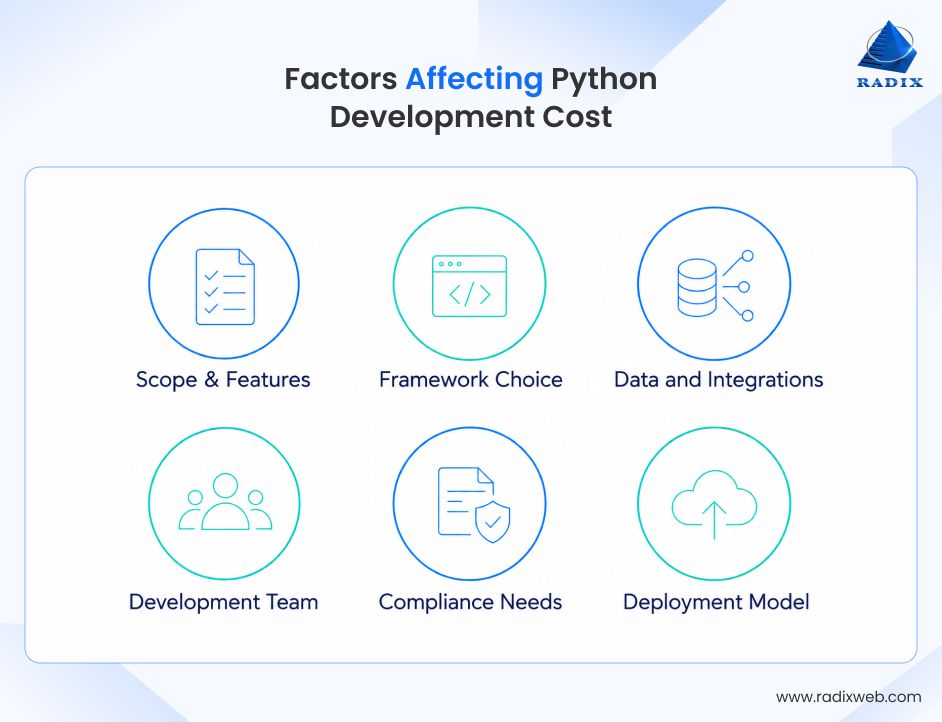
Scope drives everything else, and it is the one factor you control completely. Basic CRUD is cheap. Real-time sync, payment gateways, permission tiers, and analytics are not, and custom Python software cost grows fastest where features interact. Every non-essential feature beyond the core set adds 10% to 20%.
Django’s batteries-included design, with its ORM, admin panel, and built-in authentication, can cut early development on standard business apps by 30% to 40%, which lowers the cost to build a Python web application most when requirements are conventional. FastAPI suits microservices and AI inference endpoints, with a slight premium for async work. So, before you budget, find the best python framework that meets your project needs.
Each major integration adds $2,500 to $8,000, depending on documentation quality and edge cases. If you are integrating AI solutions to other business systems, data cleaning and labeling can take 25% to 35% of direct cost.
Seniority and specialization set Python developer cost within any region. Hiring a senior AI engineer in the US, for example, will cost several times what a junior developer in Asia does, and the gap is real, not cosmetic. Pay for senior architecture early, even if mid-level engineers write most of the code, because saving on the Python development cost by location only helps when the design is sound.
Regulated work adds 20% to 35%, and up to 50% in healthcare. Build the controls in on day one. Retrofitting compliance after launch costs two to three times as much.
Compressing a schedule means more engineers in parallel, so Python development cost by team size climbs faster than headcount, with coordination overhead adding 20% to 40% to the total.
Cloud spend climbs with traffic, storage, and concurrency, and AI features add variable token costs. A disciplined approach to cloud cost optimization keeps this line from drifting.
None of these factors are unique, yet together the factors that affect Python software development costs explain why two honest vendors can quote the same project 40% apart.
Launching a Python project is the just start of the bill, not the end, and the second invoice tends to arrive quietly. The standard benchmark for the cost to maintain Python software is 15% to 25% of the original build cost per year, so a $100,000 web app needs $15,000 to $25,000 annually. Over five years, maintenance, hosting, security patches, and feature updates account for 50% to 80% of lifetime spend.
Here’s what maintenance actually covers:
Support models
Support follows the same engagement logic as the build, so Python development cost by development model applies after launch too: a retainer for steady change, on-demand for stable systems, a dedicated team for a growing product. Whichever you choose, put 15% to 20% of the build cost into your Python development budget before the first sprint begins. Skipped dependency updates are the usual reason the number climbs.
Guessing is the expensive way to find out how much your Python project will actually cost and even a tidy spreadsheet built on guesses is still a guess. Proper Python development cost estimation, however, helps you plan your project budget on actual figures not guesses.
Here are the four simple steps you need to follow to estimate the cost of Python projects:
Once you have these details, here is how Python development cost is calculated:
Total build cost = (dev hours × blended hourly rate) + design + QA + DevOps + contingency
The blended Python development cost per hour could mix a $90 senior architect with $35 mid-level engineers, so use the Python developer rates by region above instead of one headline number. Use the same logic to test any vendor’s python software development pricing. And if their number cannot be traced back to hours, rates, and a buffer, ask why.
For uncertain modules, use three-point estimation,
(Optimistic + 4 × Most likely + Pessimistic) ÷ 6
With that, one optimistic guess cannot sink the budget.
A realistic budget for the cost of Python development in 2027 starts with more than the initial build estimate. Integration complexity, compliance requirements, testing, and ongoing maintenance can all push costs beyond the original quote.
Budget for these variables upfront, and you can control spending without compromising on quality or scalability. Here’s what you should do:
A well-planned Python development budget accounts for the full lifecycle, not just the initial build. Set clear priorities, validate estimates, and plan for future needs to keep costs predictable without sacrificing long-term value.
Scope and Start Your Next Python Development Project
ython is the language that holds most AI roadmaps together, so if AI is on your agenda, Python development is very likely what you need. Getting the cost of python software development right is what makes moving fast safe. Map the integrations, the data work, the compliance load, and the maintenance tail before the first sprint, and the budget stops being a guess. Do that mapping quickly, then start building Python software that matches your AI ambition instead of just demoing it.At Radixweb, we have spent 26+ years building and modernizing enterprise software, and we know what Python projects cost because we have delivered them. We scope what is needed, price what we scope, and never overpromise or underdeliver, which is the only way the python development company cost you agree to stays the cost you pay. Schedule a consultation with our Python experts and get a scoped estimate before you commit a dollar.
Ready to brush up on something new? We've got more to read right this way.