Read More


Recognized for AI Excellence at 2026 Globee® Awards - Read More

Vinit Kariatukaran
According to a Gartner report in January 2026, at least 50% of generative AI projects were abandoned after proof of concept by the end of 2025. The causes it named were poor data quality, weak risk controls, rising costs, and unclear business value. Notice what's missing from that list. Nobody wrote "the model wasn't smart enough."
Here's the thing: the model is rarely why AI product development fails. The data pipeline that breaks on a renamed column, the serving layer that falls over at 200 concurrent users, the dependency that updated itself overnight, the invoice that tripled once real customers arrived. That's where products die. And in most AI stacks, every one of those problems lives in Python.
Stack Overflow's 2025 survey recorded a 7-percentage point jump in Python adoption in a single year. And GitHub found nearly half of all new AI projects built primarily in Python.
But popularity is not production readiness. Teams choose Python because it gets a prototype running by Friday, then keep treating it like a prototyping language long after real users show up. At that point, the product quietly turns into a Python engineering problem that nobody staffed for. At Radixweb, we've seen this pattern often enough to give it a name. Based on that experience, below we explain where it happens, why Python sits at the center, and what disciplined Python AI engineering looks like.
Every AI product eventually stops being a model problem and becomes a software engineering problem, and in most stacks that means Python. The AI model gives you a successful product demo that investors and stakeholders would love. Data pipelines, serving, concurrency, environments, evaluation, and cost control, basically all the actual engineering, get you a product that is secure, scalable, and will work in real production environments. Python isn't perfect for all of it, but its ecosystem makes it the default, which makes Python engineering discipline the difference between a stagnated pilot and a deployable product.
| Aspect | Details |
|---|---|
| What This Guide Covers? | Why Python sits at the center of AI stacks, six engineering problems that appear in production, a six-point production-readiness framework, and when Python is not the right tool |
| Who Should Read This? | CTOs, engineering heads, and product leaders moving AI from pilot to production; ML engineers inheriting notebooks; founders choosing a stack |
Python has been the language of AI for years. What changed in 2025 is how fast the gap widened. Stack Overflow's developer survey recorded a 7-percentage-point jump in Python adoption in a single year, which it ties to Python's role in AI, data science, and back-end development. GitHub's Octoverse tells the same story from the repository side: Python leads AI-tagged projects with roughly 582,000 repositories, up more than 50% year over year, and nearly half of all new AI projects are built primarily in Python.
While TypeScript passed Python by contributor count in August 2025 to become GitHub's most used language overall, for AI work, Python is still the center of gravity.
Three technical reasons explain why Python for AI development became the default.
PyTorch, TensorFlow, scikit-learn, Hugging Face Transformers, LangChain, and LlamaIndex all ship Python-first. New research tends to appear as a Python repo before it appears anywhere else, and provider SDKs are most mature in Python. If you do not use Python for AI product development it means you have to build every layer yourself, from tokenizers to vector store clients. Because all that already exists in Python and has been battle-tested by thousands of teams, it just makes sense to stick to it.
In older setups, data scientists prototyped in Python, and a separate team rewrote the logic in Java or C++ for production. Every rewrite introduced a drift between what was validated and what shipped. With one language, the feature code that trained the model is the same code that serves it. That prevents training-serving skew, where the model sees data prepared one way in training and another way in production. It's a big reason why the use of Python in AI product development shortens the road from research to release.
The heavy lifting in AI doesn't run in the Python interpreter. NumPy, PyTorch, and CUDA kernels are compiled C, C++, and GPU code, and Python is the readable layer that wires them together. You get near-native speed where the math happens and a productive language where the logic lives. That split is why Python AI development works at all despite the language's reputation for being slow.
None of the above reasons makes Python flawless. In standard builds, the Global Interpreter Lock (GIL) restricts true parallelism across CPU-bound threads. Pure-Python loops are slow. Big dataframes eat memory. GPU dependency trees are brittle, and it's easy to write async code that quietly blocks under load.
So, when using Python for software projects that involves AI, you might feel that the language struggles exactly where production begins. But that's exactly what we need to engineer for. And that's the honest picture of AI product development with Python: a strong default with sharp edges.
When an AI product underperforms, the first instinct is to blame the model and shop for a better one. That instinct is usually wrong. Here's why:
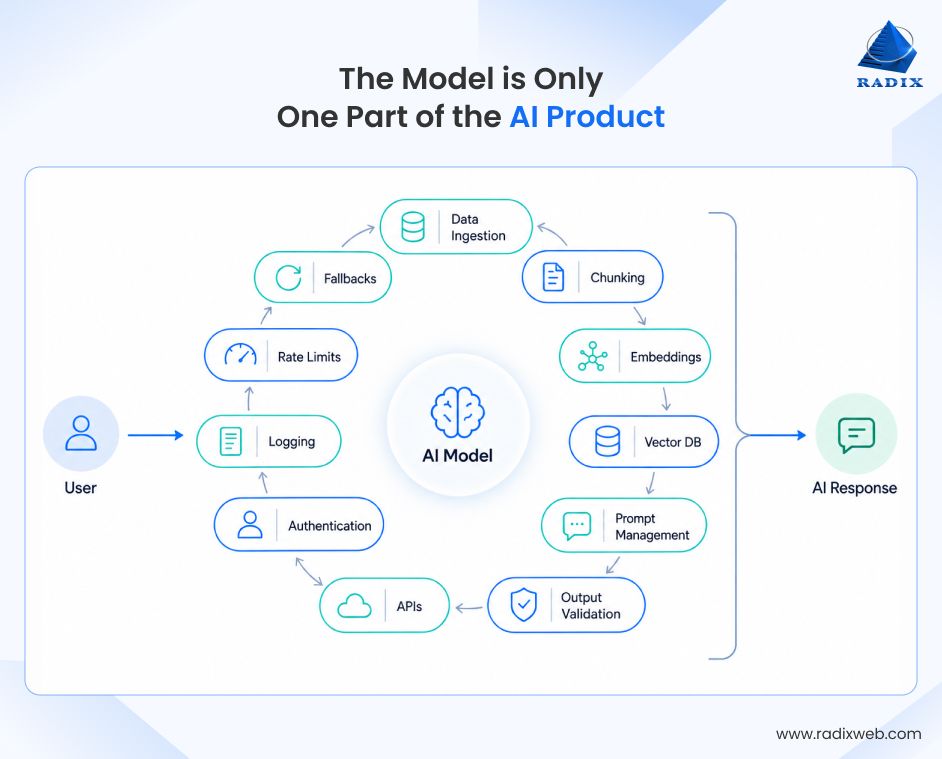
Take a customer support assistant. The model call is one line of code. Around it sit authentication, document ingestion, chunking, embedding refreshes, a vector store, prompt versioning, output validation, logging, rate limits, and a fallback for when the provider has a bad afternoon. That's a dozen components, and the model is one of them.
These are the AI product development challenges that never make it into the pitch deck. Each is a software engineering task, and each needs code that someone will maintain for years.
Swap in a better model on top of stale, inconsistent, or badly structured data and you get more fluent wrong answers. That's an upgrade in tone, not accuracy. Duplicate documents, outdated policies, mismatched schemas, and missing fields do more damage to output quality than the gap between two strong models. Without clean and AI-ready data no matter what model you use, the output will remain mediocre.
AI prototyping with Python is a good idea. A notebook lets you test a retrieval strategy in an afternoon or compare three models before lunch. We encourage it. The trouble is that a notebook demo works for one person on one machine, on the dozen questions it was tested against.
So, when a team demo a retrieval assistant that answers beautifully in the meeting. Weeks after launch, tickets pile up because real users ask things nobody wrote down. Not because anything was wrong with the model. But because nobody built the evaluation set, that would have said so. That's the real distance you need to cover before you can think about moving from AI prototype to production system, and no model upgrade closes it.
Real users bring traffic spikes, adversarial inputs, and compliance questions. Providers change model versions under you. Upstream data changes shape. A dependency update overnight. None of this exists in the demo, and all of it lands on the engineering team.
Each of these problems is a software engineering problem, and in most stacks it lands on Python. That's why when you use Python for AI product development, it is not just about the language you pick, but how you engineer everything around it. A better model won't do that, better Python AI development practices will.
None of the Python engineering challenges in AI product development are unique. If you are developing AI software solutions with Python, you'll eventually face them sooner or later.
What's also important to know and understand here is that all these roadblocks are the easiest (and cheapest!) to fix early on. The cost and complexity just rise as you move deeper into the implementation roadmap.
| Problem | Prototype habit | Production requirement |
|---|---|---|
| Data | One CSV, loaded whole | Validated, versioned, streamed pipelines |
| Serving | Model loaded per request | Loaded once, batched, autoscaled |
| Concurrency | Blocking calls everywhere | Async I/O plus worker queues |
| Environments | "Works on my machine" | Pinned, containerized, reproducible |
| Testing | Eyeballing outputs | Evaluation suite in CI |
| Cost | Unmonitored API calls | Caching, routing, budgets, alerts |
Using Python for AI data processing often starts with pandas because the dataset fits comfortably in memory and the processing logic is straightforward. The problem appears when data grows beyond available memory or processing jobs take hours instead of minutes. At that point, memory usage, serialization, and repeated data movement become bottlenecks.
Teams may need chunked processing, columnar tools such as Polars, or distributed frameworks such as Spark or Dask. There is also a less visible problem: schema drift. If an upstream field changes and the pipeline accepts it without validation, downstream features can degrade silently. Schema validation at pipeline boundaries makes these failures explicit.
Serving AI models with Python can look as simple as putting a model behind a FastAPI endpoint. In production, however, loading model weights for every request creates unnecessary startup time and memory usage. Sending requests one at a time can also leave GPUs underutilized, while long-running generations can occupy workers needed for shorter requests.
Production serving therefore requires persistent model processes, controlled concurrency, batching where appropriate, and streaming for workloads where users benefit from incremental responses. Python AI model deployment also introduces infrastructure dependencies such as CUDA, GPU drivers, container images, and inference-server configuration, all of which need to remain compatible.
FastAPI's asynchronous architecture works well when an application spends most of its time waiting for network, database, or other I/O operations. The problem starts when synchronous model calls, CPU-heavy preprocessing, or blocking libraries run inside the async request handler. While that work is running, the event loop cannot efficiently handle other requests.
The solution depends on the workload. asyncio is appropriate for I/O waits, threads can isolate some blocking operations, while processes or worker queues are better suited to CPU-heavy and long-running tasks. The important engineering decision is to keep expensive work from occupying the same execution path responsible for serving ordinary requests.
AI applications often combine the some of the best Python frameworks, model libraries, numerical packages, GPU runtimes, and operating-system dependencies. But these components can have tightly coupled version requirements. A change to PyTorch, for example, can introduce compatibility issues with CUDA, drivers, or other packages even when the application code itself has not changed.
These Python architecture challenges for AI applications are therefore as much about dependency management as application architecture. Lock files pinned base images, reproducible container builds, and a consistent environment-management approach make the application easier to reproduce and troubleshoot when something changes.
Traditional unit tests can assert that a function returns a specific value. Generative AI features are different because the same input can produce different valid outputs, while classifiers and other AI components can produce probabilistic results. Exact string matching therefore becomes brittle, while manually checking outputs does not scale.
A production system needs an evaluation of harness with a versioned set of representative inputs and measurable criteria such as correctness, relevance, structure, or safety. These evaluations can run alongside conventional unit and integration tests, giving the team a way to detect quality regressions when prompts, models, retrieval logic, or preprocessing change.
An AI feature added to a system can work correctly and still become expensive or unreliable at scale. Repeated model calls, unnecessarily large prompts, excessive retries, and sending simple requests to expensive models can increase inference costs. At the same time, provider timeouts or rate limits can propagate into application failures if requests are not bounded.
This is where Python application logic becomes part of the operational control layer. Caching can eliminate repeated work, model routing can match requests to appropriate models, while timeouts, bounded retries, backoff, budgets, and fallbacks can contain failures. These production engineering challenges for AI products directly affect whether the system remains practical under real traffic.
Six problems, one pattern: each is easy to overlook when a prototype has limited data, traffic, and operational pressure. Production exposes the assumptions that prototypes can hide. That is why AI product development challenges with Python need to be considered during architecture and not treated as post-launch fixes.
The six challenges describe where production systems break. The framework below translates those failure points into architectural practices teams can apply before they scale.
Also Read: The Complete Guide to AI Development
Python engineering for AI products involves designing, developing, testing, deploying, and managing AI applications with Python and its powerful ecosystem. It goes beyond model development to cover data pipelines, APIs, model serving, evaluation, observability, scalability, security and AI infrastructure.
None of the Python engineering challenges we discussed above are impossible to solve. The teams that get AI products into production reliably identify these risks early and build the right guardrails into the architecture from the start.
So instead of looking at alternatives to Python, you need to just work with experienced Python engineers who understand the challenges and know how to navigate them.
Here is the framework we at Radixweb use in Python engineering requirements for AI products.
Your application should call generate() or predict(), not a specific vendor SDK. Keep provider-specific authentication, formatting, retries, and fallbacks behind this interface. That way, changing models, providers, or versions becomes a controlled configuration change rather than a codebase-wide rewrite.
Web workers should handle requests while dedicated workers handle heavy inference through queues or an inference server. This lets each layer scale independently and prevents slow models or expensive workloads from consuming resources needed by core application functions.
Use typed schemas for API inputs, internal data, and model responses. Pydantic can validate structured outputs before they reach business logic or databases. Treat model-generated data as untrusted input, so malformed or unexpected responses fail safely at the boundary.
Pin dependencies, use reproducible environments, and maintain a consistent build path from development to production. AI applications often depend on rapidly changing frameworks and model libraries, so predictable environments make upgrades easier to test, reproduce, roll back, and troubleshoot.
Create an evaluation set with normal cases, edge cases, and known failure modes before scaling the feature. Run it whenever models, prompts, retrieval, or preprocessing change. This gives teams measurable quality signals instead of relying on subjective judgments about whether outputs look better.
Track latency, token usage, errors, retries, inference time, and cost per request. Connect these metrics to user journeys where possible. Tools such as OpenTelemetry provide the visibility needed to identify performance bottlenecks, unexpected model costs, and reliability issues.
That's what solid Python backend engineering for AI products looks like: typed, reproducible, and observable. These practices also make AI product scalability with Python achievable because every new feature inherits the same guardrails instead of creating another production risk.
Python doesn't have to win every layer. Ultra-low-latency inference on edge devices often belongs in C++ or Rust. Front-end and streaming UI layers often belong in TypeScript. A sound architecture uses Python where its ecosystem earns its keep (models, data, orchestration) and lets other languages own the edges. The mistake isn't picking another language. It's picking by fashion.
Building AI Products with Python That Survive Production Loads
AI products rarely fail because the model is weak. They fail in the gap between a working demo and a system that holds up under production loads, and that gap is filled with Python. The teams that cross it are the ones building typed, tested, and observable Python products that are reliable where it matters most. With those foundations in place, building AI products with Python becomes more predictable, scalable, and manageable.At Radixweb, we've spent 26+ years building and scaling complex enterprise systems, and our teams bring that discipline to AI product development with Python, from data pipelines to model serving to integrating AI into existing cloud applications. If you're taking a pilot toward production, schedule a no-cost strategy session with our AI engineers and we'll help map the Python AI engineering foundations that hold up long after the demo.
Ready to brush up on something new? We've got more to read right this way.