Read More


Recognized for AI Excellence at 2026 Globee® Awards - Read More

Sarrah Pitaliya

Beyond the AI Hype: AI has already proven what it is capable of. The more important question now is what changes when those capabilities become part of everyday work. The strongest AI initiatives are not measured by models deployed, features launched, or hours of automation alone. They are measured by the friction removed, decisions improved, bottlenecks eliminated, and new possibilities created for people and businesses. As AI moves from experimentation into everyday operations, leaders need to shift their focus from adopting AI to redesigning work around where intelligence creates meaningful business change.
The AI conversation has changed
Not long ago, most conversations started with a familiar question: What can AI do? Can it write code? Analyze data? Generate content? Summarize documents? Predict outcomes? Build software? Work autonomously? Those questions still matter, but they are no longer interesting ones. We've seen enough demonstrations to know AI is capable of impressive things. But then what?
The conversation is now moving into more difficult territory that actually talks about what changes when AI becomes part of how work actually gets done.
That is a much harder question because capability alone does not create business value.
The answers reveal whether AI is creating transformation or simply adding another layer of technology to an existing process.
I found myself thinking about this distinction recently at the CMO Asia award ceremony, where I was recognized as one of the Most Admired Marketing Leaders.
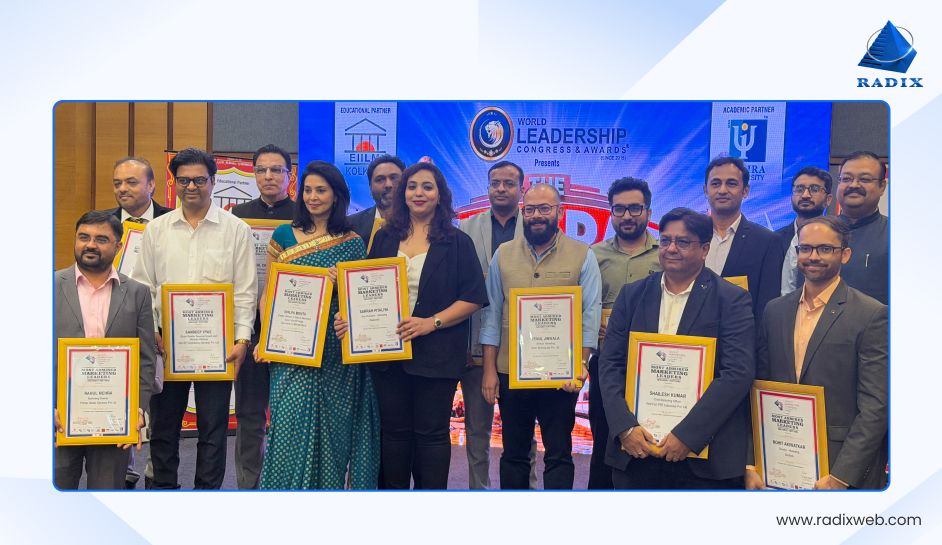
As I spoke with technology and marketing leaders who were already well beyond the stage of asking whether AI works, I realized that we weren't debating whether AI could generate, predict, automate, or analyze. That felt settled.
Instead, the conversation had shifted to what happens after those capabilities enter the workflow. How do roles actually change? Where does human judgment become more important, not less? Which processes should be redesigned rather than automated? What does it feel like when your team has to completely rethink how they work? And how do you measure whether all this technology has actually made the business better?
These are the conversations that matter now. Not whether AI works. But whether it matters.
At Radixweb, our philosophy around AI has always been rooted in a simple principle: technology serves the business, not the other way around. This isn't just rhetoric. It's how we've structured our entire approach to AI development and implementation.
We've worked on AI projects for companies across industries and geographies. All of them have seen the impressive demos. AI analyzes datasets in seconds. AI generates content at scale. AI extracts insights from documents. AI predicts outcomes. AI works autonomously. Impressive, absolutely. But those aren't the projects that drive the most value.
Here's where we differ from much of the industry: We don't start with the model and work backward to find a use case. I've seen that approach before, and it always ends the same way. The technology works, but nobody actually needs it. The executives were excited about the capability, the engineering team built something elegant, and nobody uses it.
Instead, we start with the business problem. The existing workflow. The data constraints. The systems involved. The outcome we're trying to improve. Then we ask whether AI belongs.
Sometimes the answer is building an industry-specific AI agent that handles a class of customer inquiries, freeing human agents to focus on complex cases that require emotional intelligence and judgment. Sometimes it's intelligent automation woven into a product that makes the user interface smarter, not busier. Sometimes it's a feature inside an existing system that surfaces the right information at the right moment. And sometimes, the right answer is that AI isn't the solution at all.
This matters because responsible AI development isn't about finding somewhere to put AI. It's about finding where and how can intelligence be engineered into enterprise tech to remove friction, improve decisions, or eliminate bottlenecks that are actually slowing something real. The rest is just technology theater.
The successful AI projects we've seen share a common thread: they measure success not by technical elegance but by organizational change.
One client we worked with had their analytics team spending majority of their time searching across three different systems and sharing insights with the leadership team. We built an AI agent that lets the leaders query the database in natural language and get relevant information in seconds. The speed of the system is commendable. But here's what mattered more: the analytics team now spends that freed-up time actually understanding the market and planning strategic pivots. The technology enabled that.
Another project involved a product team that could only test a handful of new designs per quarter because prototyping was so labor-intensive. When we introduced intelligent prototyping automation into their workflow, they could test three times as many ideas. But the real change again, wasn't speed, it was learning velocity. They discovered user preferences faster. They killed bad ideas before investing in them. Their product roadmap became more confident.
So, we, at Radixweb, think about AI success in terms of one simple question: What was difficult before? What is different now? That's the question every business and technology stakeholder should ask before calling an AI initiative successful. Because that's what takes your AI pilots to enterprise-grade adoption. The difference between adding technology and changing how work happens.
The Leadership Challenge Ahead
The leaders of tomorrow aren't collecting AI projects or bragging about deployments. They're articulating what actually changes because of AI and then guiding their organizations through that change. That's harder work than launching a feature. It requires understanding people, not just technology. It requires thinking about what happens when you remove a bottleneck. What does the team do with the time that opens up? It requires redesigning roles, updating training, and sometimes rethinking entire organizational structures.Because that's the real test of AI. Not what it can do in isolation. What it changes when we put it to work. And that's where the real conversation is now. Not in the demos. In the hard work that comes after. In understanding that AI adoption across industries is a business value creation initiative, not just a technology initiative. That's what Radixweb believes. And that's what we build toward.
Ready to brush up on something new? We've got more to read right this way.