Read More


Recognized for AI Excellence at 2026 Globee® Awards - Read More

Nihar Raval
What's Inside: Skilled AI software developers are scarce. The market is full of people who claim the title. But only a few have built, deployed, and maintained AI in production. Hiring the wrong one doesn't just slow you down. It sets the wrong foundation. Below, I guide you through the process of hiring an AI developer who matches your ambition, doesn’t just fill a seat.
The AI development market is moving fast. According to a World Economic Forum report, artificial intelligence developers and machine learning specialists rank among the fastest growing roles.
But they are also among the hardest roles to fill globally.
Why? Because the market is full of people who call themselves AI developers. But the pool of people who actually have built, deployed, monitored, and improved AI systems in real production environments is significantly smaller. Knowing how to tell the difference is the most important thing you can do before you hire AI experts.
Based on my experience of having hired and working with AI developers, I’ll guide you through the step-by-step process below.
Hiring AI developers for your enterprise isn’t a magic bullet that will solve all your problems. In fact, it can be an expensive mistake in the wrong circumstances. So first, ask yourself: What specific outcome are we trying to achieve and does it require a dedicated AI developer?
Below is a decision framework to help you decide when you need an AI developer, when you don’t and when you actually need to find an AI development company.
| Your Need | What You Likely Need |
|---|---|
| Add a chatbot or basic automation to an existing product | An AI integration specialist, not an AI developer for hire |
| Build a new AI feature | Hire dedicated AI developer with domain-relevant experience |
| Design and deploy a new AI software | An outsourced AI development team with architecture, data engineering, ML, and QA together |
| AI strategy and guidance | An AI consulting engagement with experts |
| Specialized AI skill that your internal team lacks | A dedicated AI developer |
If you are sure that you do need to hire AI experts, read on.
AI developers that were important 18 months ago may be obsolete today because the tooling, the models, and the architectural patterns have shifted. So, the skills you're evaluating aren't a fixed checklist.
But still, there are three categories of skills to look for when hiring AI developers.
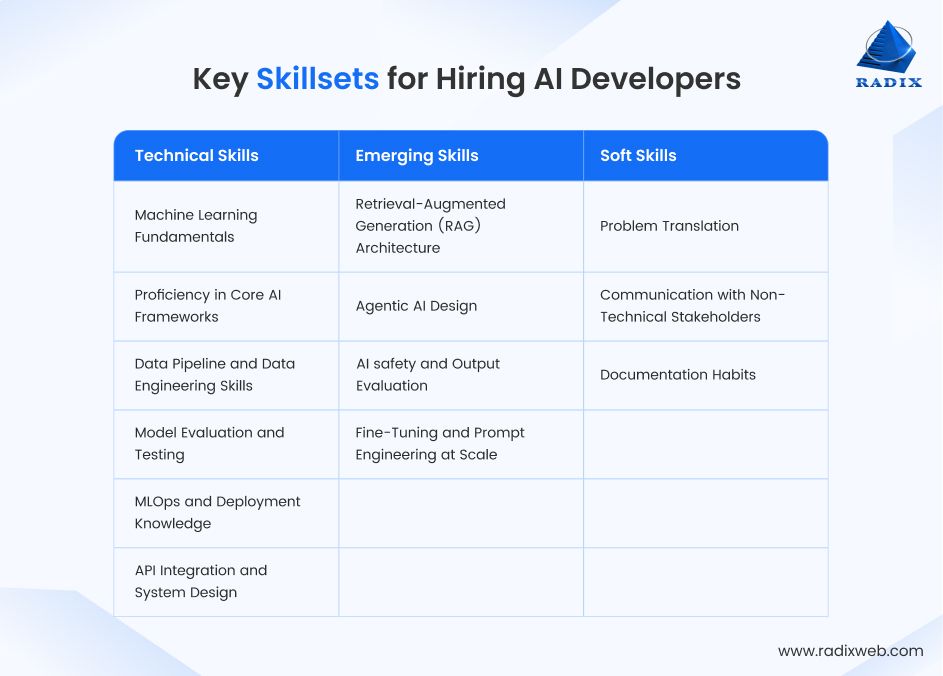
When you're evaluating technical capability, here's what to look for:
Machine learning fundamentals
An understanding of supervised, unsupervised, and reinforcement learning tells you whether a developer can select the right approach for a problem, or they'll default to the same model.
Proficiency in core AI frameworks
PyTorch, TensorFlow, Hugging Face or LangChain - the choice of AI programming language and framework should match your project's requirements, not the developer's comfort zone.
Data pipeline and data engineering skills
A developer who can't work with messy, real-world data is only half-equipped for production. Expertise in data analytics techniques is thus, important.
Model evaluation and testing
Understand if they can set up proper evaluation frameworks, interpret metrics beyond accuracy, and catch failure modes before they reach users.
MLOps and deployment knowledge
When you hire AI developers for enterprise projects, MLOps experience is especially non-negotiable for deploying models, monitoring them, and managing drift over time.
API integration and system design
Most enterprise AI projects involve connecting models to existing systems. Understanding how AI agents, chatbots, and LLMs interact with your broader architecture matters more than pure modelling skill.
In AI projects, the gap between what a model does and what a business needs is wide. To bridge that, look for the following soft skills:
Problem translation
The ability to take a business problem and define it precisely enough that it can be solved with data and code.
Communication with non-technical stakeholders
An AI developer who can only talk to other engineers is a liability on any project that touches a product team, a legal team, or a C-suite. Accountability for AI decisions sits with the business, not the model, which means someone has to translate between the two.
Documentation habits
On long-running or enterprise projects, poor documentation is a hidden project killer. A developer who documents their model choices, data assumptions, and evaluation decisions is protecting your investment.
These aren't universal requirements yet. But AI developers for projects in 2026 and beyond should have at least a basic understanding of these.
Retrieval-Augmented Generation (RAG) architecture
As enterprises move from generic LLMs to grounded, company-specific AI systems, RAG has become a foundational pattern.
Agentic AI design
AI agent development is moving from experimental to production across industries. Understanding how to design multi-agent AI systems that are reliable, auditable, and controllable is a genuinely emerging specialization.
AI safety and output evaluation
Developers working in regulated industries or customer-facing applications need structured approaches to output quality, bias detection, and failure handling.
Fine-tuning and prompt engineering at scale
Developers who understand when and how to fine-tune existing models and how to do it efficiently often deliver faster and cheaper outcomes.
The companies that hire well don't just have a better process. They start earlier and think more carefully before they open a role. Here's how you can do it right.
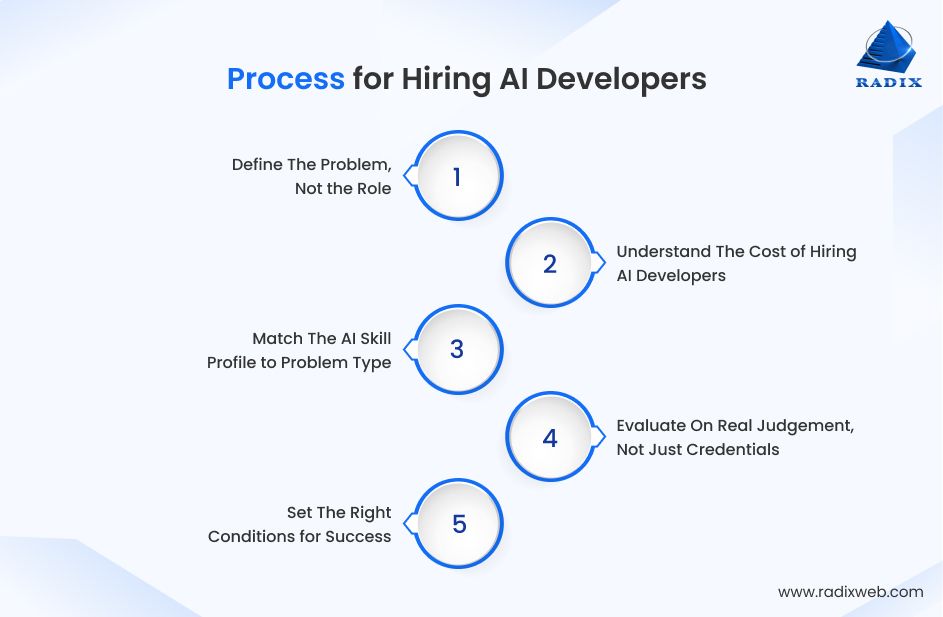
Before you write a job description, write down the specific business outcome you're trying to achieve. Not "we want to use AI." It should be something like "we want to build an AI software solution to reduce time spent on manual invoice review by 60%" That specificity determines the skills you need, the engagement model that fits, and the kind of developer who will actually succeed in the role. Skipping this step is often becomes the cause of AI project failure.
The total cost of AI development varies significantly by engagement model and level of expertise. Broadly:
Important: Don’t default to the cheapest option without accounting for coordination overheads, ramp-up time, and level of expertise required.
A developer who can integrate AI into your existing system isn’t someone who will also be able to develop an AI chatbot for you or scale your prototype to production. So, make sure you don’t treat all developers as interchangeable and specify the AI discipline for your project.
AI credentials like certificates are essential. But you need to understand that an AI software developer with 5 certificates and no exposure to production systems is less valuable than one with three years of hands-on AI intergration experience, even without certificates. So, make sure you ask about their real project experience.
The artificial intelligence developer you hire is only as effective as the environment you build for them. That means offering them:
Understanding potential AI use cases for your specific context is what separates projects that ship from projects that stall.
Mistakes in hiring AI developers for startups or enterprises aren’t just costly but also hard to undo. Here are the 6 fatal mistakes to avoid:
| Mistake | What Goes Wrong | How to Avoid It |
|---|---|---|
| Hiring for AI hype, not AI fit | Developer ships a model that solves nothing the business actually needs | Define the outcome before you define the role |
| Evaluating on tools, not thinking | Technically credentialed hires who can't navigate real-world ambiguity | Design your evaluation around judgment, not tool familiarity |
| Ignoring MLOps until post-launch | Model degrades silently in production, no one notices until damage is done | Require MLOps experience in the profile for any production-bound project |
| Hiring a developer when you need a team | Developer becomes a bottleneck; project timelines collapse | Be honest about project complexity |
| Skipping data readiness assessment | Project stalls in data cleaning for months; developer is blocked | Audit your data before the hire, not after |
| Setting no accountability framework | Poor decisions get attributed to the model rather than owned by the business | Understand how enterprises should own AI outcomes |
Avoiding these mistakes when hiring AI developers will help prevent roadblocks, save costs and ensure greater efficiency throughout the development process.
Hiring AI Developers with Radixweb
The AI developer market will continue to grow. Over time, the gap between supply and true capability will narrow. But that moment hasn’t arrived yet. Right now, the companies that move thoughtfully and hire dedicated AI developers will get a definitive edge.At Radixweb, we've been building AI systems for enterprise clients long enough to know that the hire itself is only the beginning. What matters is how the AI developer understands your problem, how quickly they can operate in your environment, and what happens when the project evolves.So, if you want to capitalize on the AI market today, schedule a no-cost consultation with our AI experts to understand what kind of AI talent your project truly requires and how to hire it the right way.
Ready to brush up on something new? We've got more to read right this way.