Read More


Recognized for AI Excellence at 2026 Globee® Awards - Read More

Anand Trivedi
Why You Should Read This Article: As organizations are now trying to connect multiple AI systems, data sources, and workflows together, that changes how enterprise technology needs to be built. This article breaks down why composable AI is becoming important for businesses already using AI or planning to scale their AI ecosystem in the near future.
TL:DR
● Composable AI uses modular services, APIs, and agents instead of monolithic systems● Enterprises gain faster deployment using reusable AI components in workflows● Four core layers: data integration, AI services, orchestration, experience APIs● Best use cases include faster customer service resolution and self-healing data pipelines● Main risks are integration complexity without strong governance standards● Adopt when scaling multiple AI use cases and avoid for single, stable applications
Composable AI systems are a modular way to build enterprise AI, where reusable components such as models, APIs, data services, and agents are orchestrated into workflows. In enterprise architecture, this approach helps teams build, integrate, and scale AI capabilities without creating rigid platforms or rebuilding the entire stack.
The current rate of AI adoption is exceeding what traditional architectures were designed for. Enterprises are paying attention to this noticeably, rising from their need for more speed, less vendor lock-in, stronger governance, and a way to reuse AI capabilities across business units without creating fragile one-off solutions.
On the ground, composable AI gives organizations a more flexible path to experiment with AI and keeps control over data, security, and change management.
To understand why this model is gaining momentum, we’ve broken down how composable AI works, where it fits in enterprise environments, and what it means for architecture, governance, and long-term scalability.

Composable AI systems have AI capabilities as modular AI components rather than monolithic blocks. Models, APIs, and AI agents are wrapped as independent services, and organizations can assemble and reconfigure them to solve particular business problems without rewriting core systems.
This design approach differs from generic AI as the latter offers one-size-fits-all tools. Composable AI allows teams to select best-of-breed components and customize them to their unique needs.
It also differs from traditional microservices that focus on software logic, as composable AI specifically focuses on orchestrating AI model outputs, data access, and intelligent agent workflows.
Composable AI functions use AI capability as a reusable service that enterprises centrally orchestrate for consolidated workflows. You design and system lays out incoming data to the appropriate AI service and manages the output flow with governance and observability in all active modules.
The fundamental tension between the need for rapid innovation and the necessity of enterprise-grade control is the inevitable reason organizations are getting increasingly invested in composable AI system architecture.
AI, from a series of fragile, isolated experiments and prototypes, becomes a foundation for custom enterprise systems that organizations can rely on and scale.
Rigid monolithic platforms are failing to keep pace with modern enterprise needs where AI experimentation and multi-vendor strategies are now the baseline. With growing data complexity, these legacy systems act as bottlenecks.
While 62% of organizations are already experimenting with AI agents, most of them, at the same time, struggle to integrate new intelligence or adapt to changing demands in the market without massive, costly overhauls.
It aligns technology decisions with business priorities such as speed, adaptability, and risk control. Key advantages include:
For example, a customer service workflow can be composed of different modules like an intent classification service, a sentiment analysis tool, and a knowledge base agent. If a new, more accurate intent model replaces the old one, the team simply swaps that single module. The rest of the workflow remains operational.
From an engineering and architecture standpoint, composable AI for enterprises introduces structural advantages that address long-standing system constraints.
Gartner states that demand for agentic AI is driving organizations toward composable architecture for faster integration and orchestration.
This type of AI-driven enterprise architecture aligns naturally with cloud-native principles. It depends on the mature API economy to connect to disparate services. Hence, leveraging cloud-native infrastructure, enterprises can treat AI services as manageable, scalable endpoints that exist independently of the core application code.
Monolithic AI represents a legacy approach where most intelligence, data processing, and workflow logic are consolidated into one single, massive system. In contrast, composable architecture takes an innovative approach to modernize legacy systems with AI capabilities. It breaks these functions into interchangeable modules and treats AI as a collection of services rather than a single black box.
This is a fundamental shift in how enterprises build and maintain their intelligence layer.
Monolithic systems require deploying the entire stack at once; composable systems allow for the independent deployment of specific AI services.
Composable AI allows teams to mix and match the best tools for the job, whereas monolithic systems lock the user into the provider's native capabilities.
Monolithic AI relies on rigid, system-wide controls, but secure composable AI enables flexible, centralized policies that govern modular services without stifling developer speed.
Here's a comparison table on monolithic AI vs composable AI:
| Comparison Aspect | Monolithic AI Architecture | Composable AI Architecture |
|---|---|---|
| Architecture | Single, tightly coupled | Modular, loosely coupled |
| Change speed | Single, tightly coupled | Fast and incremental updates |
| Vendor model | Single vendor dependency | Multi-vendor, on of breed |
| Governance | Centralized and rigid | Central policies over modular services |
| Use case fit | Stable, narrow domains | Dynamic, multi-workflow environments |
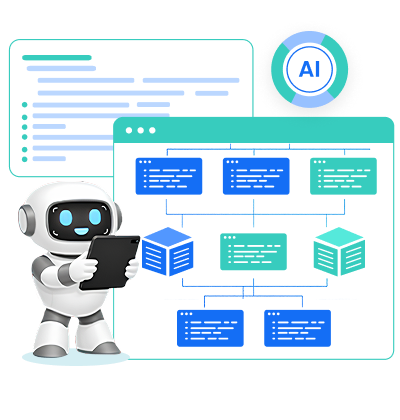
A composable AI system for enterprise architecture relies on distinct, interoperable layers or components:
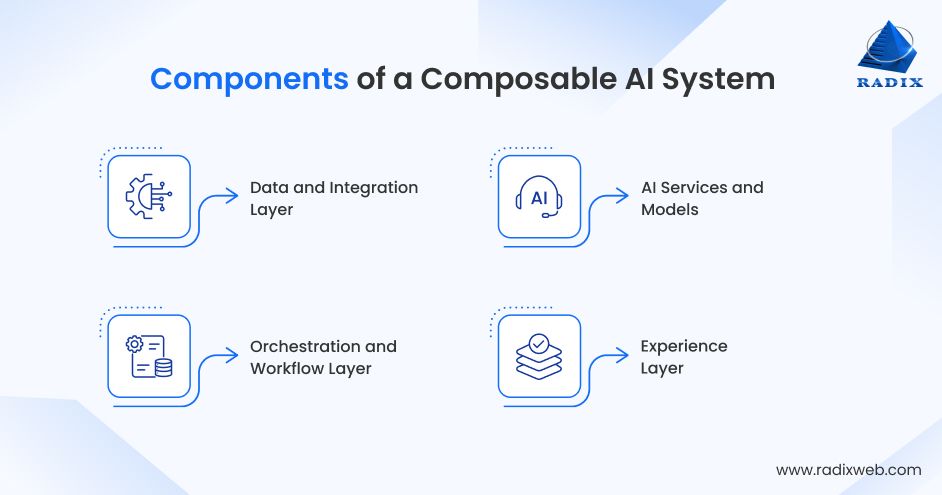
This foundational layer provides the essential data access, governance, and connectivity required to feed AI models with accurate, real-time information. AI models are integrated with enterprise systems like ERP, CRM, and enterprise data warehouses. Data remains secure and compliant while being accessible to the services that need it.
This is the “intelligence” layer of the system. Different models here are wrapped as standardized services that other modules can consume. It treats models as services, and teams can easily swap a general-purpose model for a specialized one as per the requirements of the enterprise.
The orchestration layer acts as the brain, using agent frameworks or specialized orchestrators to connect individual steps, maintain conversation or task context, and trigger the appropriate tools.
The experience layer serves as the final integration point. The intelligence generated by the underlying components becomes accessible to users and other systems.

Automating complex customer service resolutions, optimizing ERP procurement processes, or building self-healing data pipelines are some of the real use cases of composable AI. Considering the increasing number of AI use cases across various industries, composable architecture is gaining traction.
In modern contact centers, composable AI enables intelligent process and automated workflow-based solutions from reactive support systems. Services are composed of intelligent routing, multi-modal triage, real-time knowledge retrieval, and AI-driven summarization. Enterprises can scale support capacity and maintain a high-touch human experience.
AI-powered composable architecture delivers the agility needed to implement large-scale ERP systems. Using this architectural design approach, enterprises can integrate procurement, demand forecasting, and anomaly detection as modular, plug-and-play services. There's no need to replace legacy ERP systems, as these AI modules act as intelligent layers that augment existing workflows.
Data teams are leveraging composable AI services to automate the entire data lifecycle. Since it can decouple tasks, organizations create modular, repeatable AI pipelines that can be updated independently to adapt to changing data requirements. This approach aligns closely with modern data analytics solutions for enterprise-scale ecosystems.
Given how AI is evolving in financial services industry, composable AI is becoming an obvious architectural choice. It automates complex loan processing workflows. Combining modules for document verification, credit scoring, and compliance checking, banks can accelerate lending decisions and adhere to financial regulations.
For healthcare organizations, composable AI systems support clinical workflows by integrating specialized diagnostic AI, electronic health record (EHR) data retrieval, and patient risk stratification. as AI-powered healthcare solutions are being modularized, hospitals can make sure that diagnostic AI remains independent of EHR updates.
Composable AI reduces rigidity, but it also introduces the risks if the architecture is not governed well. The biggest challenge of composable architecture is that many small services can become harder to manage than one large system when integration standards, ownership, and version control are weak.
The most prevalent composable AI architecture challenges include:
Determining when to adopt composable AI requires assessing your current architectural maturity and the velocity of your business requirements. While modularity offers significant long-term flexibility, it is not a one-size-fits-all solution. Understanding whether composable AI is right for your enterprise starts with evaluating your specific integration capabilities and innovation goals.
You should consider moving toward enterprise composability with AI if:
In certain scenarios, the overhead of managing a composable architecture may outweigh the benefits. You may be better served by a monolithic or platform-based approach if:
This matrix helps determine the recommended architectural approach for composable AI based on your project needs:
| Complexity Level | Low Change Frequency | High Change Frequency |
|---|---|---|
| Low Complexity | Monolithic AI | Single Platform AI |
| High Complexity | Single Platform AI | Composable AI |
For organizations asking how to implement composable AI, a phased approach reduces risk while building internal capability. The goal is to move from isolated use cases to a well-defined, reusable AI ecosystem that is in line with enterprise architecture.
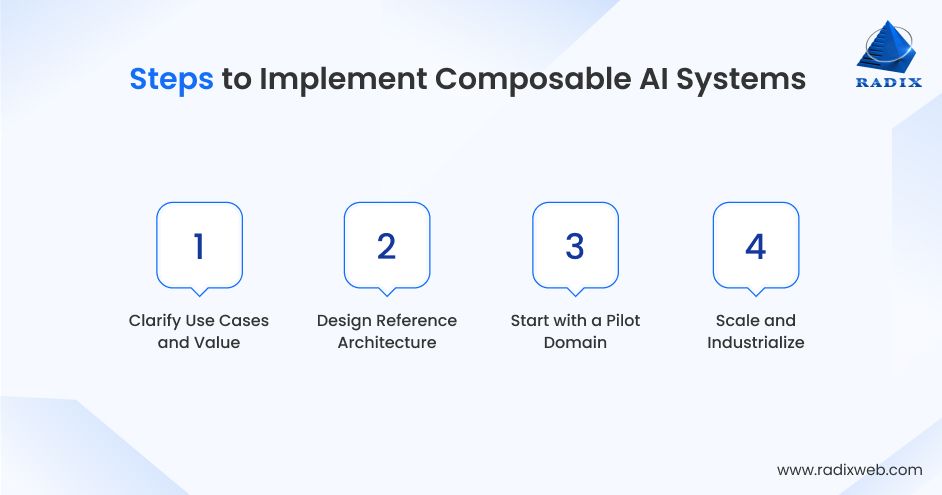
Successful adoption begins with identifying high-impact areas where modularity provides immediate business value. Prioritization should focus on business-aligned goals rather than just technical convenience. The initial investment in a composable framework yields measurable ROI quickly.
Building a scalable architecture involves establishing a common blueprint that all future modules must adhere to. This ensures that as your adaptive enterprise systems grow, they remain interoperable, secure, and easy to manage.
Pick one specific domain, such as customer service or internal procurement, to build your first end-to-end composable stack. This allows the team to learn how to orchestrate services in a live environment as well as minimize risk to the rest of the enterprise architecture.
Once the pilot domain is proven, transition the framework into an enterprise-wide platform. This phase focuses on turning individual workflows into reusable shared assets that other teams across the organization can discover and implement for their own needs.

Most organizations we talk to have already invested in AI in some form. The honest reality is that those investments rarely connect to each other, and even more rarely connect to the broader business in a way that produces compounding value over time.
Individual tools get deployed, teams adapt around them, and before long you have a fragmented landscape that is harder to govern than the problem it was meant to solve.
What Radixweb brings to that conversation is architectural discipline. We work with enterprise leadership to understand how AI should actually fit into the way the business runs, not as a layer on top of existing operations, but woven into the decisions, workflows, and data flows that drive outcomes.
That requires a level of planning and integration rigor that most AI vendors are not structured to provide.
Our work covers the full scope of what makes AI viable at scale:
We stay close to the practical side throughout. Deployment timelines, stakeholder alignment, and compatibility with the systems your teams already depend on are not afterthoughts in our process. They are central to how every engagement is structured from the beginning.
The organizations that get lasting value from AI are the ones that treat it as an architectural decision. If that is the conversation your leadership team is ready to have, we are glad to be part of it.
Your Next Step Toward a Smarter AI Ecosystem
The next step is straightforward. If your organization is at the point where AI capability is no longer the question, but structural coherence is, that is precisely where a focused conversation with our team adds the most value.We typically start with a working session, not a sales presentation. The goal is to understand where your current architecture creates friction, where integration gaps are slowing down execution, and where opportunities for scalable enterprise AI implementation are being constrained by disconnected systems. . From that, we can give you an honest assessment of what a composable foundation would realistically look like for your organization, including what it would take to get there and in what sequence.There is no universal blueprint for this. The right architecture depends on your existing systems, your team's capacity, and the outcomes your leadership is actually accountable for. That context shapes everything, which is why we invest time in understanding it before recommending anything.If that kind of engagement sounds like the right starting point, reach out to our team and we will set up time to talk through where you are and where it makes sense to go from here.
Ready to brush up on something new? We've got more to read right this way.