Read More


Recognized for AI Excellence at 2026 Globee® Awards - Read More

Pratik Mistry

According to recent industry data, 43% of startups fail because of poor market fit. Also, 80% of software features are rarely or never used. Together, these numbers point to the same problem: too many businesses spend months building products and features before validating whether customers actually want them. That's exactly why MVP software development has become the preferred approach for startups and enterprises alike. With an MVP, teams can validate market demand, gather real user feedback, and invest further with greater confidence.
Once founders embrace the MVP approach, the conversation quickly shifts to two questions: How long will my MVP take, and what does MVP software development cost? Generic answers and vague estimates waste your planning cycle. At Radixweb, we build investor-ready, cloud-native MVPs in 4 to 6 weeks for lean validation builds that later scaled to full-scale software product development. And we've scoped enough MVPs to know exactly where timelines stretch and budgets break. This guide gives you the stage-by-stage timeline, realistic 2026 cost bands, and the estimation method we use internally, so you can budget your MVP software development project with numbers instead of guesses.
Building an MVP isn't about launching a smaller product. It's about validating demand before committing significant time and budget. Most MVPs take 4-16 weeks and cost $15,000-$150,000+, depending on scope, complexity, integrations, and team composition. Accurate estimation starts with defining the core problem, not the complete product vision.
| Aspect | Details |
|---|---|
| What this guide covers ? | MVP development process and timeline, MVP software development cost breakdown, 2026 pricing benchmarks, estimation methodology, cost drivers, development phases, team composition, budgeting tips, common estimation mistakes |
| Who should read this ? | Startup founders, SaaS entrepreneurs, product managers, CTOs, innovation teams, enterprise decision-makers, non-technical founders, business owners planning a new digital product, investors evaluating MVP budgets |

An MVP (Minimum Viable Product) is a working version of your software product built with only the features needed to test your core business assumption with real users. MVP software development gives businesses a structured way to validate product ideas while estimating development timelines, costs, features, and resources before scaling.
The key word here is viable or working. An MVP is not a demo. It's not a sketch in Figma. It's not a landing page with a waitlist. Real users must be able to complete the core job your product promises to do. It exists to generate evidence: usage data, feedback, and early traction signals that tell you whether to invest in full-scale development or change direction.
The concept of MVPs was first popularized by Eric Ries in The Lean Startup, where he framed it as the version that produces maximum validated learning with the least effort.
These three terms – Minimum Viable Product, Prototype, and Proof of Concept – are often used interchangeably. But they are not the same, each of these answers a different question, and confusing them is the most expensive mistake in early product work.
Here's how they differ:
| Proof of Concept | Prototype | MVP | |
|---|---|---|---|
| Purpose | Prove technical feasibility | Test design and flow | Validate market demand |
| Users | Internal team | Stakeholders, test groups | Real early adopters |
| Working software? | Partially | No (clickable mockup) | Yes |
| Typical timeline | 1–2 weeks | 1–3 weeks | 4–16 weeks |
The question you're asking determines which you build.
Mixing these up costs enormous amounts of time and money. But if you have realized that you need an MVP, read on to know everything you should know about building it.
Based on the MVP projects we've scoped and delivered at Radixweb, a typical MVP takes 4 to 16 weeks from kickoff to launch. Lean validation builds on proven stacks land at the short end while compliance-heavy or AI-native products, where architecture decisions carry real weight, land at the long end.
| Lean MVP | Standard MVP | Complex MVP | |
|---|---|---|---|
| Timeline | 2–6 weeks | 6–12 weeks | 12–24 weeks |
| Typical budget | $15,000–$30,000 | $30,000–$80,000 | $80,000–$150,000+ |
| Examples | Single-flow web app, internal tool, landing + core feature | SaaS with auth, payments, dashboard | Fintech, healthtech, marketplace, AI-native product |
The real timeline driver here isn't just complexity though. It's discovery quality and platform count. A team that rushes through the discovery phase of the MVP development process, finds mid-project that their core assumption was wrong, and that eventually adds 4-6 weeks of rework. A team that supports three platforms instead of one doubles the development timeline.
Here's where the weeks actually go. Each stage below shows the average duration we see and what determines whether you hit the short or long end.
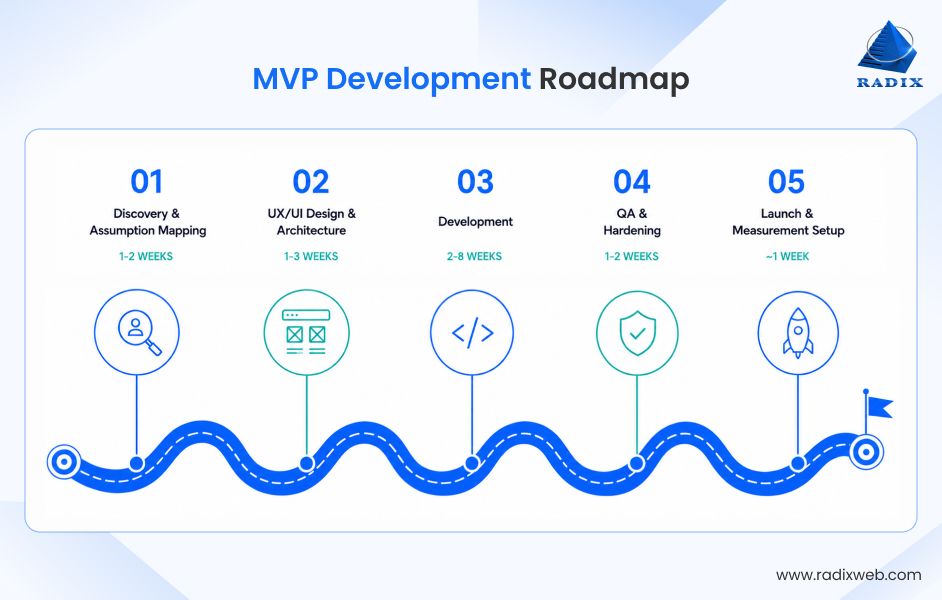
Average duration: 1–2 weeks
This is where most MVPs are won or lost. We map your riskiest business assumptions first, then design the MVP around the smallest feature set that can test them. The output is a validated problem statement, a target user definition, and a ruthless feature cut. Skipping or rushing discovery is the single biggest cause of mid-project scope changes. And scope changes are the most expensive kind of rework. A feature added mid-build costs 3x what the same feature costs if scoped upfront. When done right, the discovery phase of the software development lifecycle pays for itself in avoided rework.
Timeline drivers:
Average duration: 1–3 weeks
Designers produce wireframes for the core flow only, not every screen the full product will eventually need. In parallel, the architect makes decisions that are expensive to reverse later, like the tech stack, hosting model, data structure, and integration boundaries. Our position here is firm: cut design polish before you cut architecture quality. A rough-looking MVP that scales beats a beautiful MVP that needs a rebuild at 5K users.
Timeline drivers:
Average duration: 2–8 weeks
This is the longest stage of MVP development, and the one where complexity compounds. A single-platform web MVP with 3–5 core features sits at 2–4 weeks. Add native mobile, third-party integrations, or AI features, and you move toward 6–8 weeks.
The development phase timeline also depends on your team size. Engaging dedicated software developers to build a market-ready MVP is faster than assembling an ad hoc team in-house.
AI-assisted development tooling (GitHub Copilot, Claude, etc.) has compressed this stage meaningfully since 2024. That's why MVPs that took 8 weeks two years ago can now ship in 5–6 weeks with the same scope.
Timeline drivers:
Average duration: 1–2 weeks
A minimum viable product doesn’t mean untested. Early adopters forgive missing features, but they don't forgive a broken sign up flow. We run functional and security testing on the core path, because first impressions drive whether your validation data means anything at all. Here's what gets tested:
Timeline drivers:
Average duration: 1 week
Deployment and analytics infrastructure matter as much as the code itself. An MVP without measurement is just a small product. Define the 3–4 metrics that answer your original assumption (activation, retention, conversion) before you ship, not after. And retrofitting analytics after launch costs more time than building it in.
Here's what this stage includes:
Timeline drivers:
An MVP development process and timeline is less about speed and more about confidence. Each stage should reduce uncertainty before you invest in the next. Think of the timeline as a sequence of decisions, not a sequence of tasks. Better decisions early almost always mean faster delivery later.

MVP development costs in 2026 range from roughly $15,000 - $30,000 for a lean web build to $70,000 - $120,000+ or more for compliance-heavy or AI-native products. And the variance isn't random. It's driven by feature scope, platform count, and regulatory requirements.
Here is a breakdown of MVP development costs based on the product type:
| Product type | Typical 2026 range | Why |
|---|---|---|
| Internal tool / single-flow web app | $15,000–$30,000 | Proven stack, no compliance, minimal screens |
| Standard SaaS MVP | $30,000–$80,000 | Auth, billing, dashboard, multi-tenancy |
| Ecommerce / marketplace | $25,000–$80,000 | Payments, listings, two-sided logic |
| Healthtech | $40,000–$120,000+ | HIPAA-grade infrastructure before features. See our breakdown of building an MVP in healthcare |
| Fintech | $50,000–$150,000+ | PCI-DSS, fraud controls, banking integrations |
| AI-native product | $60,000–$150,000+ | Model integration, evals, recurring inference costs |
The figures above cover development only. The overall cost also includes certain hidden costs that most founders miss budgeting for. These include:
These costs typically add 20–40% on top of the development quote. And they aren’t optional, so budget for them upfront or you'll discover them mid-runway.
A meaningful MVP estimate starts with scope, not hourly rates or vague estimates. Below we are sharing the logic we apply when scoping client MVPs. Use the framework below to build a realistic budget based on your product's actual requirements.
Break your MVP into discrete, testable features. Not "build a SaaS tool." Specific features like:
Each feature is a unit you can estimate.
Different feature types take different amounts of time. Here are realistic bands:
These are development hours only. Testing and code review happen within these estimates.
The blended rate includes developer salary, overhead, and profit margin.
In 2026:
Pick the rate that reflects your actual team source and seniority level.
Discovery, design, architecture, project management, and deployment add roughly 30–40% on top of pure development hours. This is the work that makes development possible.
Multiply your development cost by 1.35–1.40 to get the realistic full cost.
No MVP ships exactly as planned. Budget for the first round of learning and operational costs.
Include:
Reserve 15–25% of the project budget (or up to 30% for AI-heavy or highly regulated products).
To see how the framework works in practice, here's an estimate of the cost of a typical SaaS MVP with user authentication, workspace management, subscription billing, and an admin dashboard.
| Step | Details | Example |
|---|---|---|
| 1. Development Effort | The combined effort for all features | 305 hours |
| 2. Apply a Blended Hourly Rate | Assuming a blended rate of $45/hour, covering developers, code reviews, and standard QA | 305 × $45 = $13,725 |
| 3. Add Delivery Costs | Typical allocation of 35% of development cost | +$4,804 |
| Subtotal | Total cost to design, build, test, and launch the MVP | $18,529 |
| 4. Post-Launch Budget | 25% for hosting, monitoring, bug fixes, analytics, and the first round of product improvements after launch | +$4,632 |
| Estimated MVP Budget | Total estimated investment for the MVP | ≈ $23,200 |
| Estimated Timeline | Typical delivery time for an MVP of this scope | 7–9 weeks |
This is a real, defensible MVP software development cost estimate you can put in front of investors, not a random range pulled from theory.
When you collect quotes, demand this same structure back. A trustworthy MVP quote itemizes by phase, names the team roles, and ties payments to milestones. A single flat number with no breakdown is a red flag.

Timelines and budgets for developing a minimum viable product break for consistent reasons. Understanding them upfront lets you make conscious trade-offs during the MVP development process. Here are the key factor that result in timeline delays and budget stretches:
This is the #1 timeline killer. By week 3 of development, your team has already made structural decisions around data flows, authentication, and integrations. When you add a feature after that, it's not just "write new code." It means rewiring existing code. That's why a feature scoped upfront takes 20 hours. The same feature added mid-build takes 60 hours and costs 3x. This is compounding, not linear.
A ruthless discovery phase that front-loads the hard questions is the easiest defense against scope creep.
HIPAA, PCI-DSS, GDPR, and industry-specific regulations aren't features you bolt on. They shape data design from day one. A standard SaaS MVP might take 10 weeks. A healthtech MVP with HIPAA requirements takes 16+ weeks because the entire infrastructure, including encryption, audit logging, data residency, and access controls, has to be designed correctly from the start.
Also, compliance doesn't add time linearly. It multiplies across every stage. Budget 30–50% additional time and cost if compliance is in scope.
Single platform (web-only) is fastest. Cross-platform mobile adds 30–40% to the timeline. Two native apps nearly doubles effort.
But here's the nuance: one codebase (React Native, Flutter) for iOS and Android is almost always cheaper and faster than two native apps, unless you have very specific performance or platform-specific requirements.
A team missing a critical skill completes tasks slower and does rework. Missing DevOps expertise? Deployment takes twice as long and introduces production issues later. Missing security expertise? You'll build it insecurely and spend weeks fixing it post-launch. Missing AI/ML experience? That "simple" ML feature becomes 200 hours of trial and error.
This is the strongest practical argument for engaging an experienced team over assembling one ad hoc, especially when startups need to ship software on a fixed runway.
App store reviews, API approval processes, vendor onboarding, and payment processor verification add calendar time you don't control. App store review can take 1–5 days. A new payment processor might take 2–3 days to approve your account. A third-party API might require manual approval to increase rate limits. These dependencies don't compress. You have to sequence them early and plan for delays.
The more uncertainty you eliminate before development begins, the more predictable your timeline and budget become. That's why planning remains the highest-return investment in any MVP.
Here's something most agencies and MVP development companies won't say out loud: not every idea deserves an MVP. If your riskiest assumption can be tested with a landing page, a waitlist, or a manual concierge process, building software first is wasted runway. We've advised prospects to delay development more than once, because an MVP that validates nothing is the most expensive kind of cheap.
Build the MVP when the following three conditions hold:
Until all three conditions hold, test cheaper first.
The faster you launch your MVP, the faster you start getting user feedback and the closer you get to revenue and ROI. But speeding up the MVP development process isn’t about asking the team to work faster. It's about removing unnecessary work, reducing rework, and focusing development effort on the features that validate your product idea. Here's what you can (and should) do for faster MVP development:
Teams under deadline pressure skip discovery or QA. But that's the wrong move. You should cut the feature list instead. Shipping 3 reliable features in 6 weeks beats shipping 7 unreliable features in 8 weeks.
Frameworks with mature component ecosystems and pre-built components eliminate weeks of plumbing work. Custom-build only what differentiates you. For everything else, use the shelf solution.
One codebase for iOS and Android (React Native, Flutter) beats two native builds for nearly every MVP scenario. The only exception is if you need very high performance or deep platform integration.
Short iterations surface problems while they're still cheap to fix. Stakeholder feedback at week 2 saves rework at week 8. Continuous integration and automated testing for your software MVP is how you compress timelines without sacrificing quality.
Validation speed depends on data quality. Retrofitting analytics after launch costs more than building it in. So, define your 3–4 core metrics in discovery and build them into the product during development.
The fastest MVPs are built with discipline, not shortcuts. Preserve the stages that reduce risk, eliminate everything that doesn't support validation, and you'll reach the market sooner with fewer surprises.

Start with the Right MVP Estimates
Developing an MVP before full-scale product launch delivers the best results when it's driven by clear assumptions, realistic estimates, and measurable goals, not by the lowest budget or the shortest timeline. So, get the timeline and budget right before the first line of code and everything downstream, from investor conversations and team planning to the decision of what to build next, gets easier.At Radixweb, we've spent 26+ years helping startups, scale-ups, and enterprises turn product ideas into production-ready software. Whether you're building a SaaS platform, AI-powered application, marketplace, or enterprise product, our cross-functional teams help you reach the market faster without accumulating technical debt you'll pay for later. And if you're evaluating an MVP, schedule a no-obligation scoping consultation with our team. You'll leave with a realistic timeline, a transparent cost estimate, a recommended technology approach, and a prioritized feature roadmap, whether you choose to build with us or not.
Ready to brush up on something new? We've got more to read right this way.