

Read More


Recognized for AI Excellence at 2026 Globee® Awards - Read More

Anand Trivedi
Health insurance claims processing lives in constant tension. Claims need to move faster, but teams are already drowning in manual work. Legacy systems built in 2008 or 2012 keep the lights on. But underneath that surface stability lies a mess.
We worked with a US-based health insurance company facing this exact challenge. Their contact center was running on legacy infrastructure that couldn't scale, couldn't integrate with modern communication channels, and forced their team to spend 420+ minutes handling a single case, seven hours of effort that should have taken two. Their claims processing operations faced the same bottlenecks, just with different consequences. After modernizing their infrastructure to the cloud and rebuilding their systems around modern architecture patterns, they cut case handling time to under three hours and increased first-call resolution by 33.5%.
Cloud infrastructure modernization for health insurance claims processing, thus, upgrades legacy systems and infrastructure to improve workflows, integration, and scalability. Below we explain why legacy systems slow down health insurance claims processing, what cloud infrastructure modernization changes, and how to build a practical roadmap that works for your organization.
Legacy claims systems slow processing because batch jobs, tightly coupled applications, siloed data, brittle integrations, fixed infrastructure, and limited analytics make every decision dependent on yesterday's architecture. Cloud modernization replaces these constraints with scalable infrastructure, accessible data, APIs, modular services, event-driven workflows, and AI-ready foundations. The goal is not simply moving claims to the cloud. It is reducing the infrastructure friction that keeps claims moving slowly.
| Aspect | Details |
|---|---|
| What does this guide cover? | Why legacy infrastructure slows claims, what cloud modernization changes, architecture patterns for faster processing, migration strategies, practical roadmaps, evaluation criteria, ROI impact, and FAQs on cost, timeline, and downtime |
| Who should read this guide? | CIOs, CTOs, Chief Operations Officers, Claims Department Directors, Insurance Technology Leaders, Finance Leaders evaluating infrastructure investment, Enterprise Architects planning modernization |
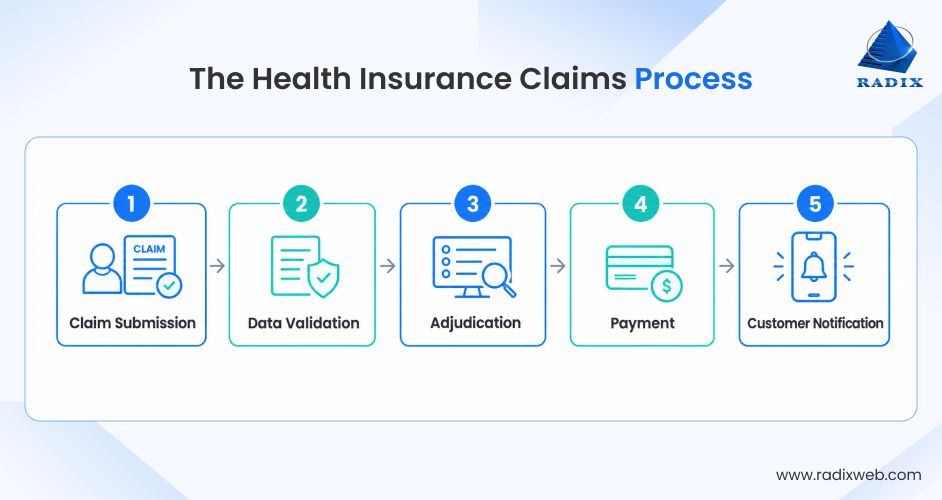
Claims processing involves several steps, from eligibility and provider validation to fraud checks, payment, and customer communication.
Legacy infrastructure can handle these tasks, but the way it is built often makes claims slower, harder to change, and harder to scale. These legacy system challenges in health insurance claims processing become more visible as claim volumes increase, integrations multiply, and insurers introduce new digital services.
Understanding how legacy systems slow down insurance claims processing requires looking beyond the claims application itself and examining the infrastructure, data flows, integrations, and operational dependencies surrounding it.
For insurers evaluating why legacy infrastructure delays claim adjudication, batch dependencies are often one of the clearest places to look because a technically successful process can still create unnecessary waiting time due to scheduled batches. Modern cloud architecture with event-driven processing ensures that submitting/validating a claim automatically triggers the next workflow.
In a monolithic claims application, functions such as eligibility, validation, payment, and reporting may depend on the same application. This is a common concern in legacy insurance system modernization, where years of accumulated dependencies can make even relatively small application changes difficult to isolate. Modernizing a legacy business system separates these functions into modular services that can be changed, deployed, and scaled independently. This makes it easier to improve one part of claims processing without disrupting the entire platform.
Legacy claims data often sits across separate systems, making it difficult to get a complete view of a claim. Employees may need to search multiple systems or move information manually. These healthcare legacy system bottlenecks can affect everything from claims validation to fraud review. Modern data architecture connects these sources and uses the right data platform for each workload. This gives claims teams and applications faster access to the information they need.
Legacy systems often rely on direct connections between the claims platform and every external system. These dependencies create serious health insurance system integration challenges making integrations difficult to maintain and can cause one system's failure to affect the wider workflow. APIs and event-based integration create more flexible connections, allowing systems to exchange information without being tightly dependent on one another.
Claims volumes can change significantly during enrollment periods or other peak periods. Legacy infrastructure has fixed capacity, which means it can become overloaded when demand increases. Cloud-based modern insurance technology infrastructure can scale resources up when workloads rise and down when demand falls, helping maintain performance without running peak capacity all year.
As the use of artificial intelligence in the insurance industry expands, insurers also need infrastructure that can support AI-native workflows. But legacy systems make it difficult to access current data across claims, providers, and other sources. That limits real-time analytics and makes it harder to deploy AI for fraud detection, document processing, claims classification, and routing. Modern cloud infrastructure provides the data pipelines, scalable computing, and production environment needed to bring these capabilities into the claims workflow.
Each modernization change addresses a specific legacy limitation. And together, these changes create a claims platform that is faster to process, easier to change, easier to scale, and better prepared for analytics and AI.
This is one of the top benefits of cloud modernization for insurance claims processing. It is not simply moving the existing claims system to the cloud. It is changing the underlying architecture so the claims operation can perform better today and adapt more easily to what comes next.
No. Cloud modernization does not automatically mean rebuilding the entire claims platform.
The right way to approach the modernization of legacy healthcare applications depends on how much of the existing system still works, where the biggest constraints are, and how much change the business can absorb.
There are five common modernization approaches, ranging from simply moving the existing system to cloud infrastructure to replacing it entirely. A sixth strategy, the strangler pattern, can help insurers make that transition gradually.
The important question here is how much of the existing platform should change.
| Approach | What It Means | Best For |
|---|---|---|
| Rehost | Move the existing claims application and database to cloud infrastructure with minimal changes. | Organizations that need quick cloud adoption or need to exit on-premises infrastructure. |
| Replatform | Move to cloud while making targeted improvements, such as adopting a managed database or optimizing specific workloads. | Insurers with identifiable infrastructure or performance bottlenecks that do not require major application changes. |
| Refactor | Modify the existing code and application structure without completely rebuilding the system. | Claims platforms where the business logic and data model remain useful, but the application structure limits scalability or performance. |
| Re-architect | Redesign the platform around modern architecture and rethink how claims, data, integrations, and workloads operate. | Legacy systems whose fundamental architecture no longer supports current business and processing requirements. |
| Replace | Implement a commercial claims platform and migrate data and processes to it. | Insurers whose requirements closely match an available commercial product and do not require extensive customization. |
These health insurance legacy system modernization strategies allow insurers to match the depth of change to business priorities, technical constraints, risk tolerance, and available investment.
So, modernization does not have to mean “replace everything at once.” The approach determines how much of the legacy platform changes and how the transition happens.
Once you decide how much to change during cloud modernization for health insurance, the next question is what modernized architecture should look like.
This is where cloud architecture patterns come in. These patterns define how applications communicate, how claims move through workflows, how data is stored, and how individual workloads scale.
In other words, the previous section answers “How do we modernize?” This section answers “What should the modernized platform be built like?”
APIs create a standard way for the claims platform to exchange information with provider networks, member portals, employer systems, medical records platforms, and other applications.
| Aspect | Key Details |
|---|---|
| Key features | Standard APIs for claims submission, eligibility, status, and communication |
| Pros | 1. Makes integrations easier to add and maintain 2. Allows internal systems to change without disrupting connected applications |
| Cons | Requires strong API security, governance, and version management |
| Best for | Insurers connecting multiple internal and external healthcare systems |
Instead of waiting for scheduled batch jobs, claims can trigger events as they move through each stage. Submission can trigger validation, validation can trigger fraud checks, and approval can trigger payment.
| Aspect | Key Details |
|---|---|
| Key features | Event-based workflows, asynchronous processing, event logs |
| Pros | 1. Reduces dependence on batch processing 2. Lets individual workloads scale independently |
| Cons | Distributed workflows can be more complex to monitor |
| Best for | High-volume claims environments where processing steps need to happen independently |
The claims platform can be divided into services for eligibility, validation, medical necessity, payments, and notifications rather than keeping everything inside one application.
| Aspect | Key Details |
|---|---|
| Key features | Independent services, deployment, scaling, and ownership |
| Pros | 1. Changes can be made without redeploying the entire platform 2. High-demand services can scale independently |
| Cons | More services increase operational complexity |
| Best for | Large claims platforms that need frequent changes or selective modernization |
With a cloud-native app developed for insurance, different workloads can use data stores suited to their requirements. Transactional claims data, real-time eligibility lookups, documents, analytics, and fraud analysis do not have to compete for the same database resources.
| Aspect | Key Details |
|---|---|
| Key features | Specialized databases, caching, document storage, analytics environments |
| Pros | 1. Optimizes different workloads for their specific needs 2. Prevents analytics and large-scale processing from slowing transactions |
| Cons | Multiple data stores increase governance and integration requirements |
| Best for | Insurers handling high transaction volumes alongside analytics, documents, and fraud detection |
When cloud infrastructure supports scalable AI operations, features like fraud detection, claims routing, or decision support can be added to the insurance software, beyond experimentation. That means data pipelines, model deployment, monitoring, and retraining capabilities also need to be designed.
| Column 1 | Column 2 |
|---|---|
| Aspect | Key Details |
| Key features | Model pipelines, production deployment, monitoring, retraining |
| Pros | 1. Makes AI easier to move into production 2. Supports continuous model improvement |
| Cons | Adds data, governance, and model-management requirements |
| Best for | Insurers building AI into fraud detection, claims routing, risk assessment, or decision support |
Overall, it is important to understand that modernization is less about rebuilding everything and more about making deliberate architectural decisions based on business priorities, processing bottlenecks, risk, and the condition of the existing platform.

Knowing that your claims infrastructure needs modernization is one thing. Knowing where to start, what to change first, and how to measure the results is another. A practical roadmap starts with the current state, focuses investment on the biggest operational problems, and moves toward modernization in manageable phases.
For insurers considering how to modernize legacy health insurance systems, the first step is to document how a claim actually moves through your organization. Trace every system, team, integration, and manual step involved. Look beyond the standard path. Include situations such as unclear eligibility, medical necessity reviews, fraud flags, or delays from external systems. Record how long each step takes and where claims wait.
This gives you a clear baseline and often reveals problems that are difficult to see from individual systems alone.
Once the workflow is mapped, identify what is slowing the workflow the most. Focus on problems that have a measurable operational impact, such as batch-processing delays, manual data entry, failing integrations, slow systems, or infrastructure that struggle during peak volumes.
While assessing legacy insurance infrastructure limitations, also measure each problem. Knowing how many claims are affected, how much time is lost, or how often an integration fails helps determine what deserves attention first.
You do not need to modernize the entire claims platform at once. Start with the components where improvement will have the greatest effect. Claims intake and validation are often strong starting points because they determine how quickly claims enter the processing workflow.
A targeted approach can also reduce insurance legacy system technical debt by addressing the components that create the greatest maintenance burden. Also, modernizing one high-impact component first creates an early result and gives your teams a chance to validate the approach before expanding it.
Before introducing new services, establish the infrastructure they will depend on. This includes identity and access management, security controls, APIs, databases, messaging, monitoring, logging, and analytics capabilities.
A strong foundation for cloud infrastructure modernization for health insurance claims prevents individual projects from becoming disconnected systems. It also gives future services a consistent environment in which to operate, integrate, and scale.
With the foundation in place, gradually introduce modern services around the legacy claims system. The strangler pattern can help here. A new service can take over one capability, such as claims validation, while the legacy system continues handling the rest.
This approach is particularly helpful in reducing migration risk when modernizing insurance claims systems for better performance, as it allows improvements without complete platform replacement.
Modernization should be measured by operational improvement, not simply by how much technology has changed. Track metrics such as processing time, claims handled per hour, manual intervention, integration reliability, and performance during peak demand.
Outcome metrics related to reducing claims processing time through cloud modernization should be measured from the baseline claim lifecycle rather than simply measuring infrastructure performance. If one bottleneck disappears but another emerges, the measurements show where the next improvement should happen.
A successful modernization roadmap does not end when the first services move to the cloud. It creates a repeatable way to identify bottlenecks, modernize high-impact capabilities, measure results, and move to the next priority.
This continuous approach supports cloud modernization strategies for health insurance companies that need to balance transformation goals with operational continuity and long-term investment planning.
Modernization decisions should start with a clear understanding of what you already have. Before choosing an approach, evaluate the architecture, data, integrations, security requirements, migration risks, and future AI needs.
Note: If your roadmap includes developing need-specific healthcare software solutions, data accessibility should be evaluated early because new applications will depend on reliable access to claims and related healthcare information.
These evaluations should be done before you start the development of any healthcare software solution so that modernization can become a realistic plan. They reveal where complexity exists, what could increase costs, which risks need to be managed, and what capabilities the future architecture must support. With this understanding, insurers can choose a modernization approach that fits their current systems while supporting their longer-term claims processing goals.
The value of cloud modernization is ultimately measured by what changes in the business. Faster claims, lower operating costs, reduced manual work, and better infrastructure utilization can all contribute to ROI. The key is establishing a baseline and measuring how modernization changes these outcomes. Here's how to think about ROI.
Maintenance, database tuning and performance monitoring are some of the common operational costs of legacy insurance systems. Cloud-managed services and modern application architectures can reduce this burden.
Quantify it: How many person-hours per month does your team spend maintaining the legacy system? A modernized system might reduce this by 30-50%. For a team spending 200 hours per month on maintenance, that's 60-100 hours recovered per month. At an average cost of $75 per hour, that's $54,000-$90,000 per year recovered.
Legacy systems can make even routine changes expensive and slow. One of the ways how cloud modernization improves health insurance claims processing is with modern architecture that allows claims rules, integrations, and services to be updated more independently.
Quantify it: How many times per year do you need to make changes to claims processing logic? Each change that now takes a day instead of a month saves 3-4 weeks of effort. If you make 6 major changes per year, that's 18-24 weeks saved. At $150 per hour, that's $100,000-$140,000 per year.
When evaluating how cloud modernization improves health insurance claims processing, faster processing and better data availability are important metrics that help improve customer experience and retention.
Quantify it: What's the churn impact of a one-week improvement in claims processing time? For a health insurance company with 100,000 members and 5% annual churn, a 2% improvement in retention is 1,000 additional members. At an average customer lifetime value of $5,000, that's $5 million.
Modernizing health insurance claims processing infrastructure makes it easier to adopt new capabilities, integrate technologies, and respond to changing business needs.
Quantify it: What's the cost of losing innovation capability? If competitors are implementing AI-driven claims decisions while you still rely on static rules, the resulting business impact should be part of the ROI calculation.
A typical modernization project costing $1.5 million could recover its investment through operational savings ($100,000-$150,000 per year), technology agility ($100,000-$150,000 per year), and customer experience improvements ($200,000-$500,000 per year) within 24-36 months.
The business case becomes stronger when improving health insurance claims processing with cloud technology is treated as an operational objective with measurable baselines rather than as a standalone infrastructure initiative. With that, the benefits continue to compound as the modernized platform supports higher volumes, faster change, and new capabilities without the same legacy overhead.
Modern Claims Processing Starts with Modern Infrastructure
Modern claims processing depends on infrastructure that can move data efficiently, integrate systems reliably, scale with demand, and adapt as business needs change. Cloud infrastructure modernization is therefore a business transformation initiative as much as a technology initiative. So, if legacy infrastructure is slowing claims down, increasing manual effort, or making every change harder, developing a modern insurance software provides a practical path forward.Radixweb brings 26+ years of software engineering experience and deep expertise in cloud modernization, healthcare technology, data, and complex enterprise systems. We help organizations assess legacy environments, identify infrastructure constraints, define the right modernization strategy, and build a roadmap around business outcomes. For health insurers, that means addressing claims workflows, integrations, data, scalability, security, and long-term technology flexibility together. Schedule a consultation with our experts to assess your claims infrastructure and get a practical modernization roadmap tailored to your organization.
Ready to brush up on something new? We've got more to read right this way.

