Read More


Recognized for AI Excellence at 2026 Globee® Awards - Read More

Anand Trivedi
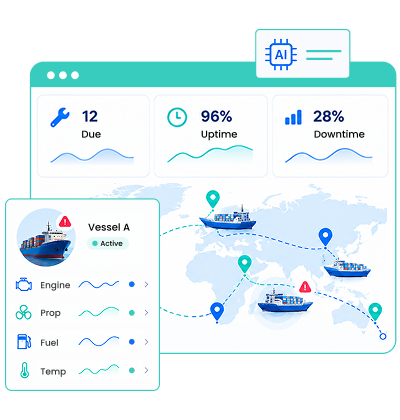
Machinery damage or failure caused 1,505 reported shipping incidents last year, accounting for more than half of all reported cases, according to Allianz’s 2026 Safety and Shipping Review. The solution to this isn’t more maintenance runs or more engineers standing by on deck. The bigger opportunity is to make maintenance smarter. AI-driven predictive maintenance can continuously analyze equipment data, spot patterns that may signal an emerging fault, and help crews act before a small anomaly turns into a costly failure.
And that shift is already gaining momentum. The global predictive maintenance in the maritime market is projected to USD 3,058M by 2034.
But ships bring their own set of challenges. They operate with different machinery configurations, harsh operating conditions, intermittent connectivity, limited access to equipment, and strict safety and compliance requirements. The data, models, integrations, and maintenance workflows have to account for all of this. That is where AI-driven predictive maintenance in maritime transport needs a different approach from generic predictive maintenance. Here’s what that looks like in practice.
Calendar-based maritime maintenance opens up healthy machinery and misses failing machinery. AI predictive maintenance in shipping fixes that by turning sensor data into early warnings and remaining-life estimates, then feeding them into the maintenance system your crew already uses. The system learns each machine's normal behavior from sensor data, flagging drift early, and turning alerts into work orders. More, importantly, AI-driven predictive maintenance in maritime transport works, but only when it's built on a clean planned-maintenance baseline and scoped to a few critical machines.
| Aspect | Details |
|---|---|
| What does this guide cover? | Maritime maintenance strategies compared, benefits of predictive maritime maintenance, the six-step workflow, equipment use cases, digital twins, PMS integration, a phased roadmap, six challenges, and ROI measurement for AI-driven predictive maintenance for maritime |
| Who should read it? | Fleet owners, technical superintendents, ship managers, and technology leaders evaluating condition monitoring or AI for their vessels |
Maintenance is fundamental to keeping maritime operations running. Engines, pumps, generators, propulsion systems, and other critical equipment all need regular attention. But how and when that maintenance happens depends on which of the following maintenance strategy the maritime business follows:
| Strategy | Trigger | What you need |
|---|---|---|
| Reactive | Failure | Nothing, until it hurts |
| Preventive (PMS) | Calendar or running hours | Accurate records |
| Condition-based | A measured threshold is crossed | Sensors and alarm limits |
| Predictive | A forecast of future condition | Sensors, failure history, models, connectivity, people |
Predictive maintenance in maritime operations moves the focus from responding to failure or following a fixed schedule to anticipating when equipment may need attention.
Instead of waiting for a component to fail or replacing it simply because it has reached a certain number of running hours, the system analyzes equipment data for patterns that could indicate deterioration. Marine equipment condition monitoring, for example, can show what is happening now, while marine equipment fault detection can identify abnormal behavior. Predictive maintenance goes a step further by estimating whether that behavior could develop into a failure.
This is where AI predictive maintenance in maritime becomes particularly useful.
Developing AI-powered platforms and systems that learn what normal operation looks like for individual equipment and account for variables such as engine load, operating conditions, and sea state will over time, support marine equipment failure prediction and, where sufficient data is available, RUL prediction for marine equipment.
In practical terms, AI in maritime maintenance adds a layer of analysis that can help crews decide what needs attention and when, rather than simply generating another alarm.
Note: There is an important distinction between technology and compliance. AI-driven predictive maintenance is not a regulatory requirement. Established maritime safety frameworks still require planned maintenance, inspections, documentation, and other controls. Predictive maintenance works alongside that baseline and does not replace it. For shipowners and operators, the value therefore extends beyond compliance. Used well, it can become a competitive advantage by helping reduce unplanned downtime, prioritize maintenance work, and make better use of engineering resources.
Calendar-based maritime maintenance has an important role. Planned maintenance schedules help operators meet regulatory and safety requirements, maintain records, and ensure critical equipment receives attention at defined intervals. But planned maritime maintenance intervals are based on expected operating conditions, while actual maritime systems rarely operate under average conditions.
Vessel loads change. Fuel quality varies between bunkering locations. Weather and sea conditions affect machinery. Components wear differently depending on how they are operated. A calendar can tell you when maintenance is due, but it cannot tell you whether a component is deteriorating faster than expected or still has useful operating life left.
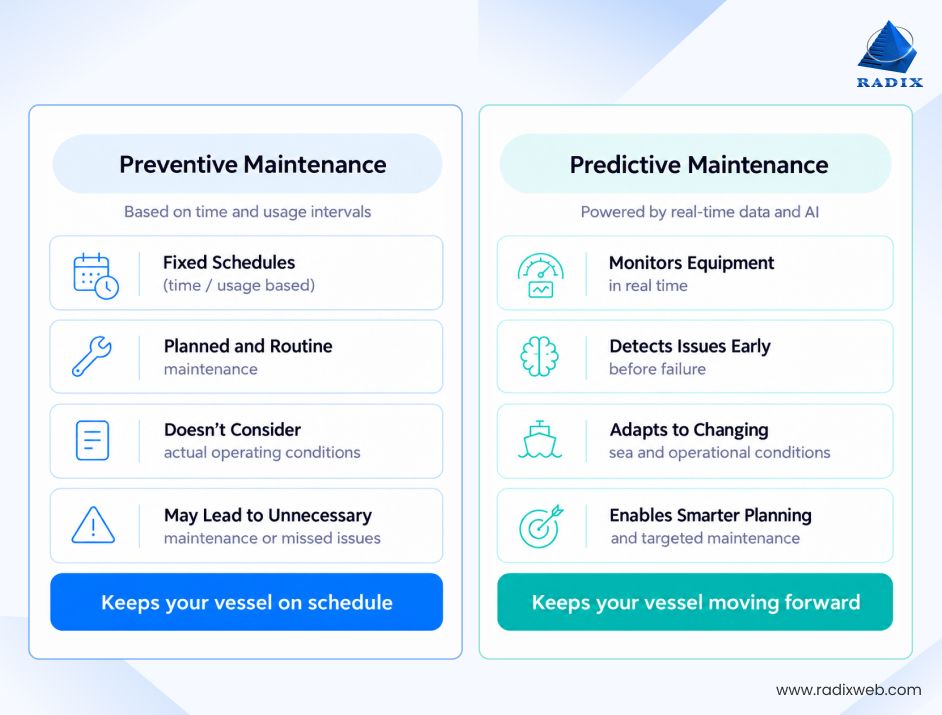
That is where predictive maintenance for maritime transport adds another layer of visibility. Here's why it is needed:
Predictive systems analyze equipment data continuously to spot abnormal patterns and early deterioration, giving crews time to investigate and intervene before a developing issue becomes a major failure.
Impact: Fewer unexpected breakdowns, emergency repairs, and operational disruptions.
AI models can account for changes in load, weather, operating conditions, and equipment behavior, helping maintenance decisions reflect how machinery is actually performing at sea.
Impact: Maintenance decisions based on real equipment condition rather than generalized operating assumptions.
Earlier warnings give operators time to coordinate repairs, arrange spare parts, and schedule maintenance around port calls, voyages, or planned dry-dock windows.
Impact: Better repair planning, fewer emergency orders, and less disruption to vessel schedules.
Not every component deteriorates at the same rate. Predictive insights can help prioritize equipment showing signs of degradation instead of treating every scheduled interval as equally urgent.
Impact: More targeted maintenance and better use of spare parts, labor, and engineering resources.
Predictive maintenance does not replace engineers or established maintenance practices. It helps teams monitor more equipment continuously and focus human attention where the data indicates greater risk.
Impact: Engineers spend less time scanning routine readings and more time making informed maintenance decisions.
Together, these benefits make a strong case for adding predictive intelligence to your maritime maintenance stack, especially where even a small equipment issue can disrupt an entire voyage.

AI-powered predictive maintenance may sound like a complex technology workflow. But the underlying process is straightforward: collect equipment data, understand what normal looks like, identify meaningful changes, and turn those signals into maintenance decisions.
The complexity, however, comes from making that loop work reliably across vessels, machinery, connectivity constraints, and real-world operating conditions. A practical maritime predictive maintenance workflow typically moves through six stages explained below:
Start with the data already available. Engine automation systems can provide exhaust temperatures, jacket water temperature, lube oil pressure, RPM, load, and other operating parameters. Add vibration sensors to critical rotating equipment where they provide meaningful additional visibility.
Marine machinery condition monitoring does not necessarily require a complete sensor overhaul on day one. Temperature, in particular, can be a useful starting point because thermal parameters can help detect faults in marine diesel engine valve systems, making marine equipment temperature monitoring a relatively accessible signal for early predictive maintenance initiatives.
A vessel cannot always depend on continuous connectivity to shore. AI models can therefore process critical signals onboard and make time-sensitive decisions locally, while non-urgent data can be synchronized when connectivity is available.
This edge-first approach makes the system more resilient. Satellite connectivity is expanding, but coverage, cost, and service availability can still vary. A practical architecture should assume that the connection will occasionally drop, so the system should be able to decide onboard and synchronize later.
Raw equipment data is rarely ready for AI. ABS has documented issues in marine operational data including missing values, invalid readings, delays, and out-of-order timestamps. These problems can distort the baseline a model uses to identify abnormal behavior.
Data therefore needs to be cleaned, synchronized, validated, and placed into a consistent structure before it becomes useful for training or analysis. In predictive maintenance, data quality is not a supporting task. It directly affects the reliability of the predictions.
This is where machine learning for maritime predictive maintenance turns equipment data into predictions. There are several approaches to how you can apply machine learning solutions to predictive maritime maintenance, and they do not require the same type or volume of data.
For many fleets, anomaly detection is therefore a practical starting point. The AI-based predictive maintenance capability can mature as more operational and maintenance data becomes available.
A prediction only creates value when an engineer can act on it. Predictive analytics for ship maintenance should therefore prioritize alerts rather than simply generate more of them.
The system should show which equipment is affected, what changed, why the behavior is unusual, and how significant the potential issue may be. Explainability matters because an unexplained alert can quickly become another alarm that crews learn to ignore.
The final step closes the loop. When an engineer investigates an alert, performs maintenance, confirms a fault, or determines that an alert was a false positive, that outcome becomes additional information for the system.
Over time, machine learning for ship maintenance can use these confirmed outcomes to improve its understanding of the vessel and its equipment. The workflow therefore becomes continuous rather than one-time: monitor, detect, investigate, maintain, learn, and monitor again.
When architecting predictive analytics system for maintenance, the key point to remember is that it is only as strong as the entire loop. Good sensors cannot compensate for poor data, sophisticated models cannot compensate for weak workflows, and accurate predictions have little value if crews cannot turn them into timely maintenance decisions. The real objective is to connect vessel data with engineering judgment in a system that keeps learning from every maintenance cycle.
The applications for AI-powered across transportation are extensive, even if we specifically look at predictive maintenance and maritime operations. But they are not all equally valuable. Some can directly affect vessel availability, fuel efficiency, and operating costs, while others are better suited for a later phase once the predictive maintenance foundation is in place.
For most operators, the practical approach is to start with equipment where failure has a clear operational or financial consequence, where useful data is already available, and where engineers can act on an early warning. Here are the use cases to prioritize first and those that can follow later.
| Application | Impact | Why |
|---|---|---|
| Marine propulsion predictive maintenance | Very high | Propulsion failures can cause off-hire time, voyage disruption, emergency repairs, and significant commercial losses. |
| Main engine and critical engine components | Very high | Early detection of abnormal temperatures, vibration, or performance changes can help prevent major engine failures. |
| Shaft line and bearing monitoring | High | Bearing degradation and misalignment can develop gradually but create serious propulsion and repair consequences if missed. |
| Generator predictive maintenance | High | Generator failures can affect onboard power availability and operational continuity, particularly on vessels with limited redundancy. |
| Pumps and purifiers | Medium | Failures can disrupt supporting systems and increase maintenance workload, but individual events may have lower commercial impact. |
| Heat exchanger monitoring | Medium | Detecting performance drift and fouling can improve efficiency, but this is generally easier to prioritize after critical propulsion assets. |
Marine propulsion predictive maintenance is often the strongest starting point because propulsion sits directly at the intersection of vessel availability, operational continuity, safety, and cost. Propulsion system condition monitoring can bring together data from the main engine, shaft line, bearings, and related systems to identify changes before they develop into costly failures.
Overall, the right starting point will still vary by vessel type, machinery configuration, available data, maintenance history, and the cost of a potential failure. There is little value in building an advanced model for equipment that has limited data or minimal operational impact.
A practical rollout is to start with two or three high-impact assets, prove that the predictions lead to useful maintenance decisions, and then expand across the vessel. This keeps AI tied to measurable operational value rather than turning predictive maintenance into another monitoring project.
A predictive maintenance system should not become another isolated dashboard. Its value comes from connecting equipment data, AI insights, and maintenance recommendations with the systems crews and shore teams already use.
So, when you are looking at potential custom software development partners for maritime predictive maintenance system development, make sure that integrating the new platform to the existing stack is a part of their roadmap.
Four integrations are particularly useful:
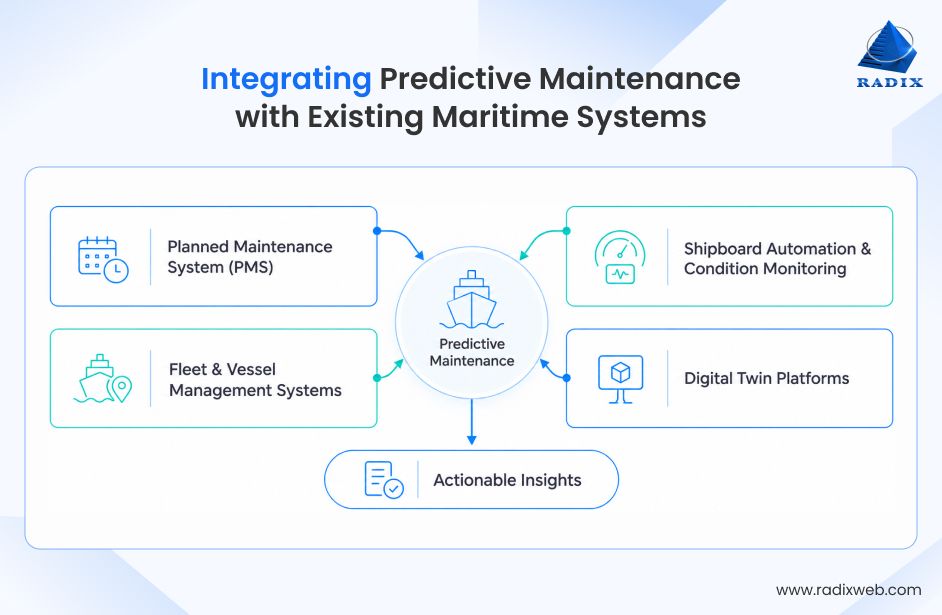
The PMS is where maintenance schedules, equipment records, work orders, and completed jobs are managed. With proper planned maintenance system (PMS) integration, predictive alerts should flow into the PMS so an emerging issue can become an actual maintenance task, with the supporting data available to the engineer.
This connects AI-driven predictive maintenance directly to the crew's existing workflow instead of leaving recommendations in a separate dashboard.
Automation and monitoring systems already collect much of the data predictive models need, including temperature, pressure, vibration, RPM, load, and other equipment parameters.
Connecting these systems gives the AI layer access to live and historical equipment behavior. It also strengthens marine machinery condition monitoring by combining multiple signals instead of relying on isolated readings.
A functional fleet and vessel management system provides the operational context that a predictive model alone may not have, including voyage schedules, vessel status, maintenance history, asset information, and planned port calls.
Combining this context with a predictive alert helps teams decide not only what may be going wrong, but when and where to address it. A developing equipment issue can then be considered alongside the vessel's next port, planned maintenance window, or dry-dock schedule.
Digital twin predictive maintenance for ships creates a virtual representation of equipment or a system and continuously compares its expected behavior with what is happening onboard. This can help identify deviations and test potential failure scenarios without waiting for the real equipment to deteriorate.
Digital twins are particularly useful for high-value assets such as main engines and propulsion systems, but they do not need to cover the entire vessel from day one. They also require reliable equipment data and realistic operating models to produce useful results.
The objective of integrating these diverse systems into a single ecosystem is to avoid creating another technology silo. By connecting predictive maintenance, operational data, digital twins, and existing maintenance workflows, predictions can move from signal → insight → work order → action.
Such integrations turn AI capability into something the crew can actually use.

Implementing predictive maintenance on ships works better as a controlled rollout than a fleet-wide technology project. A practical AI-based predictive maintenance strategy for ships should establish the maintenance and data baseline first, prove the model on a small number of high-value assets, and expand only when the results justify it.
Here's how the implementation roadmap should look like:
| Stage | What to do | Indicative timeline |
|---|---|---|
| 1. Audit | Rank critical assets, review sensor coverage, maintenance history, and data quality. | 2–4 weeks |
| 2. Pilot | Select one vessel or equipment group and define measurable success criteria. | 3–5 weeks |
| 3. Build & Validate | Train models on historical data and test against known equipment events. | 6–10 weeks |
| 4. Integrate | Connect predictions to the PMS and convert useful alerts into work orders. | 4–8 weeks |
| 5. Shadow Pilot | Let engineers assess alerts alongside actual equipment behavior before automating decisions. | 8–16 weeks |
| 6. Scale | Expand gradually, tune thresholds, retrain models, and standardize what works. | Ongoing |
At Radixweb, we have worked with Maritime organizations for the past two decades and based on our hands-on experience, there are three best practices that matter for maritime predictive maintenance implementations:
AI predictive maintenance in shipping earns adoption when engineers trust the signals and creates value only when those signals consistently lead to better maintenance decisions. These best practices help ensure that.
The challenges of predictive maintenance in maritime are less about whether the technology works and more about whether it works in the maritime context. The good news is that these challenges are manageable when they are considered during the design of the predictive maintenance program rather than after deployment.
Streaming raw sensor data ashore can be expensive and unreliable, especially when vessels have limited connectivity at sea. So, process critical data onboard, send summaries and exceptions to shore, and synchronize larger datasets when connectivity improves, or the vessel reaches port.
Marine equipment failures are relatively rare, leaving limited labeled data for training, while vibration, temperature, salt exposure, and sensor interference can introduce noise. Start with anomaly detection, validate sensor quality before modeling, and use anonymized data from
A system that generates too many false or low-value alerts can quickly lose the confidence of the engineers expected to use it. Involve chief engineers in threshold tuning, explain why each alert was generated, and prioritize a small number of actionable alerts over constant notifications.
Predictive insights can support maintenance decisions, but planned maintenance, inspections, and documentation remain the regulatory baseline, and changes to established maintenance intervals may require class involvement. Keep the PMS intact, involve the relevant class society early, and document how predictive monitoring supports existing inspection and maintenance requirements.
Connecting machinery data to shore-based systems creates additional data paths that need protection. IACS UR E26 and E27 apply to ships contracted for construction on or after 1 July 2024, so predictive maintenance architectures should include appropriate OT/IT segregation, controlled data flows, and vendor cybersecurity evidence aligned with applicable requirements.
The goal is not to eliminate every constraint before deploying predictive maintenance. It is to build technically sound and commercial-viable maritime solutions around these constraints. A focused pilot can reveal where data quality, connectivity, integration, or crew workflows need improvement before the approach is expanded across more vessels and equipment.

Building AI-Powered Predictive Maintenance for Maritime Operations
AI-driven predictive maintenance should start small, not as a fleet-wide technology overhaul. Begin with one vessel class, two or three critical machines, and a shadow-mode pilot. Keep the PMS as the system of record and address data gaps before investing in sophisticated models. The first step is to build a purpose-built software for your needs. Once the systems starts generating tangible maintenance insights, you can validate its accuracy, adjust it based on real operating conditions, and gradually scale it across more equipment and vessels.At Radixweb, we've spent 26+ years building and modernizing enterprise systems, including custom software solutions for shipping companies. Our teams build AI integrations and IoT platforms that connect to the systems you already run. If you want to see how AI-driven predictive maintenance could work for your vessel operations, schedule a consultation with our maritime experts. We'll audit your data, rank your critical equipment, and design a pilot that you get started with.
Ready to brush up on something new? We've got more to read right this way.