Read More


Recognized for AI Excellence at 2026 Globee® Awards - Read More

Nihar Raval
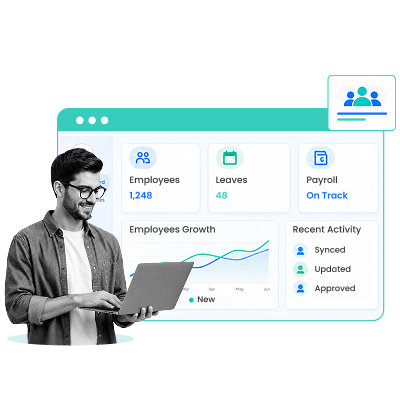
Imagine if your recruitment platform needed 60% less time to maintain, without disrupting the workflows your teams rely on. That reduction would effort directly translates to cost saving, while also freeing up your team to work on features rather than routine maintenance.
We, at Radixweb, made this possible for a recruitment industry client by modernizing their legacy platform to the cloud. By refactoring legacy code, breaking the monolith into microservices, migrating to Azure, and introducing better monitoring and scalability, we reduced maintenance effort by 60%, infrastructure costs by 35%, and overall operational expenses by one-third. And this isn’t an isolated win. We have delivered several similar cloud modernizations for recruitment platforms.
But moving to a modern cloud platform alone doesn’t guarantee savings. The way you actually modernize it does. Based on our hands-on experience, this guide breaks down what actually drives meaningful maintenance reduction and how to get it right.
Legacy recruitment platforms become maintenance nightmares because they were built for static infrastructure and manual processes. Cloud-native architectures, when properly designed, remove that manual burden entirely, reducing recruitment platform maintenance overhead. But cloud modernization isn't just about moving a system to a new infrastructure. True modernization means redesigning the application architecture, the infrastructure layer, the deployment model, and how you operate the system to eliminate the repetitive, expensive work that legacy systems demand. The right cloud modernization strategy for recruitment software helps you move from reactive firefighting (humans constantly fixing broken things) to proactive automation (systems detecting and fixing themselves).
| Aspect | Details |
|---|---|
| What does this guide cover? | Why legacy recruitment systems become expensive, the distinction between cloud migration and modernization, architectural decisions that reduce maintenance overhead, cloud modernization ROI calculations |
| Who should read this guide? | Recruitment software leaders, HR tech CTOs, IT directors evaluating platform investments, operations managers tired of firefighting, procurement teams building business cases, enterprises running 5+ year old recruitment systems, companies with high support costs relative to platform revenue |
Legacy recruitment platforms rarely become expensive overnight. Software maintenance overhead accumulates as architectural limitations create more manual work, slower releases, and more production issues. Understanding where that burden comes from helps identify what modernization needs to fix.
The cost often starts with small, recurring tasks. Engineers spend a few extra hours preparing each release, troubleshooting recurring issues, fixing integrations, managing infrastructure, or working around limitations in the existing system. None of these tasks looks significant on its own. But they are the signs that you should consider modernizing the legacy systems.
When repeated across dozens of releases, incidents, and maintenance cycles, they consume substantial engineering capacity.
As the platform grows, so does the effort required to test changes, resolve failures, maintain integrations, and keep the system stable. Teams end up spending more time keeping the platform running and less time improving it. What began as a collection of manageable maintenance tasks eventually becomes a significant and growing operating cost.
Before Your Start: Take the cloud readiness assessment for recruitment software and see if your platform is ready for the move and modernization.
When maintenance costs keep rising, migrating the on-prem legacy platform to the cloud often looks like the obvious solution. But migrating to the cloud does not remove all the problems. It just makes it more expensive to maintain. A monolith remains a monolith. Manual deployments remain manual. Tightly coupled integrations remain fragile. The infrastructure changes, but the maintenance burden does not.
That is where cloud migration and cloud modernization differ. Recruitment platform cloud migration changes where the application runs. Cloud modernization for legacy recruitment platforms is the process of updating the old architecture, infrastructure, and operations to reduce maintenance cost and improve scalability.
Modernization, therefore, goes beyond moving servers. It targets the architectural and operational causes, which helps in reducing recruitment platform maintenance overhead. In practice, this means changing several layers of the platform together:
These changes work together to reduce recruitment software maintenance costs. But it requires deliberate engineering decisions. You don't accidentally architect resilience or stumble into automation. The difference between building an HR management software that reduces costs by 10% and one that cuts them by 60% comes down to specific choices you make about application design, infrastructure patterns, and operational practices. The next section shows you exactly which decisions matter most.
Every recruitment platform is different, so there is no fixed legacy recruitment platform migration strategy. Architecture, integrations, data, and business priorities all influence what gets changed and when. But across successful cloud modernization projects for scalability, security, and performance, some engineering decisions consistently have a direct impact on maintenance and operational overhead. So, here are the eight areas where those gains typically come from:
The single biggest maintenance burden in legacy recruitment systems is the monolith itself. Every change affects everything. Every deployment is risky. With monolithic recruitment platform modernization, you organize your application around business domains, not technical layers. Don't separate frontend, business logic, and database though. Instead, create services around candidate management, job posting, communication, reporting. Each service owns its data, code, and deployment.
In practice, this is the difference between the following scenarios:
Impact on maintenance overhead: One service deployment failure is annoying. A monolithic deployment failure costs you users and real money. Teams can also operate autonomously, so you scale engineering without scaling maintenance complexity.
Services across your recruitment platform need to talk to each other. Say when a candidate gets hired, you also need to update the job posting service (one fewer slot), update the billing service (invoice the client), and update the communication service (send messages). If services call each other synchronously (service A waits for service B's response), a slow service creates cascading slowness. More importantly, a failed service crashes everything it connects to.
With recruitment technology modernization, you can use asynchronous event streams. So, when something important happens, the service publishes an event to a message bus. Other services listen for events they care about and react. The recruiting service doesn't wait for the billing service. It publishes "candidate hired," and the billing service reacts whenever it's ready. If the billing service is temporarily slow, it doesn't affect recruiting. This removes temporal coupling. Services don't need to be online simultaneously. If you deploy a new version of the communication service and it crashes, it recovers. No other service waits.
Impact on maintenance overhead: Asynchronous communication cuts emergency on-call incidents. It also lets you deploy individual services without coordinating downtime across the platform.
Legacy systems require people to provision infrastructure. When someone says, "We need a new database for this new service." the database administrator spends a day setting up the database, configuring backups, setting permissions. Next month, someone else needs a similar database and the DBA does it again.
The decision here is: write infrastructure as code. Every database, network, firewall rule, load balancer, monitoring configuration is defined in code. To provision infrastructure, you commit code. A CI/CD pipeline applies it. It's repeatable, consistent, auditable. No hidden manual configuration.
Impact on maintenance overhead: Infrastructure provisioning stops being a bottleneck. You reduce the specialized roles required. A junior engineer can deploy infrastructure confidently. Adding new environments or services becomes cheap and fast.
Legacy systems have monitoring and can answer questions like "Is the server alive? Is disk space below 80%? Modern systems on the cloud have observability instead. They can also answer: "Show me why this candidate search took 8 seconds instead of 2. Show me which integration is timing out. Show me where requests are failing."
For that, you need to instrument every component to emit traces, metrics, and logs. Use distributed tracing so you can follow a request from the API gateway through matching service, database, reporting service, and back. Use structured logging so you can query logs by any field. Use metrics to see system behavior over time.
When a customer reports slowness, instead of guessing, you can query observability data and find the root cause in minutes. Most modern platforms fail not because they're broken, but because nobody can see what's happening inside them.
Impact on maintenance overhead: Observability reduces mean-time-to-resolution (MTTR) from hours to minutes. Many issues are detected automatically before users notice, and troubleshooting becomes data driven.
The testing strategy you directly affect the platform’s long-term maintenance cost. Legacy systems get tested manually, which takes days, while bugs still slip through. The solution to that is to invest in comprehensive automated testing. Unit tests for individual components, integration tests for service interactions, contract tests for API contracts, end-to-end tests for critical workflows. These tests run automatically. If tests fail, deployment is blocked. Deployments only happen when tests pass.
This sounds expensive upfront, but it's not. It shifts testing effort left (catching bugs before production instead of after) and eliminates the multi-day QA phase. It enables rapid deployments because you have confidence that if the tests pass, the code is sound.
Impact on maintenance overhead: Automated testing reduces production incidents and enables multiple deployments per day. It removes the QA bottleneck, and teams spend less time firefighting production bugs, and more time building features.
Recruitment platforms rarely experience uniform workloads. Candidate applications, job searches, and hiring campaigns can create sudden demand. But most legacy recruitment platforms run at fixed capacity. Servers are bought for peak load and stay underutilized most of the time. With automated scaling implemented in modern cloud environments, that changes. It automatically spins up more instances when load increases and scales down when load decreases. But this requires your services to be stateless (not storing session data locally) and loosely coupled (not hardcoded to specific server addresses).
Self-healing means when a service instance crashes, the orchestration platform starts a new one without human intervention. Temporary failures are handled automatically and only systemic failures require on-call engineers.
Impact on maintenance overhead: Automated scaling and self-healing eliminate a whole category of operational toil. Seasonal peaks no longer require hiring temporary ops staff. Transient failures resolve themselves. On-call engineers only handle genuine problems, not automatic remediation.
Legacy systems require people to manage databases, caches, message queues, logging systems. Your team needs database administrators, messaging experts, monitoring specialists.
But letting cloud providers manage commodities via their managed services helps reduce that load. For example, don't run your own Postgres, use AWS RDS. Don't run your own Elasticsearch, use AWS OpenSearch. Don't run your own message queue, use SQS. This shifts maintenance from your team to AWS, which has more expertise and more scale.
Yes, you lose some customization capabilities. But the average recruitment platform doesn't need it anyway, and the cost benefits outweigh the loss of customization.
Impact on maintenance overhead Using managed services reduces your ops team size because you don't need database tuning, upgrade planning, or crash recovery. That's 100+ hours monthly that your team can spend on actual business value instead of infrastructure maintenance
We see one mistake repeatedly: organizations often consider legacy recruitment platform modernization as a complete rewrite. It sounds clean, sure. But an 18–24 month rebuild often means maintaining two systems. It also stretches engineering teams and risks business disruption. Instead, it almost always makes sense to modernize the platform in phases.
Start with components where maintenance pain is high and payback is fast. Here's a sample matrix:
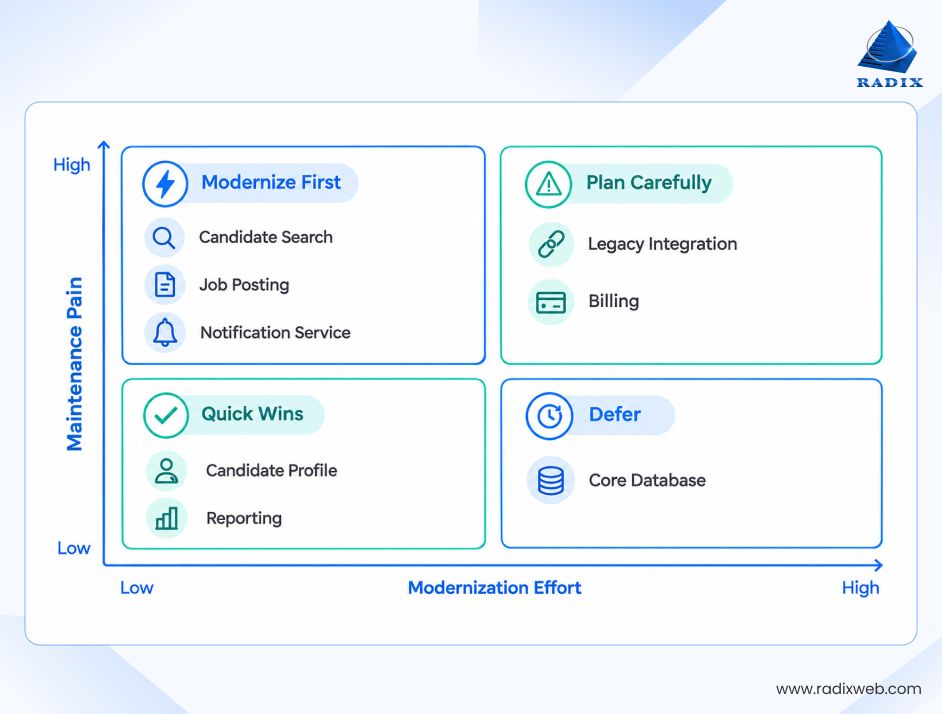
To identify what parts of your systems should be modernized first, start by mapping the major components and measuring their maintenance cost, incident volume, change frequency, and deployment effort. Next, estimate the modernization effort, annual savings, and payback for each high-priority component. Then, sequence the work based on savings versus effort.
These engineering decisions guide your cloud strategy and that's what has a real impact on maintenance cost reduction. These decisions are a standard practice in organizations that operate modern systems. The reason we're spelling them out here is that many recruitment platform teams skip some of these trying to save effort upfront. But they then end up wondering why their "modernization" didn't reduce maintenance.
“The system feels faster now”
If you hear that from your team after modernizing legacy recruitment platform to cloud, it is a great sign. But it is not enough. Especially given that an average legacy cloud modernization project can cost between $200K–$600K. To actually prove cloud modernization benefits and show that the cost of delaying modernization would have been higher, you need measurable results.
Here are some of the metrics that you should be measuring to assess modernization ROI
Maintenance cost/deployment helps understand whether modernization is making the platform cheaper to change and maintain. Start by calculating the engineering time spent preparing, testing, deploying, monitoring, and fixing each release. Then multiply it by the loaded engineering cost.
For example, if a legacy deployment takes 40 engineering hours at $75 per hour, it costs $3,000 per deployment in maintenance effort. If modernization reduces that effort to 10 hours, the cost drops to $750 per deployment. Across dozens or hundreds of deployments each year, the savings become significant.
But don't rely on this metric alone. To understand the full maintenance impact, also track:
| Metric | What It Measures |
|---|---|
| Maintenance Hours | Engineering time spent keeping the platform running |
| Mean Time to Recovery | Time required to detect, diagnose, and resolve incidents |
| Deployment Frequency | How often changes are released to production |
| Production Incidents | Number and frequency of production failures |
| On-Call Burden | After-hours alerts, escalations, and emergency fixes |
| Infrastructure Cost & Utilization | Cloud spend, resource usage, scaling, and unused capacity |
It is important to remember that these metrics only become meaningful when you have something to compare them against. So, start by measuring recruitment software maintenance costs before modernization. And then measure the same metrics at 3, 6, and 12 months after the modernized platform stabilizes and compare it to the baseline.
Stop Maintaining Legacy Systems, Start Modernizing Them
Legacy recruitment platforms are expensive to maintain. But modernization isn't necessary just because the cloud costs less (though it does!). Cloud modernization works because it reduces ongoing maintenance overhead by redesigning every layer around automation and resilience. At Radixweb, we have modernized several legacy systems to the cloud for multiple recruitment platforms. Across these projects, the pattern has been consistent. Organizations that modernize right reduce maintenance overhead, have happier engineering teams, faster deployments, and more stable systems.With 26+ years of software engineering, legacy modernization, and cloud experience, we know what works, what doesn't, and how to sequence the work for early wins. Plus, we can help you actually measure the ROI of your modernization project. So, if you don't want to continue paying hefty legacy recruitment system maintenance costs, schedule a consultation with our cloud architects. We can help you move from reactive firefighting to a platform that runs with minimal intervention, with a realistic modernization roadmap.
Ready to brush up on something new? We've got more to read right this way.