Read More


Recognized for AI Excellence at 2026 Globee® Awards - Read More

Nihar Raval
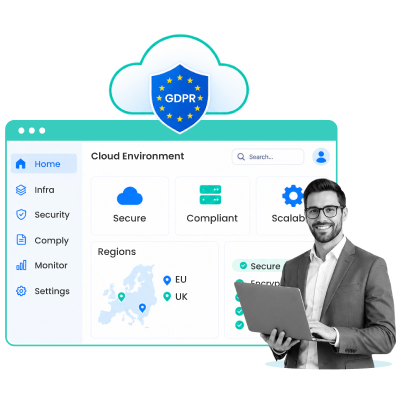
A large proportion of UK and EU organizations now invest in cloud application development. However, only 46% of UK businesses handling digitized personal data agreed that regulatory guidance was clear and easy to understand.
This gap between regulatory obligations and organizations’ ability to understand and implement them is where the lawsuits live.
Compliance with GDPR and other data privacy and protection regulations across the European Union isn't optional today. And it definitely is not automatic. But most teams treat GDPR as a checklist to tick after the app is built. That's backwards. True compliance must be architected in from day one, embedded into how data flows, where it's stored, who can access it, and how it's processed.
GDPR-compliant cloud application development embeds privacy, security, data controls, and user rights into the architecture to meet UK & EU regulatory requirements. This isn't about checking boxes. It's about designing a secure cloud infrastructure so that regulatory requirements and technical architecture work together, not against each other.
When compliance is an afterthought, you're building remediation into your roadmap. When it's built in, you're building a cloud app that actually works.
GDPR-compliant cloud application development requires embedding data protection into your architecture from day one, not adding it later. When building a cloud app for UK and EU operations you must choose compliant data residency (EU regions or US clouds with Standard Contractual Clauses), implement encryption and access controls, obtain proper Data Processing Agreements from providers, and design workflows that handle data subject rights. Building compliance-first cloud apps ensures security, reduces legal risk, and saves the millions in fines that can turn into existential crises for businesses operating in the UK or EU.
Disclaimer: The information in this article is general guidance and is not legal advice or a guarantee of UK DPA or GDPR compliance for cloud applications. Organizations should obtain professional legal and privacy advice based on their specific circumstances.
| Aspect | Details |
|---|---|
| What does this guide cover? | Data residency requirements, cloud architecture decisions for compliance with GDPR for UK and EU operations, encryption and access control, legal agreements with cloud providers, data subject rights implementation, GDPR vs. UK DPA differences, phased compliance roadmap, cost and timeline for compliance initiatives |
| Who should read this guide? | Cloud architects and CTOs building applications for UK/EU markets, compliance officers evaluating cloud strategies, business leaders responsible for EU operations, engineering teams migrating to cloud, organizations processing personal data of EU/UK residents, companies concerned about GDPR fines and regulatory scrutiny. |
Compliance mistakes aren't theoretical risks. They're expensive and disruptive. But they are also largely avoidable when you build cloud native applications with the right compliance architecture from the start.
Yet, many organizations hesitate to invest in compliance upfront. The real cost, however, often comes from what happens when those safeguards are missing.
But regulatory fines are only part of the cost. Beyond fines, failed compliance creates operational chaos too. System redesigns take months. Emergency audits consume resources. Breach notifications require legal counsel. Reputational damage causes customer churn.
In other words, the cost of GDPR-compliant cloud application development for UK & EU can be far lower than the cost of fixing compliance gaps after deployment.
How to Know You Need to GDPR-Compliant Cloud Application DevelopmentsObviously, if you're operating in the EU or UK, GDPR compliance is mandatory. But it's not just a geographic requirement. GDPR compliance needs to be a part of your cloud-native app development roadmap in many other situations too.Some examples include:● You process EU or UK residents’ personal data, even if your business operates outside Europe.● Your cloud application stores or processes personal data, including through third-party cloud services, APIs, or SaaS platforms.● You act as a data processor for European customers, handling personal data on their behalf.● You process sensitive personal data, such as health, biometric, financial, or identity information.● You are expanding into EU or UK markets, making compliance an architectural consideration before launch.● Your application needs to support GDPR data subject rights, such as access, correction, portability, and erasure.● Your business retains or transfers personal data across regions, requiring appropriate controls over storage, access, and international data transfers.● Your enterprise customers require GDPR compliance contractually, even when the application itself operates outside the EU or UK.
Useful Guide: Understand How Web Apps Differ from Cloud Apps
Most organizations assume that GDPR is just about technology. But it is also about where your data is stored.
GDPR Article 44 states that personal data of EU residents must not be transferred outside the EU without "adequate safeguards." Post-Brexit, the UK has its own data protection regime under the UK Data Protection Act 2018. This creates two separate compliance zones: the EU and the UK. Each has its own rules, its own regulators, and its own enforcement approach.
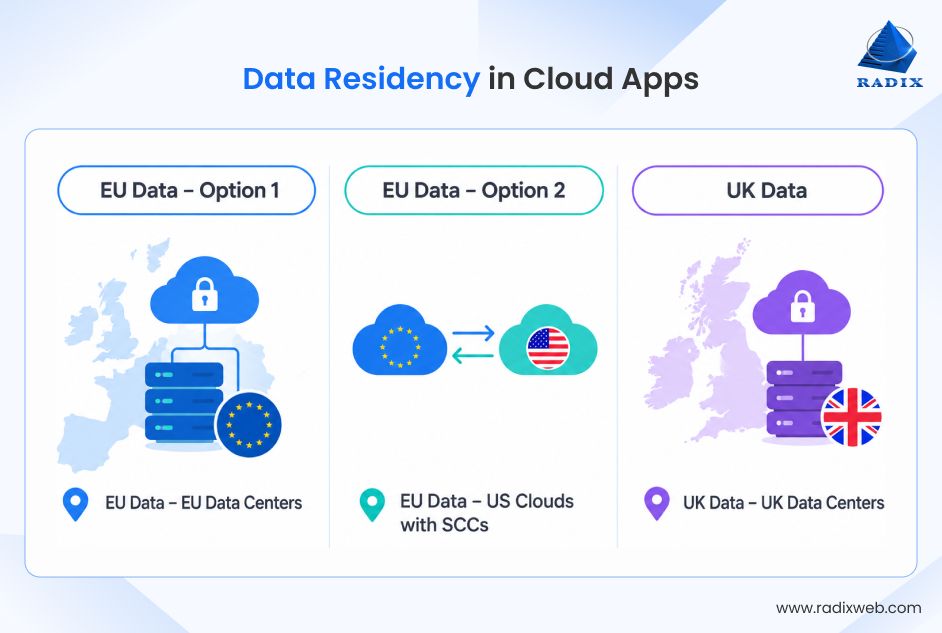
For EU data, you have two paths forward.
Need AWS us-east-1 or Azure US regions for performance reasons, or your integrations demand it? You can still comply:
The UK Data Protection Act 2018 requires similar protections but operates under ICO (Information Commissioner's Office) guidance. UK data can stay in UK datacenters. The UK also has adequacy decisions with some countries, but not others.
Note: Check the ICO website for current adequacy decisions before choosing a cloud data storage location.
Choose your path based on where your customers are, not on which cloud provider has the lowest introductory pricing. There are better ways to optimize your cloud costs than skimping on compliance.

If your company operates in or serves customers in the UK or EU, GDPR compliance is mandatory. While selecting the right cloud service provider is the first step, you also need to build a secure cloud app architecture and your app remains compliance. GDPR requirements don't exist in regulatory isolation. They map directly to technical decisions across multiple layers.
Getting these layers right from the start is important to ensure compliance and avoid costly redesigns later.
Not all data is personal data. GDPR only applies to information that identifies or relates to a living individual. A customer's name? Personal data. The color of your application's background? Not personal data. A user's anonymized usage pattern? Depends on whether they're truly unidentifiable. Most cloud applications process both these types of data simultaneously.
Start by classifying data at the point of collection and build your data models to separate them from day 1. This sounds simple, but it's not. And it has massive repercussions because even one wrong classification can mean you're violating GDPR Article 5's integrity and confidentiality principle.
So, invest time upfront in data classification. Document which fields are personal data and why. This becomes your source of truth for all compliance decisions downstream.
The datacenter you choose matters for GDPR compliance. But selecting an EU region is only the starting point. Your cloud application also needs to be architected around data residency requirements. If EU customer data must remain within the EU, the architecture may require geographic database partitioning, region-specific storage, and controlled replication. For example, EU customer data could be stored in Frankfurt while US customer data is stored in us-east-1.
When using a hybrid cloud architecture for data storage, define which data resides on-premises and which is stored in the cloud, and ensure that data transfers between environments are compliant. Backups, replicas, and disaster recovery environments also need to follow the applicable residency requirements.
This needs to be decided before finalizing your database and storage architecture. Retrofitting geographic data controls after deployment can affect the data model, replication strategy, application logic, and infrastructure. The storage layer should therefore define not only where data is stored, but also where it can be copied, processed, and recovered.
For the development of a GDPR-compliant cloud application, encryption should be applied to both personal data at rest (stored in databases, backups, and object storage) and data in transit (TLS for data moving between users, APIs, services, and other systems).
But that's not all. You also need to properly secure the encryption keys. Here are the key management options you can choose from:
1. Provider-Managed Encryption (AWS KMS, Azure Key Vault):
2. Customer-Managed Encryption:
3. Client-Side Encryption:
Document the encryption methods, key locations, access controls, and responsibilities. This becomes evidence of your compliance effort.
GDPR Article 32 requires access to personal data to be restricted to authorized personnel only. This is where many teams fail. They implement authentication but not authorization.
As a cloud app development partner offering UK-first data security, here's what we recommend:
Third-party access: If personal data is shared with analytics, AI, payment, or other external services, treat those services as part of your access and data-flow architecture. Know what data each service receives, why it receives it, and what happens when the processing purpose or legal basis changes. Your contracts and technical workflows should also support applicable deletion, access, and consent withdrawal requirements.
GDPR Article 5 requires data be collected only for specified, explicit, legitimate purposes. So, you cannot collect email addresses "just in case." You can collect them only for the stated purpose. That means the data collected for "billing" can't be repurposed for "AI model training" without a new legal basis.
If your code allows arbitrary data repurposing, you're in violation by design. The solution? Data minimization - collect only what you need. Design your data models to collect only what's necessary and make over-collection require explicit decision-making. This affects your data schema design, your API endpoints, your analytics collection, so plan it upfront.
Also, before processing personal data, define the legal basis for each processing activity. GDPR Article 6 provides six legal bases: consent, contract, legal obligation, vital interests, public task, and legitimate interests. Your application should maintain a clear mapping between processing activities, their purpose, and the applicable legal basis.
Consent management: When consent is the legal basis, the application needs to record what the user consented to, when they consented, and how that consent can be withdrawn. Consent should not be bundled into general terms or collected through pre-ticked options. Withdrawal should also trigger the necessary changes across connected systems and third-party processors.
GDPR gives individuals rights over how their personal data is accessed, corrected, deleted, transferred, or processed. Your cloud application should therefore have technical workflows that allow these requests to be handled consistently across databases, services, backups, and third-party processors.
Build capabilities for:
Designing these capabilities upfront is much easier than trying to locate and modify an individual's data across a distributed cloud environment later.
GDPR requires proof of compliance. So, logging and monitoring need to be built into your architecture from day one. Make sure you track all access to personal data (who, what, when, where, and how). Also, set alerts for unusual access patterns (bulk downloads, access outside business hours, access from unexpected countries).
Also, maintain audit trails for 6+ months minimum. When a data breach occurs, your audit logs prove what happened, who accessed data, when. This is the difference between "we got breached" and "we got breached, and here's the incident timeline with forensic detail." The second one helps your compliance case.
Another important layer is automated alerts. Because if someone downloads 100,000 customer records at 3 AM or an admin logs in from a different country, your system should flag it immediately. Manual monitoring is just not enough here.
GDPR Article 33 requires organizations to notify the relevant supervisory authority of certain personal data breaches within 72 hours of becoming aware of them. Your cloud architecture therefore needs to support rapid detection, investigation, and response.
Implement:
The goal is not just to detect a breach, but to make sure your architecture gives you the evidence and workflows needed to respond within the required timeframe.
GDPR Article 5 requires data be kept "no longer than necessary." Set retention policies based on business needs.
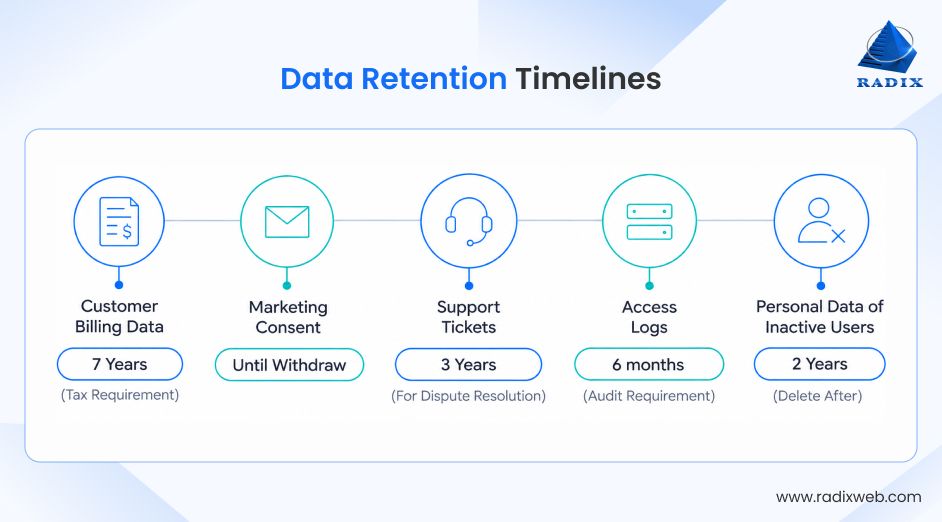
Longer retention creates unnecessary compliance risk. So, delete data when it's no longer needed by building automated deletion into your architecture and document your retention policy.
This is also important for ensuring users the Right to be Forgotten (GDPR Article 17). Make sure you engineer your app’s data architecture to allow the following when a user requests deletion:
If your backup strategy runs weekly and retention is 30 days, you have a compliance gap. Users can request deletion, but their data exists in backups for weeks. Design the architecture to handle this upfront.
GDPR compliance starts with architecture, so these controls need to be built into the cloud application from the beginning, not added later.

Building GDPR-Compliant Cloud Apps for UK and EU Operations
With GDPR-compliant cloud application development for UK & EU, compliance needs to be embedded from the start. From data mapping and secure storage to encryption, access controls, retention, and data subject rights, every architectural decision matters. A compliance-first clould app development doesn't just save you from fines. It also reduces future risks, remediation costs, and complexity while building trust with customers.At Radixweb, we've built compliance-first cloud architectures for UK and EU operations across healthcare, fintech, and SaaS sectors. With 26+ years of experience in cloud infrastructure and regulatory requirements, we know where compliance gets overlooked and how to architect around it. If you're building a cloud application for UK or EU customers, or migrating existing systems to comply with GDPR, we can help you do it right the first time. Schedule a consultation with our cloud architects, and let's build a compliance strategy that actually works.
Ready to brush up on something new? We've got more to read right this way.