Read More


Recognized for AI Excellence at 2026 Globee® Awards - Read More

Nihar Raval
Cloud is no longer a future-state technology choice for UK businesses. It is already part of the mainstream technology landscape. The UK government says cloud services are a critical enabler for UK businesses and organisations. The cloud market in the UK is worth more than £10.5 billion and growing by around 30% a year.
With this momentum, more UK businesses are developing cloud-native applications and moving new digital products, customer experiences, and internal systems to cloud environments. But before getting into the technology, the first question businesses ask is: How much does cloud application development cost in the UK?
The answer varies widely. Depending on the application's complexity, features, integrations, security requirements, and development approach, cloud application development in the UK can cost anywhere from £40,000 to £500,000+. These are broad market estimates, though. The actual cost depends on how you plan to develop a cloud-based application.
In this guide, we break down the factors behind these estimates and help you narrow the broad cost range to a more realistic budget for your application. This gives you a clearer view of the investment required, helps you plan ahead, and lets you make the right decision based on your own requirements and budget.
A mid-complexity cloud application for a UK business typically requires a budget of £250,000 to £700,000, including development, integrations, testing, security, deployment and early support. A low-complexity application often falls between £120,000 and £280,000, while complex enterprise applications can exceed £1.8 million. A 15-20% contingency and a separate discovery phase of £15,000-£40,000 provide a more realistic budget baseline.
| Aspect | Detail |
|---|---|
| What does this guide cover? | UK development costs, lifecycle costs, outsourcing, staff augmentation, in-house development, cost drivers, ROI, budgeting, timelines |
| Who should read this guide? | CIOs, CTOs, product leaders, technology directors, procurement teams, finance leaders, enterprise application owners |

There is no standard price for building a cloud application in the UK. A lightweight customer portal and a regulated enterprise platform are technically both “cloud applications”. But the cloud application development costs can differ by hundreds of thousands of pounds.
Other than the scale of the app, engineering rates, development team location, integration requirements, and cloud infrastructure choices all influence the starting budget.
The UK market also brings its own considerations. Developing an enterprise-grade application often involves established technology estates, strict procurement processes, security reviews, and requirements around UK GDPR, data protection, and industry compliance. These affect the scope of work and the resources needed to take an application from concept to production.
That is why a realistic cloud application development budget should start with the actual requirements rather than a generic market figure. Below we break down the key cost drivers and show how they affect the final estimate.
Also Read: How Much Does it Cost to Migrate to the Cloud
The biggest cost differences rarely come from the basic act of writing code. They come from what the application needs to do, the environment in which it operates and the complexity of making it production-ready.
The following categories provide a practical way to evaluate the cloud application development cost factors behind a proposal.
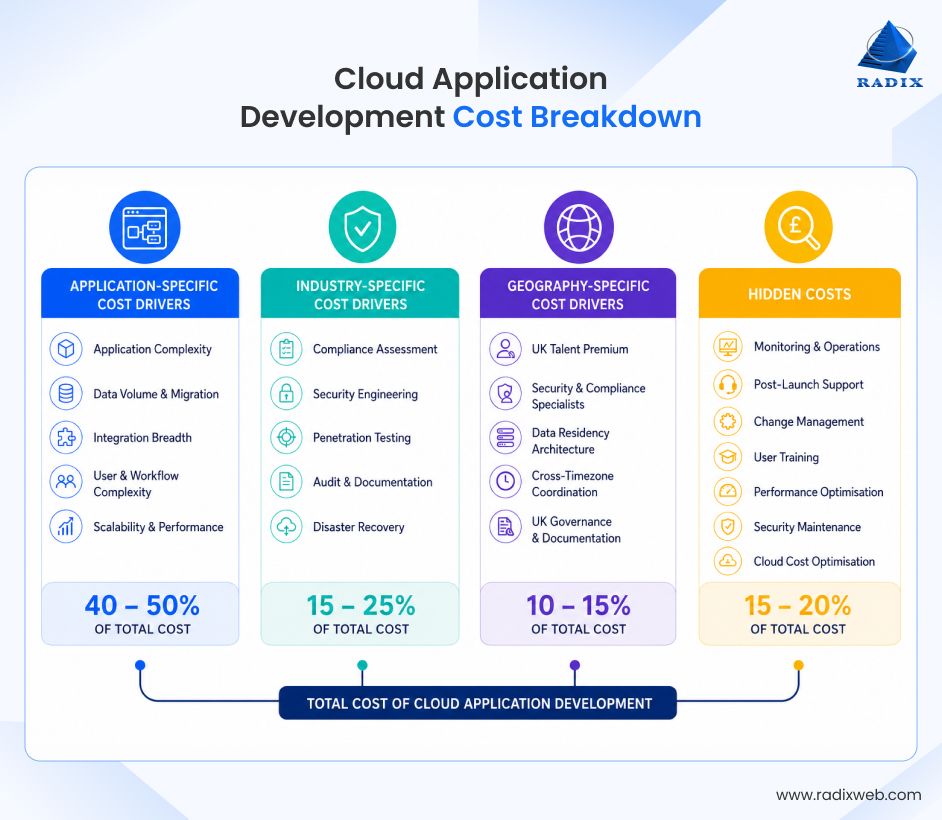
Note: These ranges describe the potential budget impact of each factor, not separate costs to be added together. The same cost can appear across multiple drivers, so they should be used to understand what moves the estimate rather than summed mechanically.
The first category relates directly to what the application needs to deliver.
Budget Impact: £40,000-£300,000+
A simple workflow application with a few user roles is fundamentally different from a multi-tenant platform with real-time processing, advanced permissions, and complex business rules.
The cloud application development complexity affects architecture, development, testing, and infrastructure simultaneously.
Budget Impact: £20,000-£150,000+
Small datasets with clean structures are inexpensive to migrate to the cloud. Large, inconsistent, or poorly documented datasets require profiling, cleansing, transformation, reconciliation, and validation.
Budget impact £20,000-£250,000+
Each non-trivial integration introduces development and testing effort. Ten integrations are not necessarily ten times the cost of one, but they create a substantially larger dependency network.
This is one of the most important cloud application development API integration cost considerations for enterprise projects.
Budget impact: £20,000-£150,000+ impact
More roles, approval paths, permissions and exception conditions increase both development and QA effort.
Budget impact: £20,000-£100,000+ impact
High transaction volumes, real-time processing and strict response-time requirements require more sophisticated cloud computing architecture planning and performance testing.
Industry requirements can change the architecture as well as the budget.
Financial services applications, for example, often require stronger auditability, encryption, identity controls, resilience, and regulatory evidence. Healthcare applications might require additional controls around sensitive health information. Retail applications may need payment security, inventory integrations, and high-volume transaction handling.
For businesses operating in a regulated industry, enterprise cloud application development cost in the UK often includes £30,000-£150,000 or more for ensuring cloud ecosystem security, compliance and validation work.
Typical industry-driven costs include:
These are not optional extras when the application processes regulated or sensitive data.
UK delivery also has geography-specific considerations. Data residency requirements, GDPR obligations, local security expectations and the cost of specialist UK talent can influence the delivery model.
The cloud application development cost that UK businesses pay also depends on whether architecture and security roles sit in the UK or are delivered from another geography.
Typical geography-related costs include:
A blended team can reduce labour costs while keeping critical decision-making close to UK stakeholders.
The most dangerous costs are the ones nobody budgets for.
When you are looking at proposals, the cloud application development cost breakdown should include post-launch management, monitoring, optimization, training, change management, and technical debt.
Typical hidden costs include:
Infrastructure also needs its own budget. Depending on workload and scale, an enterprise application might require £2,000-£20,000+ per month in cloud infrastructure after launch.
That is why the cloud application development infrastructure cost should be modelled separately from engineering expenditure.
A useful budget should also include a 15-20% contingency. This is not an admission that the project is poorly managed. It recognizes that enterprise applications contain unknowns, especially around legacy systems and data.
The true cost of a cloud application is the combined investment across its lifecycle. Looking only at development gives a distorted view because the application needs to be designed, secured, tested, deployed and supported as a production system.
For a typical UK enterprise project, the following ranges provide useful planning benchmarks. They are estimates rather than fixed market prices because scope, architecture, team structure, compliance and integration requirements can change the economics substantially.
A proper discovery phase usually costs £15,000-£40,000 and takes around two to four weeks. Its purpose is to turn assumptions into evidence before the main delivery budget is approved.
A discovery exercise should produce an architecture assessment, requirements baseline, integration inventory, data assessment, delivery roadmap, team recommendation and refined cost model.
The cloud application development cost estimate becomes considerably more reliable once these questions have been answered.
Cloud app cost drivers in the discovery and assessment stage include:
The objective is not to make discovery another consulting exercise with no delivery value. It should reduce uncertainty before the organization commits the majority of the budget.
Architecture and design typically require £25,000-£70,000 for a mid-complexity application. Larger enterprise systems with multiple environments, complex integrations, or strict security requirements require more.
This is where decisions about application architecture, cloud services, databases, APIs, identity, networking, observability, and deployment pipelines are established.
The cloud application development team cost in this phase is driven by the seniority of the people involved. Architecture requires fewer people than development, but the roles are generally more senior.
Key cost drivers include:
Architecture should also model expected infrastructure consumption. A technically elegant system that becomes unnecessarily expensive at scale is not a successful cloud architecture.
Development usually represents the largest part of the project. Building a mid-complexity, custom business application can reasonably cost between £120,000-£400,000.
The cloud application development pricing at this stage depends on the number of workflows, user roles, interfaces, backend services, business rules and integrations.
Primary cost drivers during development include:
A low-complexity application might require a team of three to five people. A larger enterprise application could require eight to twelve specialists across engineering, architecture, QA, DevOps, security and project management.
The enterprise cloud application development cost rises sharply when the application needs multi-tenancy, real-time processing, high availability, complex permissions, extensive audit trails or multiple external systems.
Integration and migration deserve their own budget because they are frequent sources of cost overruns. A practical planning range is £40,000-£180,000, depending on the number and complexity of systems involved.
A single straightforward API might cost £8,000-£20,000. A non-trivial enterprise integration involving multiple workflows, transformation rules, authentication and error handling might cost £20,000-£50,000.
This is where cloud application API integration cost becomes significant.
Major drivers of cost in this phase include:
A modern REST API with good documentation is fundamentally different from a legacy database or undocumented integration. Treating both as a single "integration" line item creates unrealistic budgets. In some cases, you might also need to modernize the legacy application before it can be integrated with the cloud ecosystem, which further adds to the overall project cost.
Testing, security and compliance typically require £40,000-£120,000 for a mid-complexity application.
The cloud application development infrastructure cost should not be confused with this phase. Infrastructure covers the environments and cloud resources required to run the system, while testing and security cover the work required to validate and protect it.
The types of tests that drive costs include:
For regulated applications, security needs to influence architecture from the beginning. Retrofitting controls or modernizing cloud apps for security and scalability after development often costs more and creates avoidable rework.
Deployment, training and early support typically require £25,000-£90,000.
The cloud application development maintenance cost starts becoming visible here. Production monitoring, incident response, optimisation, patching, and minor fixes need to be planned rather than treated as unexpected expenses.
Deployment related cloud app costs include:
For most enterprise applications, four to eight weeks of dedicated post-launch support is a sensible starting point.
The overall lifecycle therefore gives a more realistic picture than a development-only quotation. A mid-complexity project might sit around £250,000-£700,000, while larger applications with extensive integrations, large-scale and complex data migration, or unique compliance and scalability requirements can move beyond £1 million.
The cloud application development pricing models used by the delivery partner also influence how these costs are distributed. Fixed-price, time-and-materials and dedicated-team models each handle uncertainty differently.
The cost of developing a cloud native application differs depending on how the development team is engaged. There is no universally cheapest model because the right choice depends on risk, speed, control, availability of internal skills, and project complexity.
Here are the most common development routes for enterprises in the UK
Outsourcing is often the most flexible approach for UK enterprises that need to access a wider engineering talent pool without carrying permanent employment overheads. A UK-based development partner typically charges higher rates because the delivery team operates within the UK cost structure. A mid-complexity application could therefore cost £300,000-£700,000+ when delivered primarily by a UK team.
An offshore partner can reduce delivery of labour costs. India is often significantly cheaper than the UK, while Eastern Europe, Latin America and Southeast Asia sit at different points between offshore and UK pricing.
Typical planning ranges are:
| Delivery geography | Indicative hourly rate | Typical positioning |
|---|---|---|
| UK | £70-£150+ | Higher local cost, close collaboration |
| Western Europe | £55-£110 | Moderate-to-high cost |
| Eastern Europe | £40-£85 | Strong engineering value |
| India | £25-£60 | Lower labour cost, large talent pool |
| Southeast Asia | £25-£55 | Competitive delivery economics |
| Latin America | £35-£75 | Strong timezone overlap with North America |
Note: These ranges are planning benchmarks rather than universal supplier rates.
For UK organisations, a blended model often works well. Senior architecture, security and product leadership remain closer to the business, while development and QA execution use offshore capacity. The cost to develop a cloud application can fall substantially under this model without removing UK oversight.
Staff augmentation is a team expansion strategy where the organization takes more responsibility for delivery management while adding external specialists to its existing team.
The cloud application development hourly rates depend heavily on role, experience and location.
| Role | UK 3-5 years | UK 6-10 years | Offshore 3-5 years | Offshore 6-10 years |
|---|---|---|---|---|
| Software developer | £55-£85/hr | £85-£125/hr | £25-£45/hr | £40-£65/hr |
| Cloud engineer | £65-£95/hr | £95-£140/hr | £30-£50/hr | £45-£70/hr |
| DevOps engineer | £70-£105/hr | £100-£145/hr | £30-£55/hr | £45-£75/hr |
| QA engineer | £45-£75/hr | £70-£100/hr | £22-£40/hr | £35-£55/hr |
| Security specialist | £80-£120/hr | £110-£170/hr | £35-£60/hr | £50-£80/hr |
| Solution architect | £100-£140/hr | £130-£180/hr | £45-£70/hr | £60-£90/hr |
| Project manager | £60-£90/hr | £85-£120/hr | £25-£45/hr | £40-£60/hr |
A common mistake that enterprises make here is budgeting for just one or two developers and assume the rest of the work will be absorbed internally. A production cloud application, however, usually needs architecture, development, QA, DevOps, project management and, depending on the application, security and data expertise.
For example, a six-person blended team averaging £70-£90 per hour across 160 hours per person each month represents approximately £67,200-£86,400 per month before additional expenses. An offshore team averaging £35-£55 per hour would represent roughly £33,600-£52,800 per month.
This makes staff augmentation attractive when an organization already has strong product ownership and technical leadership. The downside is that internal management effort becomes part of the real cloud application development team cost.
In-house development gives the organization maximum control over the team, product knowledge, and long-term ownership. It also carries the highest employment overhead.
The salary you pay when hiring a dedicated developer for your team is only part of the cost. Employers also need to account for National Insurance, pension contributions, recruitment, benefits, equipment, software licences, office costs, training, management time, paid leave and periods when the team is not fully allocated to the project.
A UK cloud developer earning £60,000 annually does not cost the organization only £60,000. A loaded employment cost can reasonably move towards £75,000-£90,000+ per year once employer overheads are included, depending on the benefits package.
The cloud application development cost per hour in the UK therefore needs to be calculated using fully loaded employment cost rather than salary alone. A £70,000 annual employee working around 1,600 productive hours is already about £44 per productive hour before additional management and technology overheads.
For a dedicated eight-person team, total annual employment and operating costs can easily exceed £600,000-£800,000. Recruitment time also matters. Hiring several specialist roles simultaneously can delay development before the first sprint starts.
Cost is only one side of the investment decision when you are planning to develop a cloud native enterprise application. The other is return.
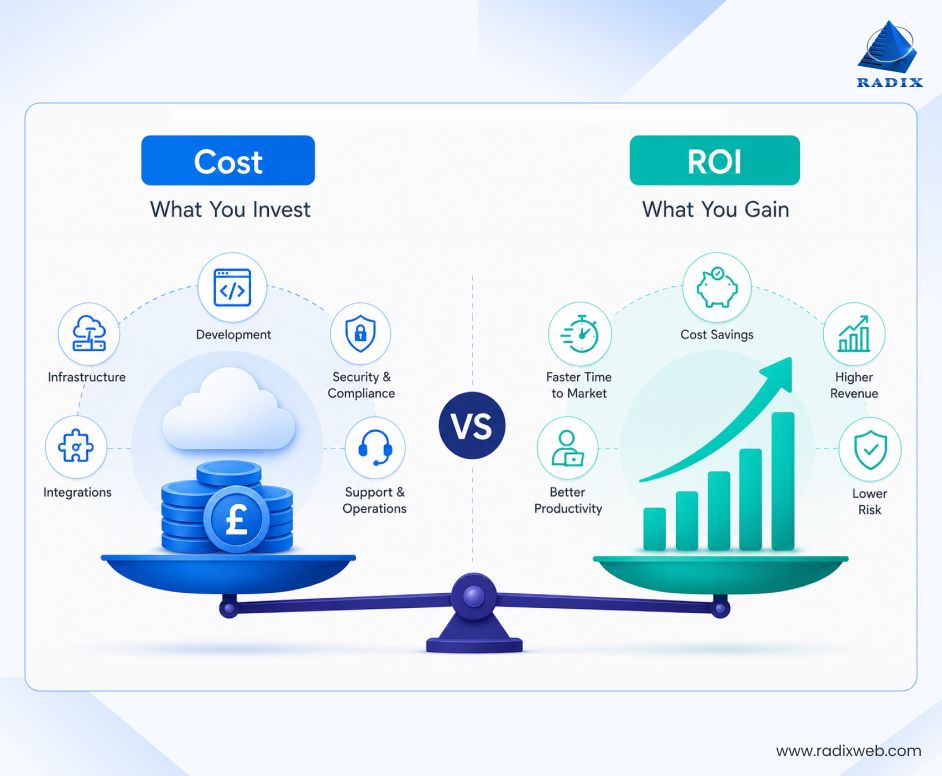
An organisation should not choose a £250,000 project over a £400,000 project simply because the first quotation is lower. The right question is whether the additional investment produces enough operational, financial, or strategic value to justify itself.
Market evidence shows why this distinction matters.
PwC's research among more than 400 UK business and technology executives found that ~66% expected all operations to be in the cloud within two years and about 75% planned to increase their cloud budget. Among organizations it is classified as "cloud-powered", 54% expected cost savings, 55% faster time to market, 57% improved cyber resilience, and 58% enhanced customer experience.
At the same time, cloud spending does not automatically produce ROI. Ekco's 2025 survey of more than 1,000 IT decision-makers across the UK and Ireland found that 54% lacked complete visibility into cloud spending, while only one-third of cloud projects delivered on every goal.
This makes estimating cloud application development ROI a business measurement exercise, not a technology assumption. Here's how you can calculate expected ROI:
Start with the annual value expected from the application:
ROI = (Total benefits - Total investment) / Total investment × 100
Benefits should include measurable items such as:
For example, suppose a new application requires £450,000 to build and operate during its first year. If it produces £180,000 in annual operating savings and £120,000 in additional annual contribution margin, the annual benefit is £300,000.
The first-year simple ROI would be:
(£300,000 - £450,000) / £450,000 × 100 = -33.3%
That does not automatically make the project a bad investment. If the same £300,000 annual benefit continues, the project reaches simple payback after approximately 18 months and generates £900,000 in benefits over three years against the initial £450,000 investment.
The better cloud application development ROI calculation therefore uses a multi-year view and includes recurring operating costs.
For example, a £450,000 build with £60,000 annual operating cost and £300,000 annual measurable benefit would produce:
The exact outcome depends on the business case. There is no universal percentage that every UK cloud application should achieve. So, do not evaluate the cloud application development cost in isolation. Evaluate the investment against the measurable value created over three to five years.
Budgeting Right for Cloud Application Development in the UK
When planning to develop a cloud application for organizations in the UK, the key is to avoid treating the initial cost estimate as a final number. Start with a two-to-four-week assessment, define the architecture, identify every integration, assess the data, establish compliance requirements, and build the delivery plan. Then separate development, infrastructure, security, migration, testing and support costs, and retain a 15-20% contingency.At Radixweb, we have been building enterprise applications and cloud solutions for more than 26 years, with experience across fintech, healthcare, retail and enterprise software. That experience helps us identify the technical and delivery issues that often sit behind underestimated proposals and create more realistic estimates. Our understanding of UK delivery expectations, compliance considerations, team economics and enterprise technology environments further helps us meet organizational expectations, not just complete technical delivery. Schedule a consultation with our experts to get a no-cost cloud-native application development estimate, based on the work you actually need rather than optimistic assumptions.
Ready to brush up on something new? We've got more to read right this way.