
Recognized for AI Excellence at 2026 Globee® Awards - Read More
About the Client
This enterprise runs a recruitment and payroll business out of Australia. They help other companies hire people, keep track of employee records, run timesheets, and process compliance-related payroll with a growing base of business customers.

Client Location
Australia

Engagement Model
Dedicated Team

Project Duration
8+ Years

Industry
HRTech
Project Goals

Recruitment and payroll had gotten fragmented and siloed over the years, so step one was cleaning that up through focused recruitment and payroll software modernization. They also needed something that could grow with them. A lot of the day-to-day work was still manual, so cutting that down was high on the list too, which meant building toward a true recruitment and payroll automation platform. And beyond just function, they wanted the actual experience to feel better for the recruiters, employers, and employees using it every day, all while keeping the system secure and easy for their team to keep maintaining long term.
Brief of the Project
The client was running on a legacy platform that had done its job for years but was starting to hold them back. Adding anything new took longer than it should have and keeping it running smoothly was becoming a real chore. Instead of treating this as a one-off rebuild, we set it up as an ongoing partnership focused on rebuilding aging systems into modern infrastructure, and that's exactly what it's turned into since 2018.
We moved the whole system over to a modern tech stack without disrupting the business along the way, then kept building on top of it, adding modules for employee management, client relationships, recruitment, payroll compliance, training, and reporting. This included recruitment and payroll software modernization services delivered in tandem, so neither side of the business fell behind the other.
Our dev team work in an agile rhythm, shipping features in phases and checking in with the client before anything goes live. Years later, the platform has grown right alongside their business, and the same team has been there for all of it.
Client Feedback

We did not expect it to still be going eight years later. But that's kind of the point. Every time we've needed something new, whether it was a compliance change or just a better way to handle reporting, the team has been right there figuring it out with us. They are a core part of how we build things now.
This project has been with our team for years now, and you can see that in how well the codebase has held up. Early on, we built a custom framework and that turned out to be one of the better calls we made. It gave every developer who came onto the project the same starting point, which made bringing new people up to speed, and keeping everything consistent, a lot less painful as the platform kept growing.

Hiren Dadhania
Key Challenges

- A lot of the recruitment and payroll work was still being done by hand, which slowed things down and left plenty of room for mistakes to creep in. It was a clear signal that recruitment workflow modernization couldn't wait.
- Recruitment info, employee records, and payroll data were scattered in different systems, which made day-to-day work and reporting more of a hassle than it needed to be.
- The client's customer base kept growing, so the platform needed to be built to handle that, not just patched together to get by for now, which is why enterprise payroll software modernization was treated as a foundation, not an afterthought.
- Users wanted things to move faster and feel easier to use, and the old system just wasn't keeping up with that expectation.
- Even small updates or routine maintenance on the old codebase had become risky and time-consuming to pull off.
Solutions Delivered

Employee Management
We built one central place to manage everything about an employee: their profile, payroll details, leave, training history, and employment paperwork. No more digging through separate tools to piece the full picture together.

Client Management
Client records, job orders, contracts, and invoices all live in one connected workflow now. Account managers can see the whole relationship with a client in one place, instead of jumping between tools.

Recruitment and Placement
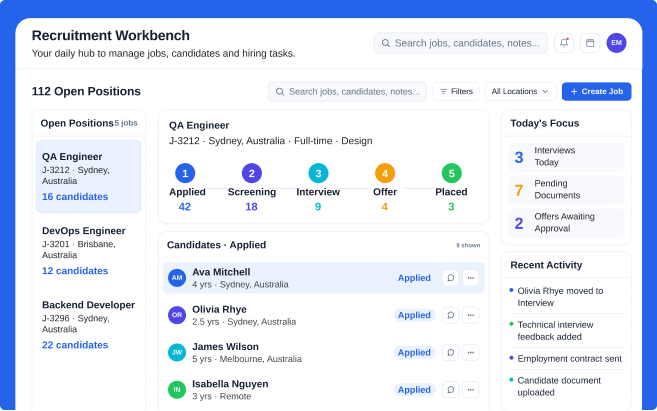
This module covers the whole hiring journey, from posting a job to tracking candidates through to placement, with digital contracts built right in. As part of the broader recruitment workflow modernization, it's made the path from job listing to signed placement a lot smoother.

Payroll and Compliance
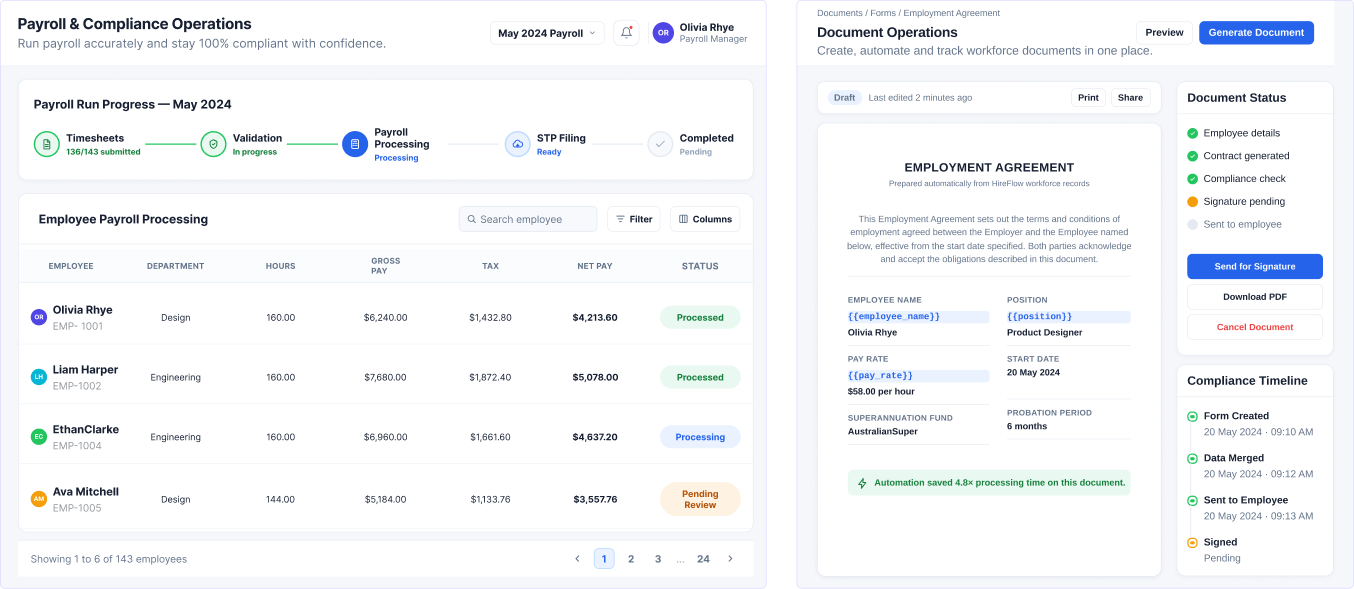
Timesheets, payroll processing, and the compliance reporting Australian businesses need, including STP and superannuation, are all handled inside the platform now as part of ongoing enterprise payroll software modernization. Less manual number-crunching, and less risk of falling behind on regulations.

Document Management and Digital Forms
We built a form builder that lets the team create industry-specific compliance forms on the fly, plus a mail merge tool that pulls employee and client data straight into employment documents automatically.

Reporting and Analytics
With the custom report writer and the dashboards we built, users can pull the reports they need and see their data visually, without having to wait on a developer every time they want a new view.
If your team is juggling recruitment, payroll, or workforce, we'd be glad to talk through what HR management solutions could look like for you.
Technologies Used
Angular 20
We went with Angular to build a front end that could handle multiple separate portals without slowing down, even as we kept adding more features to the platform over time.
ASP.NET Core (C#)
This gave us a secure, fast backend to build the REST APIs on, which matters a lot when you're handling recruitment, payroll, and compliance logic at this scale.
SQL Server
All the recruitment, payroll, and workforce data lives here, and we lean on stored procedures for the heavier queries and reports the business depends on.
Entity Framework
This took a lot of the repetitive database work off our plate, so the team could spend more time on actual business logic instead of writing data access code over and over.
TypeScript 5.8
Using TypeScript across the front end helped us catch mistakes earlier and kept the code quality solid, which matters a lot on a codebase this size, spread across multiple portals.
JWT Authentication
This keeps every API request secure with token-based authentication, so access to sensitive recruitment and payroll data stays locked down the way it should be.
Syncfusion EJ2
Rather than building grids, calendars, and document editors from scratch, we used Syncfusion's components, which saved a good chunk of time on the data-heavy screens.
D3.js
We used D3 to build the interactive dashboards and charts, giving users a much clearer, more immediate view of their data than a static report ever could.
Business Benefits

Less Manual Work
With timesheets, invoicing, and document generation now automated, the team spends a lot less time on repetitive tasks and more time on work that actually matters. Weekly paperwork that used to eat up an afternoon now moves close to 5x faster.

More Accurate Payroll
Now that payroll processing and compliance reporting run through one structured system instead of several disconnected ones, the errors that used to slip through have dropped noticeably. Manual corrections that were once routine each pay cycle are now rare.

Room to Grow
Thanks to the modular setup, lazy loading, and support for multiple organizations, new features and new client businesses can be added without touching what's already working. The platform now supports 250+ organizations on the same system, with no separate build needed for each one.

Staying Compliant, Without the Stress
As Australian regulations shift, whether that's STP or superannuation rules, we keep the platform updated, so the client doesn't have to manage that on their own. That's meant zero missed filings across every compliance update rolled out so far.
Our team has spent 26+ years building and modernizing enterprise systems. If that's the kind of partnership you're looking for, we would welcome the conversation.