
Recognized for AI Excellence at 2026 Globee® Awards - Read More
About the Client
The client is a long-established Australian HRTech and workforce solutions provider serving technical industries such as mining, construction, infrastructure, manufacturing, energy, and government. The enterprise built its reputation on skilled staffing in demanding, safety-conscious sectors.

Client Location
Australia

Engagement Model
Dedicated Team

Team Size and Roles
8 Experts

Industry
HRTech
Business Objectives

The enterprise needed to implement a workforce management modernization solution that could scale with its growth in multiple locations. Leadership wanted operational tasks reduced, reporting made consistent, and data made visible to the people who needed it, without waiting on manual extraction. The broader intent was to rebuild the HRTech platform through expert legacy modernization solutions to support increasing data volume and user activity for years.
Project Brief

When the engagement began, the enterprise was managing workforce data through a combination of spreadsheets and older applications that demanded constant manual attention. Reporting lagged behind actual operations, and no single source gave stakeholders a clear read on what was happening across sites.
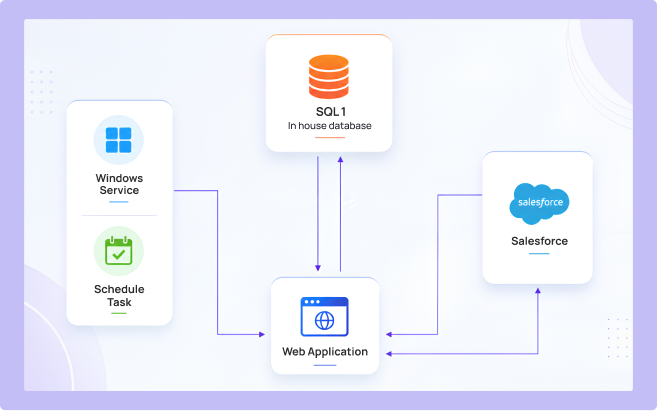
Radixweb assigned a dedicated developer to assess the existing technical landscape and modernize workforce management software, including an integration layer syncing internal systems with Salesforce, an internally used Quantum application, and a separate CNPS system.
Rather than pursuing a costly rebuild, the team focused on targeted app modernization solutions for the workforce management software: automating data flows, strengthening the reporting layer, and introducing interactive dashboards. The work has continued since 2018, evolving alongside the HRTech operational needs.
Client Feedback

Radixweb has been a steady partner in modernizing how we manage workforce data. The reporting improvements alone changed how quickly our teams can act on what they're seeing.
Rather than pushing for a full platform rebuild, we focused on practical, incremental improvements, automation, cleaner data flow, and dashboards that stakeholders use. That approach built trust and kept the engagement productive year after year.

Mounil Shah
Key Challenges

- Workforce data was scattered on spreadsheets and disconnected manual processes. Consistent tracking across business locations was difficult to maintain.
- Reporting depended on manual extraction and compilation, which slowed down decision-making and left management working with outdated information.
- The existing Salesforce integration ran on an aging MVC application and background services; a common blocker in technical staffing software modernization, where legacy architecture wasn't built for growing data volumes.
- Multiple business locations followed inconsistent workflows. It created friction whenever data needed to be reconciled or compared centrally, which highlighted the need for workflow automation for legacy applications.
- The client needed continuous improvement without downtime, which ruled out a disruptive rebuild in favor of steady, incremental delivery.
Solutions Delivered

Workforce Management Platform Development
Radixweb built and refined custom modules addressing the specific operational needs of workforce administration. This included configuration tools, administrative modules, and functionality customized to how the enterprise actually runs its day-to-day staffing and reporting processes across sites.

Automated Data Synchronization
The team replaced manual data handling with automated synchronization between internal systems and Salesforce, using AWS Lambda for background processes. This workforce management automation reduced the administrative burden on staff and minimized the errors that come with repeated manual entry.

Interactive Reporting and Dashboards
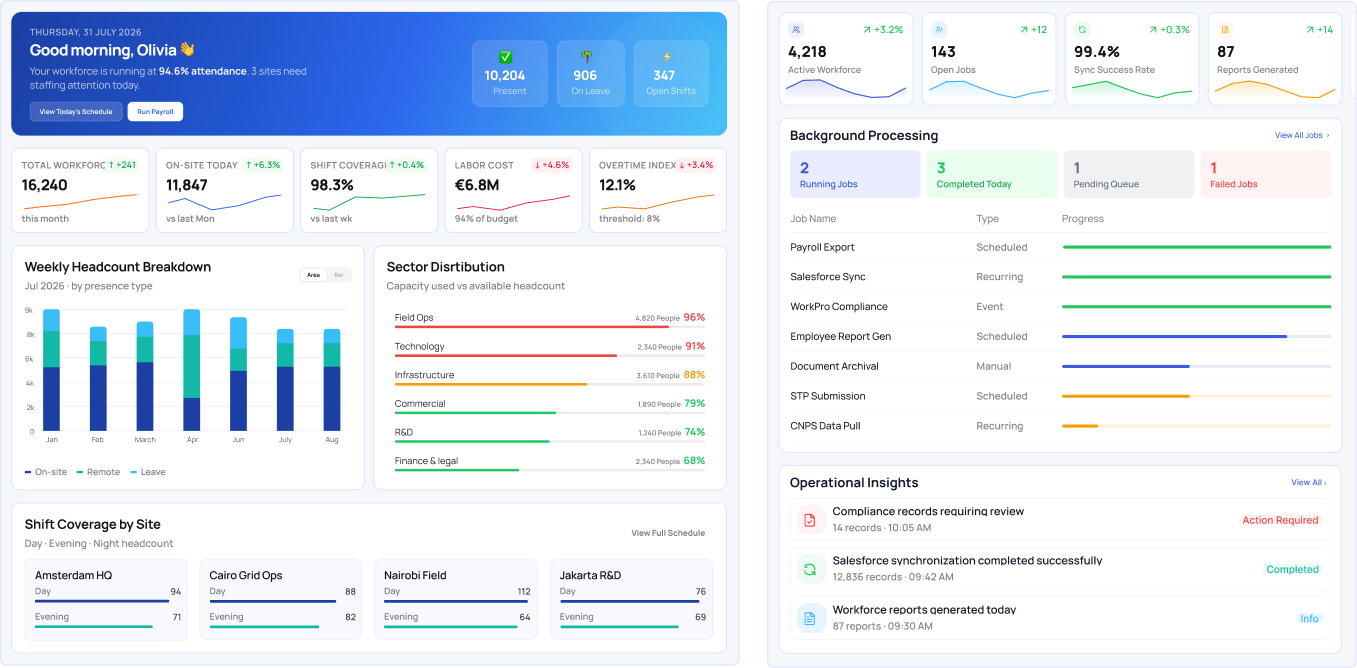
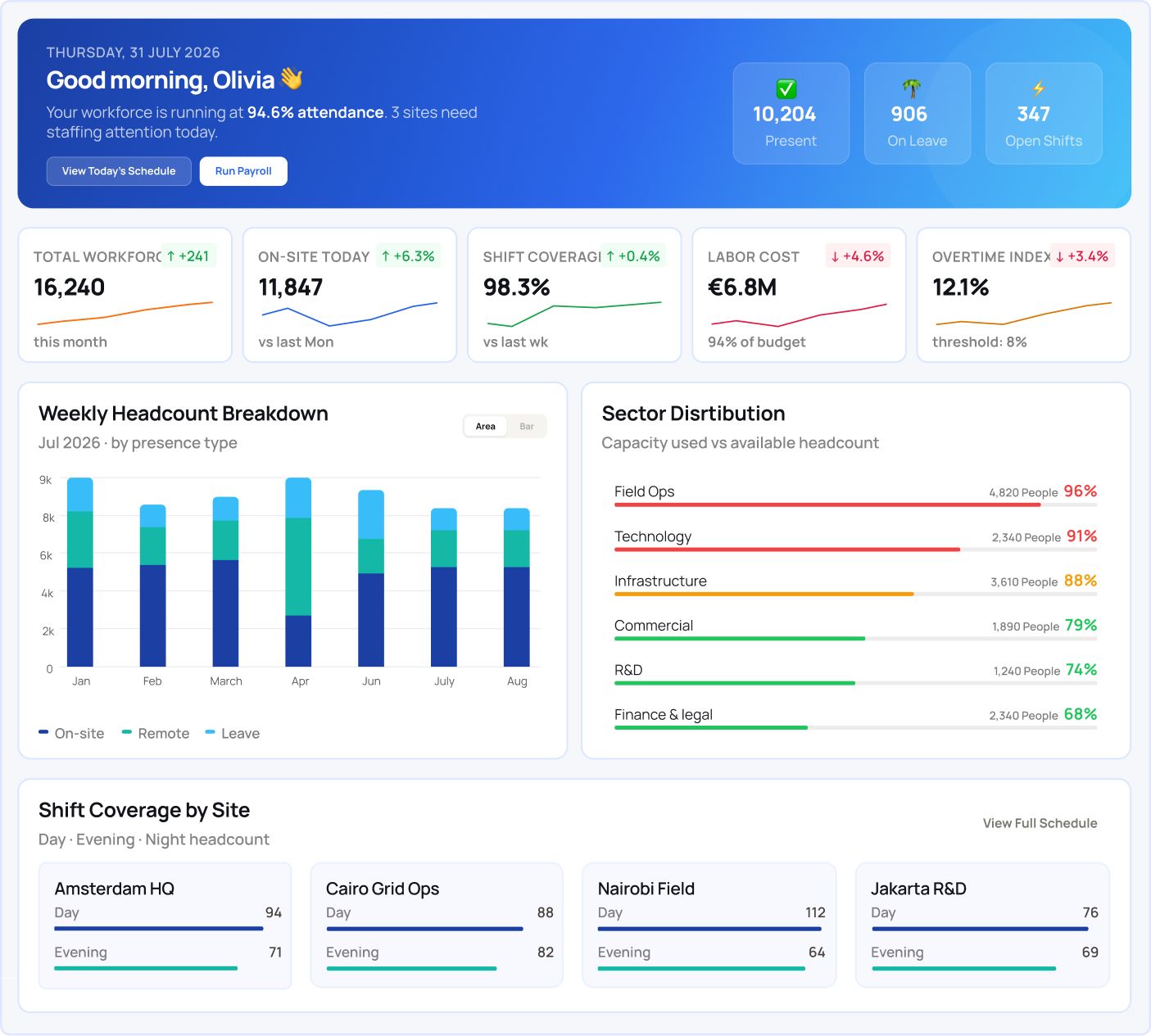
A custom reporting engine, paired with DevXpress, gave stakeholders centralized, drill-down access to workforce data. Instead of waiting on prepared reports, decision-makers could view current information directly on the HRTech system and act on it without delay.

Background Job Processing
For tasks too resource-intensive to run in real time, Radixweb implemented background job processing. This kept the applications responsive for end users while handling larger data operations separately, without disrupting daily use.

Security Hardening Across Applications
The team introduced JWT token-based authentication, encrypted communication over HTTPS, and input validation to guard against SQL injection and cross-site scripting. Session management was tightened to align with enterprise-grade security expectations.

Ongoing Production Support
Beyond initial delivery, Radixweb maintained the applications through continuous monitoring, bug resolution, and performance tuning. This kept workforce operations systems stable and allowed room for new feature requests as the enterprise's needs shifted over time.
If your organization is managing legacy workforce data, reach out to discuss how a dedicated engineering approach could work for your organization.
Technologies Used
ASP.NET (C#)
Used in all three apps for backend logic and business workflows, ASP.NET Core provided a dependable framework for enterprise-grade development. Its compatibility with existing Microsoft-based infrastructure made it a good choice for an organization already operating within that ecosystem.
Angular
Angular powered the frontend of the Quantum app. It gave the enterprise a responsive, component-based interface for a more interactive user experience and kept the codebase organized and easier to maintain as requirements changed.
SQL Server
SQL Server served as the primary data store for all three HRTech apps for handling operational data, reporting views, and integration data. Its strong integration capabilities made it well suited to the enterprise's existing technical environment.
Salesforce APIs
Salesforce APIs enabled secure, standardized data exchange between internal systems and the Salesforce platform. Using them, workforce data stayed consistent across systems without requiring duplicate manual entry.
DevExpress
DevExpress formed the backbone of the reporting layer, which gave stakeholders interactive dashboards and self-service analytics. It scaled with growing data volumes without requiring structural changes to the underlying applications.
Third-Party Integrations

- Calendly – Enables candidates and recruiters to schedule interviews and meetings through an online self-service booking system.
- Microsoft Bookings – Provides appointment scheduling and calendar management using Microsoft 365.
- Referoo – Automates employment reference checks during the candidate onboarding process.
- VSure – Performs identity verification and visa/work-right validation for employees.
- WorkPro – Manages compliance checks, workplace safety training, and onboarding requirements.
- Secured Signing – Supports secure electronic document signing for contracts and onboarding forms.
- OZEDI – Processes Superannuation payments and supports Australia's Payday Super requirements.
- QuickSuper – Integrates with Superannuation clearing houses to simplify employer contribution processing.
- Single Touch Payroll (STP) – Reports payroll information directly to the Australian Taxation Office (ATO).
- Xero, MYOB, QuickBooks, Attache, Epicor, Exo, GreenTree, NetSuite, Sage, TechnologyOne, Tencia, Wiise, Microsoft Dynamics AX, Dynamics GP, and Business Central – Export payroll and financial data to accounting and ERP systems for General Ledger integration.
- Broadbean – Publishes job advertisements across multiple job boards from a single platform.
- IDIBU / Aptrack – Supports job posting and applicant tracking throughout the recruitment process.
- LiveHire – Manages talent pools, candidate engagement, and recruitment campaigns.
- Shazamme – Integrates job listings with external career sites and job boards.
- MessageMedia – Sends SMS notifications to candidates and employees for recruitment and operational communications.
- OAuth 2.0 – Provides secure authentication and authorization for third-party application integrations.
Business Benefits

Sustained Long-Term Partnership
This engagement for legacy workforce management software modernization has been ongoing since 2018, which reflects a level of trust built through consistent delivery. Each HRTech app was modernized without disrupting daily operations. That continuity gave the client a technical partner familiar with its systems, its people, and its long-term direction.

Modernized Application Portfolio
Three distinct applications, the integration layer, Quantum, and CNPS, were modernized rather than replaced outright. This measured approach protected the enterprise from the cost and risk of a full rebuild but still delivered meaningful gains in scalability, maintainability, and user experience.

Faster, Centralized Decision-Making
Reporting that once depended on manual extraction now runs through centralized dashboards with drill-down access. Management can view current workforce data directly, rather than waiting on prepared spreadsheets. This shift reduced report preparation time significantly and gave leadership more time for analysis and strategic planning.

Reduced Manual Burden Across Teams
Automated synchronization and background job processing took over the repetitive work that previously consumed staff hours. With zero recommendations declined by the client, every suggested improvement, from automation to CI/CD adoption, was implemented and contributed to lasting operational efficiency and higher employee satisfaction.
Explore More Case Studies
If your business is facing similar friction, we're ready to talk about what a practical modernization path could look like for you.