On this page
- Software Development Statistics [Editor’s Choice]
- Software Development Market Overview
- Software Developer Demographic Stats
- Statistics of Software Development Industry [Generic]
- Software Development Trends and Statistics 2026
- Time and Cost of Software Development Statistics
- Statistics of Technologies Used in Software Development
- Stats of Software Development Programming
- Software Development Statistics and Facts in General
- Software Development Statistics for Various Industries
- The Future of Software Development
Quick Overview: In this tech-revolving industry, software development stands as a cornerstone. It powers everything from our smartphones to complex enterprise systems, irrespective of industry domains. As we navigate through the digital age, it's essential to understand the landscape of software development. This blog aims to provide a captivating overview of software development statistics in 2026 that shed light on trends, practices, and the impact of this dynamic field.
Software development is driving the global digital economy. According to industry reports, over 90% of enterprises now rely on custom software to run core operations, and global software spending is projected to exceed $1 trillion annually. From mobile apps to large-scale enterprise platforms, software underpins innovation across every industry.
The software development sector is among the fastest-growing technology domains, fueled by rapid adoption of Artificial Intelligence (AI), Machine Learning (ML), IoT, cloud computing, and automation. Today, more than 70% of organizations prioritize software-led digital transformation to stay competitive, reduce operational costs, and improve customer experience.
In this digital era, software plays a pivotal role in enabling companies to create automation tools, reduce costs, and enhance customer experience, serving as the glue that binds these capabilities together. To understand the scale, direction, and impact of this evolution, this blog highlights key software development statistics that reflect current trends shaping the future of technology-driven businesses.
Let’s read it together!

Software Development Statistics 2026 [Editor’s Choice]
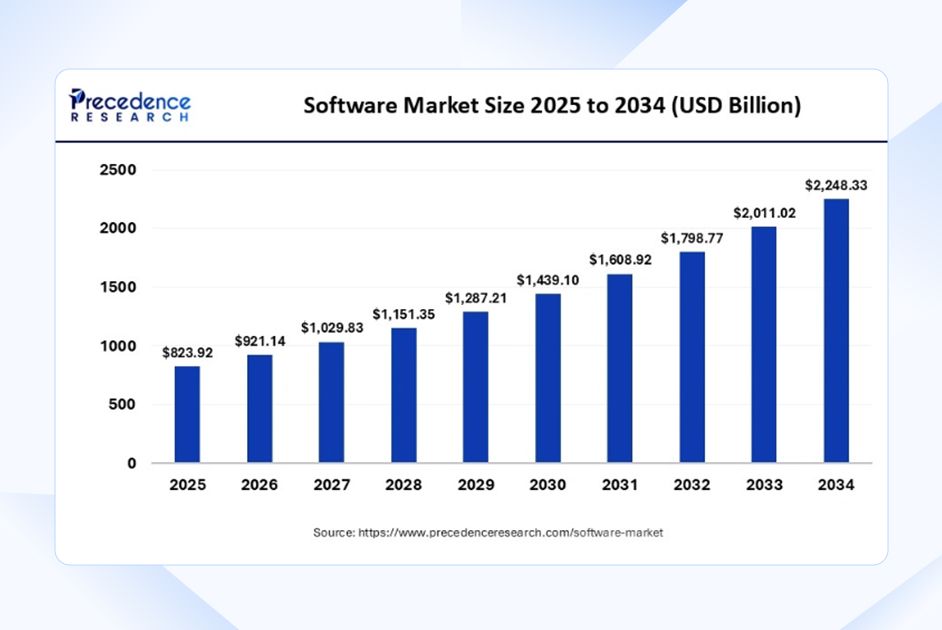
- The global software market was valued at USD 736.96 billion in 2024 and is projected to surge to approximately USD 2,248.33 billion by 2034, growing at a robust compound annual growth rate (CAGR) of 11.8% throughout the forecast period.
- IT spending on enterprise software exceeded USD 1 trillion globally, increasing by 12% in 2024, driven by digital transformation initiatives.
- 84.7% of software development projects are based on enterprise applications. 53.6% of software development projects are based on business automation, and 38.50% are eCommerce.
- Software development market is expected to reach $1039 million by 2027 with a CAGR of $22.54% from 2020 to 2027.
- Around 54% of software engineers claim to be more productive when they work from home.
- Software developers and programmers dominate the global IT ecosystem, accounting for 39% of all developer roles worldwide. This is followed by CIOs, CTOs, and IT managers at 12%, computer and data science students at 12%, technology and engineering team leads at 11.6%, and system administrators representing 8.65% of the workforce.
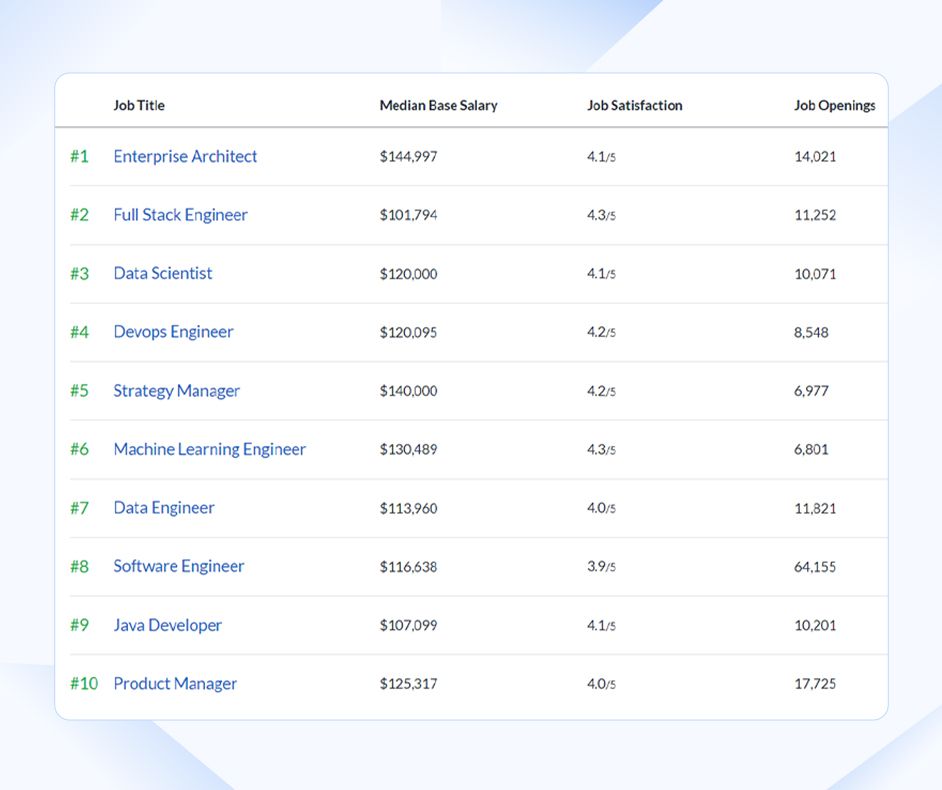
- The ongoing talent shortage continues to drive compensation upward. In the United States, the median annual salary for software developers now exceeds USD 130,000, translating to approximately USD 62.58 per hour, reflecting the premium placed on skilled engineering talent.
- Hiring timelines remain a major challenge for organizations. Nearly 85% of IT companies report taking more than 90 days to fill a software developer role, creating delays in project execution and digital initiatives.
- On average, organizations require 4.5 months to onboard a full-time senior software developer, prompting many businesses to adopt alternative engagement models. As a result, companies increasingly choose dedicated development teams that can be deployed within 24–48 hours, accelerating time to value.
- Custom software development continues to deliver measurable business impact. Over 80% of organizations report significant growth after investing in custom software development solutions, enabling better alignment with business objectives and operational efficiency.
- Companies leveraging custom-built software also see tangible performance gains, including a 5% increase in customer retention and profitability improvements ranging from 25% to as high as 95%, depending on scale and execution.
- From a cost perspective, software development projects typically range between USD 15,000 and USD 100,000 or more, with final investment influenced by factors such as product complexity, feature scope, technology stack, and integration requirements.
- Enterprise applications lead software development, accounting for 84.7% of all projects.
- Business automation drives demand, with 53.6% of software projects focused on process optimization.
- Retail and eCommerce remain key adopters, representing 38.5% of development initiatives.
- The cost of software development projects ranges from $3,000 to $150,000.
- The employment of software developers in the US will grow 22% in the US alone by 2029.
- The complex software development costs up to $1 million.
- JavaScript is the most used programming language in the world, with 49.47% usage.
- The median annual salary for software developers in the US is $110,140.
Software Development Market Overview
Do you know how huge the software development market is? What is the future of software development? Let’s address some of the most searched questions that revolve around the software development market.
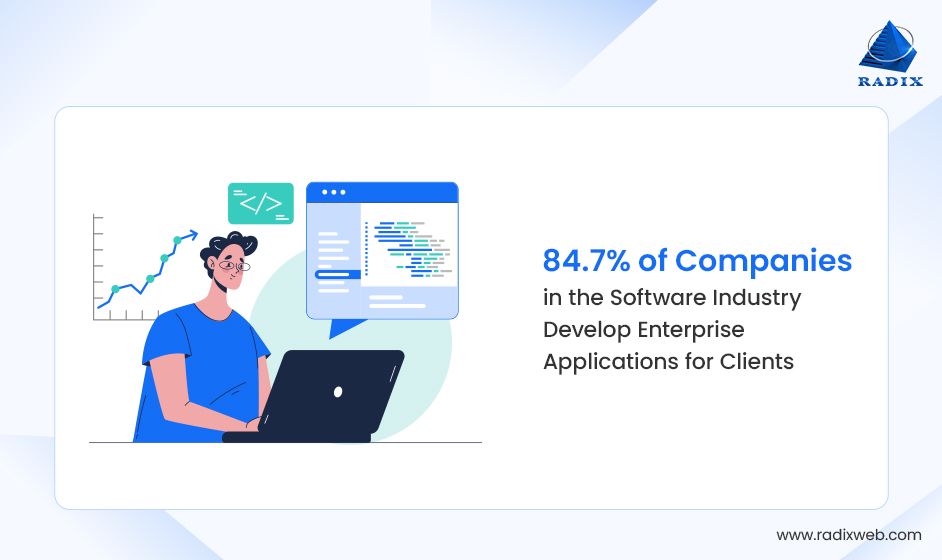
- In the software industry, 84.70% of surveyed companies specialize in developing Enterprise Applications for clients.
- 53.90% of participating companies take on software projects focused on business process automation.
- Approximately 15.40% of companies provide Customer Relationship Management software solutions.
- 7.70% of software development services providers assist their clients in building, managing, and maintaining educational software.
- 38.50% of the surveyed developers are involved in back-end software development and front-end web app development solutions for eCommerce owners.
- The software testing segment is projected to account for over 38% of the global software engineering market by 2032, underscoring its growing importance in quality, security, and release velocity.
- The global IT services outsourcing market was valued at USD 744.6 billion in 2024 and is expected to grow at a CAGR of 8.6% between 2025 and 2030. This expansion is fueled by rapid technological change, heightened cybersecurity priorities, and widespread digital transformation driving demand for specialized external expertise.
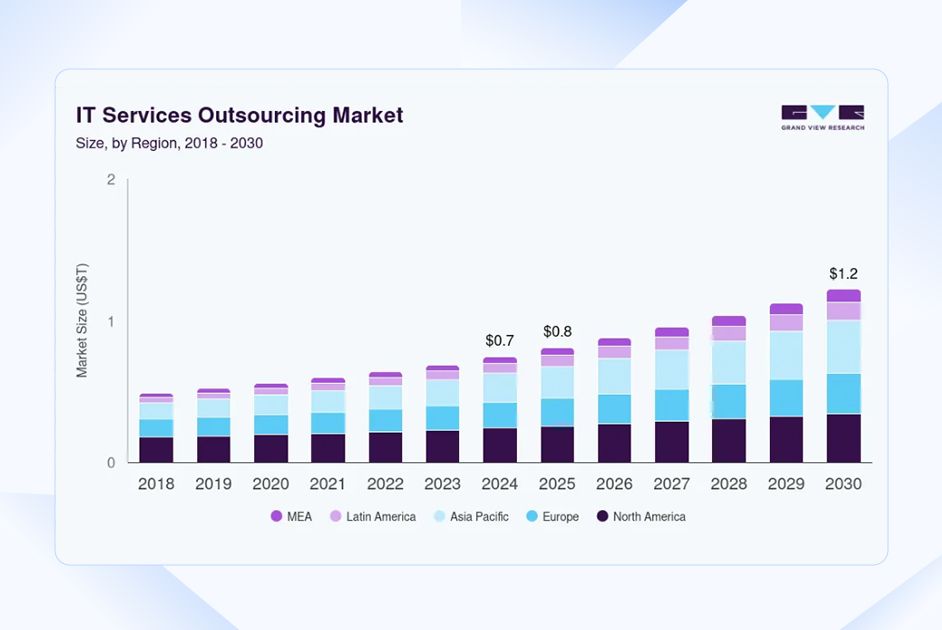
- 72% of organizations outsource software development to access skilled talent (32%), respond faster to rising customer expectations (35%), reduce costs (34%), and enhance overall software quality and performance (33%).
Software Developer Demographic Statistics
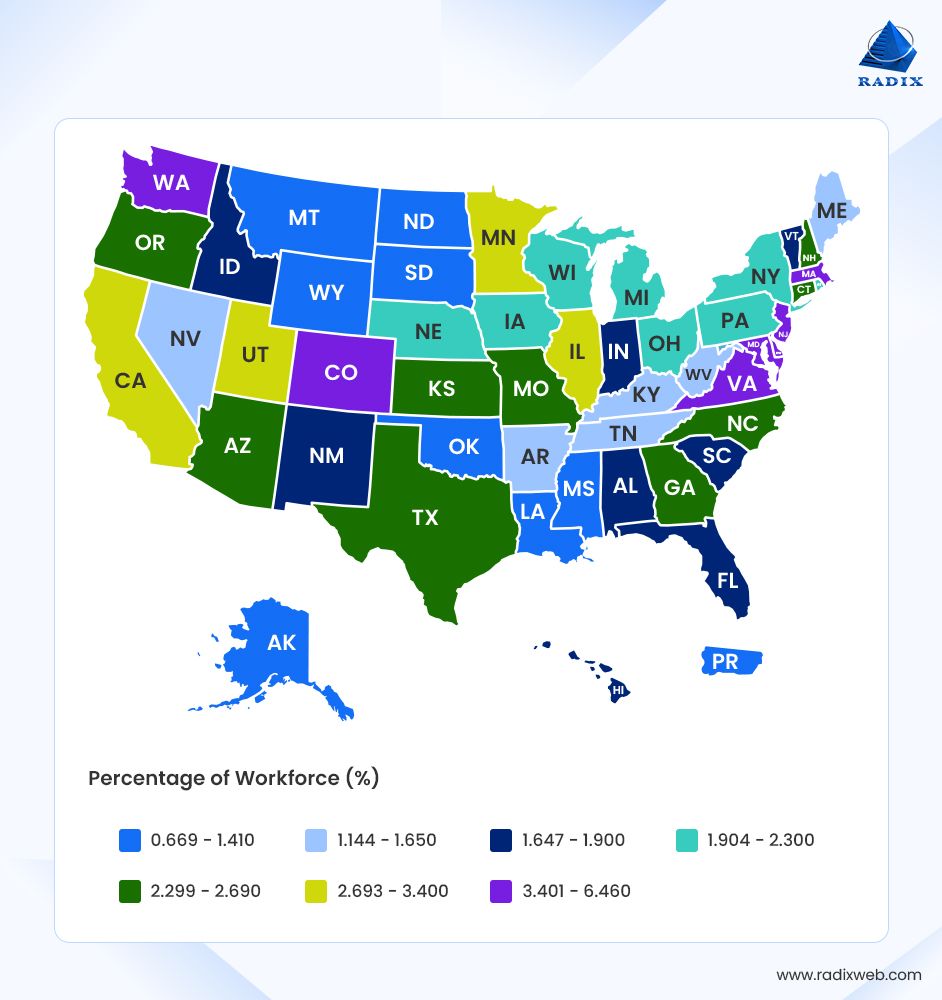
(https://dqydj.com/number-of-developers-in-america-and-per-state/)
- According to the Developer Nation Survey, 43% of professionals in the software development industry identify as programmers or software developers, making it the largest role category. Other prominent roles include computer and data science students, tech and engineering team leads, software architects, machine learning developers, and data engineers.
- These findings align with DataUSA estimates, which place the U.S. software developer workforce at approximately 1.42 million professionals. The majority are employed within the computer systems design sector, followed by architectural, engineering, and related services as the second-largest employment segment.
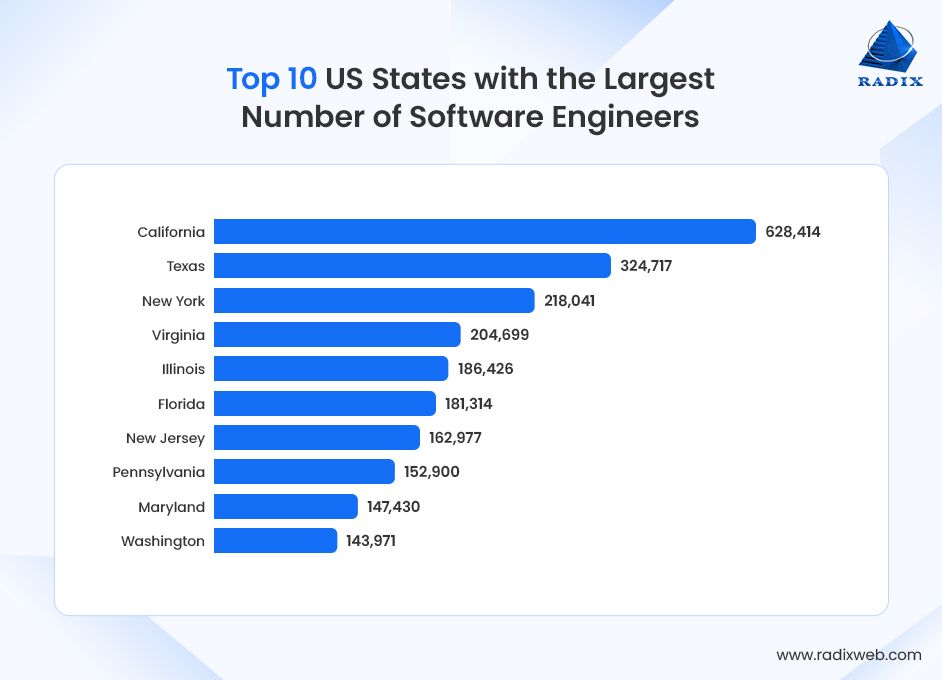
- Washington State boasts the highest-paid software engineers in the United States, earning an impressive $105,406 annually. Additionally, it leads with the highest percentage of engineers (6.42%) compared to any other state.
- The global population of software developers is estimated at approximately 28.7 million worldwide in 2025. Growth projections indicate this could reach 45 million by 2030, reflecting strong and sustained demand for development talent across regions.
- Software development remains male-dominated, with around 80 % of developers identifying as male and only 19 % identifying as female in recent global surveys.
- Developer community surveys also show female representation ranging roughly 17 % – 22 %, underlining a persistent gender gap in the profession.
- North America led the global application development market in 2024, capturing 33.72% of the total share, valued at approximately USD 37.5 billion. In contrast, the Asia–Pacific region is poised for the fastest growth between 2025 and 2032, driven by strong IT infrastructure investments and large-scale digital initiatives across China, Japan, India, and South Korea.
- The average age of software developers in the US is 39.8 years old, and 54.2% of them are white.
- Surprisingly, only 25% of software developers hold degrees in computer engineering or computer science.
- Data indicates that nearly 69% of software developers hold at least a bachelor’s degree or higher, demonstrating the profession’s strong emphasis on formal education and specialized training.
- Approximately 45 % of developers began coding within the past decade, reflecting a relatively recent and rapid influx of talent into the industry.
- The United States accounts for a significant 33% of the global tech market.
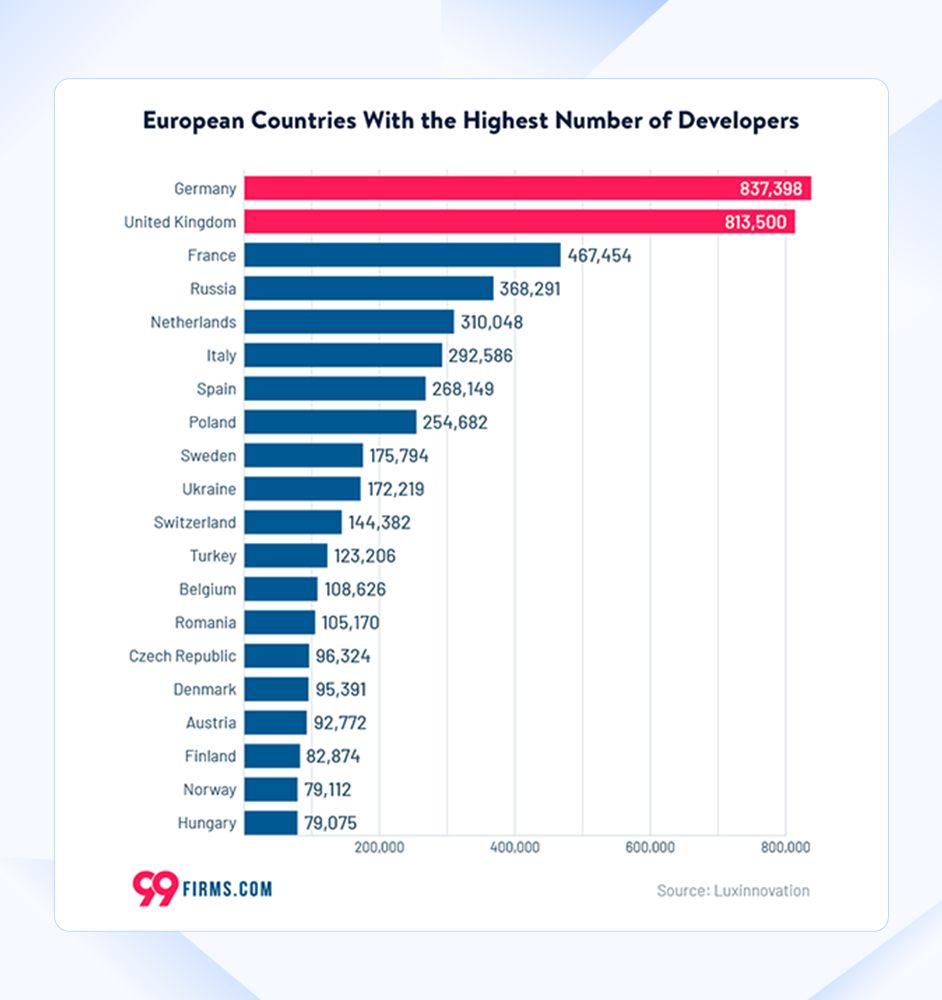
- In Europe, Germany takes the lead with the highest number of software developers, boasting a remarkable 837,398 professionals.
- 91.5% of software engineers worldwide are men.
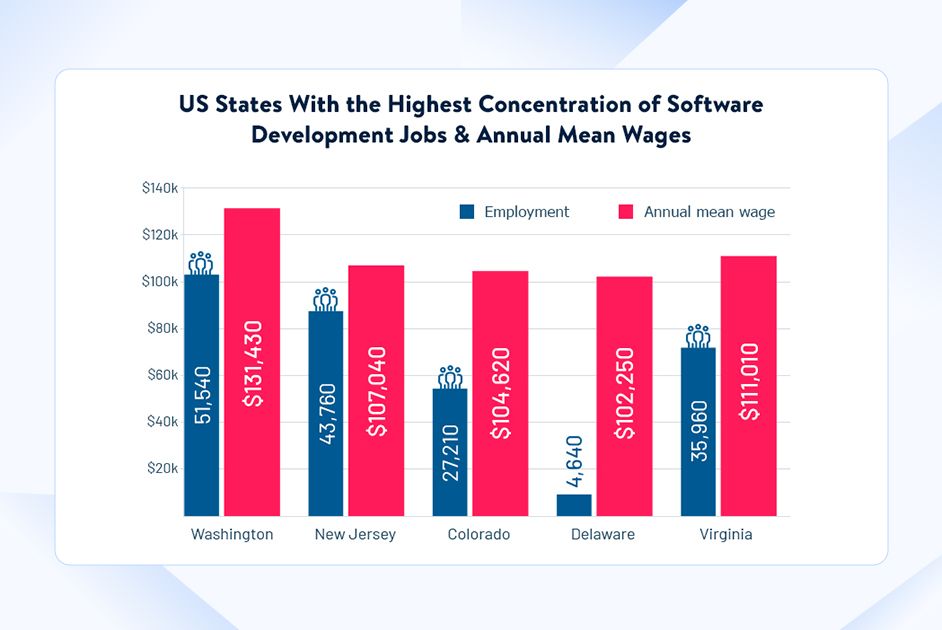
- Washington stands out as the state with the highest concentration of software development jobs in the US, boasting an impressive 51,540 positions.

Software Development Industry Statistics
The software development industry is growing rapidly, fueled by digital transformation, cloud adoption, and AI innovation. Rising global software spending reflects how software has become a critical strategic investment across industries.
- Despite the vast size of the US tech and software market, a significant 67% of technology spending takes place overseas, indicating the global appeal and demand for tech products and services.
- The global Software-as-a-Service (SaaS) market is forecast to grow from around USD 375.6 billion in 2026 to well over USD 1.4 trillion by 2034, at a strong CAGR, highlighting SaaS as a major driver of software industry growth.
- Adoption of AI tools within the software development lifecycle has surged, with around 84% of developers using or planning to use AI tools in workflows as of recent industry surveys. However, nearly 46% still express skepticism about the accuracy of AI outputs, underlining ongoing maturation of AI integration in software practices.
- Low-code and no-code development platforms are transitioning from niche to mainstream, with the low-code market expected to reach USD 44.5 billion by 2026, empowering faster delivery cycles and broader involvement by business stakeholders in software creation.
- Emerging markets such as Asia-Pacific are among the fastest growing regions for software development services and talent expansion, supported by increased cloud adoption, innovation hubs, and digital initiatives in enterprise tech stacks.
- AI-led innovation remains the leading force shaping software product roadmaps and development investments, with CIO surveys indicating over 90% of organizations planning to increase AI spending in 2026.
- Asia Pacific is experiencing a rapid rise in the software testing market, projected to achieve an impressive 8% Compound Annual Growth Rate (CAGR) by 2026.
- In terms of the number of software developers by country, Germany takes the lead with a substantial workforce of 837,389 professionals in this field. The United Kingdom closely follows as the runner-up, boasting 813,500 developers, while France secures the third position with 467,454 skilled developers. On the other end of the spectrum, Hungary and Norway stand out with 79,075 and 79,112 developers, respectively, as evidenced by software development job statistics.
Software Development Trends and Statistics 2026
Software developer employment will grow 22% in the US alone by 2029.
There are almost 1.46 million software developers in the US, although this data varies based on the different criteria set by various organizations.
Approximately 80% of the world's top 500 companies leverage offshore teams for their daily operations, highlighting the widespread adoption of this practice.
India holds an esteemed position as the leading global destination for outsourcing software requirements. Although emerging markets in Asia and Latin America show growing demand for offshoring, countries like the Philippines are establishing themselves as significant offshoring hubs. Nevertheless, based on offshore software engineering statistics, India is unlikely to be surpassed anytime soon due to its competitive prices, favorable IT policies, and exceptional services, solidifying its status as a top choice for offshoring.
Nearly 69% of businesses have embraced cloud computing technology.
Research indicates a growing momentum, with an additional 18% of companies planning to adopt cloud solutions. This trend in software development has led organizations to experience a remarkable 53% faster revenue growth.
Approximately 84% of developers proudly identify themselves as active contributors to open-source software.
Open-source code, prevalent software development trends, allows engineers to actively participate by utilizing, modifying, and enhancing the source code. Impressively, only 3% of developers have never contributed, while another 13% contribute less than once per year, as supported by software development statistics.
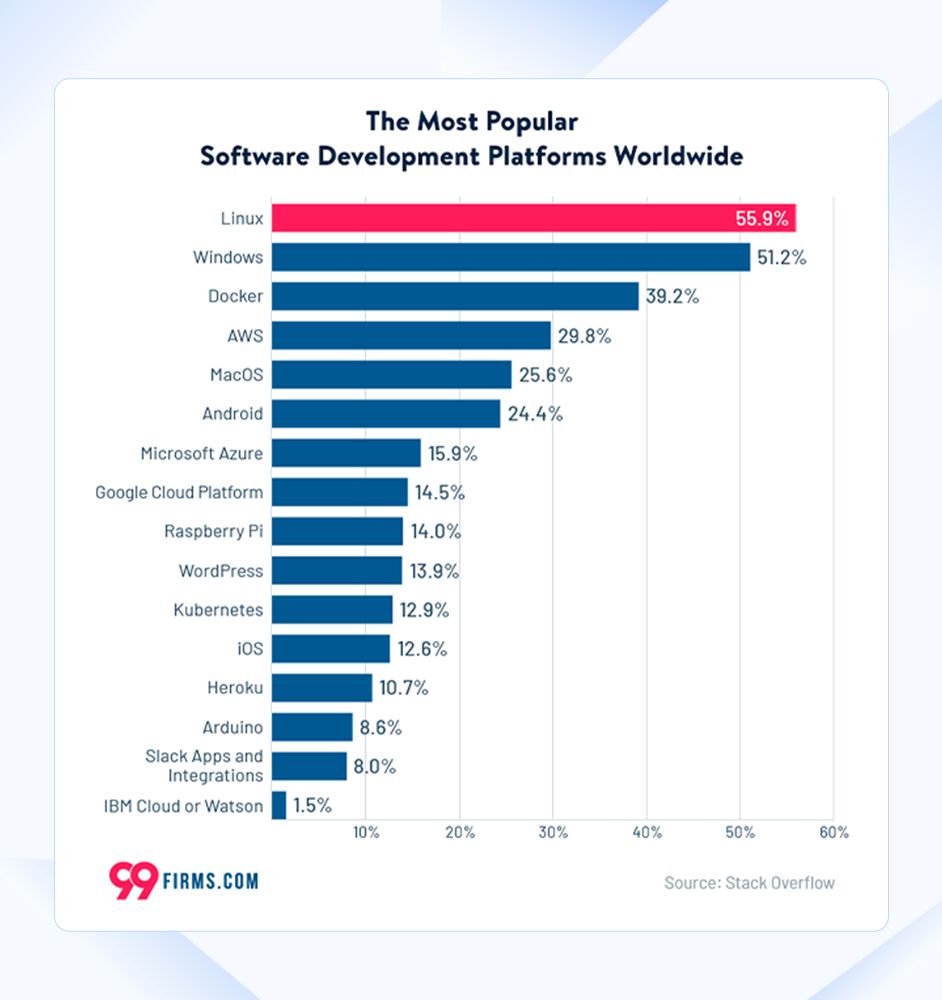
Linux has consistently maintained its status as the most favored software development platform worldwide, reigning as the top choice for 55.9% of professional developers.
While Linux's dominance remains unyielding, Windows has experienced a surge in popularity, with 51.2% of developers opting for it. With its robust open-source nature, Linux has been a driving force in software engineering for years, exemplified by its widespread use in Android phones and Internet of Things (IoT) devices.
Python stands out as the fastest-growing programming language, with an impressive 70% of ML developers choosing it for their projects.
With over six million software engineers currently utilizing Python, its open-source nature has facilitated widespread adoption, particularly in the realm of machine learning. ML developers benefit from easy access to essential libraries like PyTorch, NumPy, and TensorFlow, while Python also excels in automating backend systems, as confirmed by software industry statistics. In terms of Java, though not the fastest-growing, it remains a strong contender, ranking as the third-largest programming language community with 9.4 million Java developers.
When it comes to software project management tools, JIRA emerges as the most commonly used option, capturing a significant 39.03% share.
In recent years, the majority of companies have embraced agile methodologies, leading them to seek effective project management solutions. Atlassian's comprehensive package, featuring Jira, Confluence, and Bitbucket, stands firmly at the top with an 18.24% market share. Following closely is Microsoft Project with 6.01% and Airtable with 6.01%.
Web-based solutions accelerate adoption through flexibility and cost efficiency
Remote access, real-time data availability, and the absence of hardware-related costs are expected to fuel strong growth in web-based solutions, registering a CAGR of 21.1% from 2025 to 2030.
Mobile app development emerges as the fastest-growing segment
Accounting for 38% of the market share in 2024, mobile app development is poised for rapid growth as businesses increasingly adopt mobile-first strategies to better engage and retain users.
Desktop development remains critical for performance-intensive use cases
Despite the rise of web and mobile platforms, desktop applications continue to play a vital role, with 53% of developers still writing code for desktop environments, particularly for compute-heavy and specialized workloads.
Rust leads in developer admiration, while JavaScript and Python dominate demand
JavaScript, Python, and SQL remain the most sought-after programming languages, while Rust continues to top developer admiration rankings, achieving an 83% admiration score in 2024.
JavaScript and Python remain the world’s most popular languages
Based on combined code usage and discussion frequency, JavaScript, Python, Java, PHP, and C ranked as the most widely used programming languages in 2024.
Python surpasses JavaScript as the most used language
After a decade-long lead by JavaScript, Python has taken the top position, while TypeScript continues its rapid rise, securing its place as the third most used language globally.
Large developer communities drive language adoption
Language popularity continues to scale with community size. JavaScript leads with 28 million developers, followed by Java (23.2M) and Python (22.9M). Rust adds nearly 1 million developers annually, reaching 5.1 million, while Swift and Ruby see accelerated adoption, partly driven by AI-assisted development tools.
React and Node.Js dominate modern web development stacks
Among professional developers, React (41.6%) leads frontend adoption, followed by jQuery, Angular, Next.js, and Vue.js. On the backend, Node.js (40.7%) tops usage, with strong adoption of ASP.NET Core, Express, ASP.NET, and Spring Boot.
Python tops recruiter demand across global hiring
Python is the most in-demand programming language, with 42% of recruiters seeking Python expertise, followed closely by JavaScript, Java, C#, and SQL.
Python continues to lead global job demand
As of October 2025, Python accounts for more than 51,000 active job openings, reinforcing its position as the most in-demand programming language worldwide.

Time and Cost of Software Development Statistics
Software development timelines and costs vary widely based on complexity and requirements. Most projects take several months to complete, with costs ranging from modest budgets for basic solutions to significantly higher investments for complex, enterprise-grade software.
- On average, companies allocate 63% of their software development costs to designing and constructing new software.
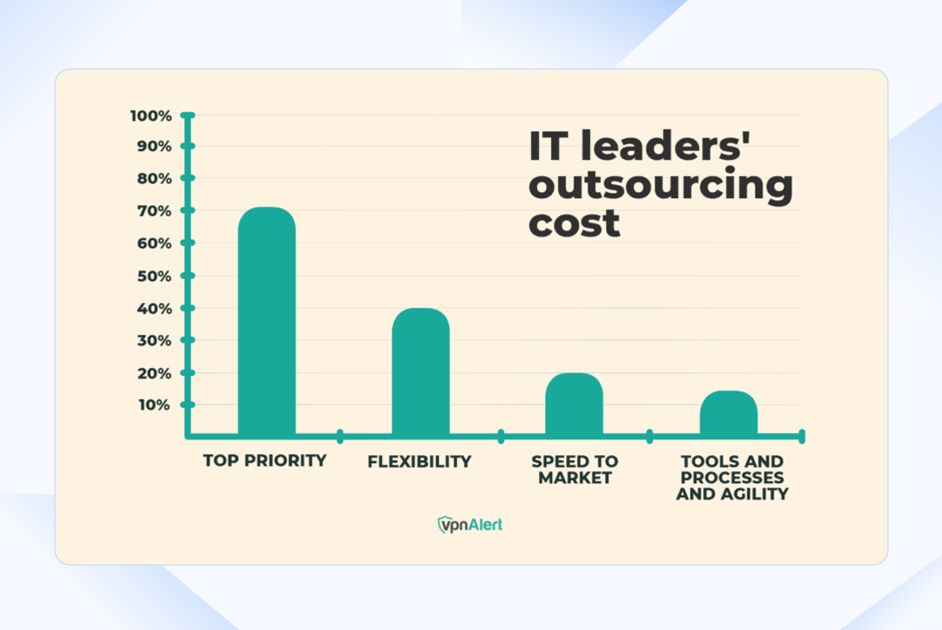
- Almost one in four companies prefer to choose software development outsourcing services for their projects. The primary reason is to reduce cost, flexibility, faster market time, and a vast pool of talent.
- Satisfaction levels for outsourced development remain relatively low, with only 17.8% of companies reporting absolute satisfaction with the work delivered.
- The typical software development project takes approximately 4.5 months to complete and costs $36,000.
- About 23% of projects surpass the $60,000 mark in development costs.
- Once the software is built, ongoing maintenance expenses amount to roughly 15% to 20% of the initial development cost.
- Around 61.60% of development companies have established an average development time period of 4-6 months, while 10.81% of software firms deliver refined software maintenance and support, taking more than 6 months.
- 10.81% of the software development companies deliver the finest software with maintenance and support, in a time span of more than 6 months.
- Software development costs for a small software or app are $30,000 to $45,000. The medium-sized software development project costs from $70,000 to $100,000, and for a large-scale complex application, $100,000 or more.
- CMS software development costs anywhere from $20,000 to $50,000 for a basic platform with design, a few custom features, configuration, etc.
- ERP software development costs $100,000 or more, depending on the number of features and size of the company.
- Software development costs for a custom eCommerce system built from scratch start at $50,000. It goes up to hundreds of thousands of dollars for more complex solutions.
- SaaS development costs from $25,000 to $100,000, and even more for complex SaaS products.
- Average software development costs vary widely based on complexity, features, and scale, but commonly reported ranges include:
- $30,000 to $300,000+ for standard custom applications.
- $50,000 to $1,000,000 for medium- to large-scale systems, particularly enterprise-grade solutions.
- Smaller projects or MVP-level development may range from approximately $4,800 to $25,600.
- Typical software development cost categories by complexity level include:
- $30,000–$80,000 for basic applications
- $80,000–$250,000 for moderate complexity solutions
- $250,000–$600,000+ for advanced or enterprise software.
Statistics of Technologies Used in Software Development
In the software development industry, there are more than 700 programming languages to choose from. Hence, while choosing the right programming language, businesses and software developers must consider many project aspects.
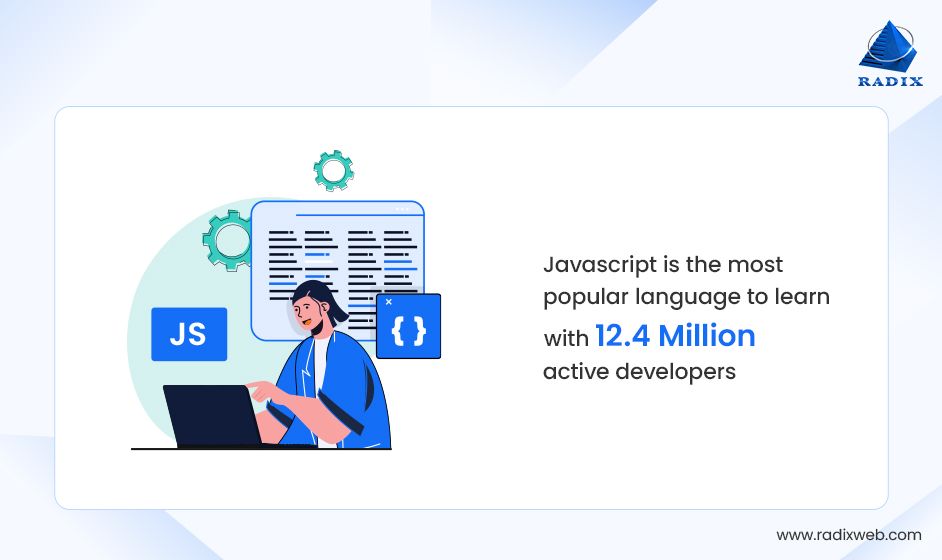
In this section, we are going to cover the most popular software development technologies and tools used.
- Nearly one in three venture capital firms backed AI-focused companies in 2024, with total investments surpassing USD 100 billion and achieving over 80% year-over-year growth.
- 79% of organizations are actively adopting or piloting AI and machine learning PaaS solutions, signaling rapid enterprise acceptance of AI-driven platforms.
- 88% of companies report improved profitability as a direct result of AI- and automation-led digital transformation initiatives, including the adoption of generative AI.
- Organizations deploying AI-driven data breach prevention—including attack surface management, red teaming, and security posture management—can reduce data breach costs by up to USD 2.2 million.
- Generative AI is the most widely implemented AI capability, with 29% of organizations actively deploying generative AI solutions across business functions.
- When selecting AI technologies, 32% of business leaders prefer proprietary AI, 32% report no strong preference, and 29% favor open-source AI. Among open-source adopters, 63% cite cost efficiency as the primary driver.
- 61% of CEOs report active adoption of AI agents, with organizations preparing to scale AI agent across operations.
- IT service management (47%) and customer service and support automation (40%) rank as the leading AI investment areas, reflecting a focus on operational efficiency and customer experience.
- AI initiatives are most mature and widely scaled within IT functions (28%), followed by operations (11%), marketing (10%), customer service (8%), and cybersecurity (8%).
- Nearly three-quarters of organizations report positive ROI from generative AI, with 43% stating expectations are being met and 31% indicating performance exceeds projected returns.
- Only 9% of organizations are considered AI-mature, meaning they have invested in durable, foundational AI capabilities that enable secure, scalable, and future-ready AI adoption.
- 78% of organizations plan to increase AI investments in the next fiscal year, signaling sustained momentum in enterprise AI adoption.
- The global cloud computing market reached USD 752.4 billion in 2024 and is expected to expand at a CAGR of 20.4% from 2025 to 2030, driven by rising demand for scalable, high-performance cloud infrastructure.
- Amazon Web Services (AWS) remains the leading cloud platform among developers, with 48% reporting usage in 2024, followed by Microsoft Azure, adopted by 27.8% of developers worldwide.
- Hybrid cloud has become the dominant deployment model, with 70% of organizations leveraging a mix of public and private cloud environments to balance scalability, security, and control.
- To manage growing cloud complexity, 60% of organizations rely on managed service providers for operational support across their public cloud workloads.
- The global data analytics market was valued at nearly USD 65 billion in 2024 and is expected to surge to approximately USD 402 billion by 2032, growing at a strong CAGR of 25.5% over the forecast period.
- 89% of organizations report improved profitability from data- and analytics-driven digital transformation initiatives, marking a 23% increase compared to 2023 and underscoring the growing business value of analytics investments.
- The global IoT market is expected to expand at a compound annual growth rate of 11.4% between 2024 and 2030, driven by increased adoption across industries.
- The number of connected IoT devices rose by approximately 13% year over year, exceeding 18 billion devices in 2024, while enterprise IoT spending increased by 10%, reflecting stronger commercial investment in connected ecosystems.
- The second programming language is Python, with 9 million active developers.
- Java comes in third place, with 8.2 million developers.
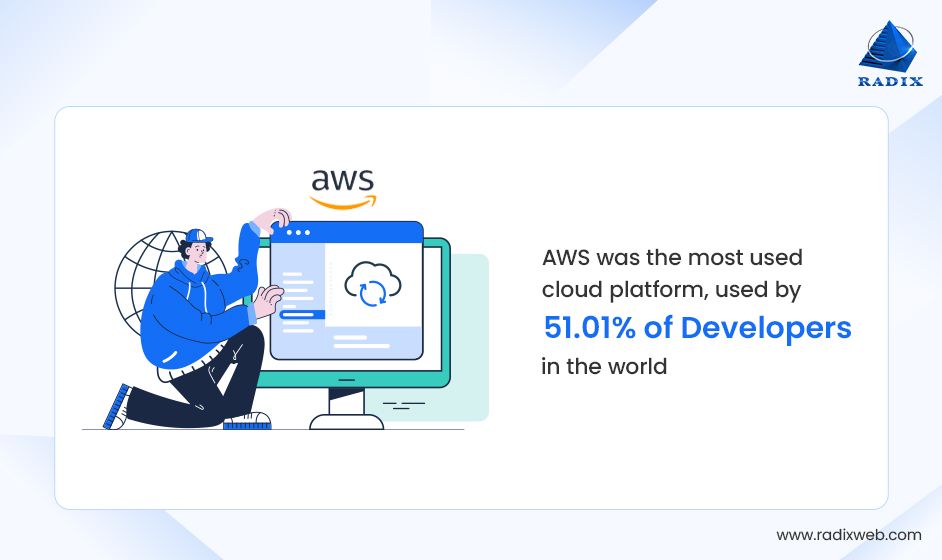
- AWS was the most popular and used cloud platform in 2022, with 51.01% of developers usage.
- Microsoft Azure is the second most used cloud platform, with 28.72%.
- Google Cloud is the third most used cloud platform, with 26.61%.
- JavaScript remains one of the most widely used languages, with about 66% of developers reporting usage in 2025. HTML/CSS follows closely at 61.9%, reflecting its foundational role in web development. SQL and Python are also among the top languages used by developers globally.
- Python has experienced accelerated adoption and continues to expand its footprint due to demand in AI, data science, and backend development.
- Rankings from industry sources show Python, JavaScript, and Java consistently leading in popularity, with languages like TypeScript, C#, C++ and Go also holding strong positions in modern stacks.
- According to developer ecosystem reports, languages such as TypeScript, Rust, and Go are recognized for high growth potential in 2025, indicating evolving developer preferences toward scalable and performance-oriented languages.
- In large surveys, many developers also adopt AI-powered tools and frameworks in their workflows, with AI integration becoming a mainstream part of coding, testing, and debugging processes across tech stacks.
- Popular frontend frameworks among professional developers include React, Angular, Vue.js, and Next.js, while backend frameworks like Node.js, Spring Boot, and ASP.NET Core remain widely used in enterprise and web applications (industry trend context).
- Version control tools such as Git retain near-universal adoption among developers, with surveys historically showing usage rates above 90% for Git in professional workflows.
Software Development Programming Statistics
In this section, we are going to cover the facts and data surrounding software development programming. Let’s understand it well.
- The average age of a software engineer is 39 years.
- Software engineers are 50% more likely to work at private companies than public sector companies.
- There are 22% of female software engineers, while 78% are male.
- 48.5% of software engineers are White, followed by Asian – 34%, Hispanic or Latino – 8.1%, and Unknown – 48.%.
- Approximately 8% of all software engineers identify as LGBT.
- An overwhelming 97% of applications make use of open-source code, reflecting its widespread adoption in the software development community.
- GitHub, a popular internet hosting service for software development, boasts an impressive 94 million developers and over 85.7 million new repositories.
- GitHub Actions, the platform's automation feature, runs a staggering 263 million automated jobs every month, consuming more than 41 million build minutes daily.
- The software development industry faces a significant shortage of talent. By 2030, global consulting firm Korn Ferry predicts the U.S. may lose $162 billion worth of revenue annually due to this shortage, which increases to a staggering $8.5 trillion globally.
- JavaScript is used by 65–67% of developers globally, making it the most widely adopted programming language.
- Python is used by 49–51% of developers, driven by demand in AI, data science, automation, and backend development.
- HTML/CSS is used by 60%+ of developers, reinforcing its foundational role in web development.
- Java and C# remain dominant in enterprise software, each used by 27–30% of professional developers, especially in large-scale and regulated systems.
- TypeScript adoption continues to rise, with 38% of developers using it, driven by scalability and maintainability in modern applications.
- Rust ranks among the most loved programming languages, with 80%+ developer retention, highlighting its growing role in performance-critical systems.
- Go (Golang) adoption continues to grow, particularly for cloud-native and microservices architectures.
- Rust ranks among the most loved programming languages, with 80%+ developer retention, highlighting its growing role in performance-critical systems.
- Go (Golang) adoption continues to grow, particularly for cloud-native and microservices architectures.
- 70%+ of developers report using or experimenting with AI-assisted coding tools, significantly impacting productivity and code quality.

General Software Development Statistics and Facts
Now is the time to understand general facts and statistics about software development. This will give you an idea about the overall software development industry.
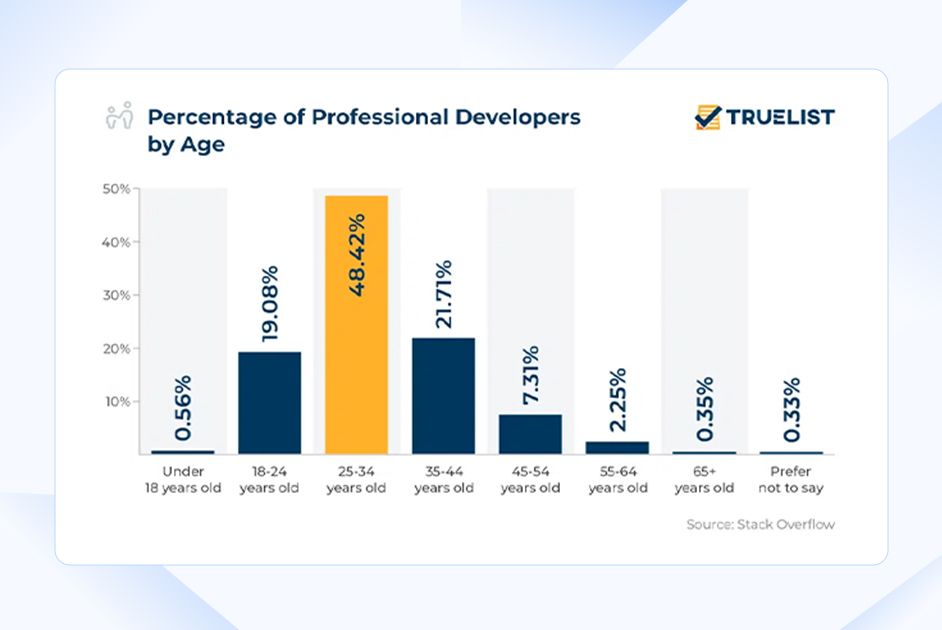
The average age of software developers is between 25 and 34 years.
As per the digit, we can say that there are many young developers in the market. 48.42% of software developers are from the 25 to 34 age group. 21.71% of software developers are between 35 and 44.
Ukraine has solidified its position as a leading destination for web development outsourcing destination.
As per the latest data, Ukraine is the home to over 200,000 outsourcing programmers with science, technology, and engineering degrees. Tech firms frequently choose Ukrainian vendors to leverage cost-effective IT expertise for their projects.
Approximately 24% of executives now opt for software development outsourcing as a strategic means to remain competitive in the dynamic business landscape while accessing skilled developers at reasonable rates.
The industry's demand-supply gap, with five positions per developer, is a clear indicator of the shortage, driving the need for outsourcing solutions. Offshore software development statistics highlight that the primary challenges in software development revolve around capacity, knowledge sharing, and prioritization.
The integration of artificial intelligence (AI) in software is a prominent and ongoing trend in the world of software development.
Utilizing deep learning and advanced machine learning techniques, developers can now create improved software solutions at an accelerated pace. Software development trends project that artificial intelligence augmentation will generate an impressive $2.9 trillion.
The United States holds an average coding experience of 15.8 years among professional developers.
However, in a Stack Overflow survey, Australian developers topped the list with the longest coding experience at 16.9 years, followed closely by the United Kingdom at 16.1 years. The Netherlands and Canada secured fourth and fifth place, respectively. Interestingly, almost one-third of these software professionals began their coding journey 5 to 10 years ago.
61% of software developers use Windows, making it the primary development environment.
Linux ranks second with 47% of developers utilizing it, while macOS takes the third spot in popularity among PC operating systems.
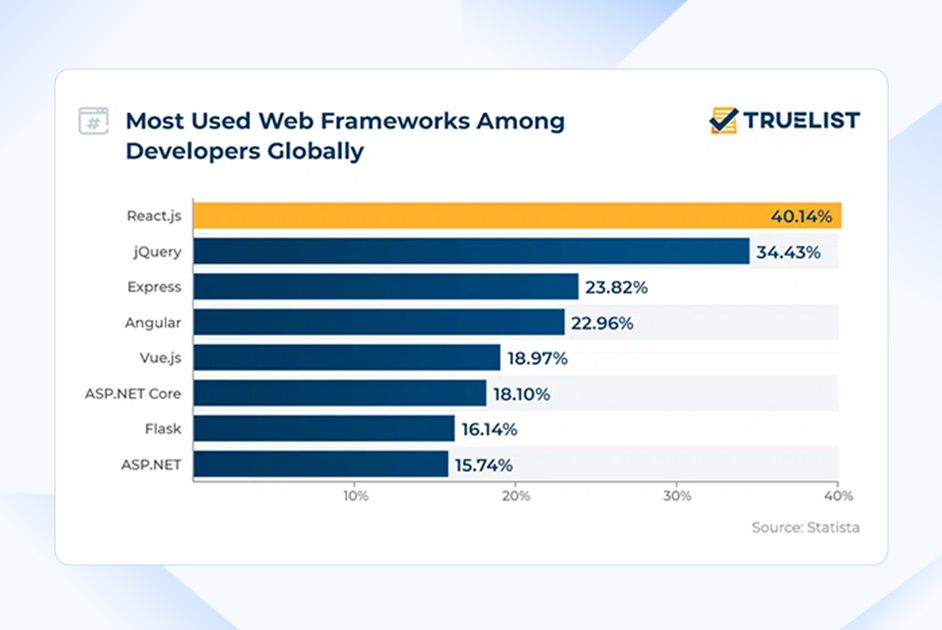
40.14% of software developers prefer ReactJS, which turns out to be the most popular technology for web development.
Selecting the proper framework for web development is crucial in the early stages of a project. Based on software development statistics, React.js stands out as one of the most popular frameworks, surpassing other web frameworks in usage. jQuery is the second favorite among software developers. The top 5 contenders also include Express, Angular, and VueJS.
When you hire software developers, the most crucial factors are their willingness to learn and their ability to fit into the company's culture.
The challenge lies in finding highly skilled developers who can add value to the team while adapting swiftly to the ever-changing tech landscape. While technical expertise is essential, interestingly, nearly 60% of recruiters prioritize soft skills when searching for tech employees.
Software Development Statistics for Different Industries
Software development trends vary by industry, as does the value they create. Understanding these trends helps industry-specific businesses unlock maximum impact. Below are key software development statistics across different sectors.
Healthcare Software Development Statistics
- Global healthcare IT market is projected to surpass USD 820 billion by 2030, driven by EHRs, telehealth, AI, and interoperability-focused software solutions.
- The global healthcare AI market is expected to reach $188 billion by 2030, increasing CAGR of 37% from 2022 to 2030.
- Over 75% of healthcare organizations are investing in custom software solutions to improve patient outcomes, data integration, and operational efficiency.
- Electronic Health Records (EHR) adoption exceeds 90% among hospitals in developed markets, significantly increasing demand for secure and compliant software development.
- The global digital health software market is expected to grow at a CAGR of 20%+, fueled by AI-driven diagnostics, remote patient monitoring, and cloud-based platforms.
- Healthcare data breaches increased by over 50% in recent years, reinforcing the need for secure-by-design healthcare software development aligned with HIPAA and global compliance standards.
Banking & Finance Software Development Statistics
- The global fintech and banking software market is expected to exceed USD 1.5 trillion by 2030, driven by digital banking, payment platforms, and AI-based financial services.
- Over 85% of banks and financial institutions prioritize custom software development to modernize core banking systems, improve agility, and support digital-first customer experiences.
- The Global fintech market size is projected to grow at a CAGR of 16.8% between 2024 and 2032, reaching a value of around USD 917.17 billion by 2032.
- AI and automation adoption in banking software can reduce operational costs by 20–30%, particularly in fraud detection, risk management, and customer service applications.
- More than 70% of financial institutions are actively investing in API-driven and cloud-native banking platforms to enable open banking and faster product innovation.
- Cybersecurity and compliance-driven development account for nearly 40% of total banking software budgets, reflecting strict regulatory and data protection requirements.
Retail & Ecommerce Software Development Statistics
- The global ecommerce software market continues to grow rapidly, driven by omnichannel retail strategies, headless commerce adoption, and AI-powered customer experiences.
- Over 80% of retailers invest in custom software development to improve customer engagement, inventory visibility, and real-time decision-making.
- AI-driven personalization and recommendation engines can increase retail revenue by 10–15%, making advanced analytics a core software priority.
- More than 70% of ecommerce platforms run on cloud-native or SaaS architectures to support scalability, performance, and seasonal demand spikes.
- When we talk about AI in retail, retailers leveraging automation and AI-powered software report up to 30% improvement in operational efficiency, particularly across supply chain and fulfillment operations.
Supply Chain & Logistics Software Development Statistics
- The global supply chain software market continues to expand rapidly as organizations invest in digital platforms to improve visibility, resilience, and operational efficiency.
- Over 75% of logistics and supply chain organizations are adopting custom software solutions for real-time tracking, demand forecasting, and inventory optimization.
- Companies using AI-driven and analytics-based supply chain software report up to 20–30% reduction in operational costs through better planning and automation.
- More than 70% of logistics platforms now operate on cloud-native architectures, enabling scalability, real-time data access, and seamless system integrations.
- Organizations leveraging automation and predictive software tools achieve up to 25% improvement in order fulfillment and delivery performance, strengthening customer satisfaction and supply chain agility.
Software Development Holds the Bright Future
The data presented in this guide demonstrates the enduring significance of software development.Software development continues to be a strategic foundation for digital-first businesses, driving innovation, operational efficiency, and competitive differentiation across industries. As technologies, architectures, and development practices evolve, organizations must move beyond ad hoc implementation toward scalable, secure, and future-ready software ecosystems.For software professionals and business owners alike, staying abreast of the industry's dynamic trends is imperative as it continues to evolve. They need software solutions that are adaptable, resilient, and built to support long-term business objectives while responding to rapid market changes and customer expectations.At Radixweb, we partner with organizations to translate evolving software trends into tangible business value. Through tailored engineering, deep technical expertise, and a results-driven approach, we help enterprises design, build, and modernize software solutions that enable sustainable growth and digital confidence.For a broader understanding of technology trends, our articles on AI Usage Statistics, DevOps Statistics, Node.js Statistics, and Agile Statistics offer valuable insights.Let’s connect with our experts now.