Read More


Recognized for AI Excellence at 2026 Globee® Awards - Read More

Pratik Mistry
Why You Should Read This Article: This article is worth reading if you want an up-to-date view of how SaaS products are actually built and scaled today. It cuts through outdated assumptions and generic advice to explain development trade-offs, cost drivers, and operational realities that directly affect product success from early validation to long-term growth.
TL:DR
● SaaS applications are cloud-hosted, subscription-based software with a globally booming market now driven by AI personalization and vertical solutions.● Top SaaS features include self-service onboarding, role-based access, continuous deployment, and usage-based billing for efficiency.● SaaS development benefits businesses with predictable revenue, lower IT costs, and rapid scalability.● The development process includes discovery, UX design, API-first builds, and CI/CD deployment.● Common challenges like data isolation and churn get solved via cloud auto-scaling, self-service flows, and compliance-ready stacks.● Development costs vary by scope, architecture, and compliance needs and should be treated as an ongoing investment.● Radixweb delivers SaaS projects yearly with certified experience and full lifecycle support.
SaaS application development is the process of designing, developing, and launching cloud‑hosted software that users can access on a browser or app and pay for its services on a recurring basis.
Enterprises run on dozens of SaaS tools for their core operations. Done right, a SaaS product gives you predictable revenue and cost, always-on availability, easy updates, enterprise-grade compliance, and the ability to scale without re‑deploying on-premise installs. Done wrong, you end up with high churn, rising infrastructure bills, and a product that struggles to keep up with security and compliance demands.
As SaaS products operate in a mature, crowded market, scalability, security, performance, and cost discipline matter as much as core functionality. The market itself is still expanding aggressively, with strong a 12-19% year‑on‑year growth rate through the late 2020s and room for niche, vertical products.
Competition and customer expectations are also at their highest. AI‑driven personalization, industry‑specific (vertical) SaaS, and flexible, usage‑based pricing are now baseline expectations.
Yet many teams still approach these decisions with outdated assumptions or strategies that no longer reflect how SaaS products are built and operated today.
This gap is precisely why this guide exists. It's written for founders, CTOs, and product owners who need an execution-focused view of how SaaS applications are actually planned, built, and scaled today. Avoiding theory, we’ve focused on practical considerations, trade-offs, and patterns to help you create a successful SaaS platform development roadmap.
A Software as a Service (SaaS) application is a cloud-hosted software product delivered through a subscription or usage-based model. It's designed to support continuous updates without customer-side installations.
Unlike PaaS (which focuses on developer platforms) or IaaS (raw infrastructure), SaaS targets end-users with fully managed, ready-to-use solutions.
Some of the defining characteristics of SaaS applications include:
SaaS in 2026 remains a high-growth industry, valued at $375.57 billion in 2026 and powering operational cores for nearly every enterprise. The growth is enabled by real demands for flexible, AI-enhanced tools that adapt to hybrid work, regulatory pressures, and economic shifts.
If you look at the recent enterprise SaaS adoption trends and statistics report, North America captures about 50% of the pie, while emerging markets accelerate via affordable vertical solutions. We can expect continued double-digit expansion as legacy systems migrate, but with consolidation among smaller players.
Key drivers include:
SaaS applications deliver core operational software via cloud subscription, featuring multi-tenancy for efficient scaling, automated updates without user disruption, and usage-based pricing tied to actual consumption like API calls or storage
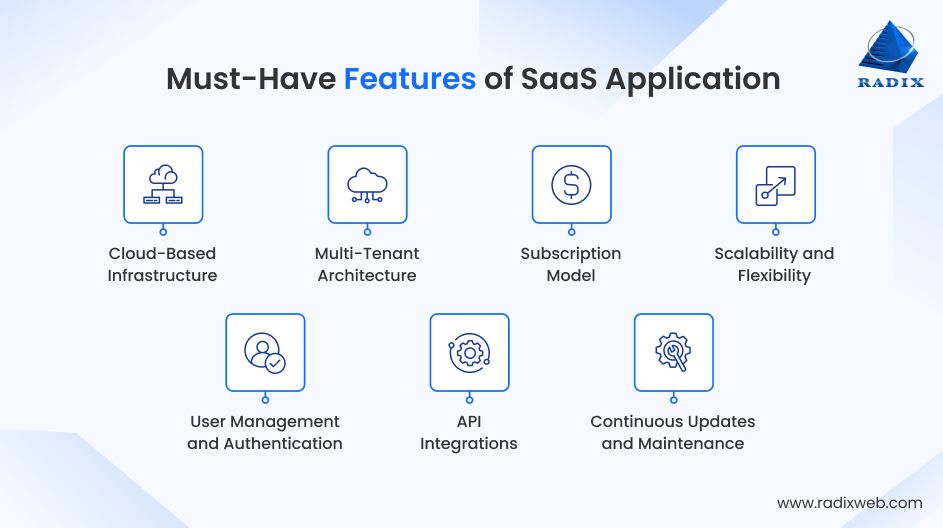
The app is hosted on different cloud platforms like Microsoft Azure, Google Cloud, and AWS rather than on local computers or servers, which makes it easily accessible and minimizes infrastructure management for users.
SaaS applications generally use multi-tenancy, where a single software instance helps multiple tenants or clients. The data of every client is isolated, but they all share the common core infrastructure and system.
These applications usually function on a subscription-based pricing model, with different service tiers based on user requirements. This is a transformation from conventional one-time software purchases.
SaaS application design should be scalable to easily manage rising users, high traffic, and data without impacting performance. They should often be flexible regarding user features, which further helps with modifications and customization to meet client needs.
Handling user accounts, authentication, permissions, and roles is significant for Software-as-a-Service development. This includes ensuring user privacy, data access, and secure logins.
Developing scalable SaaS solutions for modern cloud platforms requires incorporating other services and tools, like third-party apps, CRM systems, analytics, and payment gateways. Hence, strong API development is a must-have!
Contrary to traditional software systems, where updates are less frequent, SaaS apps come with continuous improvements and updates. Developers should deploy systems that receive regular updates, bug fixes, and integration of new features.
Developing a SaaS application delivers a number of revenue and scalability benefits like predictable recurring revenue, cuts operational acquisition, and enables global scalability without hardware investments. It positions businesses to tap a $819.23 billion market by 2030, with 12% CAGR growth.
Software as a Service development shifts from one-time sales to ongoing income, which is critical for stable cash flow.
Building SaaS applications streamlines delivery and maintenance for lean operations.
SaaS frameworks are dominantly used to build market-winning products. It’s a preferred product model for organizations looking to capitalize on trends like AI integration and vertical niches.
| Benefit | Impact | Example |
|---|---|---|
| Faster Time to Market | MVP in 3-6 months | Slack scaled to 10M users via rapid iterations |
| Global reach | Browser access anywhere | Zoom hit $4B ARR serving hybrid teams |
| Competitive edge | AI personalization | 70% of new SaaS embeds ML for retention boost |
The most popular types of SaaS applications include CRM for sales pipeline management, ERP for integrated enterprise operations, HRIS for employee lifecycle automation, project management tools for team coordination, and marketing automation platforms for lead nurturing.
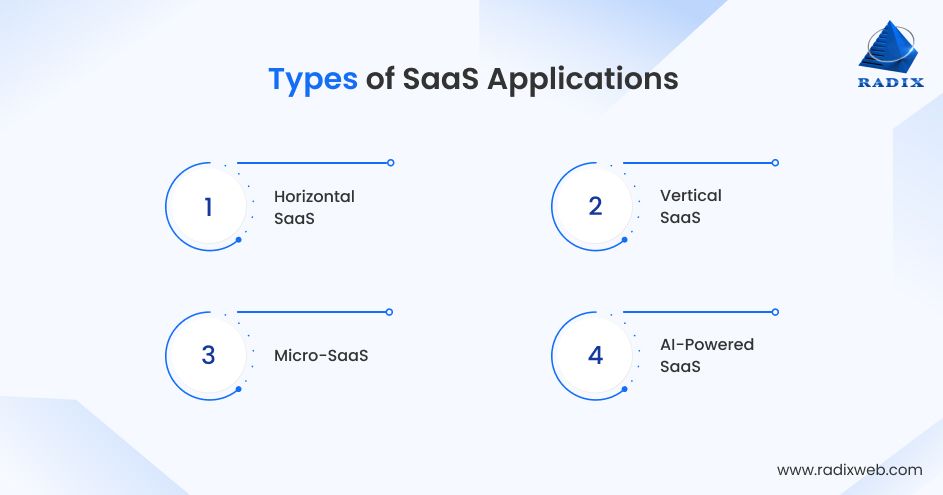
Horizontal SaaS provides broad tools for general business needs, and these tools achieve universal adoption.
Vertical SaaS solutions are industry-specific solutions that solve domain pain points with built-in compliance. For example:
Micro-SaaS refers to low-overhead tools that solve a single problem. This category of SaaS software development is booming in recent years, especially for solo founders who rely on proven SaaS growth strategies that help businesses scale niche software products sustainably and turn these focused tools into profitable ventures.
Examples include:
AI-powered SaaS development integrates machine learning and generative AI into the core platform functionality to enable automation, predictive insights, and hyper-personalization. This shift reflects how artificial intelligence is shaping the next generation of SaaS platforms, how software products are evolving from static tools into intelligent, adaptive systems.
The SaaS product development lifecycle spans idea validation to live deployment with key phases including discovery, design, build, and release. The end-to-end process emphasizes early market validation, iterative development, automated deployment, and ongoing optimization.
Here are the key fundamentals that founders must follow to build a successful SaaS product:
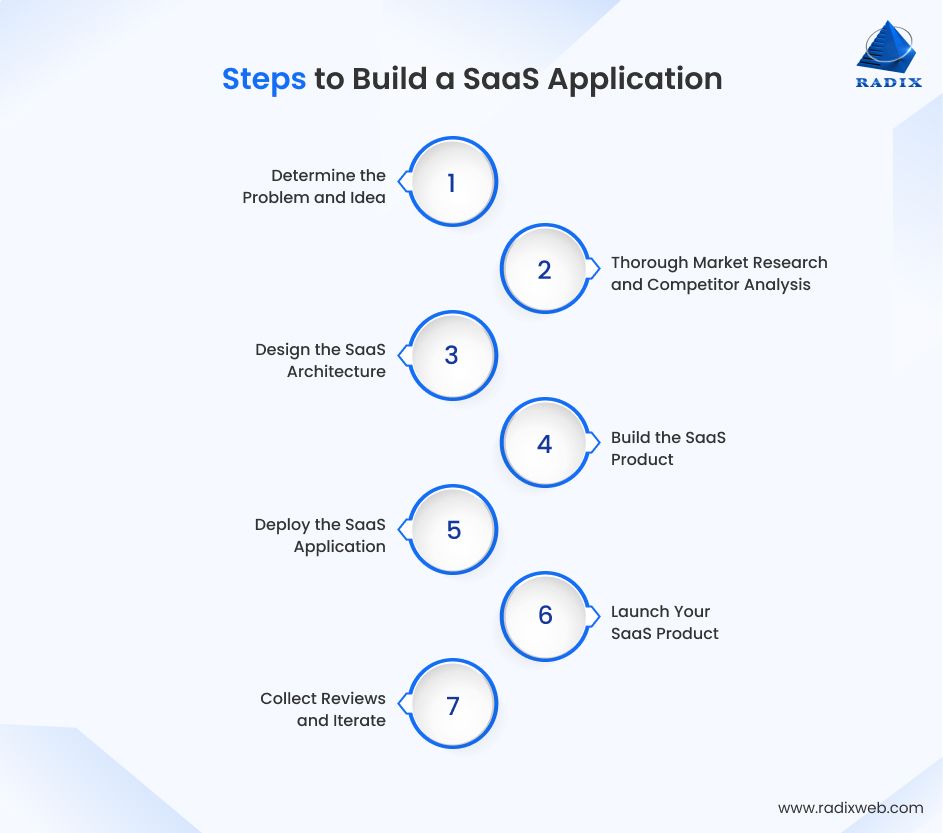
Identify the Pain Point
Validate the Idea
Define Scope and Features
Analyze Your Competition
Understand Your Target Market
Determine Unique Value Proposition (UVP)
Design the Architecture
API Design
User Interface (UI) Design
Frontend Development
Backend Development
Authentication and Authorization
Payment Integration
Choose Your Hosting
CI/CD Pipeline
Set Up Monitoring and Logging
Deploy to Production
Marketing and Promotion
Onboarding Process
User Feedback
Iterate Based on Feedback
Some of the most recurring challenges that enterprises face in building their SaaS platforms include safely sharing one system across customers, handling sudden growth surges, keeping shared data secure, connecting with other tools, meeting privacy rules, and updating without disrupting live users.
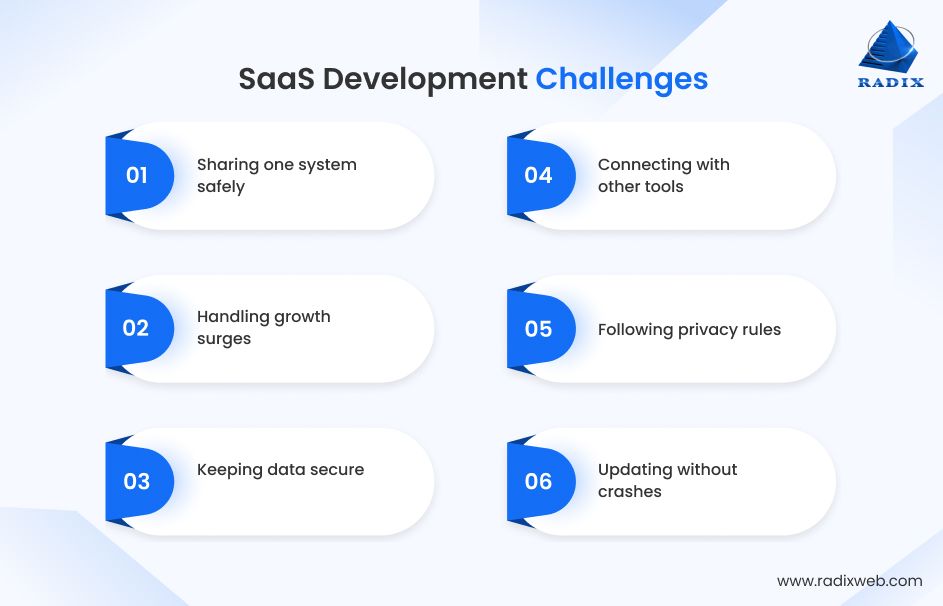
Sharing one system safely: Multiple customers use the same app, which brings the risk of data mix-ups. Ensure you separate customer info logically using built-in cloud tools.
Handling growth surges: Sudden user spikes slow down the performance of SaaS platforms. To address this, choose flexible hosting that automatically adds resources as needed.
Keeping data secure: Since hackers mostly target shared systems, add strong login checks and regular security scans to protect everyone.
Connecting with other tools: Linking payments or analytics is a very complicated and delicate process. Enterprises should use ready-made connectors for popular services like billing or tracking.
Following privacy rules: Regulations like GDPR are unavoidable compliance requirements. SaaS teams must pick compliant cloud platforms with simple audit features.
Updating without crashes: As new features might disrupt ongoing services for live users, you must test changes on copies first, then switch for service continuity.
The best tech stack for SaaS-based application development includes React/Next.js for frontend, Node.js/Python for backend, PostgreSQL for databases, AWS/Azure for cloud hosting, and OpenAI APIs for AI.
The tech stack CTOs and product managers choose for SaaS app development majorly depends on the app’s specific needs, such as the target audience, complexity, and scale.
Understanding how technology is transforming SaaS go-to-market strategies for modern software companies also plays an important role in these decisions, since platform capabilities increasingly shape product distribution, onboarding models, and growth mechanics.
Building a SaaS application can range from $30,000 to $500,000 or more, depending on complexity, features, and the team involved. Basic SaaS applications typically cost between $25,000 and $50,000, while complex ones can reach $150,000 to $500,000.
Below is the simple breakdown of cost estimation based on the app's complexity and features:
For a deeper analysis, check out our dedicated article on the complete cost breakdown for developing a SaaS application outlining the factors and strategies that shape overall expenses.
How We Help Build and Scale SaaS Applications
Radixweb’s enterprise-grade development services to build and scale modern SaaS products handle the full SaaS lifecycle from MVP to enterprise scale. We run 100+ projects a year with dedicated teams averaging 25-50 developers. Our bandwidth supports parallel sprints across discovery, build, and optimization, ensuring on-time delivery within fixed scopes.We maintain expertise through repeated deliveries in multi-tenant architecture, subscription billing, and cloud migrations, common across healthcare, fintech, and e-commerce clients.● 26+ years of SaaS-focused engineering across backend, frontend, cloud, and DevOps disciplines● ISO 27001 and SOC2 Type II certified, meeting GDPR/HIPAA needs out-of-box.● In-house teams with 80% senior engineers (5+ years), cutting ramp-up to 1 week.If you are planning to build a new SaaS product or need support scaling an existing platform, we can step in with the right technical depth and delivery capacity.Share your product goals, timelines, and constraints with us, and our team will outline a practical development approach aligned with your growth stage, architecture needs, and operational priorities.
Ready to brush up on something new? We've got more to read right this way.