Read More


Recognized for AI Excellence at 2026 Globee® Awards - Read More

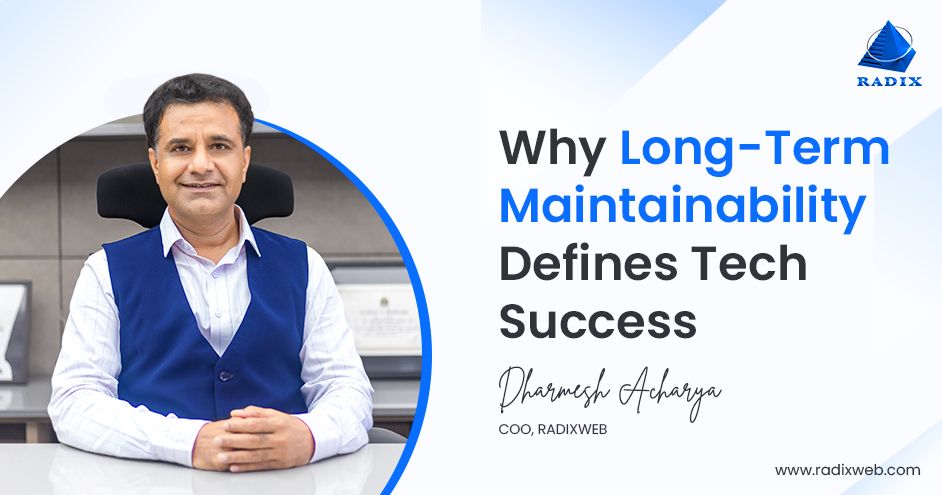
Dharmesh Acharya

Summary: Most businesses respond to technology disruption by adding more tools, more platforms, and more initiatives. The businesses that genuinely innovate do the opposite. They simplify aggressively before they expand. In this article, Dharmesh Acharya, COO, Radixweb, looks at why subtraction, not addition, has become the real discipline behind sustainable technology strategy, and what that looks like in practice.
Technology has changed the tempo of business, but it has not changed the fundamentals. Companies still need clarity, discipline, and the judgment to invest in the right places. What has changed is the speed at which those decisions affect competitiveness, customer trust, and long-term resilience.
I have spent enough years in leadership to know that every major technology shift creates the same test. It asks whether a business can adapt without losing its centre. That is the real challenge, not the technology itself. If a company treats change as something to react to only when necessary, it usually ends up paying a higher price later. The stronger approach is to respond early, think carefully, and move with intent.
If I look at the businesses that continue to perform well through periods of uncertainty, they usually share one quality. They do not confuse movement with progress. They know the difference between adopting what’s new and adopting what’s useful. That distinction matters more now than it did even a few years ago. Leaders who invest in building stronger digital enterprise change with scale, speed, and skill bear the clearest signs that a company understands how to turn change into durable advantage.

The mistake is rarely lack of intelligence, but excess confidence in the idea of progress itself. I’ve seen leaders assume that because a new tool, platform, or process is available, it must somehow be worth adopting. That’s not always true. In many cases, the business is already carrying enough complexity. Adding more without a clear purpose only compounds the strain.
I have seen this pattern enough times to know it is not caused by carelessness. It is caused by pressure. Leaders want to move quickly, keep up with peers, and show that the organization is keeping pace with change. That instinct is understandable, but that urgency can blur judgment. When that happens, the business starts collecting solutions faster than it can absorb them.
The better leaders I have worked with, do something different. They pause long enough to ask whether the new direction will genuinely improve the business or simply make it look more modern. That question sounds simple, but it is often the one that saves a company from avoidable work later.
Most organizations account only for the visible cost of technology. They calculate the licensing fees, the implementation costs, and perhaps the training overheads. What they usually underestimate is the hidden cost. Every new tool creates an operational burden. It adds another layer for teams to learn, another dependency to manage, and another point where things can go wrong.
This matters because technology does not exist in isolation. It sits inside the daily rhythm of the business. If the tool improves productivity in one area but slows collaboration in another, the net result may be weaker than expected. I have seen companies end up creating more handoffs, more confusion, and more maintenance overhead by adding systems in the hope of becoming faster.
That is why discipline matters. The cost of a tool is not just what you pay to buy it. It’s also the attention it consumes across the organization. Leaders who think carefully about that broader cost usually make better choices. They understand that simplicity often creates more value than accumulation.
There is also a strategic cost. When businesses keep layering tools without a clear architecture, they eventually make it harder to move with confidence. The organization becomes less flexible, not more. And once that happens, even good opportunities can become difficult to execute well.
For most leaders, adding something new feels active, but removing something old feels risky. Because even though outdated now, the old systems delivered results earlier. That is one reason subtraction is such an underused discipline in business. It takes more confidence to say no to a tool, a process, or a feature than it does to approve one. But that is often where real maturity shows up.
I believe eliminating random tech without proper strategy helps retain focus. It forces the business to clarify what truly matters, it also protects energy. Every unnecessary system, workflow, or approval layer asks for attention. Over time, those small demands reduce the organization’s ability to think clearly and move quickly.
This is where experienced leadership makes a difference. Senior leadership roles do not exist to maximize activity, they are there to improve judgment. And judgment often means removing what no longer earns its place. That may mean retiring outdated systems, simplifying internal workflows, or resisting the temptation to launch one more initiative before the current ones have settled.
I have always found that good businesses are not the ones that do the most. They are the ones that preserve enough clarity to keep doing the right things well. Subtraction is part of that discipline.

When leaders ask me how to move faster, I usually say the answer is not always to accelerate everything. Often, it is to reduce friction. Speed improves when teams do not have to fight avoidable complexity. The business becomes faster when the basics are cleaner.
That means innovation should not begin with a rush toward novelty. It should begin with an honest view of what is slowing the company down. Where are decisions delayed? Where do teams lose context? Where does a simple idea become too hard to execute? Those are the places where innovation can realistically help. This mindset is common among leaders who embrace technology strategically, recognizing that lasting business transformation starts with solving operational challenges before adopting new tools.
I also remind leaders that faster does not always mean better. A company that moves quickly in the wrong direction only gets lost sooner. The aim should be intelligent pace, not constant acceleration. That distinction matters because sustainable innovation requires both ambition and restraint.
If a business wants to modernize with a stronger operating rhythm, they must get guidance for strengthening long-term platform execution from a seasoned partner because it keeps the focus on practical outcomes rather than abstract change. That is usually where innovation becomes real instead of rhetorical.
In my observation, the best organizations do not treat new technology as a reflex, they discuss it with care. In a healthy leadership team, the first conversation is not “Can we adopt this?” It is “Should we?” That difference matters.
Internally, I believe the discussion should always begin with business value.
These questions may sound basic, but they keep the business honest.
We also talk about best-fit. A technology may be excellent in general, but that does not mean it is right for our environment. It must fit the maturity of the organization, the shape of the customer journey, and the level of discipline the business can sustain. If it does not fit, the risk usually grows faster than the benefit.
This is where good judgment protects momentum. It’s not about slowing the business down, it’s about avoiding commitments that will require more correction than value later.
I think restraint is one of the least appreciated strengths in modern leadership. People often associate innovation with boldness, speed, and constant movement. But the companies that innovate well usually know how to hold back when needed. They do not mistake every possibility as a priority.
Restraint allows a business to stay selective. It helps leaders distinguish between what is urgent and what is meaningful. It keeps the organization from scattering its energy across too many ideas at once. And when the business is selective, it can invest more deeply in changes that matter the most.
I have seen many teams move quickly because they felt they had to. The more effective teams move deliberately because they understand the cost of distraction. They measure success by creating meaningful business impact, not by completing more tasks. That is why restraint is not passive, it’s rather a form of active leadership. It creates room for better execution.
If the goal is to reduce complexity before adding new layers, moving older applications forward without creating avoidable disruption is where smart leaders begin rather than rushing toward something entirely new. That approach protects the business while still allowing it to evolve.
Most organizations do not lack ambition, what they lack is the muscle to say no. That comes from repeated practice, clear leadership, and a willingness to tolerate some short-term discomfort in service of long-term clarity.
The businesses that develop this capability tend to become stronger in subtle but important ways and make cleaner decisions. They communicate more clearly, avoid unnecessary detours and become less dependent on the constant introduction of new things to feel like they are moving forward.
I believe this is one of the defining traits of durable organizations. They understand that progress is not always visible in the short term. Sometimes it looks like simplification, sometimes like removing friction. While at times it also looks like deciding not to act yet. But that does not mean nothing is happening. It means the business is becoming more capable.
If a company wants to support that kind of capability at scale, it must align modernization with long-term operating strength rather than short-term noise.
I believe in a couple of years, the gap between mature businesses and reactive ones will be even clearer. The strongest companies will not necessarily be the most aggressive adopters of new technology. They’ll be the ones that know how to make sound decisions under pressure.
They will understand that a smaller number of well-chosen systems are better than larger number of disconnected ones. They will know that speed is only useful when it is directed, and will treat restraint as a strategic capability, not a limitation.
This matters because the business environment will continue to reward clarity. Customers will highly value reliability, teams will still need focus, leaders will need strategic judgment. Technology will keep changing, but the businesses that last will be those that know how to use it without being used by it.
That is the future I am preparing for. Not one defined by constant motion, but one defined by better decisions made consistently over time.

Why Calm, Well-Run Businesses Usually Outperform the Rest
The tech-powered future will not belong to the companies that chase every new development. It will belong to the ones that understand the value of discipline. The ones that know when to add, when to eliminate, and when to pause; ones that treat restraint as part of innovation rather than a barrier to it.I have realized that the strongest business leaderships are usually the most calm ones. They do not need to prove their seriousness by doing everything at once. They prove it by making the right choices, in the right order, for the right reasons. That’s how technology becomes an advantage instead of a burden.If your organization is trying to move with more clarity and less noise, then the next step is rarely more activity. It’s better judgment. Our experts at Radixweb pivot that exact conversation.
Ready to brush up on something new? We've got more to read right this way.