Read More


Recognized for AI Excellence at 2026 Globee® Awards - Read More

Pratik Mistry
More than three fourths of insurers already had plans to raise technology spending. The plans for 2027 and beyond are no different. The reason? Rising customer expectations, mounting regulatory demands, expanding carrier ecosystems, and growing operational data volumes.
For most insurance companies, sustainable growth today depends heavily on the technology infrastructure behind daily operations.
Yet, many agencies still run critical processes across a fragmented mix of systems. This limits visibility, slows decisions, and raises operational risk. More importantly, as agencies scale, these problems get harder to fix through process changes alone.
That's why tech decision makers cannot stop saying "we need an insurance agency management system." They also need to ask more strategic questions like, 'What does it take to build a system that fits our agency's workflows, integration needs and compliance obligations?"
With 26+ years of experience in delivering enterprise-grade software and specialized InsurTech expertise, here's what it takes to build modern custom insurance agency management software (IAMS).
A custom IAMS pays off when carrier integrations, commission structures or multi-jurisdiction compliance outgrow what Applied Epic, HawkSoft, EZLynx or AMS360 can configure. Builds range from $80,000 for an MVP to $900,000+ for a multi-agency SaaS product, and a 36-week phased plan places the data model and carrier integration ahead of commission logic. Legacy migration then decides whether the cutover holds, with renewal-date accuracy and a 30-to-90-day parallel run as the deciding checks.
| Aspect | Detail |
|---|---|
| What this Guide Covers? | The policy lifecycle a custom IAMS must model, ACORD and IVANS standards, carrier integration, commission tracking, multi-state compliance, the core data model and legacy migration |
| Who Should Read this? | CTOs and operations leaders deciding whether to build a custom IAMS or keep extending Applied Epic, HawkSoft, EZLynx or AMS360 |
An insurance agency management system is a software program that enables insurance agents and agencies to manage their clientele and do business. Commonly called an IAMS, it manages the operational core of an insurance agency. It replaces the fragmented mix of spreadsheets, shared calendars, and carrier portals with a single unified dashboard for end-to-end agency management.
Done well, it becomes the single source of truth every other business tool reads from, rather than one more disconnected system to maintain.
Insurance agency management software development involves building software to manage policies, workflows, commissions, carrier integrations, compliance, and agency operations.
An insurance agency management system centralizes every operational function. From client management to policy administration, claims processing to compliance tracking, and commission reconciliation into a single platform.
A modern Insurance Agency Management Software (IAMS) brings the agency's core operations into one system, connecting client records, policy workflows, carrier communications, commissions, and compliance processes. The core capabilities include:
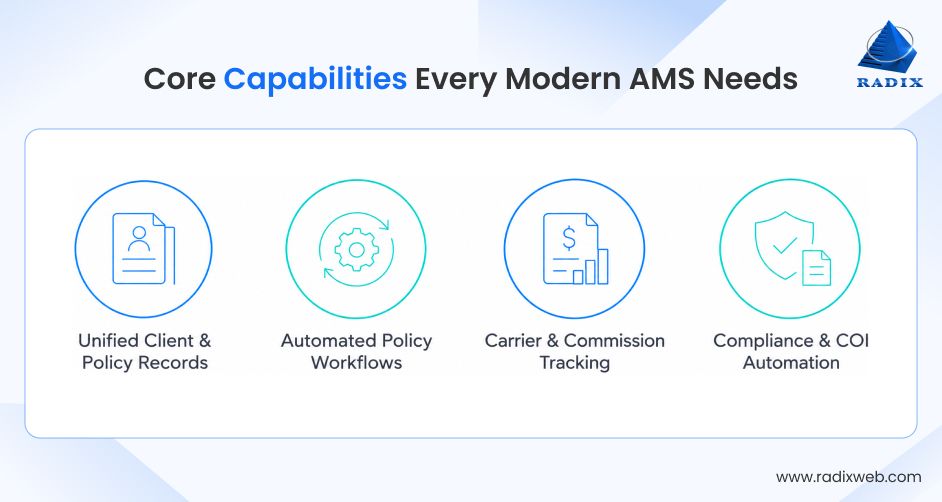
While these are some of the general features that every insurance agency needs from their management software, there are many unique workflow-specific features which you'd need. How these unique features are built and integrated with other tools/platforms you may be using should also be a part of your custom software development roadmap.
Generic CRMs such as Salesforce or HubSpot were not built around insurance data. While smaller agencies do tend to default to these systems because they are easy to use and affordable, as agencies grow, they tend to encounter the same three structural gaps:
These gaps become expensive once policy volume grows past what manual workarounds can safely absorb. A missed renewal can expose agencies to compliance issues, E&O risk, and client dissatisfaction.
Once you realize a generic CRM no longer fits, the next step is choosing a path: buy an off-the-shelf agency management platform, customize your existing solution to fit your workflows, or build tailored software around your business needs. If you're still weighing whether to keep your CRM, expert guidance on your CRM setup can show which gaps are fixable and which call for a different system.
Not every agency needs custom software, and choosing the wrong path wastes both budget and delivery time. The right IAMS strategy depends on process complexity, integration needs, and where the organization plans to be in three years. These are the same factors behind choosing custom over off-the-shelf software.
Getting this call wrong is expensive in both directions. Buying too early locks a growing agency into a platform it will outgrow within a year or two.
A full custom build is a different commitment entirely, carrying more upfront cost and more long-term control at the same time. It tends to make sense only when several of these apply together, not just one. None of these signals alone is decisive either, and agencies often assume they need a full build when a targeted customization would solve the actual problem.
The solution here is a short discovery exercise that settles the question faster than months of internal debate. It forces the real requirements onto paper instead of leaving them as assumptions everyone privately disagrees on.
Working through this decision with an outside partner often surfaces requirements an internal team misses early on. Independent expert software advisors can help pressure-test carrier, commission and compliance requirements before a single line of code gets written.
Commercial IAMS platforms serve most agencies well within their design limits. Knowing where each platform ceiling sits in practice helps a team decide when a custom build becomes the safer investment.
The four platforms below cover most of the market that an independent agency or growing managing general agent is likely to evaluate first.
| Platform | Best For | Where It Hits a Ceiling |
|---|---|---|
| Applied Epic | Large independent agencies and brokers running multi-line, multi-location books with complex commissions | Annual license cost often runs $50,000 to $200,000 or more, and customization stays limited by the platform's own roadmap |
| HawkSoft | Independent agencies that prioritize ease of use and price | Limited API access, commission splits that get cumbersome fast, and reporting that often needs an Excel export for anything beyond built-in dashboards |
| EZLynx | Personal lines quoting and client portal work, and still a widely adopted AMS among smaller agencies | Commercial lines, complex endorsements, and commission depth are noticeably thinner than in dedicated AMS platforms |
| Vertafore AMS360 | Mid-market agencies needing deep policy management and carrier connectivity | The cloud-native experience trails newer SaaS platforms. Third-party API surface is narrower than most custom builds need |
| Custom AMS | Agencies, MGAs, or wholesale brokers whose carrier mix, commission structure, or compliance footprint has outgrown all four platforms | Higher upfront cost and a longer build timeline, offset by no configuration ceiling once the ACORD-aligned data model is in place |
Remember: Irrespective of whether you choose an off-the-shelf agency management software or get a custom IAMS built, success is often dependent on the vendor you work with.
Just like when you compare the top software engineering companies for custom development, you look for experience, client testimonials, and reliability, look at platform portability, scalability, uptime commitments, and support availability when comparing ready-to-use IAMS.
Now, if you have decided that a generic solution won't cut it, the following sections will cover all that you need to know before getting a custom IAMS built.
The data model is the first engineering decision of an IAMS project and the hardest to reverse. Expert-led data mapping and flow structuring, thus, is a necessary first step for an IAMS development initiative. Every workflow, carrier integration and compliance report references it, so a change after the module is built means migrating records and rebuilding logic.
Here's how the core insurance agency management software's data model should be:
Commercial clients add complexity. One account can span multiple locations, named insureds and policies across several lines of business.
Every policy document, including declarations pages and endorsements, should be stored against the policy record with a version history. That history becomes the practical evidence trail if a claim or renewal is later disputed.
Policy records typically need retention for five to seven years after expiry. The schema should separate active policies from a read-optimized archive from the outset, so expired records never slow down live policy queries. That structure reflects the same thinking behind building software that stays maintainable as policy data grows.
Every state change should generate a timestamped audit entry automatically. That trail becomes the agency's defense if a renewal or endorsement is ever disputed later, regardless of what the client decided.
No IAMS operates in a silo. It needs to integrate with other solutions that your insurance agency may be using and meet your evolving regulatory compliance requirements, which makes it essential to map how compliance is handled before planning the integration.
Starting with integrations, carrier integration is often the most technically demanding part of insurance agency software development. Modern IAMS platforms require a standardized data model, reliable carrier connectivity, and a scalable integration architecture to support policy, renewal, commission, and quoting workflows.
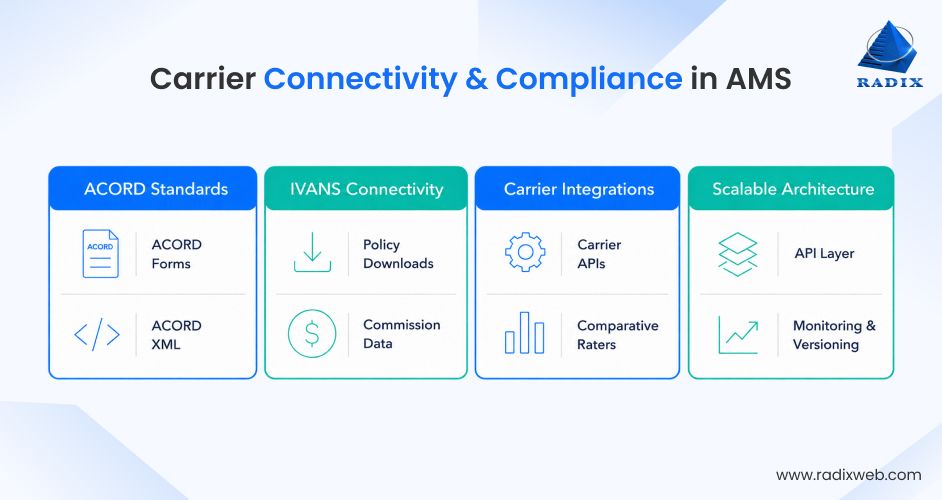
ACORD (Association for Cooperative Operations Research and Development) provides the data standards that insurance organizations use to exchange information across carriers, agencies, MGAs, and third-party platforms. Aligning the AMS data model with ACORD standards simplifies integration and reduces data transformation complexity.
Common ACORD forms include:
Beyond forms, ACORD XML remains the foundation for much of the industry's electronic data exchange, including carrier downloads and comparative rating submissions.
IVANS Transformation Station enables participating carriers to transmit policy updates, renewals, endorsements, cancellations, and commission data directly into agency management systems. It remains one of the most widely adopted agency-carrier connectivity frameworks in the insurance ecosystem.
IVANS integration typically supports:
Based on IVANS-published information, hundreds of carriers and MGAs participate in its connectivity network. For agencies that depend on carrier downloads, IVANS often becomes the primary mechanism for maintaining policy synchronization and operational efficiency. The same infrastructure also provides the data foundation for commission reporting and reconciliation workflows within the AMS.
Not every carrier participates in IVANS. When direct connectivity is required, agencies typically integrate with carrier APIs or use comparative rating platforms that aggregate multiple carrier connections behind a single interface.
Common examples include:
For many agencies, integrating with a comparative rater is significantly simpler than maintaining individual integrations with multiple carrier systems.
MGAs and insurance organizations with direct carrier relationships often connect directly to carrier rating engines. While this approach requires more development effort, it provides access to specialized programs and workflows that may not be available through comparative rating platforms.
Carrier ecosystems continue to evolve as API programs expand, and digital connectivity initiatives mature, a shift that mirrors the emerging insurance technology development trends we see worldwide. As a result, AMS integration architecture should be designed for long-term maintainability through:
A well-designed integration layer reduces the effort required to onboard new carriers, adapt to connectivity changes, and support future modernization initiatives.
Insurance buyers care deeply about how their data is protected and where compliance obligations sit inside the platform. This is an area where architecture decisions carry real regulatory weight.
A few controls come up in nearly every security review an insurance buyer runs.
Skipping any one of these tends to surface later, usually during a client or carrier audit.
An application designed for the cloud from the get-go handles loads differently than a traditional on-premises system. A few architectural choices determine how well it holds under real growth.
Locking in these architecture choices deserves real scrutiny upfront. Custom-built software designed for long-term scalability and multi-tenant cloud support needs architecture to be the first deliverable, since reversing decisions later means touching production policy data.
Insurance is regulated at the state level in the United States and at the national or regional level in most other markets. An agency or MGA operating across borders faces requirements that vary by jurisdiction and change often.
Tracked by jurisdiction and line of authority, with expiry alerts. This covers state licenses in the US, provincial licenses in Canada, FCA authorization in the UK, IDD registration in the EU and IRDAI licensing in India.
NAIC Producer Database integration for real-time verification in the US, and the equivalent regulator registers elsewhere, such as the FCA Register in the UK.
Diligent search, tax calculation (typically 3 to 6 percent of premium) and stamping office filings in the US. Lloyd's and London market placements in the UK carry their own reporting rules.
CCPA and NYDFS Cybersecurity Regulation (23 NYCRR 500) in the US, GDPR and DORA in the EU, UK GDPR in the UK, PIPEDA and Quebec's Law 25 in Canada, and the DPDP Act in India.
None of these requirements are optional once an agency operates across jurisdictions. Each one needs a clear owner inside the platform's compliance module, with rules configurable as per jurisdiction, so a new market does not require a new build.
AI is increasingly built into the IAMS itself, not just used by outside underwriting vendors. AI is truly transforming insurance operations and adoption is accelerating quickly across the industry while the gap between early adopters and everyone else continues to widen.
According to a 2025 insurance technology benchmarking report, more than 90% of insurers had already invested in data analytics within the past year, with AI and machine learning ranking as the next-largest investment priority. That analytics foundation is what makes the AI capabilities above practical to add to an IAMS in 2027.
Five use cases account for most of the AI adoption happening inside AMS platforms right now. These include:
Each of these tends to start as a narrow pilot on one workflow before expanding across the platform, rather than launching everywhere at once.
Document ingestion and renewal risk scoring consistently outperform the other AI applications in early results. Ingestion removes hours of manual ACORD form entry from a CSR's week, often within the first full renewal cycle. Risk scoring flags accounts likely to lapse before they do, so the whole team can act instead of relying on a producer's gut feel.
Most agencies see traction on these two before rolling AI out further across the platform.
These are not future capabilities and are already running in production at agencies of moderate size today. Agencies that adopted AI early are already seeing measurable time savings in day-to-day servicing.

Two modules consistently determine whether staff actually trust and adopt a new insurance-specific AMS, commission tracking and certificate of insurance generation.
So, other than a technically strong architecture, mature data policy, and robust security and compliance modules, here's what you need to ensure successful IAMS adoption:
The commission engine needs a rules layer flexible enough to represent flat splits, tiered splits and carrier-specific rates. New commission structures should not require new code every time terms change.
The reconciliation flow described earlier under carrier integration feeds directly into this engine. The engine then needs a clear dispute workflow to act on whatever it surfaces.
Contingency commissions earned at the agency level still need allocating to the producers who contributed to that threshold. This is exactly where a configurable rules engine earns its cost.
Certificate of insurance automation requires document generation services tied directly to policy lifecycle events, not a manual template process.
Agencies typically treat the holder model as core scope. Retrofitting it disrupts certificates already circulating with holders, so that decision often shapes how smoothly the rollout goes.
A custom IAMS build runs on a dependency chain. The schema comes first, then core entities, then lifecycle workflows. Carrier integration follows and overlaps with workflows. The plan below spans 36 weeks, and the overlaps between phases are what keep it from stretching. Skipping a step doesn't remove the work, it moves it into a later phase at a higher cost.
| Phase | Weeks | Focus |
|---|---|---|
| Data model and schema design | 1 to 5 | Entity schema validated against ACORD XML field definitions |
| Core entity management | 4 to 12 | Client, policy, producer and carrier master data |
| Policy lifecycle workflows | 10 to 20 | New business, renewal, endorsement and cancellation logic |
| Carrier integration | 14 to 26 | IVANS download, quoting API, commission download |
| Commission and COI modules | 20 to 32 | Rules engine, reconciliation, certificate automation |
| UAT and rollout | 30 to 36 | Testing with real producers, CSRs and admins |
Commission management is typically built after carrier integration on purpose. Reconciliation logic depends on the commission statement data carrier integration downloads first, so building it earlier just means rebuilding it later at extra cost.
Deciding how strictly these phases should run in sequence, rather than in parallel, often comes down to strategies and team size. That decision often comes down to picking a methodology that fits, and it should be locked in before phase one begins.
These figures are typical ranges observed across similar projects. IVANS connectivity, ACORD licensing and ongoing compliance updates sit on top of the build cost. Each of these varies by state count and carrier volume across the agency's footprint being served.
| AMS scope | Cost range | Timeline |
|---|---|---|
| MVP, policy management, renewal tracking, basic download | $80,000 to $180,000 | 4 to 8 months |
| Mid complexity, adds commission and quoting API | $180,000 to $380,000 | 8 to 14 months |
| Enterprise, MGA, multi-carrier API, AI underwriting | $350,000 to $750,000 or more | 12 to 22 months |
| SaaS AMS product for multi-agency distribution | $400,000 to $900,000 or more | 14 to 24 months |
Annual maintenance usually runs 15 to 20 percent of the total cost to build a software solution, a figure many first-time buyers underestimate when comparing proposals side by side. Proper planning and transparent estimations keep the numbers realistic rather than aspirational, especially once carrier scope is added on top.
Treating any estimate as a range, keeps stakeholder expectations aligned and applies whether the estimate covers a six-month MVP or a two-year enterprise build.
Most insurance agencies approaching a custom AMS are not starting from a blank slate. They are migrating years of policy, commission, and client data from legacy systems, often spanning a decade or more of records. Treating migration as a final implementation task rather than a dedicated project phase is one of the most common planning mistakes we see insurance agencies make.
Migration decisions influence architecture, timelines, budgets, and operational risk from the outset. Data quality issues, retention requirements, and cutover planning should be addressed early, since resolving them during implementation can significantly increase project complexity and delivery timelines.
Weighing timing against risk is central to how insurers modernize their technology, where migration sets the pace for everything that follows.
Moving existing apps onto an advanced platform is just the first step. What's more important for successful implementation is migration planning, which starts with an honest inventory of what the legacy system contains.
These quality issues need remediation rules agreed before migration begins. Discovering them mid-migration is what causes most timeline overruns on projects like this. Discovering them after cutover is worse still, since the legacy system is often already retired by then.
A 30-to-90-day parallel running period, with both systems kept current, is the validation most migrations need before the legacy system is retired. A few checks confirm that the new system is ready.
Picking the right delivery partner matters as much as the technology choice, and it is a decision worth making deliberately rather than by default. That means when you are vetting potential software partners consider factors like insurance specific expertise, compliance/security understanding, and experience in delivering zero downtime migrations and modernizations
Agencies that get this right rarely need to repeat the exercise again within a few years. The ones that skip this step tend to be back in the same position within eighteen months, migrating a second time. That pattern shows up often enough across the industry to plan around from the very first migration. It is not a risk unique to any one agency.
Building an AMS for Long Term Competitive Advantage
An AMS is no longer just a recordkeeping platform for agencies planning to grow through 2027 and beyond, whatever stage that growth is currently at. Real advantage increasingly comes from insurance software solutions built for unique workflows with integration depth, process automation, and intelligence layered on policy data. No single feature on a vendor checklist delivers that kind of advantage. It only comes from how those capabilities work together.At Radixweb, we brings 26+ years of software engineering experience to insurance, building ACORD-compliant data models, IVANS carrier integration, commission engines and multi-jurisdiction compliance reporting as standard components. Whether you already have an IAMS that doesn't fits your needs anymore or if you are looking for new solutions that can scale with your agency, we help you decide between building, buying, and customizing. Schedule a consultation with our solution architects and plan your custom IAMS roadmap before the design is locked.
Ready to brush up on something new? We've got more to read right this way.