Read More


Recognized for AI Excellence at 2026 Globee® Awards - Read More

Pratik Mistry
The hardest part of hiring external dedicated developers isn’t finding resumes. It’s choosing an engagement model that won’t force you to restart ramp up every eight weeks. In 2026, a dedicated developer engagement model exists to solve exactly that gap.
You get engineers who work exclusively on your product, inside your sprint cadence, tooling ecosystem, and technical environment. While your software partner handles HR, payroll, and compliance. If you already know you'll need ongoing capacity, hiring dedicated software developers for long-term growth can provide a stable, accountable team structure aligned with your product roadmap.
This blog is written for leaders who want to make those decisions with numbers, processes, and risk clarity. It walks through when dedicated hiring makes sense, how many developers you really need, what they cost across regions and models, and how to vet vendors in a way that stress tests replacement, IP, and onboarding.
For growing software products, team continuity can become as important as technical capability itself. This guide looks at the dedicated developer model through the lens of scalability, cost, vendor evaluation, and long-term product ownership to help founders make more informed staffing decisions.
| Aspect | Detail |
|---|---|
| What This Guide Covers? | The dedicated hiring model, 2026 cost benchmarks, a vetting process that works, contract terms to lock in, and how AI coding tools change the decision ROW |
| Who Should Read This? | CTOs, VPs of Engineering, and founders deciding between dedicated hiring, freelancers, staff augmentation, and an in-house build ROW |
A dedicated developer is a full-time software engineer who works exclusively on your product and operates within your sprint cadence and toolchain. They are employed and administered by a development partner who handles HR, payroll, and compliance rather than directly by your company.
This structure exists to solve a specific problem. You need someone who stays long enough for their accumulated product knowledge to compound into real velocity, instead of restarting ramp-up after every engagement. The developer reports to your technical leadership, builds long-term product context, and is not shared across other client accounts when the engagement is genuinely “dedicated”.
The Standish Group's CHAOS research found smaller, stable teams consistently outperform larger, more fragmented project structures, with small software projects achieving success rates of up to 61% compared to just 6% for the largest initiatives.
Three comparisons clarify how a dedicated developer differs from common alternatives:
Getting this distinction right early avoids a slow and expensive correction later. Knowing how a development team should be structured before you scale makes the model conversation much easier to have with your own leadership.
Choosing between dedicated hiring, freelancers, agencies, and staff augmentation is primarily about time horizon and how much product context the work requires, not just headline cost. Three questions in sequence usually point to the right model:
The most expensive mistake is not necessarily choosing the cheapest model. It is choosing an engagement structure that does not match the work. If a supposedly short project evolves into ongoing development, repeatedly changing developers or transferring knowledge can create onboarding costs, rework, communication overhead, and slower delivery.
The right model should therefore reflect how the work is expected to evolve, not simply how it looks when the engagement begins.
These are the situations where dedicated hiring often outperforms alternative engagement models, based on the level of continuity, product knowledge, and team integration required.
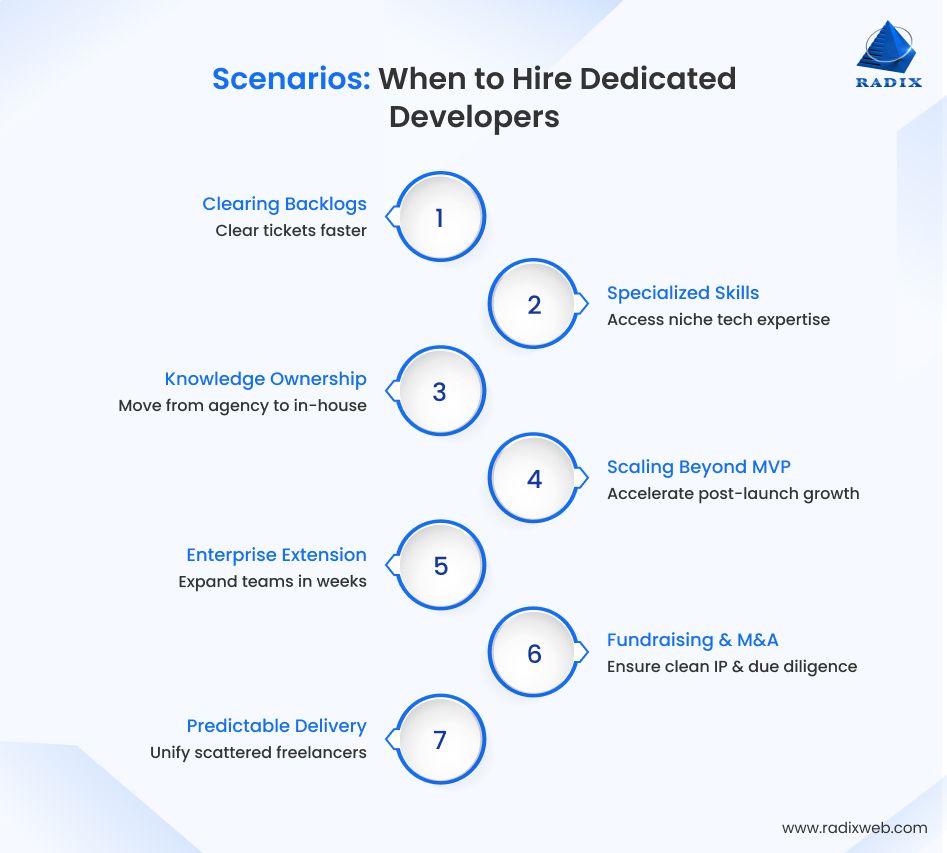
A product company with a backlog that keeps growing faster than the current team can clear it often benefits from dedicated developers. A dedicated developer becomes more productive over time as they gain familiarity with your sprint processes, workflows, and codebase. Rotating contractors often require repeated onboarding, which can reduce continuity and slow delivery.
A company facing a specific technical gap, whether in React Native, Go, cloud-native engineering, data platforms, or AI development, can gain significant advantages from dedicated hiring. Senior specialists in these domains are often difficult to source locally, while a global talent pool provides broader access to experienced engineers and full-stack developers who can contribute across multiple areas of a product.
A company transitioning away from a project-based agency relationship often needs to rebuild ownership of its product knowledge. Dedicated hiring helps retain institutional knowledge within the organization through direct team participation, shared repositories, documented processes, and ongoing collaboration rather than relying on vendor-dependent expertise.
A startup that has moved beyond MVP validation and is scaling toward a Series A milestone typically requires both execution speed and architectural consistency. In these circumstances, dedicated developers often provide greater continuity and long-term momentum than a traditional project engagement focused on delivering a predefined scope.
An enterprise extending its internal team to support a new product line can often increase engineering capacity much faster through dedicated hiring than through traditional permanent recruitment. Many dedicated hiring providers can onboard experienced engineers within weeks, allowing organizations to accelerate delivery without waiting for lengthy local hiring cycles.
A company preparing for fundraising, acquisition, or merger discussions benefits from a dedicated model with clear intellectual property assignment, documented onboarding processes, and transparent development practices. These measures can help reduce code ownership concerns, knowledge concentration risks, and continuity issues during due diligence.
A company coordinating multiple freelancers across different time zones and areas of responsibility may benefit more from a dedicated, accountable team structure than from adding additional independent contributors. Shared ownership, consistent engineering standards, and unified communication channels often result in more predictable delivery outcomes.
If you expect the same developer or team to continue contributing after the first project or milestone is complete, a dedicated hiring model will often be more efficient and cost-effective than a series of short-term project engagements. Over time, accumulated product knowledge, team familiarity, and reduced onboarding effort create compounding value that is difficult to achieve through transactional delivery models.

Most companies ask whether they should hire dedicated developers before they ask how many. Getting the second question wrong costs more than getting the first one wrong.
A simple three-question sequence helps:
What is your backlog measured in sprint-weeks?
Start by looking at your backlog in terms of sprint capacity. If you have a twenty sprint-week backlog and a four-person team working in two-week sprints, it will take approximately ten weeks to clear that work at current velocity, assuming no significant new work enters the queue. If demand consistently arrives faster than work is completed, adding capacity becomes a practical necessity rather than a strategic preference.
What is the nature of the skill gap?
Next, identify the nature of the gap you are trying to fill. A narrowly defined need, such as a senior mobile engineer, data platform architect, cloud specialist, or AI engineer, is often best addressed with a single experienced hire who can immediately contribute in that area. A broader capability gap spanning frontend, backend, QA, and DevOps may justify a small cross-functional dedicated team instead.
What does internal management capacity support?
Finally, assess your organization's ability to support additional developers. Every new team member requires onboarding, planning, code review, collaboration, and technical guidance. As team size increases, coordination overhead grows as well. Organizations that lack sufficient management bandwidth often struggle to realize the full value of larger dedicated teams.
A pattern seen repeatedly across software projects is that one experienced developer working against a clearly defined scope often delivers more value than multiple developers working against unclear priorities. Start with a strong senior hire, run at least one complete sprint cycle, measure the impact on delivery velocity, and then scale the team based on real performance data rather than assumptions.
Software developer hiring costs vary significantly based on location, experience level, technology expertise, and engagement structure. While hourly rates remain a useful benchmark, the real budget picture should include factors such as onboarding time, team continuity, productivity, communication overhead, and access to specialized skills.
| Region | Junior | Mid-Level | Senior | Lead / Architect |
|---|---|---|---|---|
| India | $800 to $2,500/mo | $2,000 to $3,500/mo | $3,500 to $5,500/mo | $5,000 to $8,000/mo |
| Eastern Europe | $2,500 to $4,500/mo | $4,000 to $6,500/mo | $6,000 to $10,000/mo | $8,500 to $14,000/mo |
| Latin America | $2,000 to $4,000/mo | $3,500 to $6,000/mo | $5,500 to $8,500/mo | $7,500 to $12,000/mo |
| Southeast Asia | $1,500 to $3,000/mo | $2,500 to $4,500/mo | $4,000 to $7,000/mo | $6,000 to $10,000/mo |
| US / UK (local) | $7,000 to $12,000/mo | $10,000 to $16,000/mo | $14,000 to $22,000/mo | $18,000 to $30,000/mo |
These numbers are based on Radixweb analysis of 2025-2026 dedicated developer engagements. The ranges are broadly aligned with industry-reported software outsourcing pricing trends, which show significant variation based on geography, technology specialization, and engagement model.
Most buyers miss one inversion in this table. The lowest monthly rate is not always the lowest total cost. A senior developer at $5,000 per month often delivers better value than a junior developer at $3,000 per month who needs substantially more guidance. Once you count loaded leadership time at a $100-150 per hour, the senior hire usually wins on total cost.
Cost comparisons only become useful when the assumptions are clear. The example below illustrates a common scenario involving two mid-level dedicated developers supporting an active software product for 12 months. It also considers continuity requirements and ongoing roadmap work.
Assumptions
| Model | Illustrative 12-Month Cost |
|---|---|
| Dedicated team | ~$80,500 |
| Freelancers | ~$105,600 |
| Staff augmentation | ~$114,800 |
| US in-house hiring | ~$210,000-$280,000 |
This is an illustrative estimate based on the assumptions above. Actual costs vary by geography, seniority, technology stack, engagement terms, and replacement requirements.
The comparison highlights an important principle rather than a universal pricing benchmark. Monthly rates tell only part of the story. Total cost is influenced by onboarding effort, developer continuity, productivity, replacement cycles, management overhead, and knowledge retention over time.

You can broadly find dedicated developers through three channels, each with different trade‑offs in speed, vetting quality, and accountability.
Vetted marketplaces including Toptal, Arc.dev, and Lemon.io offer pre-screened developers who have passed multi-stage technical assessments. You can typically reach a first candidate in 24 -72 hours. The vetting is genuinely strong, especially at Toptal, but accountability mostly ends once the placement is made.
Managed development partners keep a bench of pre-vetted developers and handle HR, payroll, and compliance directly. Deployment usually takes one to two weeks. Rates run higher than marketplace pricing because the management layer is included. However, the partner carries reputational and contractual responsibility through the whole engagement, not just at placement.
Nearshore specialist networks in time zone compatible markets like Eastern Europe for Western Europe, LATAM solve the async coordination friction that slows down fully offshore work. Sourcing nearshore talent through a curated bench typically matches candidates in 48-72 hours.
For long-term dedicated roles, the sourcing process for a dedicated software developer should be evaluated on more than candidate availability. Look at technical screening, developer exclusivity, replacement procedures, employment responsibility, security practices, IP ownership, communication overlap, onboarding support, and continuity guarantees.
A technical interview shows whether someone can write correct code. It rarely shows how they handle ambiguity, whether they flag problems early, or how they behave when a spec is incomplete. Those traits decide how much of your lead's time the developer consumes every week.
Two practical evaluation formats help:
The most predictive format for a dedicated developer is a time‑boxed async task of about two hours, sent by email or via a documentation tool like Notion. The task should closely mirror real work from your codebase like a code review, a small feature addition, or a documentation task in your stack. It should also include at least one deliberate ambiguity requiring a judgement call.
This format reveals:
These are the behaviours that matter day to day in a dedicated engagement.
Before signing a long‑term contract, run a two‑week paid trial sprint on your real codebase, not a synthetic project.
Four signals from that sprint are particularly useful:
A developer who passes technical screening and then performs well on a real trial sprint is likely to succeed in the full engagement. Someone who passes the screen but struggles in the trial is showing you something important before you commit to six months or more.
Replacement policy is the stress test for vendor maturity. Before signing, ask:
Vendors with mature processes will answer these with specifics and documentation.
Three contract details get underweighted by first time buyers. Each has a distinct failure mode if neglected:
In direct employment, work product typically belongs to the employer by default in most jurisdictions. In a dedicated developer engagement where the developer is employed by the vendor, the IP chain is longer. The vendor’s employment agreement must assign work product to the vendor, and your services agreement must then assign it to you.
If the first link is missing, the assignment in your services agreement may not fully hold. Before signing, confirm in writing that:
Data security obligations do not disappear when development work is outsourced. If dedicated developers will access customer, employee, financial, healthcare, or other sensitive information, your contract should clearly define data handling responsibilities, security controls, breach notification procedures, and compliance requirements relevant to your business.
The specific regulations will vary by region and industry:
Before signing, confirm that:
This is particularly important when developers are working remotely across multiple jurisdictions, where regulatory obligations may extend beyond the country in which the development team is located.
Most replacement clauses only cover developer departure. Fewer cover the case where the developer stays but underperforms. A strong contract includes:
This gives you a practical remedy when performance is the issue, but departure has not yet occurred.

The first 30 days of a dedicated engagement largely determine the quality of the next 11 months. In many software organizations, structured onboarding for dedicated development helps developers reach meaningful productivity by week four. While unstructured onboarding can extend ramp-up well into the second or third month.
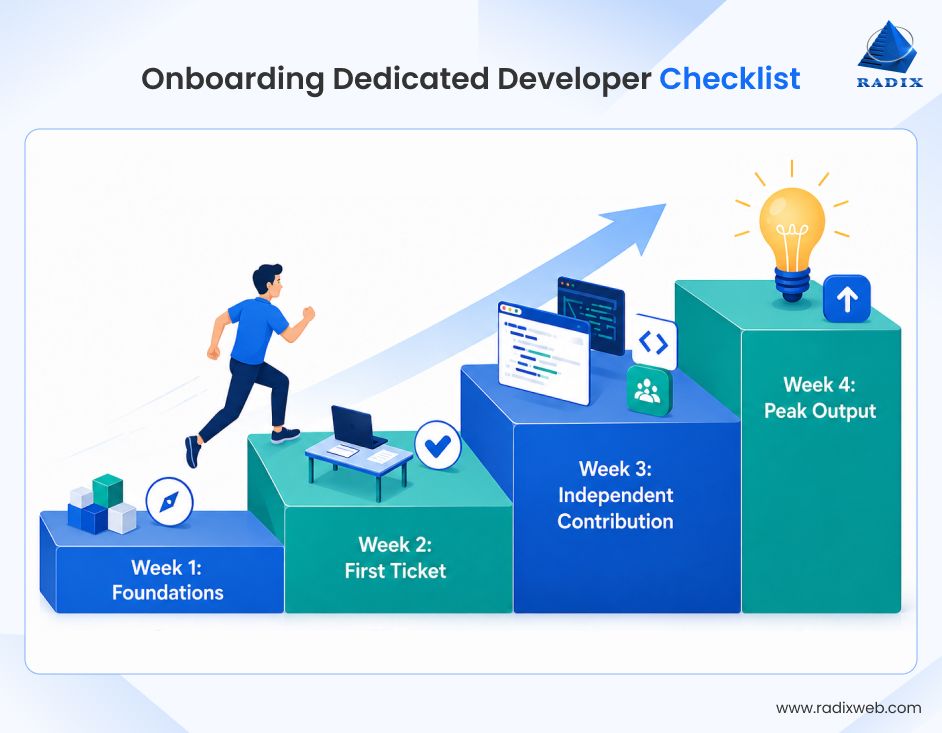
Here’s a practical checklist:
By the end of week four, a dedicated developer should be able to run the local environment, submit passing pull requests, and participate meaningfully in sprint planning. If not, either the onboarding was inadequate or a capability issue exists that the trial sprint failed to reveal.
Once a dedicated developer or team is in place, several practices can significantly influence whether productivity improves over time or plateaus.
Schedule a 30-minute demo at the end of each sprint where developers showcase completed work. This keeps progress visible, creates accountability without micromanagement, and helps stakeholders stay aligned on delivery outcomes.
Senior offshore developer rates shift as markets evolve, and a developer with 12 months of deep product knowledge is more valuable than a new hire at the same nominal rate. Quarterly rate review conversations, without implying quarterly increases, set expectations that performance and retention will be discussed regularly.
Retention matters most for your highest performers. A developer with 12 to 18 months of product context has institutional knowledge that takes months for a replacement to rebuild, even with solid documentation. Losing such a developer often costs more than a reasonable retention premium. The operational side of running a dedicated team well explains why engagement models that treat developers as interchangeable resources tend to see higher attrition.
Engineering decisions disconnected from business trade-offs often produce technically sound solutions to the wrong problems. Dedicated developers often make better implementation decisions, ask sharper questions, and spot mismatches between specification and business intent in product planning.
Certain signals in evaluation or contracting should give you pause:
Each of these may indicate process gaps that could affect delivery quality during the engagement.
In 2026, almost every dedicated hiring decision sits alongside the question of AI coding tools. GitHub Copilot, Claude Code, Cursor, and similar assistants have changed what a single developer can produce.
AI coding assistants such as GitHub Copilot, Cursor, Claude Code, and similar tools have become a standard part of modern software development workflows. Research from Microsoft has shown that developers using AI pair-programming tools can complete certain coding tasks significantly faster. AI tools are especially good at boilerplate generation, standard API integrations, documentation, tests, and refactoring.
AI cannot amplify a developer who doesn’t exist. Bringing AI capability into an existing team's workflow amplifies the engineers you already have, it does not replace a specialization you lack. AI generated code also carries measurably more risk. Veracode's GenAI Code Security research, retested through Spring 2026, found AI output carries 2.74 times more vulnerabilities than human written code, and 45 % of samples fail basic OWASP Top 10 checks. Someone still must review it with real judgment.
Practically, AI tools shrink the number of developers needed for routine, well specified work. But they do not reduce the need for a senior engineer who owns architecture, product context, and code review. Understanding how to build AI capability into a product responsibly is a useful next step if this question is live for your team right now.
Whether dedicated hiring is ‘worth it’ depends on the time horizon and what you compare it against.
For Short Work Under Eight weeks: Dedicated hiring is not the right fit even with a clearly bounded scope. Ramp-up cost eats into the value, and a freelancer or project agency delivers better economics.
For Work Extending Past Three Months: Data across multi-year engagements shows that dedicated teams can result in a lower total cost of ownership over 12 months due to greater continuity and reduced turnover-related overhead.
Here’s a clear decision metric for dedicated hirings:
| Situation | Best Model |
|---|---|
| <8 weeks | Freelancer |
| 3-12 months | Dedicated |
| Defined scope | Agency |
| Continuous roadmap | Dedicated |
The compounding factor is that a developer who has been on your product for a year is meaningfully more productive than in month one, because they know:
This context reduces rework, cuts back on clarifying questions, and improves independent judgement. That kind of value is only available from developers who stay.

Finding the Right Dedicated Development Partner for Your Team
The model decision, the vetting process, the contract terms, the onboarding plan, and the retention practices described above only pay off together. Getting one right while shortcutting the others produces inconsistent results almost every time. A dedicated development teams with vetted engineers model gives you explicit IP assignment, a documented replacement process, and structured onboarding from day one.That combination is often a stronger predictor of long-term value than hourly rate alone. If you are weighing this decision right now, reach out to Radixweb's team to talk through your specific stack, timeline, and team size before you sign anything.
Ready to brush up on something new? We've got more to read right this way.