Read More


Recognized for AI Excellence at 2026 Globee® Awards - Read More

Dharmesh Acharya

A 7 Mins Read: The value of AI isn’t in its hype; it lies in architecture. While event-driven systems bring real-time responsiveness, data-centric builds enhance trust, governance and reuse. Together, they create the foundation for scalable AI, faster decisions, and durable business impact. Architecture is a strategic lever now - that is the one thing I want every CTO, CIO, and product leader reading this to internalize before they approve another AI initiative.
TL;DR
● AI succeeds when architecture supports real-time action.● Event-driven systems help businesses respond instantly.● Data-centric design improves trust, quality, and governance.● Legacy batch systems slow AI down.● Modern enterprises need modular, scalable, AI-ready foundations.
I’ll be very direct with what I see across AI engagements for businesses of several scales. Real AI ambitions, committed budgets, promising pilots in demos. But somewhere between a controlled test environment and production, the project saliently fails.
I’ve seen this pattern resurface time and again to know that it’s not a tech problem. It’s always the foundation underneath that isn’t built to support AI initiatives. Realistically, it’s the event-driven and data-centric architectures that can feed artificial intelligence projects the real-time, trusted, governed data it needs to do anything useful at scale. At Radixweb, ‘architecture first, always’ is the core principle of how we approach each and every AI and data engineering engagement for delivering enterprise-scale value.
Understand this: if your systems were built for batch cycles and point-to-point integrations, your AI will inevitably deliver batch-cycle results. Decisions will get made on yesterday's state of your business, models will saliently drift without anyone noticing, and AI will be stuck at experimental rather than operational. I can confidently put this across: the gap between AI pilot and AI in production is almost always an architecture issue.

Most of us in the tech business have spent over three years talking about models. And I understand why! The market has experienced genuinely remarkable foundational models that pushed benchmarks of innovation. But the conversation has consistently avoided the more important question: what does the system around the model look like, and is it fit for purpose?
The most clarifying framing I have heard from practitioners who have realistically closed the pilot-to-production gap is this: success is roughly 10% the model and 90% the data architecture built around it. Look at these industry studies confirming the consensus:
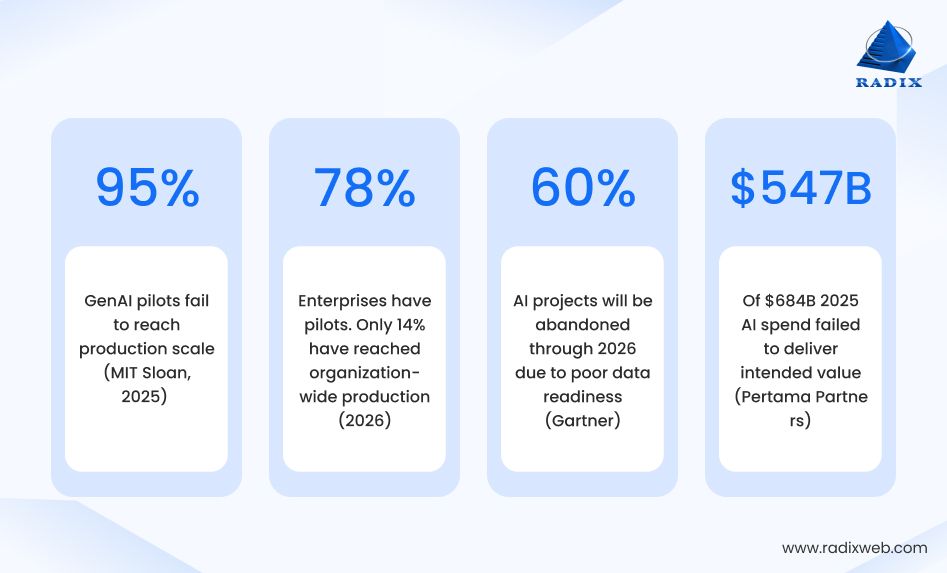
These are not marginal outcomes. They are the dominant pattern. And in nearly every case, the root cause is architectural. Not the model, not the vendor, not the vision.
When I look at what separates the 14% AI projects that scale from the majority that stall, the difference is rarely enthusiasm or investment levels. It’s always whether someone made deliberate architecture decisions about data flow, event propagation, service modularity, and governance before the first model was trained. The enterprises that did the work are the ones whose AI is operational today.
Business operations of today demand steady and continuous responsiveness. Every changed customer behaviour, each time a risk threshold I crossed, every transaction clearing are signals that demand response. Your AI systems cannot process these signals with an overnight batch processing approach.
This is what event-driven architecture targets. Rather than calling services in synchronous chains where one slow component can break the chain, events are processes through a shared backbone.
Apache Kafka is now the de-facto standard for enterprise-scale event-driven architectures. The system responds to what’s happening, in real time, rather than to insights of what happened previously.
What this realistically means for AI is significant. Events trigger model updates and predictions instantly. Fraud detection happens before the transaction completes. Credit risk adjusts the moment behavioural signals shift. Inventory AI responds to demand signals as they are flagged off rather than waiting for the next planning cycle. AI and the business move together, rather than the AI having to catch up with a business that has already moved on.
| LEGACY BATCH ARCHITECTURE | EVENT_DRIVEN ARCHITECTURE |
|---|---|
| AI Learns After an Incident | AI Responds as Events Occur |
| Data collected, processed overnight, fed to models working from historical state. By the time the signal reaches the AI, the business moment has passed, and the decision has already been made without it. | Events trigger predictions and model updates instantly. The system reflects current business reality. AI outputs are relevant to decisions that are still open, not post-mortems on decisions already made. |
Every modernisation engagement we undertake, the first conversation is about data flow, not model selection. We design event flows around real business triggers: ‘what actually needs to happen for a decision to be made at the right moment’. When modernizing legacy systems with AI for embedding intelligence at the core, we adopt the approach where event-driven designs form the baseline.

While event-driven architecture is the nervous system of a scalable AI operation, data-centric architecture act as the memory. This layer ensures data is not just collected, but trusted, governed, and made reusable across every AI use case.
However, this is where I see the most expensive mistakes happening. Businesses assume that their data is ready for AI use. But enterprise-scale businesses consistently reel from inconsistent data definitions, broken lineage, no clear ownership, incompatible schemas across business units. Most large enterprises accumulate data debts over years of system additions, acquisitions, and technical debt that nobody prioritised cleaning up because the old reporting infrastructure could work around it. But AI can’t!
Businesses that skip data foundations and jump to model development spend 2.8 X more in remediation costs before they even reach production. The cheapest time to fix data architecture is before the AI project starts; the most expensive is after the pilot has already failed.
Adopting a data-centric approach means you treat data quality, lineage, governance, and accessibility as first-class product requirements. It means building feature stores that allow AI teams to reuse trusted, versioned signals rather than rebuilding them in every initiative. It means schema contracts catch breaking changes before they silently corrupt model outputs. It also means that every AI decision your system makes, was driven by data, reliable data.
This is the very infrastructure that makes AI auditable. The EU AI Act, with high-risk AI obligations applying from August 2026, requires transparency, auditability, and bias prevention for AI systems in financial services, hiring, and a range of other sectors. Data-centric architecture is not just good engineering; it has increasingly become a compliance requirement.
Throughout all data strategy advisory sessions for supporting AI innovation, we thoroughly stress on investing in analytics-ready data, made once correctly. We implement feature stores that promote reuse across teams, enforce lineage controls from ingestion through to model output, and build governance into the pipeline as a structural layer — not a compliance checkbox added before audit. Across every AI engagement we have delivered, the initiatives that reached production fastest had data governance designed before model selection began.
‘AI didn’t work out’ is really a vague angle. Because the failure patterns are always visible:
These failures are results of decisions that were never made or were deferred in favour of moving faster on the model work that felt more exciting.
What I tell leadership teams is this: if the platform cannot support continuous data flow, modular change, and observable AI behaviour, every new AI capability you build becomes a custom project from scratch. You are not compounding on a foundation. You are rebuilding it with every initiative. That model never scales commercially.
The solution is not a different model or a bigger budget. It is the disciplined, sequential approach to building AI software that treats architecture as the prerequisite. It treats the first sprint as the one that designs the data foundation, not the one that trains the first model.
Stop asking whether AI is possible and start asking whether your architecture is ready for it.
Here is the practical readiness framework I want business leaders to go through before any AI initiative is approved:
If the honest answer to more than two of those questions is no, the AI initiative has a predictable failure mode already built in. The right response is not to slow down the AI ambition. It is to invest the next quarter in the architecture work that makes the AI initiative survivable: event-driven pipelines, data governance, observability infrastructure, and modular service design.
Every AI engagement at Radixweb starts with a scoping workshop before a line of model code is written. We map KPIs to architecture requirements, identify the data flow gaps that may block production, and design the event-driven and data-centric foundation that the AI initiative needs. Our MLOps consulting for production-ready AI is specifically built to close the architecture gap between AI experimentation and AI at scale. We provision for everything including drift monitoring, retraining pipelines, and governance frameworks that satisfy both business and regulatory requirements.
We have guided more than 50 AI initiatives from pilot to production in the last year. The ones that scaled shared one structural commitment: they treated the architecture as the product, and the model as a component of it.

What’s the Operating Model for Enterprise AI That Compounds?
The enterprises that will define AI leadership over the next three years aren’t the ones running the most pilots. They are the ones that built the right foundation early enough for the value to compound. Event-driven and data-centric architectures are the infrastructure that makes that compounding possible.By 2028, more than half of enterprise architecture teams are expected to transition from traditional governance models to AI-based autonomous governance. That transition does not happen by selecting a better model. It happens by building infrastructure where autonomous decision-making is trustworthy. Because if the data feeding it is governed and the events flowing through it are real-time, the outputs will be observable and explainable.Process intelligence, event-driven integration, and trusted agentic AI form a converged architecture that most enterprises have not yet achieved. The ones building it now will operate at a structural advantage that is very difficult to close later.At Radixweb, the version of AI we build are event-driven at the foundation, data-centric at every layer, and production-ready from day one. If you are evaluating your AI readiness or trying to move an initiative that has stalled back into motion, I would like to have that conversation with you directly.
Ready to brush up on something new? We've got more to read right this way.