Read More


Recognized for AI Excellence at 2026 Globee® Awards - Read More

Dhaval Dave
Quick Overview: Low Code/No Code is redefining HR by eliminating manual inefficiencies and empowering teams to automate complex workflows without IT dependency. This blog explores the most impactful LCNC use cases across recruitment, onboarding, performance, analytics, compliance, and employee experience.
The Human Resources team is the structural backbone that keeps an organization running smoothly. And they are also undergoing a massive shift. What was once a process-heavy, document-driven, and manually operated function is now rapidly evolving into a tech-powered, automation-first ecosystem.
Surprisingly, Low Code/No Code (LC/NC) platforms are at the center of this evolution.
According to Deloitte report, HR leaders spend up to 57% of their time on repetitive administrative tasks. Meanwhile, more than 70% of HR functions face delays in digital transformation because they depend heavily on IT bandwidth.
Low Code/No Code tools are closing this gap. This allows HR teams to choose low-code development to build HR applications, workflows, dashboards, and automation without writing code, thereby improving operational efficiency.
As HR expands beyond basic personnel operations to strategic roles like employee experience, proactive retention, and data-driven talent decisions, low-code platforms for HR automation become the primary parameter to scale.
This blog explores the most impactful low code/no code use cases in HR, how they work, the technical architecture behind them, benefits of low-code/no-code for HR departments, and real-world workflow examples.

The HR process consists of heavy, data-intensive, and collaborative tasks. This becomes an ideal strategy for low code/no code transformation. Let’s break this down in detail.
HR workflows include approvals, verifications, calculations, and document checks. Moreover, it comes with predictable logic.
That’s when low code/no code backend platforms can easily define:
We all know, typical HR teams cannot code, or develop custom HRMS or any applications. Yet, they need automation urgently. With the rise of low code/no code solutions, they can easily:
Many organizations use:
Here, low code/no code development helps unify them into one integrated HR ecosystem. As a result, this enables centralized data visibility and cross-platform automation.
HR policies often change:
Here, low code development platform supports instant modifications and fast deployment. It leads to no engineering cycles needed.
Considering recent HR technology trends, low code/no code development solutions enable HR teams to go beyond traditional administrative tasks and build automated ecosystems that connect people, processes, and data.
The following are real-world low-code use cases in HR, explained with deeper context, workflow logic, and business outcomes.
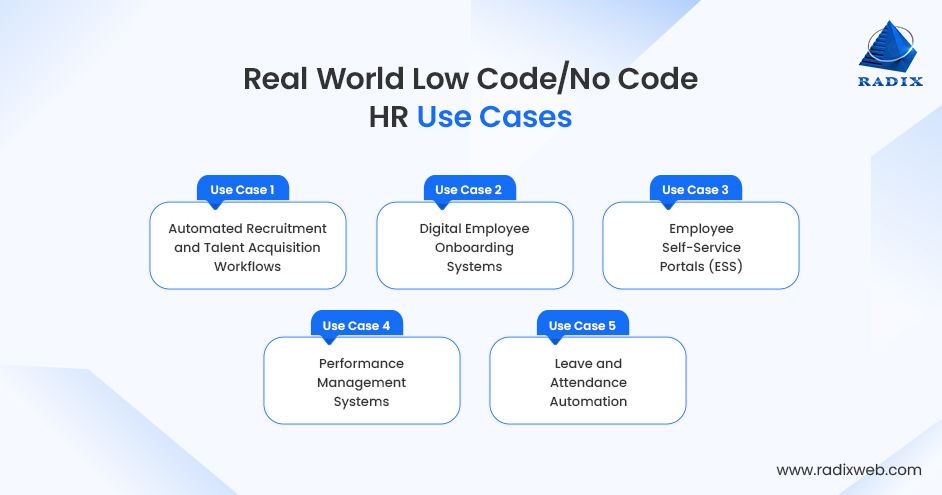
Recruitment encompasses the entire process, from sourcing to interviews and final approvals. This makes it one of the most complex HR processes. Here, low code HR platforms automate repetitive tasks, maintain data accuracy, and build a unified hiring system without depending on IT.
How Low Code/No Code Platform Helps:
Business Impact:
Onboarding is about documentation, compliance, IT access, training, and communication. As a result, it often causes delays. No code development allows HR to design fully automated onboarding journeys that scale across locations and job functions.
How Low Code/No Code Platform Helps:
Business Impact:

ESS portals empower employees to access their own information while reducing HR’s operational load. Many HRs leverage the benefits of low code/no code development to build self-service apps that are secure, personalized, and always connected with core HR management software.
How Low Code/No Code Platform Helps:
Business Impact:
Performance cycles require coordination between employees, managers, HR, and leadership. LC/NC development enables HR to create flexible systems that align with company culture, performance models, and strategies.
How Low Code/No Code Platform Helps:
Technical Capabilities:
Business Impact:
Managing attendance for distributed teams, shift workers, and multi-geography operations is complex. With Low code/no code automation, HR can automate leave and attendance rules without modifying backend HRMS code.
How Low Code/No Code Platform Helps:
Business Impact:
Let’s explore some key business benefits of low code/no code development for HR transformation.
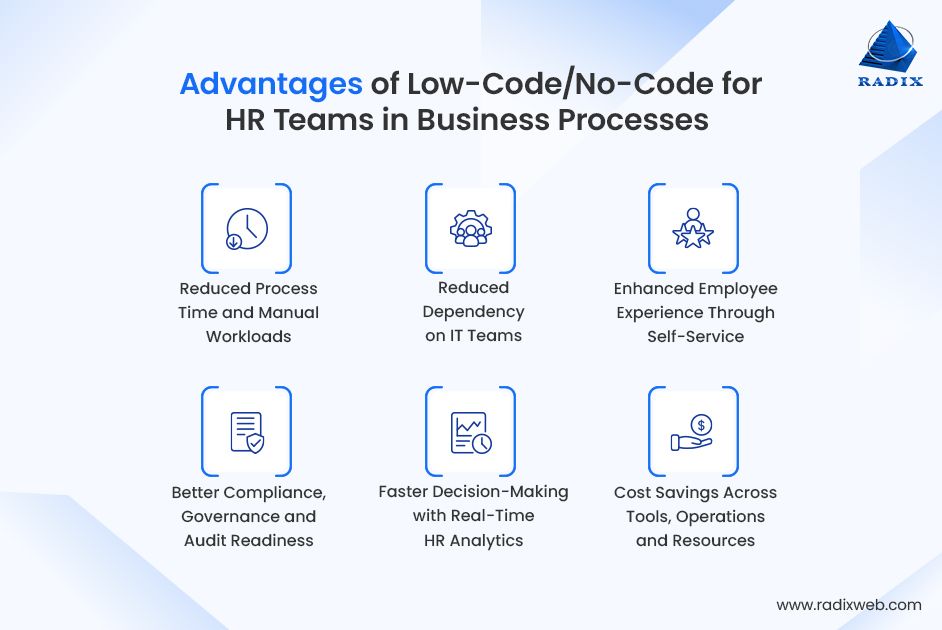
HR functions include monotonous activities, such as collecting forms, data entry, approvals and tracking, communication, and documentation. These workflows are fully automated using low code/no code (LCNC) platforms, which help the HR business move at a significantly quicker pace.
How This Plays Out:
Actually, HR depends on IT to build apps, automate workflows, fix issues, or update processes. This leads to slow execution due to IT backlogs.
Low code/no code development removes these bottlenecks by giving HR teams the tools to build and modify systems themselves.
What HR Can Now Do Independently:
Modern employees want to access their information immediately without waiting for HR responses. Now, low code development allows HR to create personalized self-service portals that give employees control over their data.
What Employees Can Access Instantly:
HR operates under strict compliance mandates, which are statutory regulations, data protection rules, and organizational policies. Low code/no code platforms strengthen compliance through automation and traceability.
How LCNC Tools Supports Compliance:
HR data is essential for making informed decisions about leadership, yet manual reporting is time-consuming. LCNC unifies data from different HR systems and visualizes it in real-time.
Real-Time Dashboards HR Can Build:
Low code/no code development drives cost efficiency across every layer of HR operations.
Cost Advantages Include:

Final Thoughts
Given the extensive benefits and use cases of HR automation, adopting low-code/no-code platforms has become a strategic imperative for modern organizations. By automating HR workflows, teams unlock higher compliance, stronger collaboration, and significantly improved productivity. Eventually, this transforms overall HR management.As a technology partner trusted by global enterprises, Radixweb considers low code/no code development as the most cost-efficient path for organizations to digitize workforce operations without overextending IT bandwidth or investing in rigid off-the-shelf systems.With our deep expertise in custom low-code/no-code solutions, system integrations, and enterprise-grade automation, we enable HR functions to accelerate innovation, elevate employee experience, and build a future-ready digital HR ecosystem.Contact our team to build custom apps at unprecedented speed, without reliance on an overloaded IT team.
Ready to brush up on something new? We've got more to read right this way.