

Read More


Recognized for AI Excellence at 2026 Globee® Awards - Read More

Anand Trivedi
Quick Go-Through: Amidst the prominent trend of digitizing business processes, organizations steadily acknowledge the need to transition from manual HR management to automated systems. So, developing an explicit HRMS can be a strategic decision that helps organizations with their management processes. In this blog, you’ll learn more about the benefits, features, and types of HRMS platforms, along with other fundamental aspects.
Human Resource Management is one of the most essential and primary assets in every organization, irrespective of industry and its size. Therefore, to streamline the HR management system, Human Resource Management Software secures its place in an organization. With the emergence of HRMS software development, the process of recruiting, training, and managing the staff has experienced a massive upheaval.
Although everyone in the organization considers this department very casually, the human resource team is responsible for carrying out small and easily manageable, yet significant, tasks like recruiting new employees, employee training management, retaining the existing employees, supervising, etc.
As a result, organizations look forward to implementing robust and feature-rich Human Resource Management Software to manage the entire process effortlessly. Human Resource Management Systems (HRMS) are designed to ensure seamless communication and coordination across both distributed and in-office teams. From enabling real-time updates to streamlining workflows, modern HRMS solutions play a critical role in managing remote work environments in diverse ways.
Here, we are going to look at the different aspects of a well-structured Human Resource Management Software. Also, we will understand how as a business, you can leverage benefits and implement them to smoothen your management process.
HRMS, or Human Resource Management Software, allows mid and large-level organizations to automate their human resource management processes. HR software solutions give full control on complement management processes like recruitment, work delegation, performance evaluation, payroll management, etc.
A dependable HR software development partner with enterprise-scale HRMS development expertise should create solutions that securely centralize workforce data while enabling seamless access to critical information from anywhere at any time.
Since HR management software is designed to manage HR management, it offers a wide range of functionalities and features than other automated personnel recruitment software. HR software solutions give HR managers and staff the ability to work with both quantitative and qualitative personnel metrics. However, retaining valuable specialists in the organization is the primary goal of any HR management software.
The HR tech market is valued at over $44 billion in 2026 and expected to nearly double by 2035, fueled by AI, automation, and cloud adoption. This is why while choosing the right Human Resource software, you should consider its key functionalities like an intuitive user interface for an amazing experience, integration with legacy apps and software solutions, scalability, and customer support.
In this competitive market, companies are paying huge attention to the most important component of their field of business in order to increase revenue. The dematerialization of various tasks is an important aspect of the rapid development process, and the role of HR is no exception here.
In fact, a study suggests that many companies in the world have tried to implement the Human Resource Management Software for their management process. This improves their productivity, allowing HR managers to participate in the growth and success of an organization.
The ability of HR management software to solve the following difficulties defines its implementation:
Cost Management: Human resource software helps reduce manual effort and operating costs while improving planning, coordination, and on-time project delivery. It streamlines workflows so software teams can execute projects more efficiently and with fewer delays.
Efficient the Business Process: HR management software helps managers handle employee records, payroll, and other routine tasks more efficiently, while workflow automation solutions for enterprises enable employee self-service and payroll management through a centralized dashboard that simplifies everyday HR operations.
Legal Compliance: It refers to the observance of legal requirements that govern employee-employer relationships. Moreover, users can resolve complex difficulties, employ flexible payroll management, and manage the flow of personnel documents.
Human Capital Improvement: It helps to enhance the skillset and facilitate the growth of a team.
Improved Communication: Human resource management systems offer robust communication channels in the workplace as they enable professionals and employees to communicate with each other anytime, anywhere. This, in turn, enhances employee experience and establishes seamless connectivity across the organization.
In recent times, the role and responsibilities of an HR department are not restricted to a single or particular task. They have many tasks on their hands to complete from candidate recruiting and onboarding process to employee performance.
Considering various tasks to perform, we have distinguished the Human Resource Management Software into three different categories.
Based on their functionalities and purposes, below are three major types:
HRIS gives HR teams a single place to manage employee master data and streamline core people's operations. For a deeper look at how to evaluate the right platform, this guide on HRIS software selection and centralized employee data management can help teams store, process, and manage employee information while also supporting recruiting, attendance, performance, and more.
Functionalities of HRIS:
Human capital management software for tracking employee contribution and productivity Monitors and manages how employees contribute to an organization’s overall productivity. In short, HCM helps businesses manage their workforce more effectively.
HCM is categorized into three different parts: workforce acquisition, workplace management, and workforce optimization.
As a result, you can get the following benefits:
Functionalities of HCM:
HR management software integrates a wide range of applications like talent acquisition, benefits administration, compensation management, and performance management to provide a single, centralized picture of the organization’s staff.
Modernized HRMS Solutions for flawless Human Resource Management cover all the important factors of an HRIS. Also, it includes the capabilities of HCM. Payroll and Time & Labor Management (TLM) are two major characteristics of HRMS.
Functionalities of HRMS:
Every organization tries to implement modern tools and technologies to make its services effective and seamless in a technology-driven world. Therefore, many companies have leveraged the advantages of Human Resource Management Software. However, the companies which have not implemented the HR software solutions may likely face difficulties in their management process. So, it’s important to take advantage of software implementation.
Below are some of the major advantages your organization can get by integrating Human Resource Management Software.
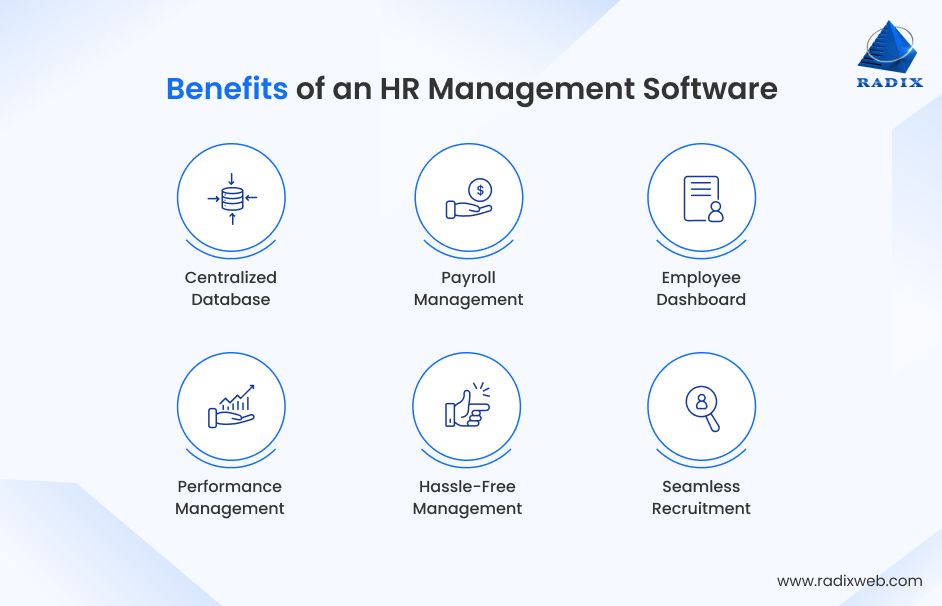
The primary advantage of HR management software is that it stores all the databases of employees in one place. So, you can easily manage and retrieve data whenever it’s required. This enhances the overall performance of an organization.
Furthermore, it also manages multiple records and files of employees. You can sort out anything as per your requirement. Human Resource software also offers a strong security feature that ensures that all the data is kept secure and safe in the database.
Another advantage that comes in the list is the payroll management system. It allows you to stop using a third-party payroll service provider. Hence, you can easily manage the payroll system within your organization.
The payroll system is linked to the activities of your employees. This way, it collects the data of employees’ arrival and departure timings, leaves, extra working hours, and many more. Also, it allows you to track the attendance of every individual employee without any manual errors. So, you can easily calculate the attendance of every employee. This way, you can get accurate information without the risk of human error.
HR resource software offers a personal dashboard to every employee. Here, the employees can enter their information and maintain their records without any interruption. In the employee’s dashboard, they can also update their data, albeit any minor updates like phone number or address.
This entire process can save the efforts and time of human resource teams.
HR software solutions allow the team of HR to analyze the performance of every employee individually. They can easily monitor the strength and skills of the employees.
Furthermore, the management can train their employees based on their skills and review their performance. Eventually, it will enhance the performance of the company.
Human Resource Management Software adheres to the security protocols and policies. Therefore, an HR team can manage and handle all the tasks without any worry of security breaches.
With the implementation of HR software solutions, HR managers don’t have to maintain paperwork and spreadsheets. This way, they can get rid of lengthy emails. This software solution can manage all your significant tasks.
Human Resource Management Software offers various features and functionalities for an organization. Hence, one more advantage you can consider is the seamless recruitment process.
The HR management software allows you to manage numerous forms and applications during the recruitment phase. This way, HR managers can easily find the right and talented employees for their company.
Integrating employee applications can make it much easier to convert an employee's database to an employee file, which can then be used for all of the selection. You can achieve this without any difficulty.
Well, these are some of the advantages an organization would get while going for HRMS software development. In addition, it will help you grow in this competitive world.
If you choose HRMS software development, any partner for tailored, enterprise-grade business software solutions would typically include the essential features needed to streamline HR operations. These capabilities help reduce the workload and responsibilities of HR managers, allowing them to focus on higher-priority tasks.
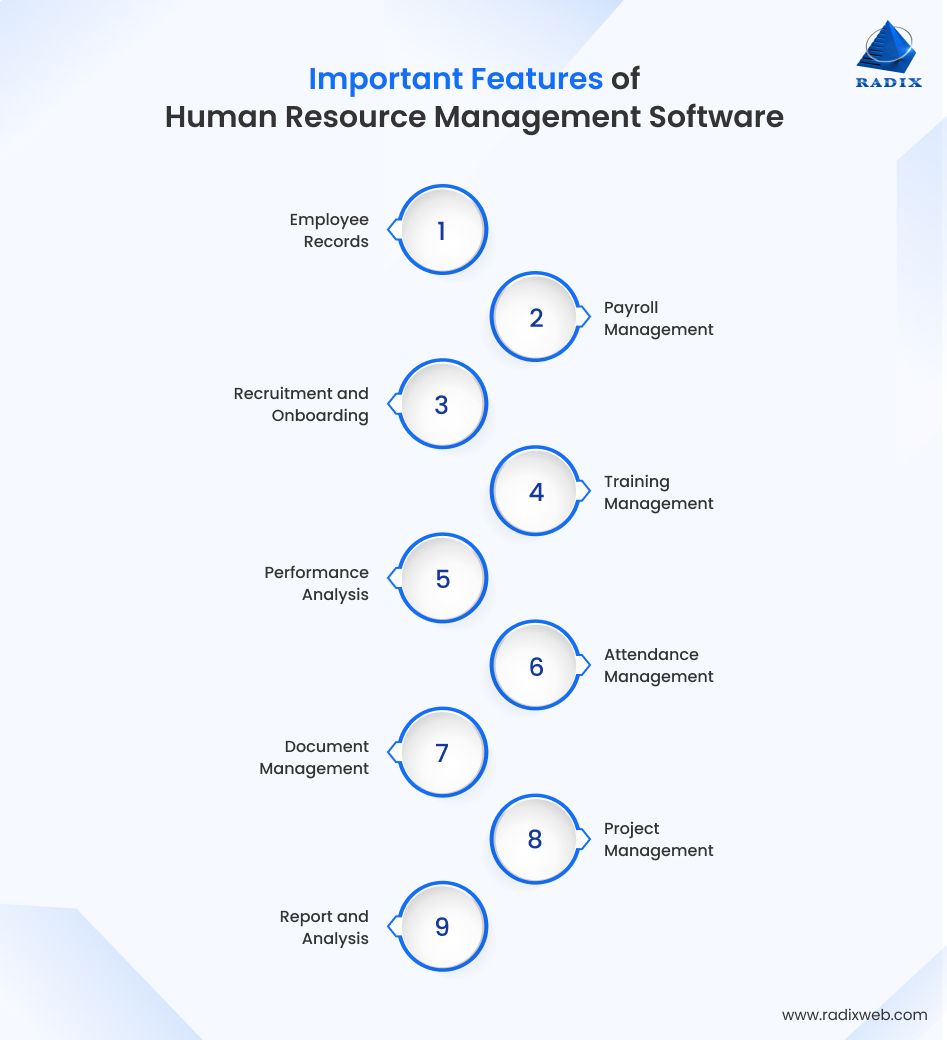
Employee records consist of various information about the employees, including medical insurance, attendance, and tax information. It also stores and manages employees’ personal information, previous job data, performance, awards, and recognition.
HR Management Software allows you to manage the employee's salary, bonus, provident funds, tax deduction, health insurance, and paychecks-related issues.
It calculates each employee's paycheck properly and effectively since it is integrated with time tracking and scheduling software. This ensures transparency in the system.
Recruitment is an important process in an organization. Therefore, HR software solutions offer a recruitment and onboarding module that helps compile and manage resumes and job applications based on the candidate’s skills/experience required for an opening.
This also helps in creating ads, managing applications, and documents. It reduces the burden from the HR manager’s shoulder and brings the best talent to the company. In addition, it also smoothens the onboarding process by acquainting new recruits with company rules and policies.
Organizations have to constantly upgrade their talent pool by re-skilling their staff through remote learning and live training. Here, HRMS enables employees to gain technical and business skills in order to compete in an evolving market.
Using this module, a senior employee can review their teammate's (junior) performance. This way, an HR team can analyze their employees’ work performance, skills, and ability.
The attendance management module allows HR managers to track the attendance (punch-in, punch-out) of employees. They can also track their leaves, arrival, and leaving time.
Here, in this module, you can save and manage all the documents of employees. It also offers a filter and sort by options. You can also convert all your documents into various formats like PDF.
Every employee and HR manager can see the time duration they have spent on a particular project. Projects and timesheets can be managed very easily.
Report and analysis modules display the performance of each employee individually for their projects. This enables you to evaluate the performance and areas for improvement.
To develop a custom HRMS software, it is essential to follow a well-defined and systematic process to ensure success. At Radixweb, we adhere to a step-by-step HR software development process tailored to clients globally, integrating technical excellence with user-centric design and regulatory alignment.
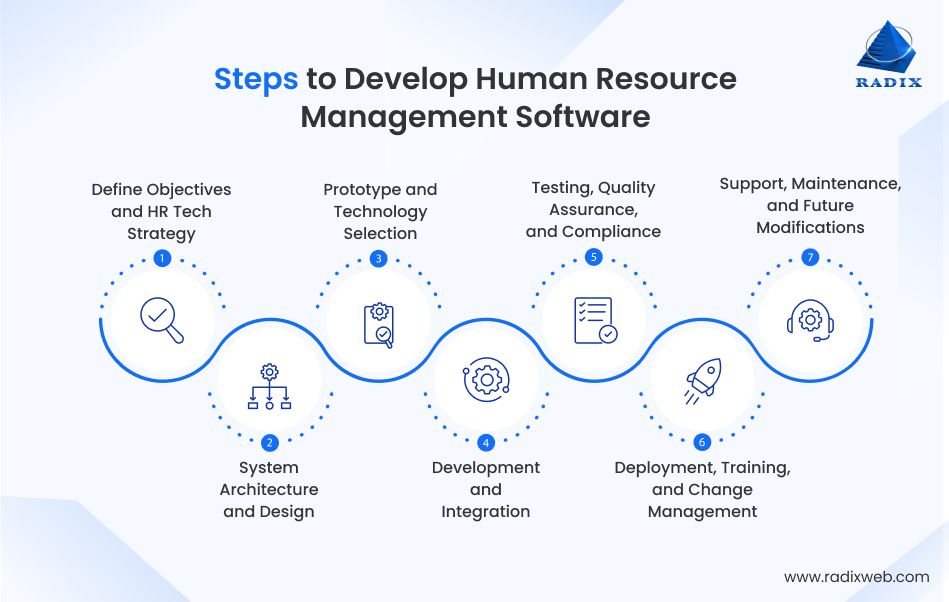
Begin by interacting with stakeholders — including operational teams, tech teams, and HR leaders — to understand the significant workflows, such as recruitment, hiring, onboarding, attendance, performance, salary, and self-service portals, among others. Focus on defining the HRMS project in alignment with your business vision and compliance needs.
After defining business goals, design a modular architecture that aligns with HR systems, ERPs, cloud or hybrid deployments, mobile and analytics platforms, and payroll integration. This step includes designing UI/UX, considering intuitive processes, manager dashboards, and building smart internal tools for HR functionality and usability.
Invest in clickable or HTML prototypes to validate user experience, flows, and features. We often choose modern tech stacks, such as React, Angular, .NET, or SQL/NoSQL.
Build and integrate core modules, including learning and development, analytics, payroll integration, performance review, ATS/recruitment, leave and attendance, and employee administration, tailored to your business needs. Also focus on API development and integration to ensure better interoperability and continuity.
Conduct crucial tests, including functional, compliance, security, and performance tests, particularly for HR data. Our experts define this by providing audited, robust systems developed for different locations.
Migrate the legacy data, train HR teams and end-users, and set up localization parameters (labor law, language, and currency). Follow a client-centric model, which ensures seamless transition and quick adoption.
After going live, focus on consistent system evolution. Fine tune analytics , leverage continuous monitoring, and integrate modern functionalities, such as AI-driven HR analytics and mobile portals, to keep your HRMS software development solutions up to date.
While using HR management software, it’s required to maintain a high level of protection and security as it consists of employees’ personal information. Therefore, it’s mandatory to protect sensitive data and uphold a positive culture.
Hence, integrating security features in your Human Resource software must be on your top priority list.
While some specific industries may have customized security requirements, you (as a customer) should insist on:
HR teams should have a super admin right for every good reason. Every employee in the organization should be able to perform their respective tasks according to their position. Therefore, every user will be able to access the HRMS as per their defined role.
All the transition and stored data in HRMS should be in an encrypted format.
The HR management software is designed in such a way that a particular role-based employee should only perform certain tasks. Some organizations have implemented security rules within the HR department to allow HR managers access to only the portions of the workforce they serve. Executive payrolls are frequently segregated into different accounting entities to secure that information.
There should be defined criteria for the password to prevent unauthorized access, such as alphanumeric, one-word capital, length, specific time for a reset, and more.
As an additional security level, mobile devices' usage has made it easier to implement two-factor authentication technology.
Working on an HRMS project is not a cakewalk, and you can encounter multiple challenges. The following are the key challenges you can encounter and the best possible ways we’ll help address them:
Even today, many businesses rely on fragmented spreadsheets, disconnected modules, and legacy tools. This might result in errors, poor analytics, and inefficiency.
Our Solution – We build HR software systems that focus on centralized operations, unified data management, and workflow automation.
With your workforce distributed across different geographies and governed by various rules and regulations, HRMS management becomes complex.
Our Solution – We deploy global compliance support, audit-ready record keeping, multi-entity/multi-currency modules, and configurable rule-sets to prevent these challenges.
Deploying HRMS is worthless if your employees don’t use it. Aspects like no self-service portals, complex flows, and poor UI can hinder adoption.
Our Solution – Our experts emphasize the integration of user-friendly self-service portals. Intuitive dashboards for HR and managers and ensure seamless end-user experience.
HRM software solutions rarely function in isolation; however, integrating them with other systems, such as HRIS solutions and payroll software, can increase complexity, which further slows down projects and increases costs. payroll software, can increase complexity, which further slows down projects and increases costs.
Our Solution – We are proficient in API development and integration, ensuring that HRMS modules can easily integrate with enterprise systems, CRM, LMS, or payroll gateways.
The overall cost to build an HRM system may vary significantly depending on factors such as project scope, feature integration, business goals, industry benchmarks, development team expertise, location, and many more. However, the overall HRMS development cost might range from USD 10,000 to USD 500,000 or even more.
| Project Scope | Cost Range | Features Integrated |
|---|---|---|
| Basic HR Software | USD 10,000 – USD 50,000 | Integrate core features like leave and attendance tracking, employee database |
| Mid-Level HR Software | USD 50,000 – USD 200,000 | Integrate modules like analytics, performance, and recruitment |
| Enterprise-Grade HR Software | USD150,000 – USD 500,000+ | Integrate advanced modules like mobile intuitiveness, integrations, higher scalability, and global compliance |

Engineer Your Next-Gen HRMS Project with Radixweb’s Expertise
In a modern, dynamic employment landscape, a tailor-built HRM software solution is no longer a choice; it has become a key differentiator. By leveraging a clearly outlined development approach, realistic budgeting, addressing key challenges, and collaborating with a trusted partner like Radixweb, businesses can use a value-driven HRMS that helps deliver seamless employee experience, growth, compliance, and operational efficiency.When you partner with us, we help you build advanced systems designed to modernize workforce management enhanced by global delivery benchmarks, niche understanding in HR tech, and flexibility to localize for different regions. So, whether you’re modernizing a legacy system or launching your first HRMS, collaborating with our experts will help you navigate the whole development and deployment journey confidently.Contact our experts to learn more about our human resource management system development services.
Ready to brush up on something new? We've got more to read right this way.

