Read More


Recognized for AI Excellence at 2026 Globee® Awards - Read More

Nihar Raval
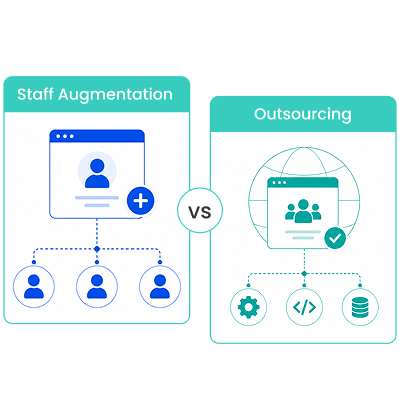
Every growing software team eventually faces the same fork in the road. Should you bring in outside engineers who work inside your own team? Or hand the whole project to a vendor who owns delivery. The choice changes how your budget behaves, how fast requirements can shift, and who keeps the knowledge once the engagement ends.
Business leaders often treat this like a pricing exercise, comparing hourly rates side by side and picking the lower number. That approach misses the real driver behind the decision, which is how stable your project scope is. A build with settled, audited requirements behaves very differently from one that will keep evolving as users respond to it.
Radixweb has spent more than two decades helping businesses build software products faster with external teams. This guide breaks down where outsourcing and staff augmentation model fails in practice. It offers a corrected look at cost claims repeated without evidence across most comparison articles online today.
Choosing between staff augmentation and software outsourcing affects far more than cost. The right model depends on project stability, delivery ownership, team integration, and long-term knowledge retention. While staff augmentation extends internal capabilities, outsourcing transfers execution responsibility. Understanding how scope, flexibility, and operational control influence outcomes is critical to making the right decision.
| Aspect | Detail |
|---|---|
| What this guide covers? | Staff augmentation vs outsourcing mechanics, the real cost picture behind both, IP and compliance rules, hybrid staffing patterns, how AI coding tools change delivery speed, and a scenario-based decision framework |
| Who should read this? | CTOs, VPs of Engineering, and Product or Delivery leads deciding how to staff a software build without disrupting scope, budget, or delivery timelines |

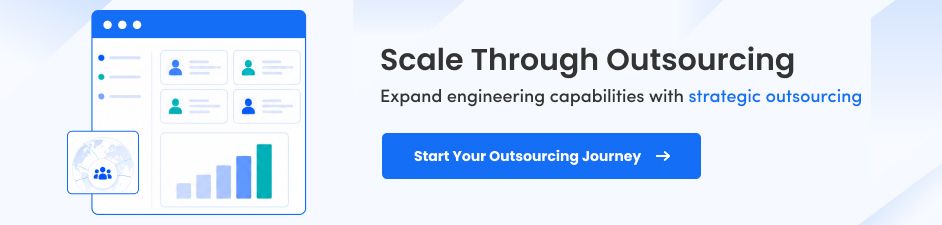
While both models help organizations access external technology talent, they differ significantly in ownership, control, flexibility, and delivery responsibility.
IT Staff Augmentation is a hiring model where external engineers directly join an in-house team and work under the client’s processes. You keep direction, tools, and delivery management.
IT Outsourcing is a service model where a third-party vendor assumes responsibility for managing teams, execution, and delivery against agreed business outcomes.
One clarification is worth making early here. Staff augmentation and outstaffing describe the same model under two different regional labels. If you are specifically weighing the latter against outsourcing, you must develop a deep understanding of how outstaffing differs from outsourcing in practice.
Misunderstanding what each model is designed to deliver often leads to avoidable project challenges.
Consider a project manager nearing the end of a 16-week fixed-bid outsourcing engagement. During development, business priorities evolve and three additional features become necessary to achieve the intended outcome. Because the features fall outside the original scope, the vendor requires a formal change order before proceeding.
Here, the vendor is not at fault. The outsourcing arrangement is operating exactly as agreed. The real issue is selecting a fixed-scope delivery model for a product expected to evolve throughout development. When change is inevitable, every adjustment can become a contractual discussion rather than a development decision.
Businesses in this exact spot often turn instead to an assembled team of skilled software developers who sit directly inside their own sprint process.
Software projects rarely unfold exactly as originally estimated. The Project Management Institute (PMI) reports that 52% of projects experience scope creep or uncontrolled changes to project scope. In fixed-scope outsourcing engagements, those changes often require formal change requests, revised estimates, and contract adjustments, making evolving requirements a significant cost and schedule risk.
Key Factors Influencing Model Decisions:
Eight practical dimensions separate these two models once you move past the marketing language.
| Dimension | Staff Augmentation | IT Outsourcing |
|---|---|---|
| Who manages daily work | Client's technical lead | Vendor's project manager |
| Who owns delivery accountability | Client | Vendor |
| Scope flexibility | High, changes absorbed without renegotiation | Depends on contract type, lower under fixed-bid terms |
| IP ownership chain | Engineers work inside client environment, cleaner IP position | IP must be negotiated through vendor's employment and services contracts |
| Compliance and data posture | Client applies its own access controls to external engineers | Client must vet the vendor's own compliance posture directly |
| Knowledge retention | Stays with the client through shared codebase access | Depends on engagement design, stronger with explicit knowledge transfer clauses |
| Cost structure | Predictable rate plus internal management overhead | Variable, fixed-bid carries change order exposure |
| Management overhead on client | Higher, needs technical lead bandwidth to direct work | Lower, vendor manages internally, client reviews milestones |
Reading this table on its own tends to favor augmentation, since control and flexibility sound better on paper than dependency and change orders. In practice, a well-structured outsourcing contract can offset several of these gaps entirely. One of the clearest signs that you need outsourcing is when you see external delivery support creating more value than expanding internal capacity.
Headline rate comparisons between these two models usually produce the wrong answer. They generally compare what shows up on the invoice, not what the engagement truly costs. The real number includes overhead that never appears on a single line item.
Staff augmentation carries a management overhead most businesses underestimate. Roughly three to five per week for two or three senior engineer per hire raises an internal rate near $100-150 per hour overhead across a six-month engagement. Teams unsure if they have that spare bandwidth often build deep understanding of which external team structure fits long-term delivery needs before committing either way.
Outsourcing carries a different hidden cost. This is tied mainly to scope change under fixed-bid contracts specifically. According to the Standish Group CHAOS research, only 31% of software projects are delivered on time, on budget, and with the expected scope, while roughly 50% are challenged by cost, schedule, or scope issues. Frequent requirement changes are among the most common contributors to these outcomes.
The figures below are illustrative estimates meant to show how hidden costs shift the total picture, not fixed numbers that apply evenly to every engagement or region.
| Cost Line | Staff Augmentation (3 engineers, 6 months, illustrative) | Outsourcing (equivalent scope, illustrative) |
|---|---|---|
| Vendor invoice | ~$90,000 | ~$75,000, typically a lower headline rate |
| Overhead or scope-change exposure | ~$15,000 in internal management time | ~$22,500 assuming 20 to 30 percent scope churn |
| Knowledge transfer at close | Minimal, stays in-house by default | $5,000 to $15,000, varies widely by contract |
| Illustrative total | ~$105,000 | ~$112,500 to $127,500 |
The headline rate favors outsourcing on paper, while the total often favors augmentation once scope drift and knowledge transfer get counted honestly. That crossover shows up most clearly once scope moves past the rough 25% threshold.
Different delivery models excel under different conditions. The choice often comes down to factors such as scope stability, ownership requirements, internal management capacity, and delivery speed. Understanding where each model performs best helps businesses select the approach that aligns with both project needs and expected outcomes.
Augmentation tends to outperform outsourcing under five recurring project conditions that show up across most software businesses. Recognizing these conditions early saves a business from picking the wrong delivery model from the very start.
Outsourcing produces its best outcomes under a narrower set of conditions, and it genuinely wins in several cases. This is a trend thoroughly reflected in recent global IT outsourcing statistics and trends.
Outsourcing also brings real advantages like access to specialized teams already fluent in a niche stack, shared delivery risk sitting with the vendor, and a faster vendor-side startup on well-scoped work are genuine strengths of this model.
Both staff augmentation and outsourcing can accelerate delivery, but they do so in different ways. The faster option depends largely on how stable the scope is and how much internal management capacity is available.
Onboarding speed favors augmentation almost every time. A vetted engineer from a reputable partner can start contributing to real sprints within one to two weeks. For rapid team expansion without full-time hiring overhead, businesses generally lean on IT staff augmentation for growing software teams. An equivalent outsourced team usually takes two to four weeks to assemble, plus discovery time before real output begins.
For a genuinely fixed scope, an experienced vendor's dedicated project management layer can remove coordination work from your side almost entirely. With requirements, timelines, and deliverables defined upfront, the software partner can focus on execution. While your teams can concentrate on business priorities rather than day-to-day delivery management.
For evolving product work, augmentation wins by a wider margin, since every requirement change under a fixed-bid outsourcing contract triggers a change order cycle. Enterprise change order processes documented across outsourcing engagements typically take one to three weeks to move through scoping, pricing, and approval.
Ultimately, delivery speed depends less on the model itself and more on how predictable the work is. Outsourcing often moves faster when requirements are fixed, while staff augmentation maintains momentum when priorities and scope are expected to evolve.
AI coding assistants have changed the staffing equation for both augmentation and outsourcing. Engineers using modern AI development tools can complete routine coding tasks faster, though the impact varies by project, team, and workflow. Organizations looking to benefit from these productivity gains often bring in experienced AI development specialists rather than assuming every delivery team will achieve the same results.
The difference is where those gains show up. In a staff augmentation model, engineers work inside your team, tools, and sprint processes, making productivity improvements more visible to delivery outcomes. Outsourced teams benefit from the same tools, but the gains may primarily improve the vendor's internal efficiency. Regardless of the model, AI-generated code should always be backed by code reviews, security testing, and automated quality checks to maintain quality and reduce risk.

Most staffing decisions get made on cost and control alone, without checking the contract details that determine whether a business owns what gets built. Both models need explicit language here, not assumptions based on which one sounds safer on the surface.
Augmented engineers typically work inside your own repositories under your version control, which gives a cleaner starting IP position from day one. Leaders must carefully dissect the key principles behind IT staff augmentation models, including direct team integration and client ownership of day-to-day delivery. Confirm in writing that the staffing partner's employment agreements include IP assignment clauses covering the work product.
In outsourcing, the work product sits inside the vendor's own environment, produced by engineers the vendor directly employs and manages. Confirm the same IP assignment language runs cleanly through both the vendor's employment contracts and your services agreement before any engagement starts.
For regulated industries, the honest distinction is narrower than it first appears in most comparison articles. Staff augmentation generally lets a business apply its own access controls and security policies directly to external engineers. This is irrespective of whether they sit onsite or connect remotely over a managed connection. Outsourcing still requires the same diligence on the vendor's own compliance posture and any required data agreements. Because those engineers are not automatically covered by your internal policies.
In outsourcing, the client must vet the vendor's compliance posture, certifications, and data handling policies independently, and for HIPAA-adjacent work, ensure Business Associate Agreements cover the vendor's environment and personnel. The due diligence burden is meaningfully higher in outsourcing for regulated data categories.
Six recurring situations show how this decision actually plays out once you move past the theory and into a real backlog.
Staff augmentation fits best here. The CTO already has the technical leadership to direct outside engineers, and the backlog keeps evolving as user feedback comes in every sprint.
Outsourcing fits here instead. The scope is fixed by compliance sign-off, internal teams have no spare management bandwidth, and the vendor's efficiency in delivering a known output is the actual value.
Neither augmentation nor a fixed-bid vendor solves this cleanly on its own. A managed pod or a dedicated team with its own delivery lead is usually the better fit, since it adds capacity without demanding more of an already stretched internal lead.
Outsourcing fits well here. Scope is defined, the internal team genuinely cannot spare management time, and the deliverable is bounded and separable from the core product's knowledge base.
Staff augmentation fits best. Regulated financial data needs direct oversight, and the API layer will touch core architecture that should accumulate knowledge inside the business, not outside it. Success depends heavily on selecting the right delivery partner, making the key criteria for selecting a software outsourcing vendor worth reviewing before the project begins.
Outsourcing fits the immediate project here, paired with an honest look at internal management capacity before the next engagement. The earlier failure was a precondition problem, not proof that augmentation itself does not work.
Most organizations past early startup stage do not pick one model as a permanent policy. They run both at once depending on the work in front of them. Core product development usually stays under augmentation, where knowledge needs to stay inside the business for the long term.
Peripheral, well-defined functions like one-time data migration or a stable third-party integration with documented requirements move to outsourcing instead. Teams weighing this split often review software woven into existing business systems before deciding exactly which pieces to hand off.
The boundary that keeps this hybrid approach working is a clear agreement on what counts as core versus peripheral, set before either engagement even begins. Augmented teams that drift into peripheral work, and outsourced teams that drift into core decisions, both create coordination friction later.
These five questions build directly on the scope discussion earlier in this guide, rather than replacing it, and each one narrows the decision further.
Question 1: Is the scope of this project fully knowable before development begins?
If yes, requirements are externally specified, legally fixed, or sufficiently mature that changes are not expected, outsourcing is viable. If no, requirements will evolve through user feedback, market response, or internal product decisions, augmentation is the model that handles this without cost escalation at each iteration.
Question 2: Does your technical leadership have 3 to 5 hours per week available per 2-3 external engineers?
If yes, augmentation is operationally viable. If no, augmentation will produce coordination debt, not capacity. Outsourcing, or freeing up internal technical bandwidth, is the resolution.
Question 3: Does the work involve regulated data or touch core product architecture?
If yes, augmentation's compliance posture (engineers inside your environment and security perimeter) and knowledge retention advantages apply. If no, neither model has a structural advantage on this dimension; continue to Question 4.
Question 4: Is the work core to your product's competitive differentiation, or is it peripheral and separable?
Core product work should stay under augmentation for knowledge retention. Peripheral, defined work suits outsourcing because the vendor's efficiency in delivering a known output is the value, not the institutional knowledge accumulated along the way.
Question 5: Does budget predictability matter more than scope flexibility for this specific project?
If the project budget must be known upfront and mid-project change orders are operationally unacceptable, fixed-bid outsourcing. If scope flexibility and cost transparency are more valuable than a fixed total, augmentation.
The evaluation criteria differ by model, though a few checks apply to both regardless of which one you eventually pick.
Ask any partner for a documented replacement process and real client references before signing anything binding. Businesses without an internal technology strategy team often bring in outside help through technology strategy consulting for informed decisions before choosing either model.
For staff augmentation, ask whether engineers in your specific tech stack are available now, not after a multi-week search process begins. A partner without a clear, specific answer to that question is not operationally ready to hold real accountability for your product.
For outsourcing, ask for references who can describe what happened the last time scope changed mid-project. How many change orders resulted, how long each took to process, and what the final cost looked like against the original contract.
For either model, ask to see work in a comparable domain rather than a broad portfolio of unrelated case studies. A team that has actually shipped inside your industry understands the compliance and architecture patterns you will hit sooner than one that has not.
Match Your Staffing Model to the Work
The staff augmentation vs outsourcing decision goes wrong most often when it gets treated as a pure cost comparison from the start. Outsourcing usually carries a lower headline rate, though it also carries scope exposure and knowledge transfer risk that augmentation does not. Radixweb's approach to enterprise IT staff augmentation with flexible scaling pairs pre-vetted talent with a documented replacement process and clear IP terms built in from the first day of the engagement.Augmentation carries its own overhead too, mainly management time that outsourcing does not require from your side of the table. The correct starting point is always the work itself, not the invoice, since fixed scope work fits outsourcing and evolving product work fits augmentation more naturally.Cost accuracy only becomes possible once that structural fit question gets answered honestly, before any rate card enters the conversation at all. If you are weighing this decision, a conversation about your specific project with our team can help map the right model before you commit to either one.
Ready to brush up on something new? We've got more to read right this way.