Read More


Recognized for AI Excellence at 2026 Globee® Awards - Read More

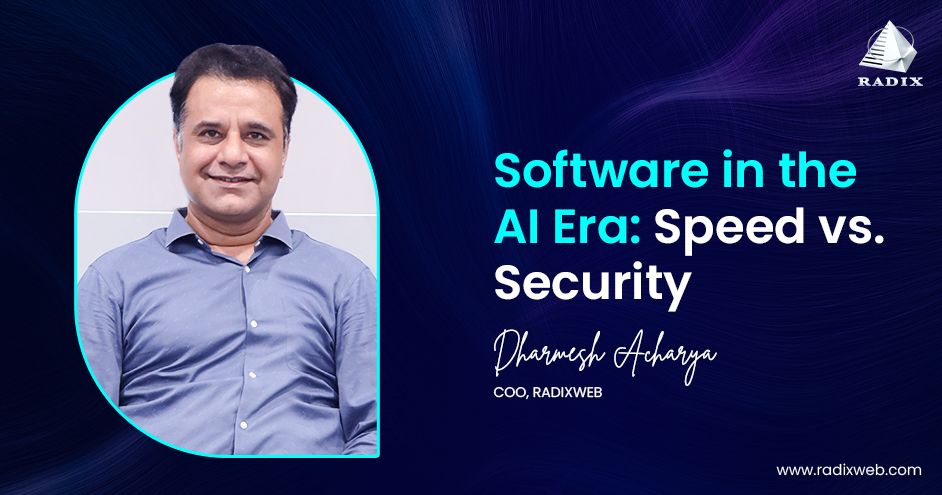
Dharmesh Acharya

Summary: The goal is to turn innovation from a slogan into repeatable business value. In this blog, Dharmesh Acharya, COO, Radixweb, explains how leaders can accelerate a culture of innovation by removing friction, building trust, and making experimentation part of daily execution. It emphasizes clear ownership, accountable decision-making, and systems that help ideas move faster.
Twenty-six years of building technology organizations has corrected more of my assumptions than it has confirmed. One belief I held early in my career, was that innovation was largely a function of talent and technical headroom. Hire strong engineers, give them the right tools, and the ideas would follow on their own. Experience proved that assumption incomplete. The correction has shaped how I lead and how we build at Radixweb to this day.
What I have learned instead is that the organizations struggling to innovate are rarely short on capable engineers or solid technical instincts. They are short on the operational conditions required for an idea to survive contact with a roadmap, a budget cycle, and a room full of stakeholders before someone with real authority ever gets to evaluate it on its merits. The discipline we apply when architecting software with niche capabilities for a client, questioning assumptions early, surfacing risk before it compounds, building in checkpoints rather than waiting for a launch date to reveal problems, is the same discipline that determines whether an organization's best technical ideas ever make it past a whiteboard.

Innovation stalls in engineering organizations in a specific, predictable way that has nothing to do with budget or headcount. An engineer notices that a service is architected in a way that will not hold under projected load, or has an idea for a cleaner approach to a recurring integration problem, and decides not to raise it in the sprint planning meeting. Because raising it does not feel worth the friction it might create.
In a technical context, this plays out constantly in places leadership rarely sees directly: a junior engineer who spots a flaw in a senior architect's design but stays quiet in the review, a developer who has a faster approach to a problem but does not want to contradict the tech lead in front of the team, a QA engineer who suspects a release is not ready but does not want to be the person who delays the sprint.
I have sat in enough architecture reviews to know that most engineering leaders genuinely believe their reviews are open forums. The engineers sitting across the table frequently do not experience them that way.
The turning point for me came from watching the same pattern repeat across very different engineering teams, including some of the strongest technical talent we have ever hired. We would bring in genuinely excellent engineers, give them real ownership, and still see a thin trickle of architectural pushback or original technical proposals compared to what their skill level should have produced.
What changed my thinking was recognizing that technical skill was never the constraint. The constraint was whether an engineer believed it was safe to challenge a design decision, flag a risk in someone else's code, or admit they did not fully understand a system before it caused a production incident. In engineering terms, that translates directly into bugs caught too late, architecture decisions that go unchallenged until they become technical debt, and code review comments that stay diplomatic rather than honest.
Leaders often wonder: Why did some of our strongest hires go quiet in technical discussions within a few months of joining, contributing far less critical feedback than their resumes suggested they could give? The answer was almost always that they had learned, through some early interaction in a standup or a pull request review, that flagging a problem honestly carried more social cost than letting it slide.

There is a specific and measurable gap that exists in most organizations, including ones that consider themselves genuinely open to new ideas. Leadership believes the culture supports risk-taking, but employees experience something considerably more cautious. That gap between stated policy and lived experience is where innovation either thrives or quietly stalls.
This matters because it means most engineering leaders are operating on a false signal. They look at their blameless postmortem template and their open code review culture and conclude the technical discourse is healthy. Meanwhile, the actual behavior that determines whether problems surface early, whether an engineer flags a risky dependency before it ships or waits until it breaks in production, is shaped by something else entirely: what they have personally watched happen to a colleague who raised a similar concern before them.
Psychological safety in an engineering context is not the absence of code review rigor or technical accountability. Genuine psychological safety on a technical team means an engineer can ask a question that exposes a gap in their understanding of the codebase, flag a production risk before it becomes an incident, or push back on an architecture decision made by someone more senior, without fear of being seen as difficult or incompetent.
Balancing psychological safety with high standards is essential for genuine high performance, and a culture that encourages people to speak up while maintaining real accountability consistently produces better business outcomes.
What this requires from technical leadership is specific and demanding. It requires treating a production incident as a systems failure. It requires responding to a junior engineer's pushback on a senior architect's design with genuine technical curiosity rather than defensiveness. And it requires consistency, because one sharp reaction in a code review can undo months of carefully built trust across an entire team.
Trust on an engineering team gets built and destroyed through small, specific moments far more than through a documented engineering culture deck. I have watched technical leaders undo years of careful trust-building with a single visible reaction to a missed deadline.
The behaviors that build genuine safety in a technical setting are specific:
Bringing in specialized engineering capability works realistically if the environment those engineers join does let them use that capability honestly. I have seen highly capable engineering teams underperform consistently, not because of a skills gap, but because the environment had taught them that surfacing a technical risk early was riskier than letting it surface later, in production, when it was harder and more expensive to fix.
Psychological safety, long understood as the foundation of high-performing teams, is under significant pressure across organizations right now, at precisely the moment when businesses most need rapid technical adaptation and genuine engineering innovation to stay competitive.
Part of this pressure is coming from the pace of technical change itself. As new tools, frameworks, and AI-assisted development workflows get introduced faster than most teams can fully absorb, the natural response to that uncertainty is caution rather than experimentation.
Engineers who are unsure whether a new approach is safe to propose will default to the familiar pattern. Technical leaders who do not actively counter that instinct will find their teams quietly retreating into safer, more conservative architecture decisions exactly when bolder technical thinking is most needed.
This problem requires deliberate, sustained attention from technical leadership, because the default direction.
The engineering organizations that innovate effectively through the rest of this decade are not the ones running the most hackathons or offering the most generous incentives internally. They are the ones systematically removing the fear that keeps a junior engineer from flagging a senior architect's flawed assumption, or a QA lead from delaying a release they genuinely believe is not ready.
Teams facing constant new tools, frameworks, and AI-assisted workflows need genuine safety to experiment and push back more than ever. Technical leaders who build that safety deliberately, will be the ones whose teams keep catching problems early while their competitors' teams quietly learn to stay quiet until the production incident makes the problem impossible to ignore.
Measuring engineering progress by what actually shipped and held up in production, rather than by what got built and demoed, requires the same honesty internally that we ask our clients to apply to their own technology investments.

Conclusion
The clearest lesson I can offer on building a culture of innovation is this: stop looking for better ideas and start looking honestly at whether your people feel safe enough to share the ones they already have.Most leadership teams are sitting on more good ideas than they realize. They are simply not being voiced, because somewhere along the way, an employee learned that staying quiet was the safer choice. Reversing that requires consistent, deliberate leadership behavior over time, not a single initiative or a memo about open communication.If you are thinking seriously about what it takes to build a genuinely innovative organization, reach out to our team and let us talk through what that actually requires.
Ready to brush up on something new? We've got more to read right this way.