
Read More


Recognized for AI Excellence at 2026 Globee® Awards - Read More

Pratik Mistry
'One outsourcing decision can turn a promising project into an expensive business problem.'
Software outsourcing can give businesses access to specialized talent, scalable engineering capacity, and faster delivery. Yet choosing the wrong vendor, engagement model, or contract can lead to delays, rework, rising costs, and ownership risks.
The market is expanding fast, with the global software development outsourcing market estimated at USD 618.38 billion in 2026 and projected to reach USD 977.04 billion by 2031.
So, how do you decide what to outsource, which engagement model fits your business, and what should you verify before signing a contract?
Below, we will explain the key decisions that shape software outsourcing outcomes, from selecting the right model and evaluating vendors to managing costs, contracts, compliance, and delivery risks. Grounded in global IT outsourcing growth and adoption statistics, these insights help you plan the right outsourcing strategy with greater clarity.
Software outsourcing decisions fail when businesses treat vendor selection as a procurement task instead of a structured evaluation process. The right approach starts with segmenting work correctly, keeping core IP and product decisions in-house while outsourcing well-specified, non-differentiating work. Choosing between dedicated teams, project outsourcing, and staff augmentation depends on how stable your requirements are and how much internal bandwidth you have to direct the work. Beyond vendor capability, contracts must cover MSA structure, DPDP and GDPR compliance, IP assignment, and replacement guarantees. Partnerships that last are built on active governance, not passive status reports, from day one.
| Aspect | Details |
|---|---|
| What does this guide cover? | What work to outsource versus keep in-house, choosing between dedicated teams, project outsourcing, and staff augmentation, the 11-step vendor evaluation process, contract essentials including MSA, SOW, and compliance clauses, true engagement costs beyond hourly rates. |
| Who should read this guide? | CTOs and VPs of Engineering evaluating outsourcing vendors, founders deciding whether to outsource before product-market fit, procurement teams structuring outsourcing contracts, businesses that had a past outsourcing engagement fail, companies expanding into new markets without local tech talent. |
Outsourcing demand is shifting from general development capacity toward specialized engineering capability. The market stood at USD 564.22 billion in 2025 and is growing at a 9.60% compound annual growth rate (CAGR) through 2031, but the more useful signal for buyers is what that spending is going toward.
For businesses, this growth signals more than industry expansion. It reflects the increasing availability of external engineering capacity and specialized expertise, which widens the reasons to outsource beyond cost savings and gives companies more options when deciding how to build digital products, modernize systems, or scale development teams.
Demand behind those numbers is concentrating in seven areas:
The direction of the outsourcing market points toward more options for accessing technical expertise and scaling software initiatives. The right outsourcing model can help align development resources with business goals, whether the priority is launching a new product, modernizing existing systems, or expanding digital operations.
The outsourcing decision is not binary. It is a segmentation of the work into what belongs externally and what must stay internal, and getting that segmentation wrong is more consequential than choosing the wrong vendor. The in-house versus outsourced development trade-offs shift by component, so the split has to be made component by component.
The Practical Test: Ask whether losing the engineer responsible for a component would put your competitive advantage, proprietary knowledge, or business continuity at risk. If the answer is yes, keep that work in-house. For other components, assess how clearly the requirements can be documented, transferred, reviewed, and managed by an external team.
Also Read- Software Development Approach for Enterprise CTOs
Many custom software outsourcing projects struggle in their first year because the business outsources too early. At this stage, the product may still be changing, making it difficult to define requirements clearly. The internal team may also lack the time or experience needed to manage an external development team, while working across different locations can make frequent changes and quick feedback harder to handle. The real factors it's time to outsource point to a capacity or skills gap, not to an unfinished product.
Finding product-market fit requires fast iteration, building something, watching how users interact with it, discarding what does not work, and rebuilding. The feedback loop between the person who sees user behavior and the engineer who changes the code needs to be as short as possible.
An outsourced team in a different time zone, managed through sprint ceremonies and async documentation, runs a feedback loop that is structurally longer.
This does not mean outsourcing before PMF is always wrong. It means the conditions must be right:
Note- If those conditions do not hold, outsourcing before PMF produces expensive throwaway code and delays the iteration speed the business needs. Without proper alignment, a typical vendor strategy for startup product development fails to achieve the speed needed before finding product-market fit.
Selecting among different software models depends on how much control you want to retain, how clearly the work can be defined, and how your internal team is structured. The table below shows where each model fits based on your development needs and level of involvement.
| Model | Who directs the work | Best for |
|---|---|---|
| Dedicated team | Client | Ongoing product development, evolving requirements |
| Project outsourcing | Vendor | Defined scope, stable requirements, non-core work |
| Staff augmentation | Client (individual engineer embedded) | Specific skill gap, short-term capacity, core product work |
A dedicated development team for long term product engineering works as an extension of the client's organization, with the client directing priorities, sprint planning, and technical decisions, while the vendor provides the engineering team and employment infrastructure.
The dedicated team model is suited for organizations that have a client-side technical lead to manage the team, and the ongoing bandwidth to provide regular direction as priorities shift over time. Understanding how to hire dedicated teams helps you build the right one.
Project outsourcing assigns delivery responsibility for a defined scope to the vendor. The client specifies what needs to be built, while the vendor determines how it will be delivered. This model works best when requirements are complete, and the scope is clearly defined before development begins.
When requirements evolve mid-project, project outsourcing is more likely to produce scope of disputes and rework, since the delivered solution may match the written specification without matching the client's actual intended outcome.
Staff augmentation fills engineering skill gaps by adding individual engineers to an existing internal development team. These engineers work within the client's tools, processes, and codebase as part of the existing engineering organization, which is how IT staff augmentation works in practice.
Onboarding runs heavier here, since engineers need to get familiar with existing systems, and the primary ongoing risk is knowledge transfer, when an augmented engineer leaves, their context leaves with them unless documentation gets actively maintained throughout the engagement. Staff augmentation and outsourcing solve different problems, despite often being used interchangeably.
Different outsourcing destinations offer different advantages depending on talent availability, collaboration requirements, and project complexity.
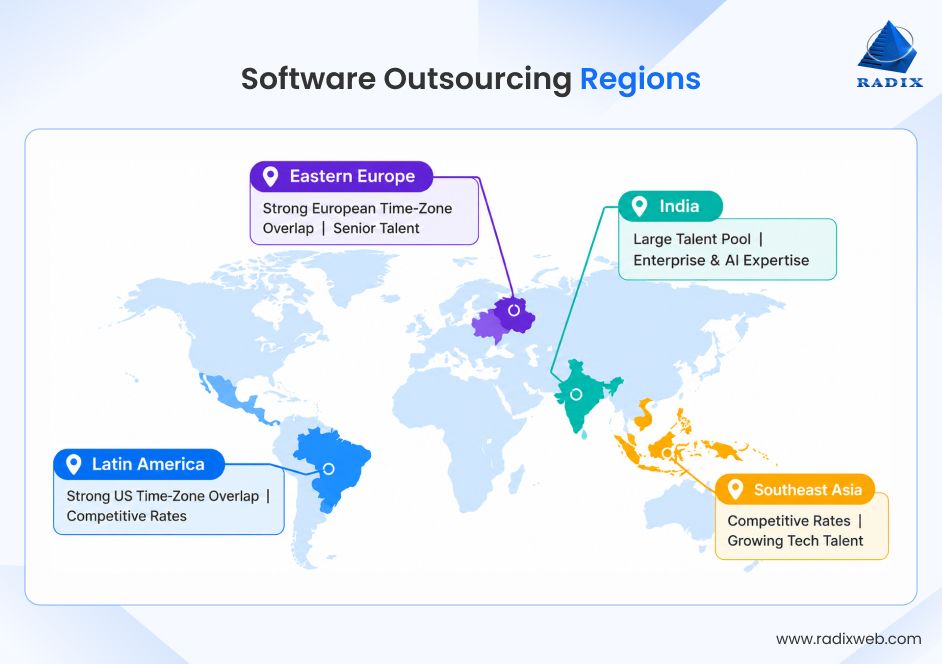
None of these geographies are wrong for every project. The right geography follows from the collaboration model required (time zone matters), the technology stack depth needed, and the compliance requirements of the engagement. India, for example, has the most pronounced advantage in specific domains such as Java and .NET development, cloud infrastructure, AI/ML, and large-scale software projects).
Most approaches to evaluating outsourcing vendors stop at portfolio reviews and pricing comparisons, missing the contractual and compliance checks that actually prevent costly disputes later.
These 11 steps cover both capability verification and the legal, security, and data-protection groundwork that a serious outsourcing engagement requires.
A thorough vendor evaluation gives you a clearer view of the partner’s technical capability, contractual readiness, security practices, and ability to deliver consistently. Completing these checks before signing can reduce avoidable risks and create a stronger foundation for the engagement.
The size of an outsourcing vendor does not determine the quality of delivery. It primarily affects how your project is staffed, managed, and prioritized.
| Large IT Vendors | Small Specialist Firms |
|---|---|
| Deep resource pools and established delivery processes | Direct access to senior engineers and leadership |
| Suitable for large, multi-year programs with 50+ engineers | Better suited for small to mid-sized projects where senior involvement is important |
| Strong multi-location delivery capability | Founders and senior engineers are often directly involved in project delivery |
| Smaller engagements may receive lower priority, with day-to-day work handled by junior engineers | Limited bench strength means replacing key engineers can be more challenging |
| Can absorb staffing changes with minimal disruption | Greater exposure to geographic and staffing concentration risks |
The right choice depends on the scale of the engagement. Large vendors are well suited for enterprise programs requiring significant delivery capacity, while specialist firms often provide greater senior-level attention for projects where expertise and close collaboration are the highest priorities.
The matching logic:
Note- Vendor size should therefore be one consideration within the broader evaluation. The actual team assigned to your project, their relevant experience, the engagement structure, and the vendor's ability to meet your specific requirements should carry greater weight in the final assessment.
Several contract provisions are frequently overlooked during outsourcing engagements, despite having a significant impact on project risk and long-term ownership.
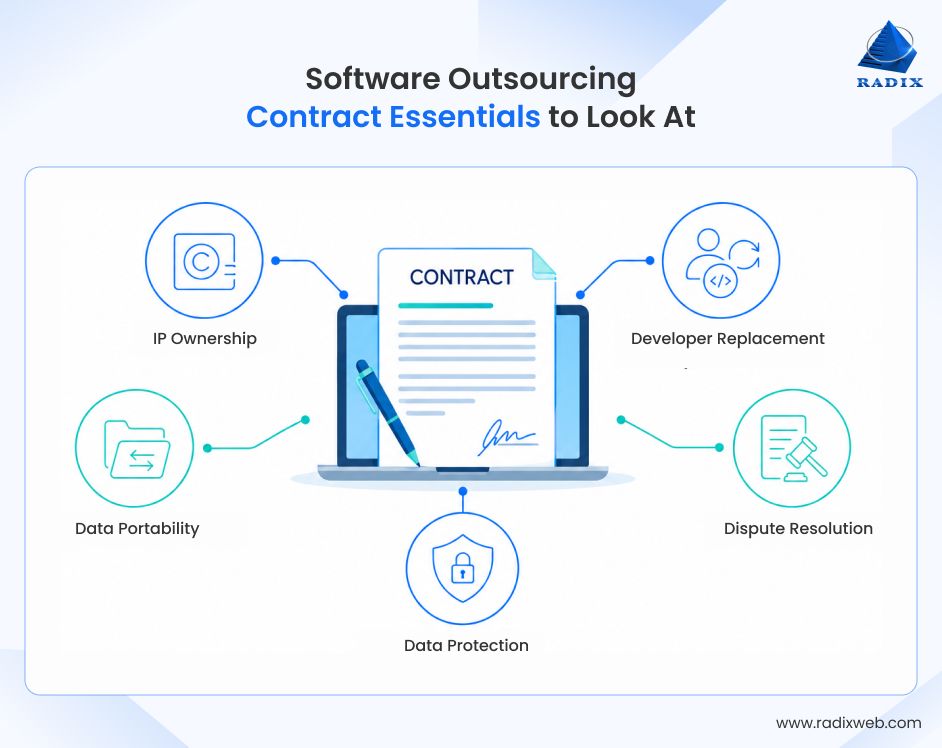
Contracts should define both:
Performance measures may include sprint completion rates, code review quality, and recurring delivery issues.
The agreement should allow the client to request project assets at any time, not only when the engagement ends.
Specify both the delivery timeframe (usually 14 to 30 days) and the required formats, such as:
For international engagements, define the governing law and dispute resolution process in advance. International arbitration, such as ICC (Singapore) or LCIA (London), is commonly preferred over resolving disputes through the vendor's local courts.
Where an Indian vendor processes personal data, execute a written DPDP-compliant Data Processing Agreement (DPA) before any data is shared.
The agreement should define:
Failure to comply with the Digital Personal Data Protection (DPDP) Act can result in penalties of up to INR 250 crore per violation.

The partnerships that last a decade share one characteristic that the ones that fail in six months do not; the client invested in the relationship at the same level they expected the vendor to invest in it.
The failure pattern is consistent; the client selects the vendor, signs the contract, attends the kickoff, and then disengages. They check in through weekly status reports rather than participating in daily delivery.
When problems appear, the client learns about them through the status report rather than observing them in the work. By the time the status report reflects a problem, four or more sprints of wrong direction have accumulated.
The governance practices that produce durable partnerships:
The specific mistake that causes most early failures is under-specifying requirements and assuming the vendor will ask the right questions. Experienced vendors ask questions at the level of the specification they were given.
If the specification does not address a requirement, the vendor builds what was specified and the client discovers the gap at delivery. Every requirement that matters must be written down before the sprint that implements it begins.
The early partnership failures discussed above are often governance failures rather than vendor quality failures. A clear governance structure with defined communication, escalation, technical oversight, and personnel-change protocols can surface issues early and give both parties an opportunity to address them before they affect delivery.
Software development outsourcing costs range from $25 to $180 per hour by region and seniority, with typical team start times ranging from 2 to 14 weeks in 2026. The hourly rate is only the starting point, since the real cost of an outsourcing engagement includes overhead that never appears on an invoice. The table below breaks down rates by region, followed by the hidden costs that determine actual ROI.
Rate ranges by region and seniority (senior developer)
| Region | Senior rate | Start time |
|---|---|---|
| India | $40-$70/hr | 2-4 weeks |
| Eastern Europe | $55-$90/hr | 3-6 weeks |
| Latin America | $45-$80/hr | 2-5 weeks |
| Southeast Asia | $25-$50/hr | 2-4 weeks |
| US (onshore) | $130-$180/hr | 5-14 weeks |
Total engagement cost is not the rate multiplied by hours. Three of the hidden costs of IT outsourcing engagements appear on no vendor invoice but are real.
Vendor management overhead, internal hours spent on sprint planning participation, code review, briefing, and quality review. An engagement with three external engineers typically requires 5 to 8 internal hours per week from a senior client-side engineer or technical lead.
Rework cost, when seniority is misrepresented, the client discovers it through declining sprint velocity and increasing defect rates, not through the rate card. The rework cost from a mid-level engineer operating at senior scope consistently exceeds the rate of saving.
Knowledge transfer at engagement end, codebases with undocumented dependencies, inconsistent patterns, or limited test visibility can take weeks to transfer. By contrast, well-maintained codebases with architecture decision records, clear documentation, and documented test coverage can often be handed over in days.
Build knowledge-transfer requirements into the contract and manage them throughout the engagement to prevent this cost from becoming a late-stage surprise.
Every evaluation criterion covered in this guide, from Master Service Agreement (MSA) structure to Digital Personal Data Protection (DPDP) compliance to replacement guarantees, is built into how Radixweb operates by default, not negotiated after a problem surfaces.
Next Steps: Designing Your Software Outsourcing Strategy
Software outsourcing involves deciding what to keep in-house, which engagement model fits your business, which vendor can deliver, and which contract terms protect your interests throughout the engagement. At Radixweb, we support businesses across 30+ industries through bespoke software development for businesses using dedicated teams, staff augmentation, and project outsourcing models based on their requirements.With 26+ years of software engineering and outsourcing experience, we help businesses select the right engagement model, build engineering teams, and manage development around business goals. Whether you need to extend your team, build a product, modernize legacy applications, or scale development capacity, our services align with your technical and delivery requirements. Have a project in mind? Talk to our software development outsourcing specialists to discuss your requirements and goals.
Ready to brush up on something new? We've got more to read right this way.

