

Read More


Recognized for AI Excellence at 2026 Globee® Awards - Read More

Anand Trivedi
Why Backend Matters
Your backend isn’t just infrastructure. It’s your competitive edge. It governs how fast your product ships. It decides how reliably (and if at all!) your system scales. It impacts how securely your software handles data. It decides how easily it integrates with third-party systems.We live in a world where user experience is expected and performance is demanded. And a fragile backend won't just fail your tech; it will fail your business. If you're aiming for velocity, resilience, and control, backend architecture should be a boardroom conversation. It is more than just a developer debate. Read on to find out the top backend frameworks and which one fits you best.
The backend is where product ambition meets technical execution. Every business-critical function—from user authentication to transaction processing—runs through it. Now, architectures are shifting toward APIs, microservices, and global scale. In such situations, the right backend framework becomes a strategic lever. Choose right, and you gain speed, stability, and flexibility. Choose wrong, and you invite bottlenecks, rework, and missed opportunities.
But the tech jargon that envelops backend frameworks, complicates the choice for business decision makers. This blog cuts through that noise. Below, we have mapped the top contenders to real-world needs. With that, you can evaluate backend frameworks through a business lens.
Read on because whether you're building for 10 users or 10 million, the backend decisions you make today will define your operational agility tomorrow.

Java, PHP, Ruby on Rails, do they ring a bell? If yes, then the concept of back-end technologies is familiar to you, as they are the best backend technologies! Well, they are the pillars of your website and web app! Do you want to learn more about the back-end technologies as we start with the back-end frameworks?
A back-end framework is an ecosystem that helps speed up and automate the steps of the web development process. A back-end framework is, more specifically, a collection of models and tools that can aid a developer in creating the framework for a website, web application, mobile app, or piece of software. Well, most of you must confuse the backend with the frontend, but you must understand there is a difference! To get clarity of our thoughts, read our article frontend vs backend and clear your thoughts.
To further understand, let's use an example: see the best back-end web framework as a model for a piece of graphic design. Without the framework, you are left with a blank slate to construct each component, individually design each element, choose any color and placement, and ensure that everything is compatible. With a template (or framework), you can do the job in half the time because you already have the structure in place and the pre-built components; you need to use them all at once rather than constructing them separately and then merging them.
The developer's job is made simpler with a back-end web framework in the same way: rather than writing every line of code in a different programming language, the developer can build their application by utilizing a pre-existing structure, tools, and modules.
The most popular backend framework has advantages beyond just making programming simpler and faster. Not only is it time-saving and makes things simpler for the experts and the beginners, but the fastest backend framework also provides:
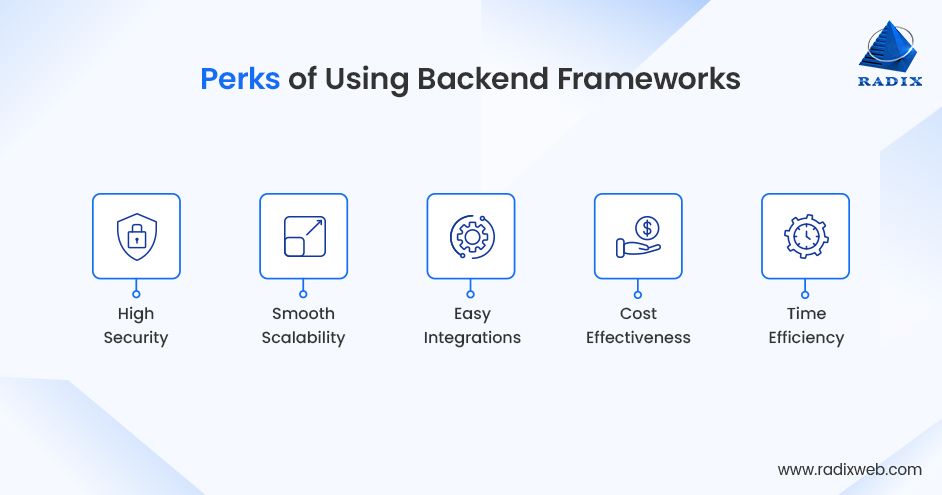
1. Security: Security is offered by a framework from several angles. The application quality you're constructing could be lowered by security from external assaults and problems, crashes, slowness, and other bad factors.
2. Scalability: Frameworks are quite flexible. For example, suppose you have chosen the appropriate backend framework for your project. In that case, you can continue to use that framework as you develop your web application, from the most basic to the most complex.
3. Integrations: Frameworks simplify the integrations; the reason behind the same is that they provide pre-build tools.
4. Cost and Time Efficiency: Backend frameworks have various ready-to-use features and functionalities that significantly minimize scripting duration. Similarly, organizations must hire limited programming experts for their projects.
5. Faster Development Cycles: Backend frameworks come with pre-built modules, routing systems, and standardized project structures. This reduces the need to write repetitive boilerplate code and allows development teams to focus on implementing business logic rather than building foundational components from scratch.
6. Standardized Architecture: Most frameworks enforce consistent architectural patterns such as MVC or layered architecture, which makes applications easier to understand, maintain, and extend, particularly when multiple developers are working on the same codebase.
7. Improved Maintainability: Framework conventions organize code into predictable layers and modules. It improves readability and simplifies debugging, testing, and future enhancements in long-term enterprise software projects.
8. Extensive Ecosystem and Libraries: Popular frameworks maintain large ecosystems of plugins, packages, and third-party integrations. Resources accelerate feature development by allowing teams to integrate tested components rather than implementing everything internally.
9. Built-in Testing Support: Since many frameworks provide integrated testing tools or compatibility with testing frameworks, developers can implement automated unit tests and integration tests.
10. Easier Integration with External Systems: Backend frameworks often include built-in support for REST APIs, GraphQL endpoints, messaging systems, and database connectors for easy integration with services such as payment gateways, analytics tools, and enterprise software platforms.
11. Strong Community and Long-Term Support: Widely adopted frameworks benefit from active developer communities and long-term maintenance. In addition to new features getting introduced regularly, teams also have access to learning resources and support.
Looking at the different types of top backend frameworks, as a business, you need to understand that there are two types, broadly classified into:
1. Client-side web framework: This framework covers only the user interface. The user's experience and the ease with which they may use the application are both considered part of the client side.
2. Server-side web framework: This type of framework is used for the back-end functionalities, such as database manipulation, data and web server management, and the list goes on.
Now that you have an idea and an understanding of a web back-end framework and how it can help your business and your developers, let us get started with the top back-end frameworks that can help you in 2026!
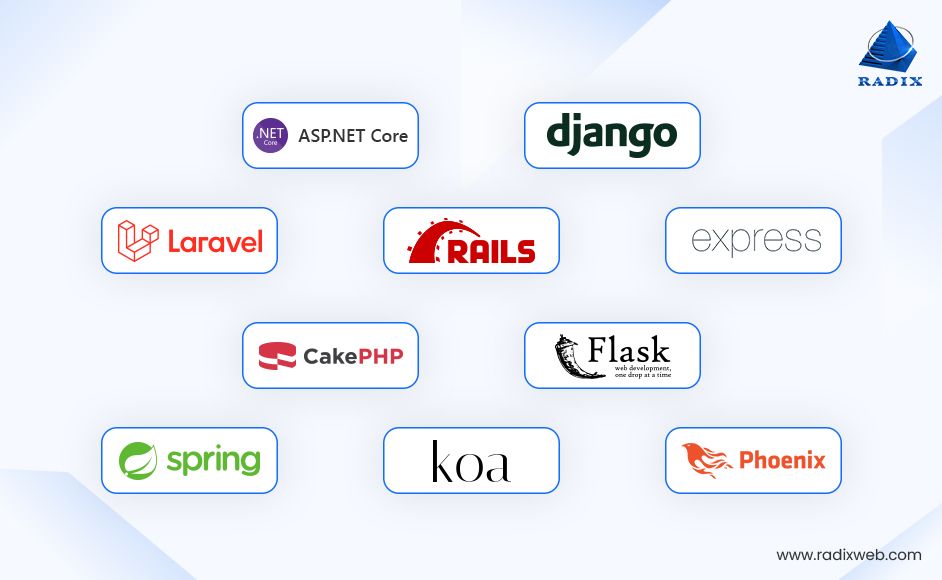
ASP .NET Core is an open-source, cross-platform framework for creating applications using .NET. This framework is a lightweight implementation of the Microsoft server stack with which you can build and run applications in a variety of platforms and environments. It can be used to build web apps and API servers with many programming languages including C#, F#, Visual Basic, NodeJS, and JavaScript
Benefits of ASP .NET Core
When developing mobile or web applications for Windows users, ASP .NET Core is the best architecture to employ as your backend language and framework.
Django is an open-source web framework written in Python that follows the model–view–controller architectural pattern. It focuses on building database-driven complex websites. If your utmost priority is to have a high-performance website, Django is the right solution for you.
Benefits of Django
Django is considered the most appropriate for creating a database-driven website, and it is one of the most used backend frameworks.
76.8% of websites are powered by PHP as a server-side programming language. Since PHP offers faster turn-around time and enhanced security, PHP and its frameworks have become the preferred choice for web developers.
If you have been surfing the web for a PHP backend framework, then Laravel is one of the ideal choices that you can make. This open-source is specifically designed for symphony-based web applications. If you want to pay attention to back-end development, Laravel is the most suitable.
Benefits of Laravel
The benefits must intrigue you, right? Well, if you are fascinated and want to hire a PHP developer to develop your web application, then there are certain things that you need to keep in mind. Please read our article on tips for hiring PHP developers and make the ideal choice for your business.
Laravel could be better for beginners, plus it is complex when it comes down to managing a simple or a small project. It is most suitable for expert developers who want to work with complex projects.
The Ruby on Rails framework is famous as much for its full-stack capabilities as it is for its ease of use. The focus of the framework is to building web applications simpler than ever before by taking a lot of the hard work out of the equation. The framework provides the infrastructure (components) while you can focus on what matters- your application’s code.
It is a popular backend framework even if it is not a widely used programming language since it supports developers during the programming process with ease, automated testing, and libraries.
Benefits of Ruby on Rails
Ruby on Rails can be ideal for freshers as it is easy to use.
It is a Node.js backend framework known as Express, used to build APIs and web applications. It is a MEAN stack backend component along with Angular JS frontend and NoSQL databases. Additionally, it is acknowledged as one of the top frameworks for developing online applications.
Benefits of Express.js
If you are familiar with the JavaScript framework for the backend but are insecure with other programming languages, Express.js can be ideal for you.
Cake PHP makes custom web development easier by providing a scaffold that can be used as a kickstart when building web applications. You can use the scaffold (code) as a starting point for building a web application. It follows the MVC architecture and is available under an MIT license.
Benefits of CakePHP
If you have hands-on experience with the PHP backend framework, then CakePHP can provide the standard architecture to build your web application at any level making it the most secure backend framework.
Flask is a WSGI framework: it runs the web server rather than a user’s browser. Several modern applications run on the Flask; the reason behind the same is that it allows them to create customized projects that run at a smooth pace. It offers assistance for the feature-adding extensions that might make them appear as though they were built directly into Flask.
Benefits of Flask
Any developer who is familiar with a Python-based framework can easily use Flask. It is the ideal back-end web framework if you need to concentrate on server-side web development.
Spring Boot framework is an open-source, enterprise-level framework that is used to build stand-alone, production-ready, and web-based applications. It’s part of the large Spring ecosystem that is used to create Java applications, which runs on the Java Virtual Machine (JVM).
Benefits of Spring Boot
Koa is a minimal, open-source, and flexible Node.js backend framework. Node.js has been one of the best frameworks for app development. If you are a tech enthusiast and want to know more about Node.js frameworks then read our blog about Node.js frameworks.
Using async functions, Koa removes call-backs and vastly improves error handling. It provides users with access to a variety of quick server writing techniques and is free of any fundamental middleware.
Benefits of Koa
If you have had your hands on Node.js, this can be an ideal backend platform.
Phoenix is an open-source framework that is an advanced web app platform written in Elixir and Erlang. It makes use of the Elixir programming language with a syntax closer to Ruby and the Erlang VM for reliable, fault-tolerant apps. It supports real-time client communication via WebSocket and agnostic channels and request/response functionality from the Cowboy server.
Benefits of Phoenix
The information presented above can assist you in selecting the best back-end framework among the top ten currently on the market. The top backend frameworks addressed in the article included Django, Laravel, and Ruby on Rails, among others.
Here’s a quick summary of all the top backend frameworks that we have discussed so far:
| Frameworks | Release Year | Programming Languages | Architecture/ Model | Core Features | Real-World Usage |
|---|---|---|---|---|---|
| ASP.NET Core | 2016 | C# (.NET) | Modular, cross-platform web framework | Strong tooling (Visual Studio), built-in DI, middleware pipeline, cross-platform | Enterprise APIs and web services, Microsoft/.NET ecosystem apps |
| Django | 2005 | Python | Monolithic/MVC (MTV) — batteries-included | Firm security defaults, admin UI, ORM, templating | Instagram, Disqus, large content websites, and many data-driven web apps |
| Laravel | 2011 | PHP | MVC (opinionated, full-stack) | Packages and ecosystem (Forge, Vapor), Eloquent ORM, Artisan CLI, Elegant syntax | Laravel-focused e-commerce and CMS backends, popular among PHP web apps and SaaS startups |
| Ruby on Rails | 2004 | Ruby | Full-stack MVC (convention-over-configuration) | Strong testing tools, RESTful defaults, Active Record ORM, scaffolding | Many web platforms and SaaS apps, Early startups / rapid MVPs |
| Express.js | 2010 | JavaScript (Node.js) | Minimalist, middleware-based (microservice/APIs friendly) | Integrates in MEAN/MERN stacks, fast API development, and a middleware ecosystem | Backbone of many Node.js stacks, APIs, and microservices across multiple startups |
| CakePHP | 2005 | PHP | MVC (convention + rapid scaffolding) | Easy CRUD, secure defaults, scaffolding, built-in validation | Custom business application, traditional PHP web apps |
| Flask | 2010 | Python | Microframeworks (modular/extendable) | WSGI, simple routing, extensible via plugins, great for APIs | Popular for microservices and prototypes, used in services like parts of LinkedIn and Pinterest |
| Spring Boot | 2014 | Java (also Kotlin, Groovy) | Opinionated Spring-based (microservices-friendly) | Production-ready metrics/health, auto-configuration, servers, embedded servers, | Large enterprise and cloud services, for multiple e-commerce/finance backends |
| Koa | 2013 | JavaScript (Node.js) | Minimal, async/await middleware core | Small surface, no bundled middleware, async/await native middleware, | Modern Node.js APIs and services |
| Phoenix | 2015 (v1.0) | Elixir | MVC on BEAM (high-concurrency, real-time friendly) | High concurrency and low latency, fault-tolerance, LiveView | Real-time apps and high-concurrency services |
Selecting the right backend framework has a direct impact on how efficiently your application performs, scales, and evolves. To make a future-ready decision, it’s essential to examine the key factors that impact both long-term ROI and development quality. Let’s now go through the significant factors:
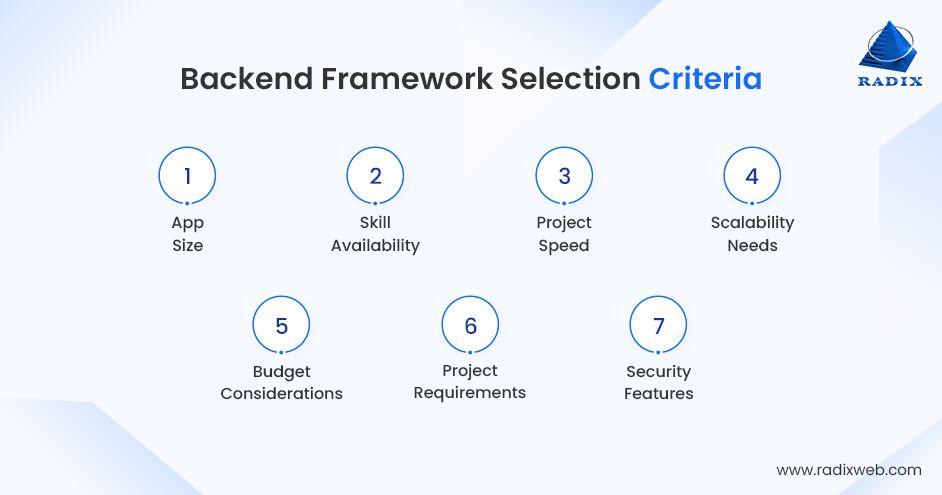
1. App Size
The size and complexity of your application significantly impact the frameworks you choose. Simple APIs or lightweight apps deliver the best results with flexible, minimal backend frameworks, while enterprise-grade systems often need powerful, full-stack frameworks.
2. Skill Availability
Your team’s skills and expertise level serve as crucial factors. It's essential to choose a framework that goes with your developers’ skillsets - whether in Java, .NET, PHP, Python, or JavaScript. This helps minimize onboarding time, accelerate delivery, and optimize code quality.
3. Project Speed
If you’re prioritizing rapid time-to-market, choose backed frameworks popular for their performance features, such as Boilerplates, CLI tools, strong community support, and scaffolding. Faster development cycles help you validate ideas and minimize the overall development time and effort.
4. Scalability
As your target audience expands, your backend needs to scale smoothly. So, make sure you choose a backend framework that supports cloud-native scalability, caching, efficient concurrency handling, and modular architecture. This ensures system reliability even during high-traffic conditions.
5. Cost
Budgetary considerations include long-term scalability, maintenance overhead, infrastructure, and developer-related costs. Generally, backend frameworks with strong documentation, comprehensive libraries, and large communities help minimize development and operational costs.
6. Project Requirements
Every project has unique functional and technical needs, such as real-time features, integrations, or architecture patterns. Choosing a framework that aligns with these requirements reduces complexity and ensures smoother development and maintenance.
7. Security Features
Backend security is critical for protecting data and users. Backend frameworks with built-in authentication, authorization, encryption, and protection against common vulnerabilities help reduce risks and ensure long-term application stability.
Understanding the strength of every backend framework will help your development teams choose the right tech stack for higher performance, scalability, security, and time-to-market. The following are some practical use cases that can help you decide which is the ideal framework for your needs:
Django’s robust ORM, “batteries-included” approach, and built-in security features make it the best option for data-powered enterprise tools, EHR systems, patient portals, and fintech dashboards.
With cloud-native capabilities, high performance, and production-ready modules, Spring Boot helps with mission-critical services, telecom applications, large-scale financial systems, and enterprise microservices.
Laravel’s rich ecosystem, Blade templating, and expressive syntax allow fast delivery of subscription-based apps, custom eCommerce, SaaS platforms, and MVPs.
With high concurrency and event-driven architecture, Node.js outshines all others when it is used for developing IoT backends, streaming platforms, real-time collaboration tools, live notifications, and chat apps.
Enterprises love ASP.NET Core for secure, high-performance applications integrated with Microsoft ecosystems. It handles massive traffic and stays reliable for banks and corporate systems.
Startups favor Rails for "convention over configuration" speed. Teams prototype MVPs in weeks when market validation matters more than premature optimization.
For rapid prototyping with built-in ORM and scaffolding, CakePHP is great. Small businesses get feature-complete apps without complex setup or configuration.
Python teams choose Flask for flexibility and simplicity in API development, especially when you need custom backend logic without framework overhead or conventions.
Koa is preferred by advanced Node.js teams for its modern async/await syntax over Express. Clean middleware handling makes it great for sophisticated API architectures and SPAs.
Elixir developers choose Phoenix for real-time apps with unbeatable performance. Its "LiveView" eliminates API calls, perfect for chat apps and collaborative tools.
Why Trust Radixweb for Backend Development?
Every framework mentioned above - from .NET to Phoenix - comes with its own benefits. But the final choice would depend on your specific project needs. But even the most robust backend framework won’t perform alone. What you also need is expert backend development services. That's how you will be able to make the most of your selected backend framework.For that, you can trust Radixweb’s team of dedicated developers. Why trust Radixweb? Because:● Have been in the business for 26+ years● Successfully delivered 4,500+ projects● Worked with clients from 30+ industries and countries● Maintain a 98% client satisfaction rate● Have 5-star ratings across third-party platformsThis means we don’t just understand backend tech; we also understand how to make the tech work for your business.So, don’t let your backend be your weakest link? Hire dedicated backend developers and gear up for success with Radixweb.
Ready to brush up on something new? We've got more to read right this way.

