
Recognized for AI Excellence at 2026 Globee® Awards - Read More
Machine Learning in FinTech: Turning Pilots into Production
Most organizations now use machine learning in FinTech. But far fewer have made it pay. The gap is rarely the algorithm and mostly data, MLOps, explainability, and compliance. With 26+ years of software engineering experience and 250+ FinTech products delivered, our machine learning services for FinTech take ML from proof of concept to measurable P&L impact.
Written By:

Expert Insights By:

- 75%
- Orgs Using ML
- 14%
- Call ML Transformational
- 27%
- More Loans Applicants
- 18 Mo
- Average Payback Period
For years, financial institutions have collected more data than they could use. The use of machine learning in financial services changes that. Every payment, loan application, customer interaction, and market tick becomes training signal for models that score fraud risk, estimate repayment probability, rank compliance alerts, and forecast cash flow. But adoption alone does not create advantage. Machine learning in FinTech uses algorithms to analyze financial data, identify patterns, predict outcomes, detect fraud, and automate smarter financial decisions. But the impact of ML depends on clean data, production pipelines, explainable models, and a clear link between each prediction and a business decision. Also, the implementation of machine learning solutions does not replace judgment. It sharpens every financial decision that judgment depends on.
The Business Case for Machine Learning in Financial Services
Machine learning earns its budget when a prediction improves a specific decision. Five levers show up repeatedly in the P&L, each tied to a number a CFO can track.
Alert Cost: Fewer False Alarms

Alert Cost: Fewer False Alarms

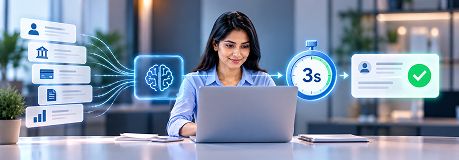
Credit Throughput: Seconds, Not Days


Credit Throughput: Seconds, Not Days
Liquidity: Earlier Shortfall Warnings
Liquidity: Earlier Shortfall Warnings

Fraud Losses: Higher Precision, Fewer False Declines
Fraud Losses: Higher Precision, Fewer False Declines

Addressable Market: Wider Credit Access
Addressable Market: Wider Credit Access

The Current State of ML in FinTech
Adoption of ML in FinTech is broad but shallow. Market data shows 48% of finance departments use ML for risk and fraud analysis, forecasting, and reporting. Yet 50% to 75% of financial AI pilots stay stuck at proof of concept.
The Evolution of Machine Learning in FinTech: Past, Present, and What's Next
| Phase | Period | What Defined It |
|---|---|---|
 Experimental prototypes | 2000–2021 | Isolated prototypes, standalone predictive models, static scoring rules, manual processing, fragmented data silos |
 Production ML and MLOps | Early 2020s | Continuous-learning platforms, MLOps frameworks, models moved from notebooks into live workflows |
 Real-time, governed decisioning | Today | Streaming pipelines, feature stores, explainability (SHAP, LIME), model risk rules (EU AI Act, SR 11-7) |
 Predictive, generative, and agentic | Now to next | ML scores, a generative layer explains, and agents run multi-step workflows under hard authority limits |
 Collaborative and frontier | Next | Federated learning across institutions, sub-100ms on-chain risk stacks, quantum and neuromorphic experiments |
“The machine learning algorithms used in FinTech are rarely the hard part. The hard part is the decision around it... which payment to approve, which borrower to refer, which alerts to investigate. Teams that design the decision first and the models and algorithms second are the ones whose ML systems survive contact with production, auditors, and customers.”

Pratik Mistry
The Key Challenges of Implementing ML in FinTech


From Pilot to Production
Roughly 50% to 75% of financial AI pilots never leave the proof-of-concept stage. Long procurement cycles, missing MLOps pipelines, data drift, and legacy integration stall projects long after the model proves it works.
We plan the implementation of machine learning in FinTech for production from the first sprint. That means CI/CD/CT pipelines, feature stores, model registries, shadow-mode runs, and automated drift alerts, so a proven model reaches live traffic without a rebuild.
Explainability vs. Accuracy
High-performing models such as deep neural networks and XGBoost are often opaque. Regulations including ECOA and Regulation B require specific reasons for credit denials, so a black-box score that cannot be explained becomes a compliance liability.
That’s why we pair high-performing models with SHAP, LIME, and counterfactual explanations, and keep the lending policy separate from the model. Reason codes are generated with every decision and stored for audit. That keeps adverse-action notices accurate and regulator-ready.
Data Quality & Model Drift
Financial datasets suffer from missing values, class imbalance, and data locality issues. When markets or fraud patterns shift, historical relationships decay and a once-accurate model quietly degrades, often unnoticed until losses appear.
So, we build data-quality checks, imbalance handling, and out-of-sample validation into every pipeline. Continuous monitoring triggers automated retraining when performance slips, and simpler regularized models are preferred where regimes change fast, so decay surfaces before it becomes a loss.
Legacy System Integration
Many ML models are written in Python, while core financial systems run on C++ or Java. That mismatch introduces language conflicts, memory bloat, and unexpected inference latency, and hidden technical debt makes these issues harder to diagnose later.
With our machine learning integration services for FinTech, we connect models to existing platforms through APIs, event streaming, and low-latency serving bridges, so core banking, lending, and payment systems stay in place. Integration is designed and load-tested before the model is finalized, reducing rework.
Real-Time Latency
Real-time fraud engines must score transactions in 50 to 250 milliseconds, and trading systems operate at microsecond latencies. A model that is accurate but slow cannot sit inside the payment path.
We use streaming backbones such as Kafka and Flink, optimized serving layers, and defined fallback rules, so a model outage never becomes a payment outage. Latency budgets are set per use case before build begins.
Fairness & Regulatory Compliance
Machine learning in FinTech risk management draws extra scrutiny. Credit models can reproduce bias hidden in historical data, and proxy variables can discriminate without naming a protected class. Under the EU AI Act, credit scoring is classified as high-risk, with mandatory conformity assessments, transparency, and human oversight.
We run proxy-discrimination audits, fairness-constrained training, and independent validation aligned with SR 11-7 before launch. Immutable audit logs record model versions, feature hashes, and override reasons, giving regulators a clear trail. Human review stays in the loop for high-impact decisions.
FinTech ML Use Cases That Drive Outcomes
At Radixweb, we don't just deliver impressive demos, but implement ML systems that your FinTech business uses. Below, we explain some of the most impactful FinTech machine learning applications and the results they reported.

Fraud Detection and Transaction Risk Scoring
Fraudulent activity rarely follows one predictable rule. A payment may look normal by amount, yet become suspicious alongside a new device, an unusual location, and a sudden change in account behavior. Systems that use machine learning for payment fraud prevention weigh these signals together and return a risk score. For machine learning applications in online payments, that score decides in milliseconds whether to approve, challenge, or decline.
Implementation in Action: Danske Bank, working with Teradata's Think Big Analytics, replaced handcrafted fraud rules with machine learning models in production, plus an interpretation layer that explains blocks. False positives, at times as high as 99.5%, fell while fraud detection rose, by about 50% to 60% each.

Credit Scoring and Automated Underwriting
Traditional scorecards rely on a narrow set of variables. Gradient-boosted trees and ensemble models learn relationships across repayment history, obligations, cash flow, and permitted alternative data, then output a probability of default. A separate policy engine decides to approve, price, or refer, which expands access for thin-file applicants and cuts default rates by roughly 20%.
Implementation in Action: Upstart's underwriting model, built on alternative data and machine learning, was reviewed by the CFPB under its first no-action letter (2017). In the Bureau's 2019 update, the model approved 27% more applicants than a traditional model at 16% lower average APRs, with no fair-lending disparities flagged for the tested segments.

AML Compliance and Transaction Monitoring
Fixed thresholds still matter in AML, but they miss patterns that only appear across accounts and time. ML adds anomaly detection, customer risk scoring, entity resolution, and network analysis, then ranks alerts by estimated risk, so investigators focus on complex cases. An anomaly score is a lead, not evidence, so documentation and controls still wrap every case.
Implementation in Action: HSBC deployed Google Cloud's AML AI alongside its rules-based transaction monitoring. HSBC reported identifying two to four times more suspicious activity while cutting alert volumes by more than 60%, and shortened processing for billions of transactions from several weeks to a few days.

KYC and Digital Identity Verification
Digital onboarding depends on trust at speed. Machine learning combined with custom computer vision solutions extracts data from identity documents, compares it against submitted information, flags inconsistencies, and supports biometric checks. A solid onboarding flow covers document authenticity, selfie-to-ID matching, device and session signals, and sanctions screening. Standardizing these repetitive checks speeds onboarding and routes unusual cases to human reviewers.
Implementation in Action: State Bank of India (UK) adopted Onfido's AI-powered document and biometric verification for remote KYC. The bank reported cutting customer verification from 24 hours to a few minutes, and Onfido says 95% of ID checks complete within minutes.

Cash-Flow and Liquidity Risk Forecasting
Liquidity surprises hurt businesses and lenders alike. A FinTech serving small businesses can analyze inflows, outflows, invoices, recurring expenses, and seasonality to forecast future cash positions. Liquidity warning models can flag a shortfall up to three months ahead. Forecast quality depends on data coverage, though: if customers keep key accounts elsewhere, the model sees half the picture.
Implementation in Action: Intuit's QuickBooks Cash Flow Planner, launched in 2020, uses machine learning on bank and accounting history to forecast small-business cash flow 90 days ahead in real time. In 2021 Intuit added ML-based GST (BAS) predictions in Australia, so owners see tax obligations before they fall due.

Algorithmic Trading and Portfolio Intelligence
Quant teams use LSTMs, transformers, reinforcement learning, and FinBERT sentiment analysis to detect micro-trends in tick data, forecast short-horizon returns, and optimize execution. The same techniques power machine learning in wealth management and investment, from robo-advisor rebalancing to portfolio risk monitoring. Models work best as decision support, because market relationships can shift abruptly after economic shocks.
Implementation in Action: JPMorgan's LOXM, trialed in European equities from early 2017, uses deep reinforcement learning trained on billions of historical and simulated trades to execute orders at the best price with minimal market impact. JPMorgan reported it outperformed manual and existing automated methods in trials.

Document Intelligence and RegTech Automation
Financial institutions process contracts, bank statements, invoices, loan applications, and claim forms at huge volume. NLP, LLMs, and computer vision extract structured fields, classify documents, monitor regulatory updates, and draft filings such as SARs. The model rarely makes the final decision. Its job is to turn unstructured documents into reliable inputs for the systems that do.
Implementation in Action: JPMorgan's COIN (Contract Intelligence) reads commercial loan agreements in seconds, work Bloomberg reported took lawyers and loan officers about 360,000 hours a year. The bank also said it cut loan-servicing errors tied to interpreting roughly 12,000 new contracts annually.

Personalization and Proactive Customer Insights
Clustering models and contextual recommendation engines match financial products and education to each customer's risk profile, behavior, and goals. Churn models watch for declining activity, fewer transactions, or rising service contacts, then hand retention teams a ranked list. Recommendations must respect suitability and regulatory requirements, not just clicks.
Implementation in Action: Bank of America's Erica pairs predictive analytics with natural language processing to deliver proactive insights such as spending trends and unexpected charges. By August 2025, it had passed 3 billion interactions, served nearly 50 million users, and delivered more than 1.7 billion proactive, personalized insights.
Match ML Use Cases to Your Decisions
Our ML engineers help you find the decision where a model pays back fastest
The Engineering Stack Powering Production ML in FinTech

Data Ingestion & Streaming
Apache Kafka acts as the high-throughput event backbone for payments, trades, and customer events. Apache Flink and Spark Streaming handle low-latency feature extraction and micro-batch anomaly detection, with Flink supporting sub-100ms processing for real-time fraud and risk decisions.

Storage & Query Layers
Historical tick data and unstructured logs sit in scalable object stores such as Amazon S3. Relational backends like Amazon RDS serve transactional records, while time-series databases such as TimescaleDB support trend analysis, so training and production draw on consistent, queryable history.

Feature Stores
Feature stores persist computed signals such as rolling averages and user velocity scores, so the features used in training match those served in production. This training-serving parity prevents a common source of silent accuracy loss and lets teams reuse features across fraud, credit, and AML models.

MLOps & Model Lifecycle
MLflow tracks experiments, stores artifacts, and manages model versions in a registry. CI/CD/CT pipelines add continuous training, so models retrain on trigger when drift appears. Together they move teams from notebook prototypes to governed, repeatable releases, closing the gap where many financial ML pilots stall.

Modeling Frameworks
Python remains the workhorse, with PyTorch, scikit-learn, and Hugging Face Transformers powering everything from ensemble credit models to FinBERT sentiment analysis. Where microseconds matter, such as order routing and signal engines, custom C++ bridges carry the latency-critical path.

Model Serving & Monitoring
Real-time APIs deliver predictions into payment, lending, and trading workflows, with defined fallback rules if a model service fails. Dashboards in tools such as Tableau and Power BI track accuracy, drift, and business metrics, so teams see performance decay before it turns into losses.
How ML Drives Benefits Across the FinTech Value Chain

Intelligent Alert Prioritization
ML ranks compliance and fraud alerts by estimated risk instead of treating each equally. Analysts work the highest-risk cases first, queues shrink, and investigators gain time for complex cases that genuinely need human judgment.
Automated Document Handling
Models classify documents and extract fields from bank statements, invoices, loan applications, and claim forms. Less manual data entry means faster underwriting, KYC, accounting, and compliance workflows, with staff time redirected to exceptions and review.
Continuous Risk Monitoring
Streaming pipelines score transactions and account behavior as events arrive, not in nightly batches. Risk teams see anomalies and shifting exposure earlier, and automated drift alerts show when a model itself needs retraining.
A no-commitment, 30-minute strategy session where you see the real numbers.
Security & Compliance: The Non-Negotiables of FinTech ML

EU AI Act
The EU AI Act classifies financial AI tools, especially credit scoring, as high-risk. That brings mandatory conformity assessments, transparency obligations, and human oversight. Build documentation, explainability, and review checkpoints into the ML lifecycle early, because retrofitting them after launch is slower and costlier than designing them in.

SR 11-7 / SS1/23
US and UK model risk guidance expects independent model validation, conceptual soundness checks, and continuous monitoring, especially for non-linear models. In practice that means documented validation, shadow-mode parallel runs, proxy-discrimination audits, and a named owner for every risk threshold, so auditors can see who approved what and why.

DORA & GDPR
DORA and GDPR enforce strict data protection, operational resilience, and limits on data retention. To reduce data-leak risk, leading teams use differential privacy, homomorphic encryption, and synthetic data pipelines that simulate money-laundering patterns without exposing real customer PII, backed by append-only audit logs retained up to seven years.
Where ML in FinTech Is Heading: Five Shifts
Agentic AI for Financial Workflows
Autonomous agents are moving beyond advisory prompts to executing multi-step workflows, such as AML triage and credit covenant monitoring. Transfers, permission changes, and credit approvals stay behind deterministic controls, so intelligence and authority remain separate.
Maturity Early production: targeted wedge deployments, such as AML overlays, can go live within months.
Your move Pilot a multi-step AI agent first, set hard authority limits, and log every agent action.
Federated Learning Across Institutions
Fraud and risk models usually learn from a single institution's data. Federated learning lets several institutions train shared models collaboratively without centralizing sensitive customer data, strengthening defenses against emerging fraud patterns while keeping privacy and regulatory boundaries intact.
Maturity This shift is still emerging and has not yet reached mainstream adoption in finance.
Your move Ask vendors whether fraud models can train across institutions without moving any raw customer data.
On-Chain Risk Stacks for Digital Assets
Stablecoins, digital assets, and 24/7 blockchain rails need risk engines that never close. Greenfield on-chain stacks target sub-100ms decisioning under new regulatory regimes, and with no legacy systems to retrofit, teams can design latency, explainability, and auditability upfront.
Maturity This shift is emerging, and it is mostly happening in greenfield builds without legacy constraints.
Your move Design risk, compliance, and audit logging together from the start of any digital-asset product.
Quantum and Neuromorphic Computing
Early experimental architectures promise exponential acceleration in portfolio optimization and deep fraud pattern matching. Neither technology is production-ready for most financial workloads, so for now, track proofs of concept and identify which optimization problems would benefit first.
Maturity This shift is experimental today and is not yet production-ready for most financial workloads.
Your move Keep this on the watchlist, and avoid committing budget until proofs of concept mature.
Generative AI Layered Over ML Models
Generative AI and ML increasingly work together. Specialized ML models produce fraud scores, credit-risk predictions, and forecasts, while a purpose-built generative AI layer explains the result in plain language. The rule: let AI interpret, let models score, and let policy decide.
Maturity Early production: assistants already call fraud models behind the scenes and explain each score.
Your move Let ML models score, let policy decide, and let language models explain the result.
ML Solutions Purpose-Built for Modern FinTech
We offer machine learning development services for FinTech that deliver custom solutions that plug into your data, policy engines, and infrastructure.
Fraud Detection & Transaction Risk Engines
Fraud rarely follows one rule. Our FinTech machine learning solutions for fraud weigh device, location, behavior, and network signals together, then feed policy rules that approve, step up authentication, or route to investigators. Fallback paths are built in.
- Gradient boosting and deep neural network scoring
- Graph analytics for fraud ring detection
- Sub-250 ms scoring for real-time payments
- Fallback rules for model-service failures
- Fraud loss and false-positive tracking
- Automated drift alerts and retraining triggers
Credit Scoring & Underwriting Models
Modern lending needs decisions that are faster and fairer than static scorecards. These custom machine learning FinTech solutions use ensemble risk models with alternative data, and keep the lending policy separate, so rules can change without retraining the model.
- XGBoost and ensemble probability-of-default models
- Alternative data scoring for thin-file applicants
- SHAP-based reasons for every decision
- Proxy-discrimination and fairness testing before launch
- Policy engine for approve, price, refer
- Shadow-mode parallel runs before go-live
AML, KYC & RegTech Automation
Compliance teams face rising volumes and tighter rules. We use anomaly detection, entity resolution, NLP, and computer vision to prioritize alerts, verify identities, and draft documentation, with human investigators making the final call. Everything is auditable.
- Risk-ranked transaction monitoring alerts
- Customer risk scoring and entity resolution
- NLP-drafted SAR narratives for analysts
- Document authenticity and selfie-to-ID matching
- Sanctions and watchlist screening integration
- Append-only audit logs retained seven years
Predictive Customer & Cash-Flow Intelligence
Forecasts, customer predictions, and predictive analytics dashboards only pay off when someone acts on them. We build cash-flow, churn, lifetime-value, and recommendation models that feed ranked action lists directly into retention, relationship, and financing workflows.
- 30-day cash-flow forecasts with liquidity alerts
- Churn probability scoring for retention teams
- Survival-model customer lifetime value estimates
- Contextual product recommendation engines
- Suitability and consent checks on offers
- Dashboards linking predictions to business outcomes
Algorithmic Trading & Portfolio Analytics
Investment decisions depend on processing market, portfolio, and sentiment data fast. We build ML signal and risk models, from LSTMs and transformers to regularized regression and clustering, as decision support with documented limits and out-of-sample validation.
- LSTM and transformer return-direction forecasting
- FinBERT sentiment signals from market text
- Reinforcement learning for rebalancing strategies
- Volatility and correlation-shift detection
- Concentration-risk and exposure monitoring
- C++ bridges for latency-critical execution
MLOps & Production Engineering
Much financial ML value is lost between the notebook and production. Our enterprise machine learning solutions for FinTech include foundational MLOps strategizing to close gaps and keep models accurate, auditable, and deployable at scale.
- MLflow experiment tracking and model registry
- Feature stores for training-serving parity
- Kafka and Flink streaming pipelines
- Automated drift detection and retraining
- Independent validation aligned with SR 11-7
- Legacy integration through APIs and bridges
Why Trust Radixweb’s ML Solutions for FinTech
With 26+ years of engineering expertise and 250+ FinTech products delivered, we know where financial ML succeeds and where it stalls. That’s why our machine learning consulting for FinTech starts with the decision, not the model.

Production-Ready ML From the First Sprint
Industry data suggests 50% to 75% of financial AI pilots stall at proof of concept. We close that gap with MLOps pipelines, shadow-mode validation, and drift monitoring from day one, so models move to live traffic with governance, explainability, and security already in place.

Compliance-First, Explainable by Design
Radixweb is ISO 27001:2022 certified, and we design for the EU AI Act, SR 11-7, and GDPR from the start. SHAP, LIME, and counterfactual explanations are built into validation, with audit-trail logging for every prediction, override, and model version.

Deep Expertise Across Financial Systems
ML creates value where decisions happen, so integration matters as much as modeling. Our teams connect models to core banking, lending, payment, and AML systems through APIs, streaming, and low-latency bridges that join Python ML stacks with legacy C++ and Java environments.
Frequently Asked Questions
What is machine learning in FinTech?
What is the difference between AI and ML in FinTech?
What are the best machine learning cases in FinTech?
How is machine learning used in fraud detection?
How much does it cost to implement ML in FinTech?
How long does a FinTech ML implementation take?
Can machine learning be integrated with legacy banking systems?
Find Your First ML Win in 30 Minutes
- The one use case most likely to pay back first
- A straight answer on data readiness, timeline, budget, and expected ROI
- A step-by-step roadmap from proof of concept to production


Business Inquiry
Tell Us About Your Project for Tailored Guidance
By submitting this form, you agree to our Privacy Policy