Read More


Recognized for AI Excellence at 2026 Globee® Awards - Read More

Disha Shah
TL;DR: Vibe coding is the latest software development trend where developers and non-developers describe software in natural language and use Artificial Intelligence to generate functioning code. With the rising adoption of vibe coding in software development, enterprises must balance vibe coding benefits with vibe coding risks. In this blog, we help you separate reality from hype and prepare to use this innovation responsibly and securely.
We live in a world where ‘vibes’ rule.
Everything is decided by vibes. Which cafe to go to? The one with a better vibe. Which song becomes popular? The one with a better vibe. Who do we connect and form interpersonal relationships with? Someone who matches our vibe.
And now, we are also creating apps and software with vibes.
Unless you are living under a rock, you would have seen and heard people share vibe coding examples where they developed fully-functioning applications without coding.
Social media platforms and dev forums are abuzz with discussions around vibe coding. Tools like Lovable, Base44, Replit, Bolt, and Emergent have not just become popular but even started raising funding.
But what exactly is vibe coding? How does it work? What are the benefits? Are there any related risks? And most importantly, do enterprises really need to care about it or is it just for the non-devs to have some fun?
In this blog, we answer all these questions and more. Plus, a simple checklist to help you understand if you need vibe coding in your workflow or not.
Vibe coding is the practice of using large language models to generate application code through conversational instructions. Basically, you tell AI what you want your app to do and look like. Then it creates that app for you.
It is one of the most talked about software engineering trends today.
With vibe coding, you don’t look at the code, don’t care about it, and make no changes to it. If the app works, congratulations! You are now a successful vibe coder. If not, tell the tool that and let it debug. Repeat until you have a functioning app.
This modern style of vibe coding software development blends natural-language design, rapid iteration, and AI-powered code generation. Unlike traditional methods, it emphasizes intent over syntax, speed over manual assembly, and outcomes over handcrafted structure.
The term was first used in February 2025 by AI leader Andrej Karpathy, who used “vibe coding” to describe the emerging natural-language-first development workflow.
By mid-2025, the phrase had spread rapidly across social platforms, developer communities, and mainstream media. Collins Dictionary even named “vibe coding” the 2025 Word of the Year, solidifying its cultural relevance.
The social buzz aside, the rise of vibe coding trends signals a major shift in how humans think about building software. As more AI tools evolve, it is not just the non-technical folks, but also developers and enterprises who are experimenting with it. New workflow models are now blending creativity, automation, and real engineering across organizations.
Despite the playful name, vibe coding is far more than a meme or craze. It points to a real shift in how software and applications will be developed in the near future. Here are some vibe coding statistics to help put things in perspective:
Source: Second Talent
This rapid rise is driven by three powerful industry forces:
90% of leading businesses have invested in AI. And next-generation AI systems such as GPT-5 class models, Claude-Opus generation models, and other specialized AI-powered vibe coding tools now understand context, architecture patterns, and complex instructions. This evolution is how vibe coding works in a practical and reliable manner than ever before.
Non-developers, domain experts, and product managers now directly participate in vibe coding programming. Instead of waiting for engineering bandwidth, they can prototype quickly. This democratization expands vibe coding use cases across industries.
Today, time-to-market pressures are sharper than ever. Enterprises want to test ideas fast, validate concepts, and reduce upfront engineering load. That’s where vibe coding benefits show maximum measurable value.
Should companies abandon developers and development teams and switch to pure vibe coding AI workflows?
Absolutely not.
Vibe coding is great for personal passion projects that live on local systems and are fun projects made only for single-person use. But if you want to develop an application that lives on the Internet, is used by people other than the vibe coder, and should work with other applications, you need expert support.
We haven’t reached that point in this evolution where you can actually start comparing vibe coding vs. traditional coding for enterprise needs.
Vibe coding can, however, definitely accelerate MVPs, automation scripts, and help build small internal tools and proofs of concept. But you still need traditional engineering to power mission-critical systems that require high availability, strict security, and regulatory compliance.
For enterprises, vibe coding isn’t an alternative to traditional coding. It is a strategic way to break traditional barriers and make the best use of available technology. Before diving deeper into that, let’s first understand the vibe coding opportunities and vibe coding risks.
Beyond the hype of letting everyone become a ‘developer,’ vibe coding has become one of the most popular use cases of AI. Here are the real, measurable vibe coding benefits shaping the next wave of software creation:
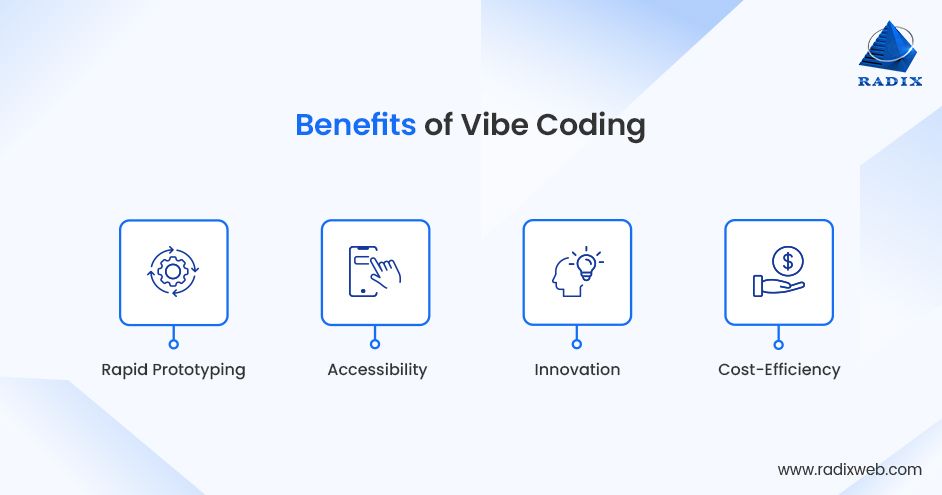
With vibe coding tools and AI-generated structure, early prototypes can be built in hours (sometimes minutes!) instead of weeks. This acceleration helps teams validate ideas faster and reduces wasted engineering cycles.
Domain specialists, analysts, and business teams can participate in vibe coding programming, expressing requirements using natural language. This opens the door for non-developers, who are not well-versed with AI programming languages and enables shared ownership of innovation.
When code generation takes minutes, experimentation becomes inexpensive. Teams can explore more vibe coding examples, iterate on UI/UX ideas, and test variations. All without heavy resource investment. This benefit also extends to vibe coding for developers, who can test ideas faster.
AI reduces overhead for MVPs, prototypes, and internal utilities. This is especially impactful in early-stage projects, where AI vibe coding tools enable speed without adding full engineering cycles.
Across industries, these benefits have led to multiple vibe coding use cases, making it a critical component in the future of coding with AI.
While promising, there are several vibe coding limitations that need to be addressed before it can be used for professional development. Some of the most pressing vibe coding challenges include:
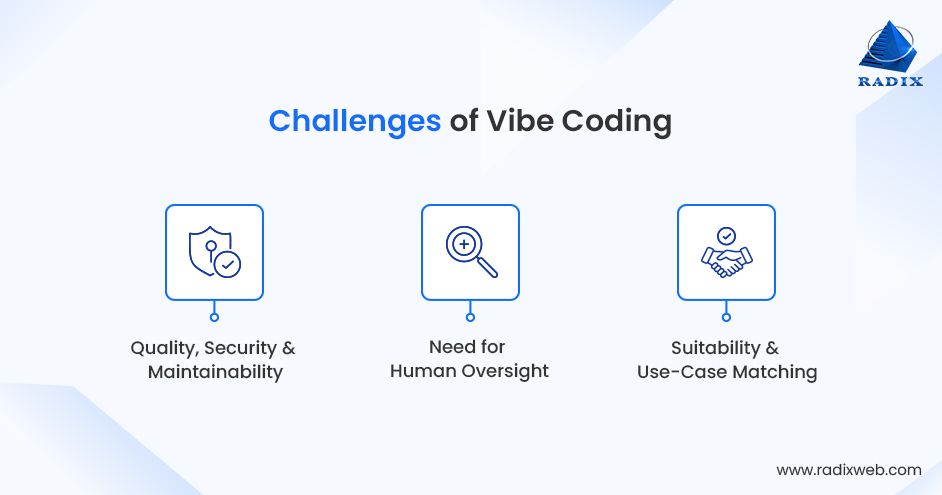
AI-generated code may contain hidden vulnerabilities, outdated patterns, fragile dependencies, or scaling issues. These vibe coding risks make it unsuitable for production without human review.
Even with advanced vibe coding AI systems, manual QA, architectural supervision, threat modeling, and performance testing remain essential. Enterprises must enforce strong vibe coding best practices, including reviews and automated scanning.
Vibe coding vs. traditional coding is not a binary choice. Vibe coding may excel for prototypes, internal tools, and low-risk applications. But traditional engineering is non-negotiable for banking, healthcare, supply-chain, and mission-critical products, especially when they are for wider, public-facing use.
In short, the best outcomes arise when organizations adopt AI-powered vibe coding responsibly and when the risks and challenges are addressed with governance, guardrails, and enterprise-grade caution.
Below is a quick guide to help you decide when to use vibe coding and when to stick to traditional custom software development:
| Use Vibe Coding for projects like: | Use Traditional Development for projects like: |
|---|---|
| Quick prototypes or MVP concepts | Large-scale enterprise applications |
| Simple internal tools or automations | Mission-critical systems (banking, healthcare, security) |
| UI/UX mockups or interactive demos | High-performance systems (real-time, low-latency) |
| Creative or experimental apps (AI features, generative tools) | Long-term products with big teams and strict architecture |
| Learning projects or tech explorations | Systems requiring compliance, audits, or heavy testing |
| One-off utilities, scripts, or workflows | Enterprise-wide digital transformation projects |
| Infrastructure-heavy apps with complex integrations | |
| Legacy system modernization projects |
Suggested Reading: If you are looking to use AI for your enterprise needs, here’s a quick enterprise AI guide to help you get started.
At Radixweb, in recent times, we’ve had a lot of clients come to us with half-baked apps. All vibe coded. All good looking. Some even working on the frontend. But behind the top layer, it was all a hot mess.
Security? Non-existent
Code clarity? Barely there.
Documentation? Just vibes, no pages.
Scalability? Let’s just say the moment you pushed beyond a demo environment, things started falling apart.
And maintainability? Unless you were the original “vibe coder” who wrote it at 2 AM with lo-fi playing in the background, good luck figuring out how anything worked.
The truth is: Vibe coding can spark incredible velocity, but without guardrails, it leaves enterprises with technical debt disguised as innovation.
That’s why the solution to making these vibe-coded apps not just work, but work right, is to blend AI-first expertise, cloud-native maturity, and engineering discipline. This helps enterprises adopt vibe-coding software development safely and effectively.
At Radixweb, we are well-equipped (with tools, expertise, and experience) to help you take your vibe coded apps into actual production environments. Here are our key strengths that make it possible:
Generative AI & AI Agent Development
Integrating vibe coding tools, copilots, and AI-assisted workflows into enterprise pipelines.
Cloud Support & Data Engineering
Ensuring secure, scalable, compliant environments for AI-powered development.
Machine Learning Expertise
Building robust automation and quality checks around vibe-coding workflow models.
Enterprise-Grade Software Engineering
Adding the architecture, governance, and “responsible innovation” layer organizations absolutely need.
With that, we can support rapid prototyping, low-code automation, internal tools, MVP development, and small-to-medium application development. Our teams ensure quality, maintainability, and security, bridging fast iteration with long-term sustainability.

The Future of Software Development: Vision & Vibes
As we look toward the future of vibe coding, it’s clear that AI-driven software development will play a transformative role. But vibe coding is not an all-in replacement for engineering. It's a powerful, creative accelerator within the future of coding with AI.Radixweb embraces vibe coding trends while upholding the values of reliable, secure, cloud-native development. Our approach blends speed with responsibility, enabling teams to innovate confidently and sustainably.Exploring how vibe coding with ChatGPT or other LLMs can improve delivery, productivity, or prototyping? Our experts can help you align AI capabilities with enterprise-grade requirements.
Ready to brush up on something new? We've got more to read right this way.