Read More


Recognized for AI Excellence at 2026 Globee® Awards - Read More

Pratik Mistry
Summary: Software product development succeeds or fails on decisions made before the first sprint like problem validation, commercial model, and IP structure. This guide walks CEOs and product leaders through the six-stage lifecycle, 2026 cost benchmarks, build-vs-partner trade-offs, and how AI and cloud-native architecture are reshaping what a defensible product looks like.
I have observed that somewhere between the product idea and the first paying customer, most software product initiatives lose the thread. It's rarely the code or the design It happens quietly in the decisions made months earlier: the market assumption nobody tested, the architecture locked in before the pricing model was settled, the development partner engaged before anyone agreed who'd own the source code.
The organizations that navigate this well treat software product development as a commercial discipline first and then as an engineering discipline. That sequence changes what gets decided before the first sprint, what gets scoped into the MVP, and what the product looks like 12 months after launch. Teams weighing this early usually leverage a structured approach to building commercial software products rather than starting from an engineering brief.
PDMA's 2025 research puts a hard number on this, 80% of software projects approved for development never become a commercial success. In 42% of cases the root cause is not technical; the product simply did not address a problem people would pay to solve. AI-accelerated competitors can now replicate core features in weeks, shrinking the window for discovering this the hard way.
Three kinds of organizations run into this most often: companies building a proprietary software product as a new revenue line, independent software vendors testing unvalidated market assumptions, and enterprises asking whether internal software has commercial potential beyond its original use.
Each situation calls for the same disciplines: validating the problem before scaling the solution, sequencing the build around what needs to be learned, and committing the post-launch investment before the initial budget is approved.
The organisations that get this sequence right build products that compound in value. The ones that get it wrong build products that compound in cost.
Software product development is the process of designing, building, and iterating a software solution intended for repeated commercial use across a customer base, rather than for a single client or internal function. It covers the full lifecycle from problem validation through architecture, build, launch, and ongoing evolution.
The distinction that changes every decision that follows is how a software project ends at delivery. A software product begins there.
Custom software built for internal use is designed around one organisation's workflows, reviewed by one set of stakeholders, and maintained by one team with institutional context.
A software product is designed to be adopted by people who were not involved in building it, onboarded without the development team present, and evolved based on what aggregated user behaviour reveals about what users realistically need versus what the product assumed.
This difference determines the architecture, the go-to-market model, the pricing structure, and the long-term investment required to make the product commercially viable.
Not all software products are built the same way or for the same commercial model. The category a product falls into shapes the architecture decisions, the regulatory exposure, the monetisation approach, and the go-to-market complexity. For a deeper look at how product types influence delivery paths, build a deep understanding on engineering product development from innovation to fabrication.
Multi-tenant, subscription-based, delivered via browser or API is the dominant commercial model for new software products in 2026. The architecture decisions made during the build phase determine how the platform scales and at what cost.
Database isolation strategy (shared vs. separate schemas), authentication model, usage metering, and billing integration are product foundations, not implementation details. Getting these wrong costs significantly more to fix at 10,000 users than it would have at the design stage.
Software built to run inside another organisation's product or system like automotive software, industrial control systems, medical device firmware, telecommunications infrastructure.
These products carry the highest compliance burden, the longest certification timelines, and the strictest quality requirements of any software category. Regulatory certification alone can add 12-18 months to a development programme.
Sold as licences or subscriptions to large organisations with complex procurement cycles and extended implementation timelines. Success depends as much on the implementation model as on the product itself.
Enterprise products that require extensive professional services to deploy have a higher cost of sale, a longer time to revenue recognition, and a greater dependency on customer success capacity than most initial business cases account for.
APIs, SDKs, infrastructure software, AI models and inference platforms. Sold to or adopted by developers rather than end users. Adoption follows different patterns from B2B SaaS like free tier to paid conversion, community-driven growth to enterprise contract. Developer experience is the primary product quality metric, and technical documentation is a growth channel.
| Product Category | Primary Buyer | Commercial Model | Time to First Revenue |
|---|---|---|---|
| SaaS Platform | Business users | Subscription | 6-18 months post-launch |
| Embedded/OEM | Device manufacturers | Licence & royalty | 12-36 months post-certification |
| Enterprise software | IT and procurement | Annual licence | 12-24 months sales cycle |
| Developer tools | Engineering teams | Usage-based or freemium | 3-12 months via community |
The decision to build a software product is frequently made when the idea is clear enough to be exciting and before the conditions for success have been established. These are the signals that indicate organisational readiness.
A software product built on a validated problem has paying customers or documented willingness-to-pay before architecture begins. This does not require a finished product. It requires interviews with specific potential users, evidence that the problem is painful enough to justify spending, and confirmation that the proposed solution addresses the right version of the problem.
Products built on assumed problems are the source of the 42% failure rate attributable to lack of market need. The assumption feels like validation because the people who made it believed it. The market is indifferent to how sincerely the assumption was held.
SaaS subscription, perpetual licence, usage-based pricing, and freemium each carry different architectural implications. A product built for subscription billing that later pivots to usage-based pricing, requires re-engineering the metering and billing infrastructure. A product built as a perpetual licence that shifts to subscription, needs a fundamentally different customer success and renewal model.
The commercial model decision belongs before the first database schema is designed, not after the first user starts paying.
Building a software product to commercial readiness requires sustained engineering capacity over 12-24 months for a first version.
Organisations that start the vendor selection process after the product is scoped consistently lose 4-8 weeks of development time. They start the build with a partner who hasn’t had the opportunity to challenge the product assumptions before committing to them.
For organisations investing in strategic software development capacity extension, source code ownership, IP assignment, and derivative works rights must be in the contract before any development begins., source code ownership, IP assignment, and derivative works rights must be in the contract before any development begins.
Under standard contract law in most jurisdictions, work product from independent contractors does not automatically belong to the commissioning organisation without explicit written assignment.
A significant proportion of organisations asking about software product development are not starting from zero. They have an existing system, a legacy platform, or internal tooling that partially addresses the problem and are deciding whether to extend it or replace it.
The technology stack question often surfaces here too, especially for teams weighing legacy platform modernization strategies against a ground-up rebuild. The modernise-versus-rebuild decision is determined by a technical audit, not by how old the system looks or how frustrated the team has become with it. by a technical audit, not by how old the system looks or how frustrated the team has become with it.
The cost comparison is rarely straightforward. A rebuild that appears 30% more expensive than modernisation may deliver significantly lower annual maintenance cost over a 5-year horizon. The right consideration is not "which is cheaper" but "which produces the better return on the total investment over the product's commercial lifetime."
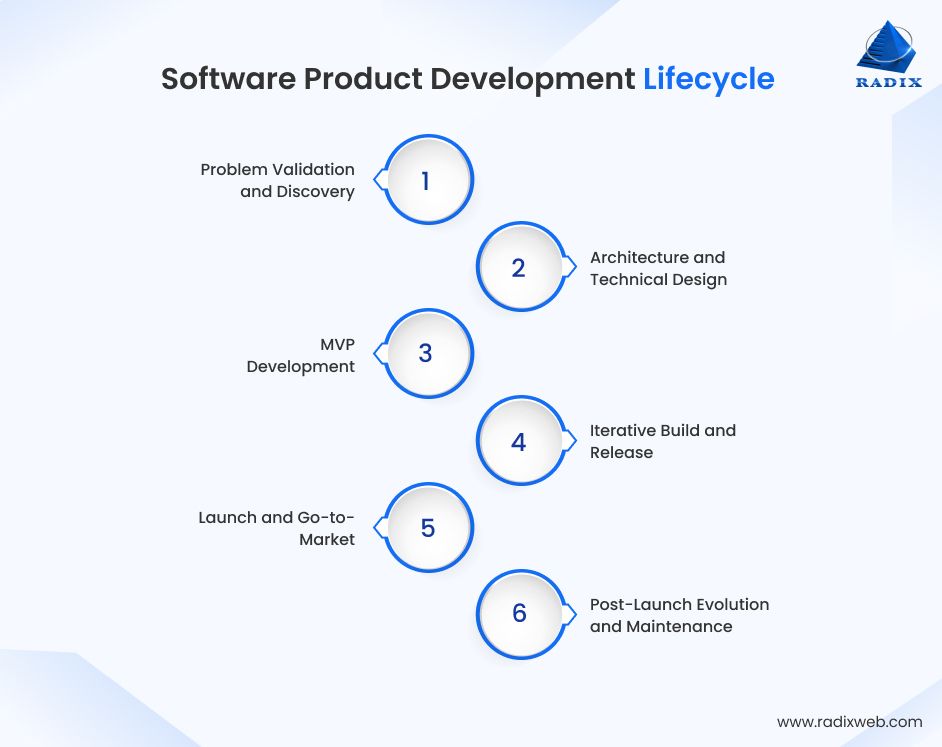
The lifecycle of a software product is not a linear sequence of tasks. It’s a series of decision points, each of which either opens or closes commercial options downstream.
The deliverable at this stage is not a requirements document. It is a validated business case with evidence that a specific customer segment will pay for a specific solution to a specific problem. Discovery that produces only a list of desired features has not yet answered the commercial question.
User interviews, competitive analysis, and willingness-to-pay conversations should precede technical architecture work. For organisations building a new product type, the discovery phase typically runs for 4-8 weeks. For organisations entering a competitive market, the competitive analysis component demands more depth and more time.
High-level technical architecture, data model design, integration mapping, and UX information architecture. The decisions made here are the most expensive to reverse in the entire product lifecycle.
Three decisions made in this stage consistently generate the highest cost when revisited later:
The minimum viable product is the smallest version of the product that delivers the core value proposition to early adopters and generates real usage data. In practice, most MVPs contain too many features. The discipline of cutting scope to the smallest set that tests the core commercial hypothesis is the most valuable product management skill in this phase.
Building a well-scoped MVP for a B2B SaaS product typically runs 8-16 weeks for a dedicated team. The purpose is not to impress. It is to learn cheaply enough that the insights can still change the direction of the product.
Agile delivery in defined sprints, with regular releases to a growing user base. Feature prioritisation shifts from ‘what was planned’ to ‘what usage data and user feedback indicate the product needs.’ This transition is the moment when product development diverges from project delivery.
Teams that do not make this transition continue building to the original plan regardless of what users show them. Teams that make it build the product users are realistically using rather than the product that was specced at 12 months earlier. The commercial outcomes of these 2 approaches, measured at the 18-month mark, are consistently different.
Pricing, packaging, distribution strategy, positioning, sales enablement, and customer success model everything lives in this stage. Most technical teams underestimate how much of a software product's commercial performance is determined in this phase.
Data backs this up. According to Salesmate's 2025 Go-to-Market Strategy Guide, companies with a structured go-to-market strategy see 10% higher launch success rates and 3X greater revenue growth than companies with ad-hoc approaches. A product with strong engineering and weak go-to-market consistently underperforms a technically weaker product with strong market positioning and a well-executed launch plan.
Maintenance, security updates, performance monitoring, and the continuous product roadmap driven by retention and usage data belong here. Annual ongoing costs for a SaaS product typically run 20 to 30% of the original build cost, higher than the 15 to 20% for custom software because product evolution is continuous, not periodic.
Only 13% of companies maintain detailed product roadmaps beyond 12 months. The products that compound in commercial value are the ones where roadmap decisions are driven by retention data and user behaviour analytics.
Three structural approaches exist for software product development. Each carries different implications for IP ownership, development speed, cost, and long-term organisational dependency.
Full IP control, the deepest integration of domain knowledge into the product, and the highest fixed cost. Building in-house is the right choice when the software product is the core IP of the business and when the engineering team is intended as a long-term competitive asset. The organisation must have the recruiting, management, and retention capacity to build and sustain a product engineering team over a multi-year horizon, particularly when you’re planning long horizon product team structures.
Here's the cost that most business cases underestimate. A senior software engineer in the US costs $180,000 to $240,000 annually on a fully-burdened basis. Building a 5-person product engineering team in-house costs $900,000 to $1.2M per year before infrastructure, tooling, or management overheads. For organisations at the seed or early Series A stage, this math usually points to a different model.
Businesses often face lower fixed cost, faster time to first build, and higher dependency risk if the partnership is not structured correctly. The critical decisions when outsourcing product development are different from outsourcing a project especially when you’re weighing location-driven software delivery advantages:
In a hybrid approach: the partner provides engineering capacity, delivery methodology, and technical architecture input while the product company retains product ownership, roadmap control, and full IP. This model works well for organisations that have product vision and domain expertise but lacks the engineering capacity to build at the required velocity.
Businesses without in-house engineering capacity increasingly lean on flexible technical staffing arrangements to bridge the gap without long-term headcount risk.
The practical distinction from pure outsourcing is that in a co-development model, the product company's team and the partner's team are in regular direct communication about product decisions. The partner participates in product thinking rather than just executing specifications.
| Model | IP Control | Time to First Build | Annual Cost (5-person team) | Best For |
|---|---|---|---|---|
| In-house | Full | Slowest (6-12 months to hire) | $900K-$1.2M | Core IP, long-term product asset |
| Outsourced | Full (if contracted correctly) | Fastest (3-6 weeks to start) | $180K-$360K (offshore) | Defined scope, speed priority |
| Co-development | Full | Fast (4-8 weeks to start) | $240K-$480K (offshore) | Strong product vision, need technical depth |
Cost ranges for software product development vary more widely than for custom project development because the scope of "software product" spans from a focused vertical SaaS tool to an enterprise platform serving thousands of organisations. These ranges reflect what fully-funded, professionally managed product development costs in real world.
| Product Type | MVP Cost Range | Full V1 Cost Range | Annual Evolution Cost |
|---|---|---|---|
| Focused SaaS tool (single workflow) | $50,000-$120,000 | $120,000-$300,000 | $40,000-$80,000 |
| Multi-feature SaaS platform | $100,000-$250,000 | $300,000-$700,000 | $80,000-$180,000 |
| Enterprise software product | $200,000-$500,000 | $500,000-$1,500,000+ | $150,000-$400,000 |
| Developer tool or API platform | $60,000-$150,000 | $150,000-$400,000 | $50,000-$120,000 |
| Embedded or OEM product | $150,000-$400,000 | $400,000-$1,200,000+ | $100,000-$300,000 |
The hidden cost that most product business cases underestimate are from customer onboarding and implementation tooling. A product that requires significant professional services to deploy has a higher cost of sale, longer time to revenue, and lower net revenue retention than a product with self-service onboarding. Building self-service onboarding into the product from the first version costs more in the build phase and less over the product's commercial lifetime.
The AI integration premium in 2026 adds 20 to 50% to the base development cost depending on the AI capability involved. An LLM-based chat interface with knowledge retrieval adds $15,000 to $60,000. A custom recommendation engine built on product usage data adds $40,000 to $150,000.
The primary cost driver is not the AI model itself. It is the data pipeline work that makes the AI feature accurate enough to be useful at production scale.
Three shifts in 2026 are materially changing what software product development looks like, how long it takes, and what it costs to sustain.
Development teams using AI coding tools (Claude Code, GitHub Copilot, Cursor) report 30 to 50% reduction in time for standard feature development. This changes the MVP economics drastically. A product that previously required 6 months to first release can reach that milestone in 3-4 months with a team that has integrated these tools effectively.
Tech forward businesses that are evaluating development partners now must specifically ask about AI tooling adoption and what productivity data the team has from recent product builds to build a practical roadmap for AI-assisted software delivery. A team not using these tools in 2026 is building at 2022 productivity levels. Their timeline and cost estimates for equivalent scope will be proportionally higher.
Adding AI capabilities to a software product for wider operationalization is a product strategy decision that carries strong data architecture requirements. Tech leaders and CTOs must answer these three questions before AI features are scoped:
Products that answer these questions in the architecture stage build AI features that improve with use. Products that add AI features as marketing decisions build AI features that erode user trust when they underperform. Teams scoping this correctly usually start with structured machine learning development engagements rather than bolting a model onto an existing product.
Cloud-native architecture, microservices, containerisation, and CI/CD pipelines are no longer advanced choices for sophisticated engineering teams. They are the baseline for any software product intended to scale.
Products built on monolithic architectures in 2026 consistently reach a point where adding features or scaling user volume requires architectural work that delays product roadmap progress. Getting authentication, multi-tenancy, and compliance right at this stage is where enterprise-grade cloud architecture planning earns its cost. The investment in cloud-native architecture at the build stage is the investment in roadmap velocity over the product's commercial lifetime.
Platform thinking is the discipline of designing a product so that its value grows as more users, integrations, and use cases are added. It manifests in product decisions like:
Products designed with platform thinking from the first version have higher net revenue retention, lower churn, and higher customer lifetime value than equivalent products without it. The design decisions that enable platform thinking are architectural, and they are significantly more expensive to add post-launch than to include at the design stage.
IP disputes in software product development are almost entirely preventable. They occur because the relevant agreements were not in place before development began, not because the underlying legal questions are complicated.
Any product built with an external development partner requires explicit IP assignment language in the contract. The clause must state that all work product, including code, designs, documentation, derivative works, and any training data generated from the product, is assigned to the client organisation upon creation.
The distinction matters because if the relationship ends before final payment, the contract without this clause leaves ownership ambiguous.
Source code must be in the client's version control repository from the first commit. Not held in the vendor's repository and transferred at project completion. This is the contractual protection against the scenario where the vendor becomes unresponsive or uses the codebase as negotiating pressure during a dispute.
Software products built with open-source components carry licence obligations that affect commercial distribution. GPL-licensed components incorporated into a commercial product trigger copyleft obligations that require the product's source code to be made available to users. MIT and Apache 2.0 licences are generally safe for commercial use without these obligations.
A licence audit before the first commercial release costs a fraction of what a licence dispute costs after it. The audit should cover all third-party libraries, frameworks, fonts, and any AI model weights incorporated into the product.
For products that incorporate AI features, three ownership questions require explicit contractual treatment:
These questions didn’t require specific contractual attention even three years ago. They require it now, and the answers are not yet settled by case law in most jurisdictions.
The evaluation criteria for a software product development partner are different from the criteria for a project development vendor. A project vendor needs to execute a specification accurately. A product development partner needs to help build the right product, which sometimes means pushing back on the specification.
A CTO must ask prospective partners for examples of engagements where they challenged a product requirement and what the outcome was. A partner with genuine product experience will have these examples readily available. A partner that has only executed project specifications will struggle to answer this question specifically.
Also, ask for reference clients who are software product companies or ISVs, not just enterprises that commissioned custom internal software. The delivery dynamics are different, and experience with one does not guarantee capability with the other.
What is your process when the MVP data suggests the product direction needs to change? The answer reveals whether the partner has a product development methodology or a delivery methodology.
How do you handle IP assignment and source code custody during the engagement? A professional product engineering partner has a documented answer. Vagueness here is a signal.
What is your developer retention rate on long-running product engagements? A product development engagement that loses 2 senior engineers mid-build loses the institutional knowledge those engineers accumulated. Ask how the partner manages this.
Do you use AI coding tools, and what is your data handling policy for client code? Teams using AI coding tools without enterprise data protection configurations are processing client code on third-party infrastructure the client did not authorise.
Can we speak with a client whose product direction changed significantly after launch? How a partner handles product pivots reveals more about their capability than how they handle successful straightforward builds.
Will you run a 4-week paid pilot on a real product component before the full engagement begins? A partner confident in their capabilities accepts this without hesitation.
There are three shifts that are changing the competitive dynamics for software products in 2026 in ways that affect strategic decisions about what to build, when to build it, and how to position it.
The AI feature parity problem. Core AI features, chat interfaces, semantic search, content generation, basic recommendation, can be built by a competent team in 4-8 weeks using foundation model APIs. This means that any software product whose primary differentiation is an AI feature is differentiated for weeks. The durable differentiation in AI-integrated products comes from proprietary data (what the AI is trained or fine-tuned on), proprietary workflows (how the AI is integrated into the user's actual job), and network effects (how the product becomes more valuable as more users generate more data). Products that compete on AI features alone are competing on something that converges to commodity.
The build cost floor has risen. Engineering salaries, cloud infrastructure costs, and the compliance overhead associated with data privacy regulations have all increased substantially since 2021. The $50,000 MVP that appeared in business cases 5 years ago typically costs $80,000 to $120,000 today for equivalent scope. Business cases that use 2021 cost benchmarks will underfund the build.
The consolidation dynamic in vertical SaaS. Vertical SaaS markets that appeared to have room for 10-15 competing products are consolidating to 3-5. Buyers in markets like construction management, field service, and healthcare operations are becoming less willing to evaluate new entrants without strong evidence of category differentiation. New software products entering established vertical markets need a sharper answer to ‘why would a customer switch from the incumbent’ than they needed three years ago.
The Product Starts Where the Project Brief Ends
Software product development requires a different kind of investment than software project delivery. For organizations planning a full lifecycle build, a specialized software product development approach helps align those investments with commercial outcomes. The engineering is the same. But the surrounding decisions, about the commercial model, the validation process, the IP protections, the go-to-market model, and the post-launch evolution budget, are what determine whether the engineering produces a product that performs commercially or a product that performs technically.Radixweb's software product development team has delivered product engineering engagements across healthcare, logistics, financial services, and enterprise technology for ISVs and product-led companies over 26 years. Speak with the team before architecture decisions are made.
Ready to brush up on something new? We've got more to read right this way.