Read More


Recognized for AI Excellence at 2026 Globee® Awards - Read More

Pratik Mistry
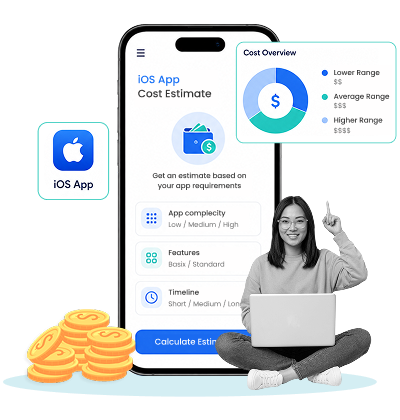
Inside This Guide: Building an iOS app in 2026 can cost anywhere from $10,000 for a simple MVP to $300,000+ for a complex enterprise platform. The exact cost will depend on your app’s features, backend complexity, AI integrations, design expectations, and development approach. This guide breaks down actual cost ranges, hidden expenses most companies miss, the factors that inflate budgets, and practical ways to reduce development costs without compromising product quality or scalability.
iOS App Development Cost in 2026: Key Numbers at a Glance● Simple iOS MVP apps in 2026 typically cost between $10,000 and $30,000● Most business-grade iOS apps with APIs and user accounts cost $50,000 to $150,000● Complex enterprise iOS applications with AI and real-time features can exceed $300,000● UI/UX design alone can add $8,000 to $25,000 to total app development costs● Backend infrastructure and API integrations often increase budgets by $15,000 to $80,000+● AI integrations like chatbots and recommendation engines can add $8,000 to $40,000+● Cross-platform frameworks like Flutter and React Native can reduce costs by 30–50%● Annual iOS app maintenance typically costs 15–20% of the original development budget● Experienced iOS developers in India charge roughly $20–$50/hour versus $120–$200/hour in the US● Scope creep is one of the biggest reasons iOS app projects exceed their original budget estimates
Budgeting an iOS app is hard because no one wants to give you a straight number. Ask ten agencies and you'll get ten wildly different quotes. Ask why and you'll get ten different explanations. That's frustrating when you're trying to make a real business decision before you've signed anything.
This guide cuts through it.
In 2026, iOS app costs vary massively because the gap between a simple MVP and a production-grade app is no longer just about screens and features. Backend infrastructure, AI integrations, App Store compliance, security requirements, and post-launch scalability now influence budgets as much as development itself. At the same time, the mobile app market is projected to surpass $1.2 trillion by 2035, with 1251 apps being published on the Apple app store every day. This shows how important it is accurately budget for and plan iOS app development.
Read on to understand what actually drives iOS app development costs in 2026.

Most people assume that the cost of iOS app development is just what you pay to get the app built. However, in reality, iOS app development cost covers everything across the entire mobile app development lifecycle and is the total investment required to design, build, test, launch, and maintain an application on Apple's platform. It includes not just developer time but UI/UX design, backend infrastructure, quality assurance, App Store deployment, and ongoing maintenance, which typically adds 15-20% of the initial build cost annually.
Here’s the honest 2026 range for iOS app development costs:
Most business apps, the ones with user accounts, payment processing, push notifications, and API integrations, fall between $50,000 and $150,000.
Those ranges are wide for a reason: the final number is determined by decisions you make before the first line of code is written.
After having delivered 500+ mobile applications for clients across North America and Europe, the single most consistent finding is that budget surprises don't come from development itself. They come from underestimating the complexity of compliance, backend infrastructure, and post-launch costs that weren't scoped in the original estimate. Understanding these in advance is what separates a realistic budget from an optimistic one.
The most useful way to think about iOS app cost is by complexity tier. Your app's complexity determines the development hours required, the team size you need, and the timeline before you can launch.
Here’s a quick summary of iOS app development costs based on complexity tiers:
| Tier | Typical Features | Cost Range | Timeline |
|---|---|---|---|
| Simple / MVP | Single function, local storage, basic UI | $10,000 – $30,000 | 2 – 4 months |
| Medium complexity | User accounts, API integrations, dynamic content, custom UI | $30,000 – $100,000 | 4 – 8 months |
| Complex / Enterprise | AI/ML, real-time features, multiple user roles, compliance | $100,000 – $300,000+ | 8 – 18 months |
Let’s understand these estimates in detail.
Simple or MVP-tier apps are built around a single core function. Think calculators, task lists, informational tools, or a stripped-down version of a product idea being tested for market fit. There is no backend server, data is stored locally on the device, and the interface uses standard iOS components rather than custom animations. These apps typically cost $10,000 to $30,000 and take 2 to 4 months with a small team.
The startup use case for this tier is specific: you're testing whether your idea generates engagement before you invest in the full product. An MVP built right gives you real user data to justify, refine, or kill the bigger investment. Built wrong, it becomes a sunk cost that's too brittle to build on later. Architecture matters even at this stage.
Medium-complexity apps are where most business products land. They include user accounts with authentication, dynamic content pulled from a backend server, third-party API integrations (payment gateways, maps, social login), push notifications, and a more polished UI with some custom design elements. This tier costs $30,000 to $100,000 and typically takes 4 to 8 months. Senior developers with SwiftUI experience are required, not junior engineers learning on your project.
Complex and enterprise-tier apps involve real-time features, multiple user roles and permission levels, AI or machine learning integrations, advanced security requirements, large-scale backend architecture, and often regulatory compliance.
Examples include digital health platforms, fintech applications, marketplace apps, and enterprise workflow tools. These cost $100,000 to $300,000 or more and take 8 to 18 months from kickoff to launch. Timeline overruns at this tier almost always trace back to requirements that weren't fully specified at the start.

Complexity tier gives you a starting point, but the final number moves based on specific decisions. These are the factors with the biggest budget impact.
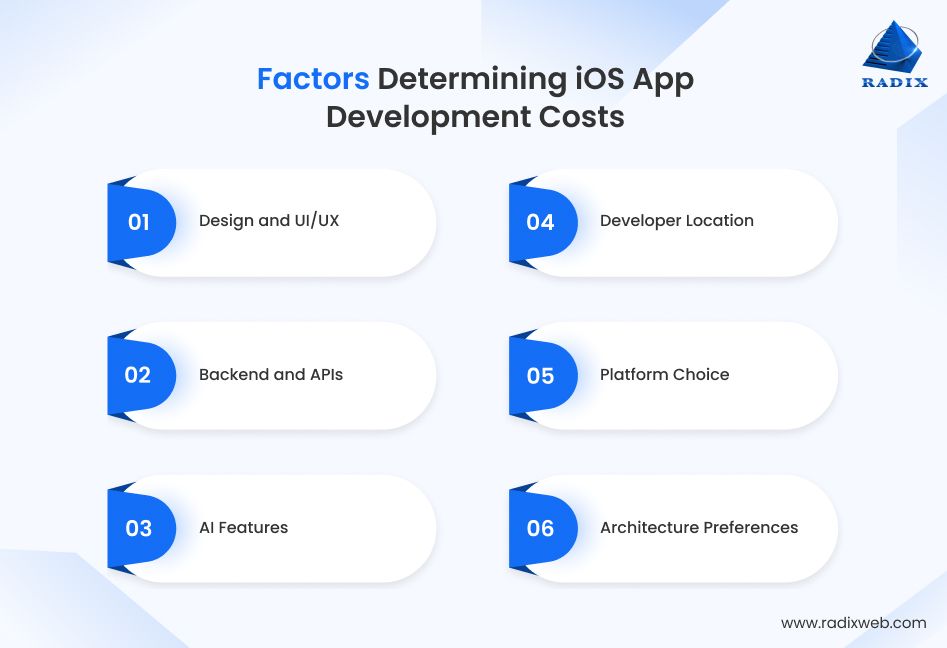
Design is where scope creep starts most often. A clean interface built on standard iOS components costs significantly less than a fully custom experience with bespoke animations, branded illustrations, and intricate interaction patterns.
Now, skimping on design may save money upfront, but it also results in more uninstalls. Poor UI is the #1 reasons apps get abandoned after download. Rebuilding UX after launch costs more and takes 3-5X longer than getting it right the first time.
UI/UX design alone for a medium-complexity app typically runs $8,000 to $25,000, including research, wireframes, high-fidelity mockups, and prototype testing. Expect the upper end if your app requires complex navigation, custom components, or accessibility compliance under WCAG standards.
The backend is what makes the front end work: user authentication, data storage, real-time syncing, push notification delivery, payment processing, and third-party service connections. A simple app with no backend has minimal infrastructure cost.
A medium-complexity app with a custom backend can add $15,000 to $40,000 to the build. A complex platform with real-time collaboration or high-volume transaction processing can push backend costs past $80,000 on their own.
Third-party integrations facilitated by APIs add both development time and ongoing operating costs. Each API connection requires error handling, testing, and maintenance as external services update their own systems. Payment gateway integrations (Apple Pay, Stripe) typically cost $3,000 to $8,000 to build correctly with proper security and compliance. Maps, CRM connections, and analytics tools each add time and ongoing subscription fees that most initial estimates omit.
AI is no longer a premium add-on in 2026. It's increasingly an expectation in competitive apps. But AI costs vary dramatically depending on what you're actually building.
A basic recommendation engine (suggesting related content, products, or features based on user behavior) costs $15,000 to $40,000 to integrate. A conversational AI chatbot built on a third-party API like OpenAI costs $8,000 to $20,000 for the integration, plus ongoing API usage costs that compound with user volume.
Custom machine learning models trained on your own data start at $50,000 and scale significantly based on data volume, model complexity, and the infrastructure needed to retrain and maintain them over time.
Apple's Core ML framework allows on-device AI processing, which improves privacy, reduces latency, and avoids recurring cloud API fees. But on-device AI raises upfront engineering effort. Teams building with Core ML need to balance the engineering investment against long-term API cost savings. For most business apps in 2026, a third-party API integration is the practical starting point. Developing custom machine learning models is a decision for when you have real user data to train on and a specific performance gap that third-party tools can't close.
One important note: AI features require ongoing maintenance that most initial quotes don't capture. Models drift. Apple updates Core ML. Third-party APIs change their pricing or capabilities. Budget for AI as a living system, not a one-time build.
Developer location is the most frequently cited cost lever, but it's also the most misunderstood. The metric that matters is total cost of delivery, not hourly rate.
| Region | Typical iOS Developer Rate (2026) |
|---|---|
| United States / Canada | $120 – $200/hr |
| Western Europe | $80 – $150/hr |
| Eastern Europe | $40 – $80/hr |
| India | $20 – $50/hr |
| Australia | $100 – $180/hr |
A US-based senior iOS developer at $150/hr and an India-based developer at $35/hr look very different on a rate sheet. Over a 6-month, 1,500-hour project, that's $225,000 versus $52,500.
The question is whether the output and delivery reliability justify the difference. Experienced India-based teams with strong iOS portfolios and established North American client relationships close much of the quality gap while maintaining the cost advantage. What matters more than geography is execution quality, architecture decisions, and delivery experience.
At Radixweb, we have an iOS application development team that has delivered 500+ apps with a 95% client satisfaction rate precisely because experience accumulates across projects in ways that a single hourly rate doesn't capture.
Team composition affects cost independently of location. A typical medium-complexity iOS project requires an iOS developer (or two, depending on timeline), a UI/UX designer, a backend developer, a QA engineer, and a project manager. Understaffing any of these roles creates bottlenecks that extend timelines and ultimately cost more than staffing correctly from the start.
This is the decision that shapes your entire budget structure. Building a native iOS app in Swift gives you the best performance, the deepest integration with Apple frameworks (ARKit, HealthKit, Apple Pay, Face ID), and the highest-quality user experience. It also means a separate codebase if you ever want an Android version, which effectively doubles your development investment.
Choosing cross-platform frameworks like React Native and Flutter let a single codebase run on both iOS and Android. This reduces development cost by 30 to 50 percent compared to building two separate native apps, and simplifies maintenance since updates only need to be applied once. For most startups, service apps, and MVPs targeting both platforms, cross-platform is the smarter starting point.
Where native wins is specific: if your app relies heavily on AR, advanced camera processing, hardware-dependent features, or requires the kind of performance and UX polish that only native rendering delivers, native iOS is worth the premium. For apps that are primarily information delivery, commerce, and user engagement, cross-platform frameworks in 2026 are capable enough that the quality gap has largely closed. Our iOS team helps clients make this call based on their specific feature requirements and growth roadmap, not a default preference for either approach. The right choice depends less on trend and more on your product roadmap, feature requirements, and long-term scalability goals.
Technical architecture and even the iOS app programming language you choose directly affects development speed, scalability, and long-term maintenance costs. This is one of the most overlooked factors affecting iOS app development cost in 2026.
One major example is SwiftUI vs. UIKit. Teams building in SwiftUI can often develop and maintain apps faster because the framework reduces boilerplate code and simplifies UI updates. Teams still relying heavily on UIKit may require additional engineering effort for migrations, refactoring, or maintaining older architectures.
The final cost of your iOS app depends less on a single estimate and more on the technical, architectural, and strategic decisions made before development begins.
This is the conversation no one has at the start of a project, and it’s where more iOS budgets blow past their estimates than almost any other factor.
And it usually happens gradually, not all at once. You start with a focused MVP: login, a product feed, and a basic checkout flow. Then real-time chat gets added. Then GPS tracking. Push notifications. An admin panel. Individually, each addition feels manageable. Collectively, they can 2X or 3X the original scope because every new feature increases backend complexity, QA effort, infrastructure requirements, API usage, and long-term maintenance costs. Before long, a $35K MVP quietly evolves into a $90K platform.
But it is avoidable. Here’s what you can do to avoid scope creep:
The apps that stay on budget are usually the ones disciplined enough to build the right features first instead of trying to build everything at once.
The build cost is what you negotiate. Hidden costs are what you discover after you've signed. And in many iOS app development projects, these ongoing operational expenses are what quietly push budgets beyond expectations. Planning for them upfront is one of the most practical things you can do for your budget.
Here’s are some hidden costs you should be aware of:
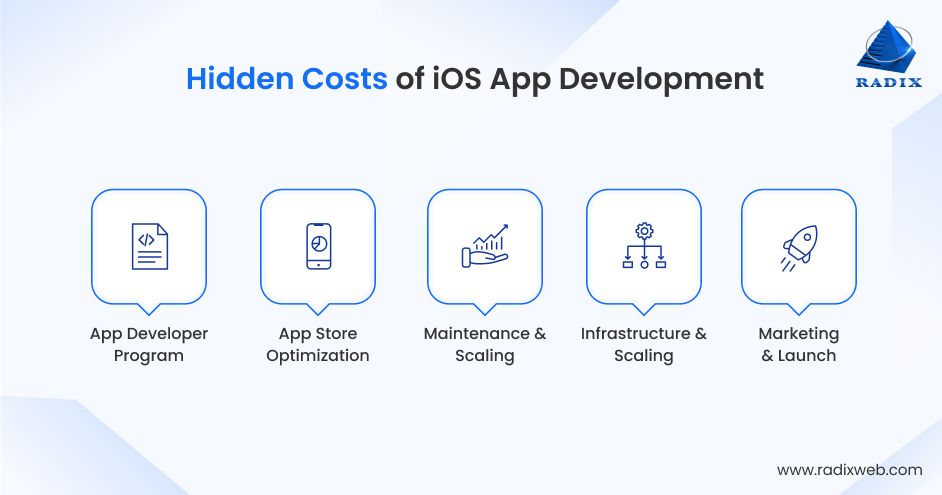
Apple Developer Program
$99 per year for individual and company accounts, covering unlimited app submissions for iOS, macOS, watchOS, and tvOS. Enterprise accounts for internal distribution cost $299 per year. This is a fixed, recurring cost regardless of whether your app generates revenue.
App Store Optimization (ASO)
Apple takes a 15% commission on in-app purchases and subscriptions for developers earning under $1 million annually, and 30% above that threshold. If your business model depends on in-app revenue, this commission is a structural cost that needs to factor into your unit economics from day one. ASO (keyword optimization, screenshots, review management) is a separate ongoing investment that drives organic discovery, typically $500 to $2,000 per month for active management.
Maintenance and compatibility updates
Apple releases a major iOS update every September. Your app needs to be tested against it, patched for any compatibility issues, and resubmitted. That's a minimum annual maintenance cycle regardless of whether you're adding features. Budget 15 to 20 percent of your initial build cost per year for maintenance. On a $60,000 app, that's $9,000 to $12,000 annually before you add any new features. Ignoring this produces a broken app within 18 months.
Backend infrastructure and scaling
Server costs scale with users. An app that costs $200 per month to host for 1,000 users may cost $2,000 per month for 10,000 users and $20,000 per month for 100,000. Building a scalable architecture from the start is more expensive upfront but significantly cheaper than re-architecting under load. Cloud hosting (AWS, Google Cloud, Azure) for a medium-complexity app typically runs $500 to $5,000 per month depending on traffic and feature requirements.
Marketing and launch
This is the most commonly forgotten line item. Many businesses spend $60,000 building an app, allocate nothing for user acquisition, and wonder why downloads are in the dozens. A realistic launch budget includes ASO, paid acquisition, PR outreach, and potentially influencer or content marketing. A common benchmark: match your development budget with your marketing budget, at least in year one.
The businesses that budget accurately for iOS development are usually the ones that treat launch and long-term maintenance as part of the product investment, not as afterthoughts once development ends.
Cutting iOS app development costs is possible without compromising product quality. The biggest savings usually come from making smarter product, architecture, and delivery decisions early in the project rather than trying to cut corners during development.
Starting with a minimum viable product, the smallest version of your app that delivers real user value, can reduce upfront development costs by 40% to 60% compared to building the full product immediately. More importantly, it gives you actual user feedback before investing in expensive secondary features.
Define your MVP with a single constraint: what is the one thing this app must do for users to find it valuable? Everything else belongs in version two.
If your app does not depend heavily on hardware-specific iOS capabilities, frameworks like React Native and Flutter can reduce total development costs by 30% to 50% compared to building separate native apps for iOS and Android.
A shared codebase reduces development effort, simplifies maintenance, and allows simultaneous deployment across platforms. For many commerce, content, and productivity applications, this is often the most cost-efficient approach.
Working with experienced offshore iOS development teams can significantly reduce costs while maintaining quality, provided the team has proven technical experience and mature project management processes.
The biggest risk in outsourcing the development is not geography. It's inexperience. A junior team charging $20/hour that requires 3,000 development hours often costs more than a senior team charging $40/hour that can deliver the same scope in 1,500 hours.
Evaluate portfolios, technical expertise, communication processes, and delivery track records, not just hourly rates.
Swift Package Manager and established open-source libraries can handle common functionality like authentication, payment processing, analytics, and push notifications without rebuilding everything from scratch.
Using reliable pre-built components instead of fully custom implementations can reduce development time by 20% to 30% for standard app functionality while allowing teams to focus resources on features that actually differentiate the product.
Agile development with short sprint cycles and milestone reviews helps identify scope, usability, and technical issues before they turn into expensive rework.
Projects with continuous feedback loops are generally easier to control than projects where everything is reviewed only at the end. Time-and-material engagement models combined with milestone checkpoints also provide more flexibility to adjust priorities without restarting the entire project scope.
Reducing iOS app development cost is less about spending the least amount possible and more about allocating budget toward the features, infrastructure, and decisions that create long-term product value.

Budgeting Right for iOS App Development in 2026
A bad iOS app development cost estimate today can become a six-figure correction later. But most budget overruns are not caused by development itself. They happen because businesses underestimate backend complexity, feature expansion, scalability, maintenance, and post-launch costs. In 2026, the gap between a $40,000 app and a $150,000 app often comes down to decisions made before development even starts. The businesses that budget well are usually the ones that define scope early, prioritize the right features, plan for long-term scalability from day one, and hire the right team of iOS app developers for design, development, and deployment.At Radixweb, we can help you plan, build, and scale iOS applications with dedicated developers and full-cycle development teams experienced in Swift, SwiftUI, backend engineering, QA, and product delivery. Whether you need end-to-end iOS app development or want to extend your in-house team by hiring experienced iOS developers, our team can help you build with a realistic roadmap and budget from the start.Book a no-cost, no-commitment consultation and get your app idea evaluated by iOS development experts, get technical breakdowns and estimated development investments.
Ready to brush up on something new? We've got more to read right this way.