

Read More


Recognized for AI Excellence at 2026 Globee® Awards - Read More

Sarrah Pitaliya

The Future of InsurTech is Here: In 2026, insurance technology is no longer about chasing every buzzword. With rapid AI adoption, embedded insurance growth, and real business outcomes at stake, insurers must distinguish impactful trends from noise. This blog clarifies the InsurTech landscape, highlights key innovations, and shows how insurers can convert technology into measurable value.
Today, the spending on technology in the insurance industry stands at 15-20% of the total expenses. Half a decade ago, it was merely 5 – 6%. Yet many insurance providers are struggling with outdated systems and chasing hype instead of trends that drive real ROI.
Why? Because they are often asking the wrong questions.
Instead of asking, “what are the current trends in the insurance industry?”, they should be asking “which current trends in the insurance industry are worth adopting?”
With that, they’d be able to filter out the noise around insurance technology trends.
So, in this blog, we cut through the clutter to help you see what’s strategic now and what drives the impact of technology in the insurance industry.
With 26+ years of tech experience, we don’t just see trends; we predict what’s worth adopting and what you can pass. So read on as we explain the 10 new trends in insurance technology that you should be adopting in 2026 and beyond.

The insurance technology landscape today is shaped by a dramatic acceleration in digital transformation.
The global Insurtech market was valued at about USD 1.19 trillion in 2025 By the end of 2026, it will be worth USD 1.34 trillion. With a CAGR of 12.72%, the market is expected to be worth USD 2.44 trillion. This continued expansion of technology in the insurance industry driven by automation, AI, embedded models, and digital platforms. Nearly 72% of insurers are investing in digital workflows, and over 65% say they plan to invest more than $10 million into AI in the next three years and use automated or AI-supported processes across underwriting and claims.
This shift reflects a broader industry evolution: insurers are moving from point solutions to enterprise-wide digital ecosystems. Customer engagement has migrated online, with mobile and digital channels covering more than half of policy interactions in some markets, while cloud platforms enable scalable, agile operations.
Additionally, regulatory and ecosystem dynamics are pushing insurers toward data interoperability, explainable automation, and privacy-centric infrastructures. Carriers that delay modernization risk widening gaps with Insurtech newcomers that embed technology into every customer touchpoint.
That said, the key to using technology in insurance businesses is knowing which trends to follow and what hype to ignore. Read on as we explain 10 trends that deserve your tech investments.
In 2026, trends aren’t about experimenting with tech. Instead, it is about operationalizing it at scale. Here are the 10 latest trends in the insurance industry that insurers are focusing on because they deliver measurable impact and tangible ROI.
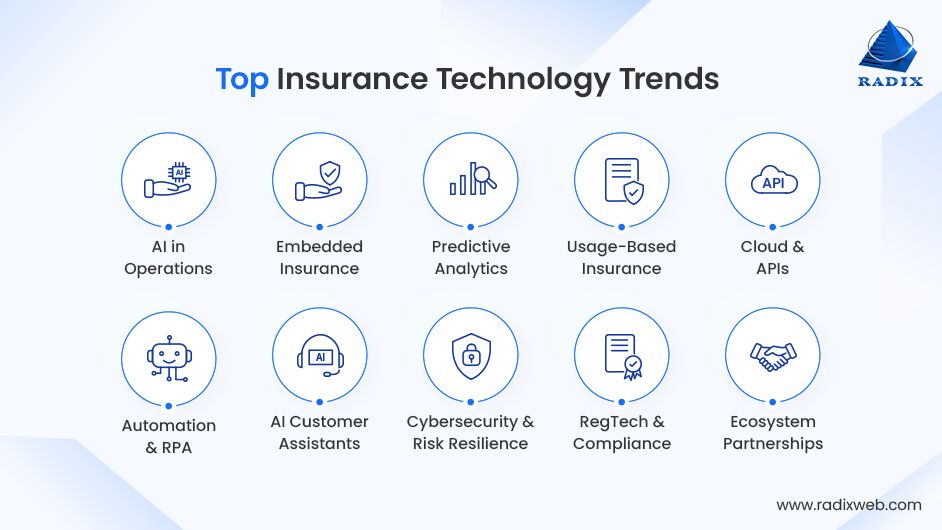
Today, artificial intelligence in insurance has evolved beyond task automation into agentic systems that can reason, decide, and act across workflows. Generative AI models now assist with:
Agentic AI also coordinates multiple processes end-to-end. So, instead of supporting individual steps, these systems manage entire journeys, such as processing a claim from submission to settlement. This shift improves speed, consistency, and scalability while reducing dependency on manual intervention. Insurers adopting AI at this level gain faster decision cycles, improved accuracy, and the ability to personalize products and services at scale.
For example, AI-powered platforms like Lemonade use machine learning for pricing and claims automation. In some segments, automated claims close instantly without human involvement, reshaping customer expectations and operational efficiency.
Embedded insurance is one of the latest trends in the insurance industry which integrates coverage directly into digital journeys where customers already transact. This can be eCommerce platforms, travel bookings, mobility apps, and financial services. Rather than purchasing insurance separately, customers opt in at the point of need, making coverage more relevant and frictionless.
Today, this model is powered by APIs, real-time underwriting, and automated policy issuance.
Embedded insurance expands distribution reach, reduces acquisition costs, and enables insurers to access new customer segments. For insurers, it represents a shift from product-centric selling to ecosystem-driven participation. With that, insurance becomes a natural part of broader digital experiences.
For example, Tesla offers embedded auto insurance directly through its vehicle app and at the point of purchase. They use real‑time driving data to price policies and give owners immediate coverage without needing a separate insurer interaction.
Also read: Complete Guide to Developing an Insurance App
Predictive analytics in insurance now combines historical data with real-time inputs from external sources such as IoT devices, geospatial data, behavioral signals, and climate models.
Insurers then use these insights to continuously assess risk rather than relying on static, periodic evaluations. This allows for dynamic pricing, proactive loss prevention, and more accurate underwriting decisions. Advanced analytics also improves portfolio management by identifying emerging risks early.
As data volumes and complexity grow, insurers that invest in data analytics and intelligence gain a competitive advantage through better risk selection, improved profitability, and more responsive product design.
For example, AXA has deployed advanced predictive analytics to simulate catastrophe risk and forecast customer behaviors. This helps tailor pricing and manage exposure before extreme weather events occur.

Usage-based insurance has become one of the popular insurance industry tech trends. It relies on real-world behavior data collected through IoT devices, sensors, and telematics systems. Instead of flat premiums, policy pricing adjusts based on how customers actually use insured assets, such as vehicles, equipment, or property.
Today, scalable Internet of Things platforms are expanding beyond auto insurance into health, commercial, and property segments. Usage-based approaches promote fairness, encourage safer behavior, and improve risk accuracy. For insurers, they reduce claim frequency and strengthen customer engagement by aligning premiums with individual behavior rather than generalized risk categories.
For example, Progressive Insurance’s Snapshot offers usage-based auto insurance program that uses telematics data from in-vehicle or smartphone sensors to monitor how customers drive and adjust premiums based on real driving behavior.
Cloud-native platforms have become the foundation of emerging trends in insurance. These systems replace rigid legacy infrastructures with modular, scalable, and resilient architectures. API-first design enables insurers to integrate quickly with partners, Insurtech's, and third-party services, supporting faster innovation cycles.
Cloud adoption also improves data accessibility, operational flexibility, and disaster recovery capabilities. As insurers expand digital channels and embedded models, cloud-native cores allow them to launch new products faster, adapt to regulatory changes, and scale efficiently without heavy upfront infrastructure investments.
For example, Nationwide Insurance implemented an API-first strategy across its organization to empower developers and connect services more flexibly as part of its broader cloud transformation.
Intelligent automation is one of the strongest technology trends in the insurance industry combining insurance robotic process automation with AI capabilities such as document recognition, natural language processing, and decision logic. Insurers use these tools to automate high-volume, repetitive tasks across policy administration, claims processing, renewals, and compliance reporting. Such automation helps:
As operational efficiency becomes a competitive differentiator, intelligent automation plays a critical role in modern insurance operations.
For example, Bajaj Allianz General Insurance has deployed RPA bots across its policy issuance and administrative workflows to automate repetitive tasks like proposal handling and approvals, significantly cutting processing times and boosting operational efficiency.
Customer AI Assistants & Omnichannel Engagement are not just emerging trends in insurance; they are becoming table stakes. Customers now expect fast, simple, and consistent service. No matter if they show up via call center, app, chat, or messaging.
Today, insurers are exploring diverse AI use cases like multimodal AI assistants that can talk, type, and listen, while remembering context across channels so customers don’t have to repeat themselves.
These AI assistants are no longer just answering questions. They handle renewals, policy changes, billing updates, and basic claims interactions end to end. They connect directly into core policy and claims systems, which enables straight-through processing for common tasks. When things get complex, the AI hands off to a human with full context, making agents faster and more effective.
For example, Allstate uses AI-driven virtual assistants across chat and digital channels to manage claims updates and policy servicing. Generative AI helps draft clear, empathetic responses, reducing call volumes and support costs while improving customer satisfaction and NPS.

As insurers handle growing volumes of sensitive personal and financial data, cybersecurity has become a strategic priority rather than a technical afterthought. With cybersecurity technology trends in the insurance industry, zero-trust architectures, continuous monitoring, and advanced threat detection systems are getting widely adopted across insurance platforms.
These frameworks assume no implicit trust within networks and enforce strict access controls at every level. Strong cybersecurity not only protects data but also supports regulatory compliance and customer trust. With cyber risks themselves becoming insurable products, insurers must demonstrate resilience and security maturity across their own digital ecosystems.
For example, insurer Beazley plc has built out Beazley Security, integrating advanced threat detection and managed cybersecurity services into its operations. With that, it proactively defends against cyberattacks and supports clients with resilient risk-mitigation resources.
Regulatory pressure is increasing across global insurance markets. Manual compliance processes no longer scale. So, in 2026 and beyond, insurers will move towards embedding regulatory controls directly into operational workflows. With RegTech, compliance is set to transform and become proactive, not reactive.
Automation will now handle regulatory monitoring, reporting, and audit trails. Controls will be enforced during underwriting, claims, and data access. This will:
It also supports new rules around AI governance and data privacy.
For example, Prudential Financial has deployed RegTech automation to handle complex compliance reporting and Sarbanes-Oxley (SOX) controls, reducing manual work and improving audit accuracy.
Insurance in 2026 and beyond will operate within interconnected ecosystems rather than isolated value chains. Insurers now collaborate with insurtech startups, technology providers, big data platforms, and non-insurance businesses to co-create products and services.
These partnerships enable faster innovation, shared risk, and access to new distribution channels. Ecosystem participation allows insurers to focus on core competencies while leveraging specialized capabilities from partners.
As competition intensifies, insurers that build strong ecosystems gain agility, scale, and relevance in rapidly evolving digital markets.
For example, Ping An has built a broad insurance ecosystem by partnering with healthcare providers, auto services, banks, and smart city platforms. This allows customers to access insurance, medical care, financing, and related services seamlessly through a single integrated experience.
These recent trends in the insurance industry are not ephemeral. They represent structural shifts in how insurance is sold, priced, managed, and experienced in 2026. Together, they define a competitive innovation curve for insurers ready to embrace digital transformation at scale.
Seeing the recent trends in the insurance industry is just the first step. Executing on them strategically is what determines whether they drive growth or become expensive experiments. Based on our long-standing experience in helping insurance providers get ahead with technology, here are the 5 steps that can help you turn trends into tangible ROI:
Start by assessing which innovations align with your business goals, customer segments, and operational bottlenecks.
Make sure you define clear ROI metrics for trend implementation. It could be anything from reduced claims cycle times, higher retention, or faster underwriting approvals.
Advance insurance tech trends cannot be plastered over your existing systems. Instead you need to invest in cloud platforms, APIs, and data infrastructure before layering advanced ecosystem and AI integrations.
Establish AI governance, security controls, and compliance tooling early to mitigate risk and regulatory friction.
Work with ecosystem partners like digital technology vendors, insurtechs, and digital platforms to accelerate innovation without having to reinvent each component from scratch.
With that, you’d be able to take insurance technology trends for 2026 from fancy pilots to result-driving, production-grade solutions that are scalable and secure.
Moving Towards the Future of InsurTech
Insurance leaders often say the hardest part is getting started. And fair enough, in our 26+ years of experience and deep involvement in insurance software development across underwriting, digital platforms, AI, and data modernization, we’ve seen that in practice.Business leaders know that they need to implement insurance technology trends in 2026 to stay with the market. But they struggle during implementations. That’s where we, at Radixweb, come in as a dependable partner for implementing these trends.Whether you’re modernizing legacy systems or building new digital products, our experts can help you identify the right trends for your business. But that’s not all, we can also deliver tailored solutions that don’t just help you match the hype, but drive real business ROI. So don’t wait. Schedule a no-cost consultation with our insurance technology experts to begin your transformation journey.
Ready to brush up on something new? We've got more to read right this way.

