Read More


Recognized for AI Excellence at 2026 Globee® Awards - Read More

Vinit Kariatukaran
Why This Article is Worth Reading: This is not another overview of Flutter features. It explores how performance decisions in Flutter apps influence real commerce metrics such as conversion, retention, and release velocity. You will see where implementations typically succeed, what separates scalable builds from average ones, and how to structure Flutter apps specifically for high-traffic, revenue-driven e-commerce environments.
TL:DR
● Performance directly influences conversions, retention, and revenue in mobile-first e-commerce environments.● Flutter delivers near-native speed through AOT compilation and GPU-accelerated rendering.● Smooth UI interactions improve product discovery, engagement, and checkout completion rates. ● Single codebase reduces development cost while maintaining a consistent cross-platform user experience.● Flutter enables rapid experimentation with features, promotions, and UX improvements.● Scalable architecture supports growth from MVP to enterprise-level commerce platforms.● Performance-first development approach ensures long-term stability, faster releases, and measurable business outcomes.● Ideal for D2C, marketplaces, and UI-intensive commerce applications.
Over the years, Flutter has steadily become a very reasonable choice for building high-performance e-commerce apps. Businesses that are particularly in need to deliver a consistent shopping experience on both iOS and Android without managing separate codebases, Flutter is for them.
It allows teams to design rich, responsive interfaces following a streamlined development lifecycle – which is critical for features like product browsing, dynamic filters, and checkout flows.
In terms of performance, the impact is immediate and visible. Speed directly affects engagement and conversion, and even a one-second delay in load time can reduce customer satisfaction by around 16%. Flutter’s rendering engine and native compilation help create smooth scrolling, fast screen transitions, and stable performance, even when handling large product catalogs or high user traffic.
Looking at it from a business perspective, building an e-commerce Flutter app simplifies a lot of heavy lifting. Faster launches, less maintenance hassle, and the ability to scale without overspending.
If you're evaluating how to approach your next commerce app, it’s worth exploring how Flutter development services can support your product and growth goals.

Performance of e-commerce apps directly shapes how users behave, how long they stay, and whether they complete a purchase. If the experience feels slow or inconsistent, users rarely wait around to see if it improves. They simply leave.
Speed kills (or saves) revenue. Every 100ms delay in page load time cuts conversions by 7%. Cart abandonment skyrockets as 53% of mobile users ditch if load times exceed 3 seconds.
Mobile dominates with 60%+ of e-commerce traffic, so apps that prioritize instant responsiveness win the retention game. Flutter steps in here by rendering native-like performance from one codebase.
User expectations have shifted toward immediacy. Search results are expected to appear as users type, and product listings should scroll smoothly, even when loaded with high-resolution images and dynamic elements. Any stutter in this flow disrupts the browsing experience and reduces engagement.
Checkout, in particular, demands precision. Users expect a clean, uninterrupted path from cart to payment confirmation. If the experience feels even slightly cumbersome, users reconsider the purchase.
Native iOS/Android means double the dev work, double the bugs, double the release delays. Hybrid frameworks like older React Native versions deliver platform-specific UI quirks and animations that deliver "second-class experience."
Maintenance becomes a nightmare as you tweak one platform and break the other. That inconsistency creates revenue leakage through poor retention and higher support tickets.
Flutter flips this by compiling to native ARM code everywhere and cutting the overhead but keeping experiences identical.
Flutter, as one of the best mobile app development frameworks, is designed to deliver near-native performance and maintain development efficiency by controlling how apps are rendered, compiled, and executed, rather than relying heavily on intermediary layers. This is why an e-commerce app using Flutter remains responsive even under complex UI and data conditions. responsive even under complex UI and data conditions.
Flutter uses AOT compilation to convert your Dart code directly into ARM-native machine code before the app even launches. There's no need for JavaScript bridge overhead like React Native.
This means your e-commerce catalog loads instantly; filters respond without delay, and checkout animations feel native. Developers see fewer "bridge bottlenecks" that plague hybrid frameworks.
Flutter's top feature is the Skia graphics engine (now enhanced with Impeller on modern platforms). It bypasses platform-native UI kits and draws directly to the GPU canvas for hardware-accelerated rendering.
As a result, you get consistent 60fps+ frame rates, even when scrolling through 200+ products or animating cart updates.
Flutter's declarative widget system builds UIs as composable trees that render predictably every time. Interfaces do not have any dependency on inconsistent OEM skins since Flutter owns the entire pixel pipeline.
This predictability speeds up iteration massively. Tweak an e-commerce product card widget, see identical results everywhere. When you build high-performance mobile apps using Flutter, that means faster A/B testing of CTAs, personalized recommendations, and checkout flows without platform-specific hacks eating your dev cycles.
Write once, run natively everywhere. Flutter achieves 95%+ code reuse across iOS, Android, web, and desktop without sacrificing speed, something hybrid frameworks can hardly achieve.
Engineering teams save 40-50% on maintenance compared to dual native codebases. Your app stays lean (typical Flutter commerce app: 10-15MB), loads quickly, and scales to millions of users without performance cliffs.
Flutter shines in e-commerce because it handles the features users notice most, such as fast browsing, smooth interactions, secure checkout, and real-time updates — all from one codebase for iOS, Android, and web.
Here are the top benefits of using Flutter for e-commerce apps:
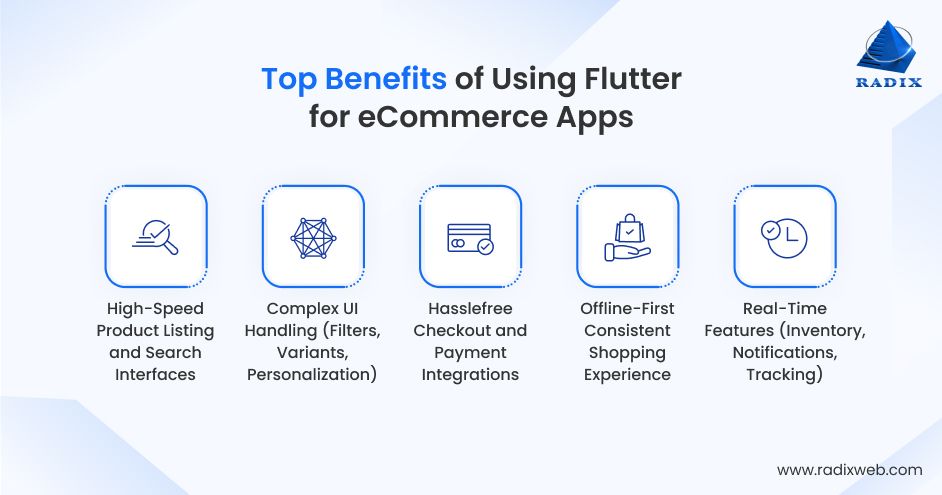
Result: Users browse deeper without bounce
Result: Higher engagement through relevant discovery
Result: 20-30% lower cart abandonment
Result: Better retention in poor network conditions
Result: Fewer support tickets, improved customer trust
Flutter influences how quickly a business can respond to market changes, how efficiently it operates across platforms, and how consistently it delivers user experiences. In a competitive commerce environment. These factors materially impact revenue and growth.
Here's the breakdown of how Flutter delivers for e-commerce decision-makers:
Launch across iOS and Android from one codebase. You don’t have to wait for 2-3 months for staggered platform releases. As MVPs ship in as early as 6-8 weeks, you can test seasonal campaigns or new markets on demand.
40-60% cost savings come from 95% code reuse across devices. One team handles everything instead of separate Swift/Kotlin teams. At the same time, fewer platform bugs slash QA and support overhead.
Customers notice when your Android app looks "budget" next to iOS. e-commerce Flutter apps render identical pixels everywhere. They have the same animations, typography, and brand colors that create premium perception on every touchpoint.
Ship A/B tests for checkout flows, dynamic pricing, or recommendations quickly. Progressive delivery lets you test with 10% of users first, while hotfixes bypass App Store review delays.
Flutter's 60fps scrolling and instant interactions can deliver 7-12% conversion lift vs hybrid apps. As friction points are removed from search to checkout, building an e-commerce app with Flutter compounds into higher revenue.
Flutter excels in app-based digital commerce solutions and scenarios where visual polish, cross-platform consistency, and rapid delivery matter most. It's ideal for businesses wanting one team and one codebase to deliver premium UX across iOS, Android, and web storefronts.
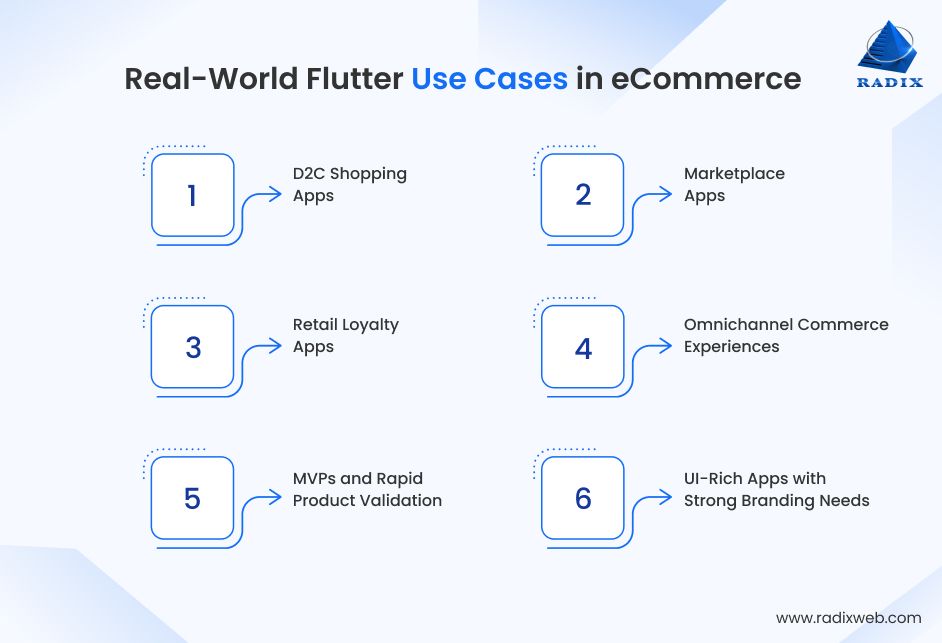
1. D2C Shopping Apps
Direct-to-consumer brands need standout mobile experiences to compete with marketplaces. Flutter delivers pixel-perfect brand identity for every device without platform compromises.
2. Marketplace Apps
Multi-vendor platforms demand scalability and real-time sync across high-volume catalogs. Flutter handles complex seller/buyer flows without performance cliffs.
3. Retail Loyalty Apps
Loyalty programs live or die by engagement. Flutter creates sticky experiences that keep customers returning through gamification and personalization.
4. Omnichannel Commerce Experiences
Brands spanning mobile, web, in-store, and delivery need unified experiences. Flutter's consistency across form factors eliminates "channel silos."
5. MVPs and Rapid Product Validation
Test commerce concepts fast without platform-specific engineering debt. Flutter gets you to market in 6-8 weeks with production-grade polish.
6. UI-Rich Apps with Strong Branding Needs
When visual storytelling drives conversion, Flutter's design freedom creates top-notch shopping moments that generic web experiences can't match.
7. The Flutter sweet spot
App-centric commerce where one team + one codebase = premium multi-platform experiences. If your customers live in apps and your brand demands visual excellence, Flutter delivers ROI through higher engagement and faster launches, and a more scalable foundation for businesses investing in e-commerce app development for modern digital commerce platforms.

Flutter’s credibility in e-commerce is reinforced by its adoption across both large enterprises and fast-moving startups. It supports early-stage experimentation just as effectively as it handles large-scale, production-grade commerce systems, which makes it a reliable choice across growth stages.
Alibaba uses Flutter in parts of its ecosystem to support high-traffic commerce environments. The focus is on maintaining smooth performance across large product catalogs while delivering a consistent experience across devices.
eBay Motors leverages Flutter to streamline development and improve user experience in its automotive marketplace. The platform benefits from faster UI rendering and reduced complexity in maintaining cross-platform consistency.
Etsy has explored Flutter to enhance mobile experiences and accelerate feature delivery. The emphasis remains on delivering visually rich interfaces while improving development efficiency.
Startups often work with Flutter technology consultants and developers to quickly build functional prototypes with production-level UI. This allows teams to validate ideas without investing heavily in separate platform development.
With faster build cycles, startups can present working products instead of static concepts. This improves investor confidence and shortens the path from idea to funding.
Flutter supports a modular approach, allowing features to be added or refined without disrupting the entire system. This makes it easier to scale as the product evolves.
By integrating with API-driven backends, Flutter apps can handle increasing data complexity and user demand. This setup ensures that performance and scalability remain stable as the business grows.
For e-commerce apps, performance tuning goes beyond general best practices. It requires deliberate decisions across UI, state, data flow, and rendering. This is where Flutter can move from being “fast by default” to delivering consistently high performance at scale.
Here are some of the best practices for developing e-commerce apps using Flutter, explained simply, with real user benefits:
Instead of loading huge product photos immediately, show small thumbnails first, then bigger images as users scroll. Add smooth fade-ins so pages never look broken.
Users notice: Catalogs load 2x faster, they browse longer without waiting.
Use tools like Riverpod to manage cart, filters, and user data without slowing down the app. Changes in one area (like adding to cart) won't freeze the product screen.
Users notice: Filters and search work instantly, no lag when updating cart.
Mark static parts of your app (like product cards) as "const" so they don't rebuild unnecessarily. Wrap fancy animations in special containers.
Users notice: Smooth 60fps scrolling through hundreds of products.
Save product details, wishlists, and search results locally so returning customers see everything instantly, even with spotty internet.
Users notice: App feels familiar and fast on every visit.
Break checkout into 3 simple screens max. Auto-save forms, add one-tap payments, show clear progress bars.
Users notice: Complete purchases confidently without frustration.
Ask for less data at once (just product names and prices first). Only load full details when users tap. Delay search requests slightly to avoid spam.
Users notice: Search results appear before they finish typing.
Don't dump 1,000 products at once. Show 20, load 20 more when users scroll. Display skeleton screens while waiting.
Users notice: App feels instantly responsive, perfect infinite scroll.
Flutter wins on UI consistency and development speed for cross-platform commerce apps, but native development leads for platform-specific features while web stacks dominate SEO. The decision of creating an e-commerce app with Flutter or any other framework must be based on your priorities - speed-to-market vs deep OS integration.
Not all frameworks fit every e-commerce need. Here's a balanced comparison across key decision factors:
| Framework | UI Consistency | Performance | Dev Speed | Ecosystem | SEO | Best For |
|---|---|---|---|---|---|---|
| Flutter | Pixel-perfect everywhere | Native-level (60fps) | 2x faster (single codebase) | Growing fast | Weak on web | App-first commerce |
| React Native | Good, some quirks | Good, bridge overhead | Fast | Largest | Weak on web | Hybrid apps |
| Native (Swift/Kotlin) | Platform perfect | Best possible | Slowest | Mature | N/A | Deep OS features |
| Web-first (Next.js) | Consistent | Good (web limits) | Fast | Huge | Best | Content-heavy sites |
Both are cross-platform frameworks, but Flutter pulls ahead for shopping apps:
Native development offers the most control but also incurs the highest cost. Flutter gets 95% there for less:
Web stacks (Next.js, Gatsby) own SEO. Flutter owns app UX:
Flutter solves 80% of commerce needs brilliantly, but consider alternatives when:
Decision framework: If your customers live in App Store/Google Play and you need to launch with speed and visual consistency, Flutter dominates. But if you need bleeding-edge native or SEO-first content, look elsewhere.
Flutter's future in e-commerce centers on AI personalization, AR shopping, headless commerce frontends, and web/desktop expansion. With businesses moving toward more adaptive and experience-led models, Flutter is positioning itself as a flexible front-end layer that can upgrade with these shifts.
Flutter with AI/ML delivers hyper-personalized commerce at scale:
Hyper-personalized commerce at scale becomes more achievable when Flutter is combined with ML-driven recommendation systems through enterprise-grade AI integration services.
Augmented reality is gaining traction in categories like fashion, furniture, and beauty. Flutter’s growing support for AR integrations enables businesses to offer interactive experiences.
Flutter + ARKit/ARCore:
Flutter fits well into headless commerce architectures as a frontend layer that can connect to platforms like Shopify, Magento, or custom APIs. It's highly compatible with modern headless CMS development solutions.
Perfect stack:
Flutter for e-commerce development is also extending into web and desktop environments for more unified commerce experiences across devices.
Flutter multi-surface commerce:
Why Flutter leads the future: Single codebase, native performance, and maturing web solutions result in omnichannel commerce without engineering silos. Hence, brands adopting Flutter now gain first-mover advantage in AI/AR shopping.

Bringing Performance-First Flutter Development to eCommerce at Radixweb
Flutter is more than a cross-platform decision in e-commerce. It directly influences how quickly you can launch, how consistently your brand shows up, and how efficiently you can improve conversion over time. In a category where small UX delays can lead to revenue loss, those advantages compound quickly.If you are evaluating Flutter for your e-commerce roadmap, the real advantage comes from combining the right framework with the right execution model. If you want to explore how this would apply to your specific use case, you can review our exclusive services focused on building and deploying Flutter apps or connect directly with our team.We approach Flutter development with a performance-first architecture, where UI rendering, state management, and backend orchestration are designed around commerce-specific behavior such as catalog-heavy screens, real-time updates, and checkout reliability. This allows us to maintain responsiveness even under scale, not just in controlled environments.Book your Flutter commerce strategy session with our Technical Lead. Let's build what scales.
Ready to brush up on something new? We've got more to read right this way.