Read More


Recognized for AI Excellence at 2026 Globee® Awards - Read More

Maitray Gadhavi
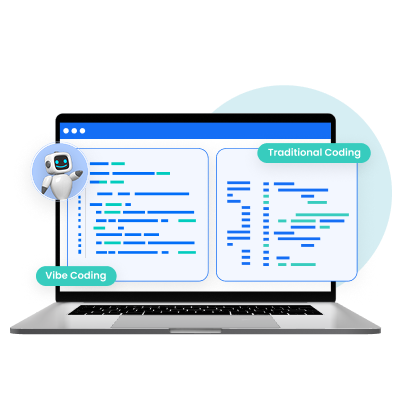
The Latency-Free Answer: Neither vibe coding nor traditional development wins outright. The right choice depends entirely on what you are building, how fast you need it, and what it needs to do 5 years from now. Below, you will find a practical decision framework, clear use case breakdowns, and a head-to-head comparison to help you pick the right approach.
Till 2025, software development needed a lot of time, effort, and money. Today, people are using $20/month tools to build software without coding and going live in minutes.
And this – vibe coding – is here to stay. Users across industries are shipping working prototypes, internal tools, and even early-stage apps with vibe coding.
But that doesn’t mean every project can be vibe coded. The real question isn’t which is better: vibe coding or traditional coding. Instead, it is knowing what vibe coding is, when it fits your project and when you need to stick to traditional software development. Below, I walk you through exactly that.
The vibe coding vs. traditional coding debate is more nuanced than most people assume. So, before you choose a side, understand what each term actually means.
Vibe coding refers to the specialized use of artificial intelligence where you describe what you want in natural language, and a tool generates the implementation. Cursor, GitHub Copilot, and Replit are the vibe coding platforms driving this shift.
Let’s take a look at the vibe coding benefits and vibe coding challenges.
| Vibe Coding Benefits | Vibe Coding Challenges |
|---|---|
| Build prototypes in hours | Hard to debug unfamiliar code |
| No deep coding expertise required | Struggles with complex logic |
| Lower early development costs | Poor documentation and structure |
| Fast feedback-driven iterations | Hidden security vulnerabilities & compliance gaps |
It is the discipline of writing software with full understanding of the underlying logic, architecture, and system behavior. It follows a defined process for code quality standards, version control, and documentation. Traditional coding is scalable, auditable, and doesn’t fall apart even when requirements get complex.
Let’s explore the traditional coding advantages as well as the challenges of traditional software development
| Traditional Coding Advantages | Traditional Coding Challenges |
|---|---|
| Reliable and maintainable code | Slower development early on |
| Built to scale with growth | Higher upfront talent costs |
| Strong security practices | Harder to pivot quickly |
| Designed for regulatory compliance | Requires specialized teams and tools |
| Clear documentation for future teams | Longer onboarding for new developers |
Next up, let’s see how the two coding approaches differ.
Here is a head-to-head comparison of the core dimensions of vibe coding vs. traditional programming.
| Dimension | Vibe Coding | Traditional Coding |
|---|---|---|
| Who Codes | AI generates, humans direct | Human writes every line |
| Speed to prototype | Hours to days | Days to weeks |
| Code quality | Variable; depends on AI output | Consistent with proper process |
| Scalability | Limited without refactoring | Designed for scale |
| Security | Required manual auditing | Baked in by design |
| Cost (Short-Term) | Lower | Higher |
| Cost (Long-Term) | Can escalate with tech debt | More predictable at scale |
| Best for | MVPs, prototypes, internal tools | Production systems, solutions for regulated industries |
| Team Required | Minimal – Solo or small team | Skilled engineering team |
| AI Dependency | High | Low to moderate (using AI as a tool) |
Now, neither traditional development nor vibe coding is categorically superior, and the vibe coding vs manual development debate is, at its core, a question of fitness.

Traditional coding vs vibe coding isn’t a permanent allegiance. It is a project-level decision. The mistakes most teams make today is defaulting to one without asking whether it actually fits what they are building, for whom, and what happens to it in the next 5 years.
There is no universally correct answer to whether AI coding is better than traditional coding or the other way around. Use the 5-step decision framework below to reach the right answer for your specific project.
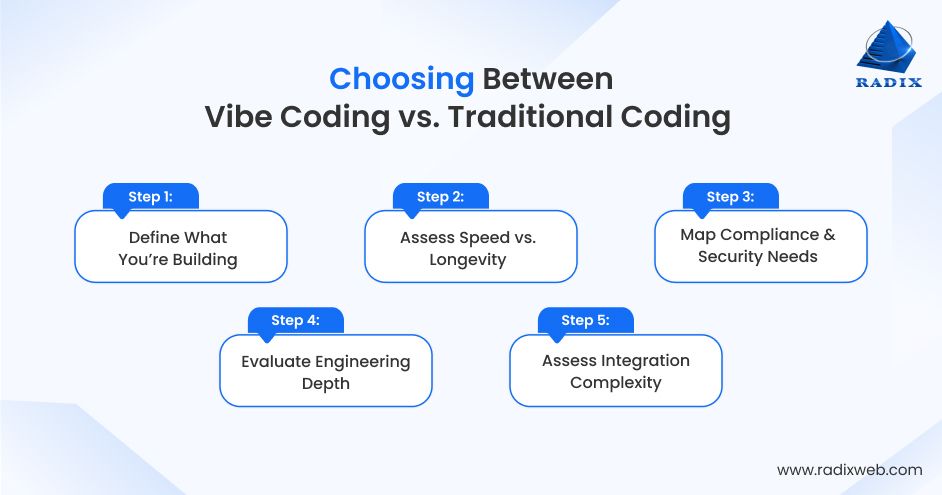
Start with the most basic question: Is this a throwaway prototype, an internal tool, a customer-facing product, or a core business system?
Do this: Write one sentence describing what the software must do, who uses it, and what breaks if it fails. If the answer to ‘what breaks’ is ‘nothing critical’, vibe coding is likely sufficient. If the answer involves customers, revenue, compliance or safety, you need expert software developers who use AI for app development.
While you are deciding on the coding approach, answer two questions:
If your answer is ‘fast and short-lived', using vibe coding for MVP development, pitch demos, or internal dashboards makes strong economic sense. But if your answer is that ‘this needs to support 10x user growth and integrate with multiple other systems in 2 years’ traditional development may be better.
A cost comparison between vibe coding and traditional development is also important here. The former looks cheap upfront but is expensive later. So, instead of vibe coding solo, you may also want to explore the option of using no-code or low-code software development with expert support.
Several regulations, data protection requirements, and security standards apply to software projects. If GDPR, HIPAA, SOC2, PCI-DSS, ISO 27001, etc. apply to your project, the risks of using AI-powered coding tools in your project become disproportionately high. AI-generated code is not security-audited by default. It may contain vulnerabilities that the model learned from insecure training data. So, here traditional development is better suited.
Also, the risks of AI-generated code in certain niches are significant. So, if you are building for healthcare, fintech, law or other regulated industries, go the traditional route and consult AI experts before project kickoff.
One of the core limitations of vibe coding in software development projects is the ownership gap. When AI writes a 500-line function and something breaks at 2 am, someone has to understand that code well enough to fix it.
So, be honest about who’s going to maintain your project after it is built. Does your team have the engineering depth to own, debug, extend, and secure what comes next? If your team can handle data engineering before, during, and after the project and review AI output, vibe coding can help. But for a primarily non-technical teams, you need to know who owns the vibe coded output tomorrow. and review AI output, vibe coding can help. But for a primarily non-technical teams, you need to know who owns the vibe coded output tomorrow.
The challenges of adopting vibe coding for enterprise apps becomes the most visible in complex integration environments. AI tools are excellent at greenfield code. But they struggle with undocumented APIs, legacy systems, and multi-system orchestrations.
So, list systems, APIs, databases, and third-party services your software needs to communicate with. If this integration map is simple, vibe coding can handle it. If not, you need disciplined and guided software development to hold it together.
The decision framework above tells you how to think. The scenarios below will tell you what that looks like in practice.
There are clear use cases for vibe coding where the tradeoffs work in your favor. The situations include:
The following use cases for traditional coding are where robustness, security, and longevity matter more than speed.
Use traditional coding for:

Embrace AI-First Development with Radixweb
The boundary between vibe coding and traditional coding is already blurring. Effective development teams today aren’t choosing one but using both together. And when these approaches intersect, the discussion goes far beyond productivity. Vibe coding vs. traditional development is more than a productivity question. The real challenge is building systems that:● Scale easily● Stay secure● Meet compliance requirements● Integrate cleanly● Remain maintainable years laterAll this demands expertise, judgment, and accountability that no prompt can replace.At Radixweb, we’ve spent 26+ years building software for businesses that can’t afford shortcuts. We have hands-on experience with machine learning, data engineering, AI integrations, and full-stack development. We use vibe coding tools where they add value and engineering expertise everywhere else.So, if you’re evaluating the right approach for your next project, we can help. Schedule a consultation with our AI and software development experts to discuss what's best for your project.
Ready to brush up on something new? We've got more to read right this way.