
Read More


Recognized for AI Excellence at 2026 Globee® Awards - Read More

Anand Trivedi

Quick Summary - Automated Valuation Models (AVMs) are revolutionizing how the real estate industry values properties, delivering data-driven insights, accuracy, and speed in less time. In this article, you will explore how AVMs work and why they’re becoming a trusted tool for lenders, investors, and agents alike.
Diving into real estate tech, you’ll spot how app advancements and Proptech are seriously shaking things up when dealing with properties. It’s a dynamic fusion of groundbreaking concepts and ripe opportunities, such as automated valuation models. With these advanced solutions, you’re not just flicking through listings; you get a customized house-hunting adventure that zeroes in on what you want.
Moreover, innovative technologies such as AI, Blockchain, IoT, and machine learning are the new ace for real estate professionals – making their work slick and keeping clients more than just satisfied. A latest Statista report mentions thar the global real estate market is anticipated to grow at an annual rate of 2.77%, resulting in a market value of USD 727.80 trillion by 2029.
As this sector evolves rapidly due to Proptech continually pushing boundaries forward, it's clear why staying updated on emerging trends in real estate app development can give investors, agents, and entrepreneurs alike a significant edge in today’s market. AVM (Automated Valuation Model) is one such trend!
Instead of spending countless hours determining the value of a property, technology-driven property valuation tools like AVM can do this in a matter of seconds. Let’s understand the fundamentals of AVM in detail.

An Automated Valuation Model (AVM) is a tool used to determine property values in residential and commercial real estate through statistical modelling techniques.
However, the process of ascertaining the value of a property has become seamless with the use of real estate software solutions. AVM, or Automated Valuation Model, is the software that real estate agents and brokers use to evaluate property value.
Understanding the systematic use of AVM for real estate will help you understand its strengths and weaknesses:
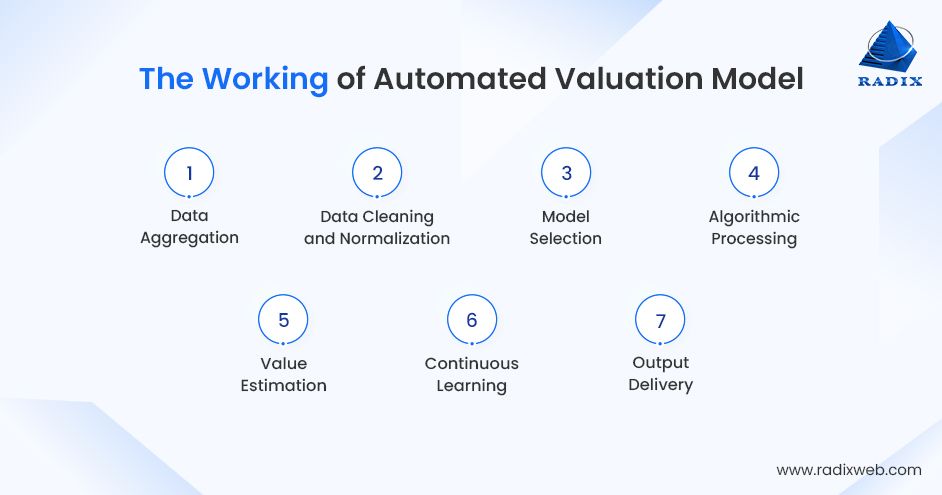
1. Data Aggregation – Gather large datasets including recent sale prices, property details like age, size, or features, market trends, and neighborhood demographics.
2. Data Cleaning and Normalization - Ensure data precision by standardizing formats, rectifying errors, and removing outliers.
3. Model Selection - Choose the suitable AVM model based on property type and data availability.
4. Algorithmic Processing – Deploy machine learning and statistical algorithms to identify the relationship and patterns between property characteristics and prices.
5. Value Estimation - Calculate the estimated property value, along with the error margins or confidence scores.
6. Continuous Learning – Upgrade the models comprehensively with new data inputs, which adapt to market changes and improve accuracy.
7. Output Delivery – Offer accurate valuations via APIs, integrated platforms, property management software, or user-friendly dashboards for smooth access by stakeholders and clients.
Using AVM implies that human involvement in property valuation is minimized. Automating the valuation process offers many advantages, including faster calculation time. Let’s check out the main benefits of the automated valuation model.
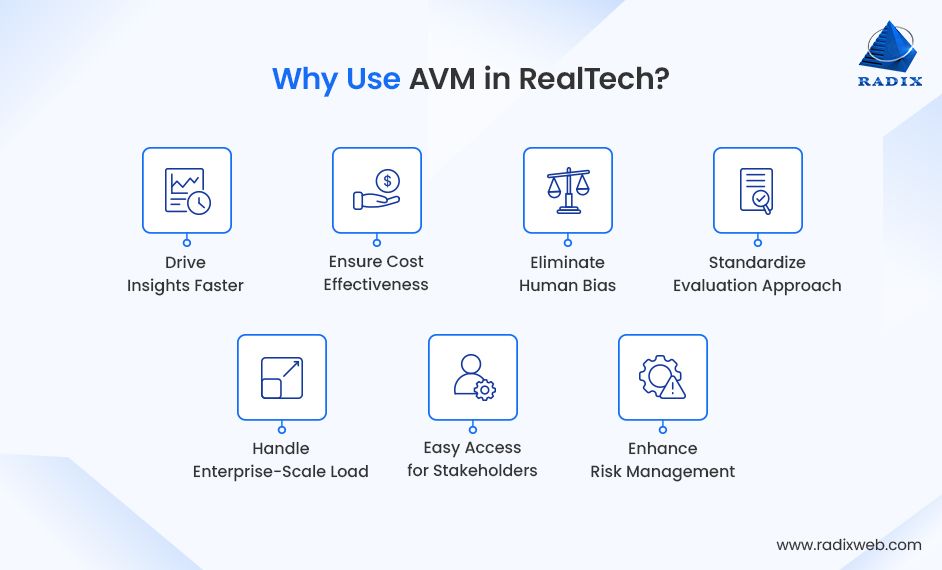
Conventional property valuation methods are time-consuming due to the numerous steps involved and the extensive data required. However, an automated valuation model can determine the value of properties quickly with the help of algorithms.
Estimating property value manually is not only a headache but also costly. AVM minimizes the cost by removing intensive manual labor.
It offers automated property valuation across multiple properties and timeframes. AVM standardizes valuation approaches for reliable decision-making.
AVM for real estate helps process higher volumes of properties efficiently and simultaneously. It also helps with real-time market analysis without manual intervention.
Provides immediate evaluation outcomes that you can access via APIs and web platforms. AVMs also help stakeholders, including appraisers, lenders, sellers, and buyers.
AVM helps identify possible loopholes and outliers early. It also supports financial institutions in portfolio management and examining loan risks.

Look at the advancing trends in real estate technology, AI-led innovation and automation is everywhere. As for AVMs, they have carved out their own niche by expanding their service capabilities steadily. New-age AVMs work on different property valuation models that affect their results. The following are the significant types of automated valuation models.
The real estate landscape is becoming extensively dynamic and data-rich. AVMs are now critical-enablers of advanced, automated property evaluations. Here are some reasons why AVMs are crucial for property evaluations in the new-age PropTech landscape:
Speed at Scale: Legacy appraisal models take a couple of days to weeks. AVMs however, deliver thousands of property evaluations simultaneously in seconds. AVMs are essential for bulk transactions, high-impact lending and portfolio rebalancing.
Democratizing Data Access: Earlier formal appraisals were limited to institutional players. However, with AVMs, individual consumers like buyers, sellers, and renters can procure formal data-backed estimates for clear decision-making.
Empowering Lending and Mortgage Pipelines: Fintech institutions and banks are now embedding AVMs into underwriting workflows. This helps in weighing risk collateral in real time, reduce manual reviews and progress faster loan processing.
Empowering AI and Predictive Analytics: Insights from AVMs serve as proprietary training signals for the next PropTech models. They deliver valuable inputs on price forecasting, neighborhood trend analysis, rental yield prediction, investment scoring, etc.
Portfolio Monitoring for Investors and REITs: AVMs generate daily or quarterly portfolio repricing without needing individual appraisals. AVMs deliver continuous market-to-market evaluations that large-scale property holders require.
Regulatory and Risk Compliance: Regulators now demand beyond subjective manual appraisals - thoroughly documented, repeated valuation methods. AVMs build highly consistent and auditable evaluation trails.
Hyper-local Market Intelligence: Modern AVMs are granular in approach. They factor elements like infrastructure investment, school/medical facility proximity, natural disaster risks, density of local amenities etc. This helps investors and developers make smart location-based decisions.
Let's understand the fundamental differences between the automated valuation model and the appraisal model.
| Features | Automated Valuation Model (AVM) | Traditional Appraisal Model |
|---|---|---|
| Approach | Statistical modeling, data-driven algorithms | On-site property evaluation by an appraiser |
| Subjectivity | Minimal, objective | Subject to the appraiser’s judgment |
| Cost | Low to no cost | Higher expenses due to manual labor and expertise |
| Speed | Immediate to a few minutes | Several days to weeks |
| Accuracy | Accuracy might vary; however, it is suitable for uniform markets | High accuracy, particularly for unique homes |
| Scalability | High, value thousands of properties quickly | Low manual work restricts volume |
| Use Cases | Mass appraisal, risk management, and mortgage underwriting | Refinancing, legal disputes, and home sales |

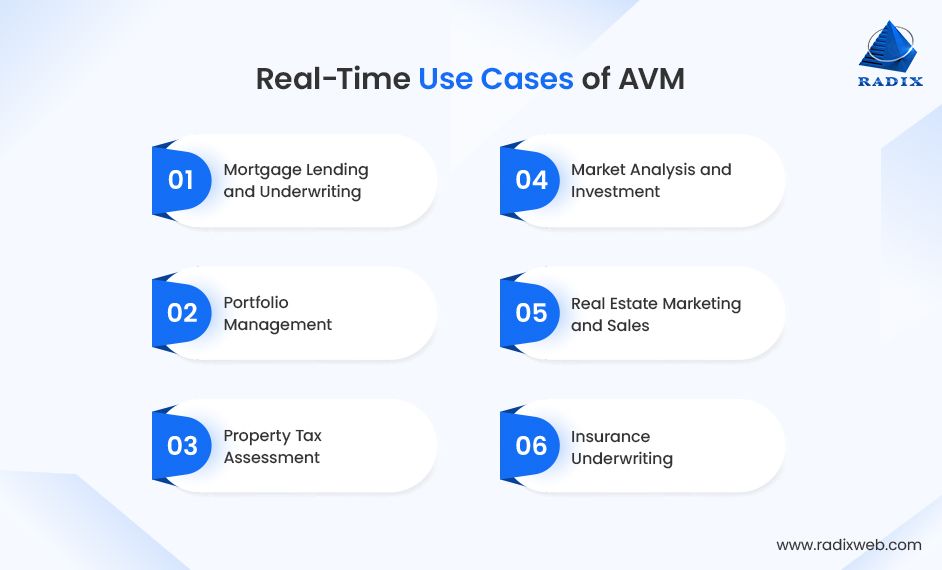
Automated valuation models have become imperative digital assets across different domains of the real estate industry due to their speed, data-driven insights, and efficiency. The following are the significant use cases of AVMs:
AVM outputs are only as good as your inputs and modeling approaches. Several crucial factors impact AVM accuracy:
While there are several advantages of AVMs, they also come with specific challenges and limitations that need to be addressed to maximize their efficiency. Enlisted below are the significant challenges of AVM along with their best solutions:
Incomplete or inaccurate data might lead to inconsistent valuations. And at certain times, public records may be outdated.
How to solve? Integrate diverse data sources, including proprietary databases, satellite imagery, and MLS listings, to improve data quality for AVM accuracy. You can also deploy machine learning algorithms to flag errors for manual review.
In local markets, rapid shifts such as zoning changes and economic transformations are not instantly visible in AVM outputs.
How to solve? You can utilize adaptive learning models and real-time market data feeds to update valuations, taking into account macroeconomic parameters and new technological trends.
AVMs sometimes struggle to justify property conditions or unique features, such as aesthetic appeal, structural issues, and the need for renovations.
How to solve? You can deploy AI-powered owner-provided updates and image analysis to augment traditional data points, which allows AVMs to evaluate property conditions more efficiently.
AVMs in real estate must adhere to appraisal standards and lending regulations, which may vary by jurisdiction.
How to solve? You can integrate compliance modules that align with AVM workflows, incorporating industry best practices and local laws, to ensure auditable, transparent, and automated property valuation.

The future of AVM technology in real estate is poised for considerable growth and innovation, driven by advancements in cloud computing, data analytics, and AI.

Next-gen AVMs will leverage the capabilities of deep learning and AI in real estate to assess more complex datasets, which include social sentiment, economic parameters, and satellite imagery. It helps deliver highly customized, precise valuations tailored to particular market niches.
Blockchain technology helps improve the security and transparency of the property data AVMs use. In contrast, Internet of Things (IoT) devices help provide real-time data on property conditions, which further enhances valuation accuracy.
As AVMs in real estate become integral to financial transactions, you can expect stricter regulatory frameworks that emphasize data privacy, transparency, and fairness. Moreover, ethical AI practices will soon become a defining feature for AVM providers.
Property images alone do not do justice when influencing leads. By turning images into structured and objective insights, AVMs record realistic conditions, features, and neighbourhood quality for faster, more reliable AVM evaluations.
Take the Next Step with Radixweb!
Determining the value of a property was a challenging task in the past, but now it has become a seamless process thanks to software like AVM. The Automated Valuation Model offers a simple method for calculating a property’s value. It calculates the property value based on mathematical formulas and property characteristics.Do you want to create an AVM? Partner with Radixweb to transform your vision into scalable, high-performance digital solutions. We help real estate businesses build custom software tailored to their unique needs. With years of industry experience and deep technical expertise, we deliver innovative, reliable real estate software solutions that drive growth.Contact us to gain a quick understanding of our services and choose us to develop exceptional real estate solutions.
Ready to brush up on something new? We've got more to read right this way.