
Read More


Recognized for AI Excellence at 2026 Globee® Awards - Read More

Sarrah Pitaliya
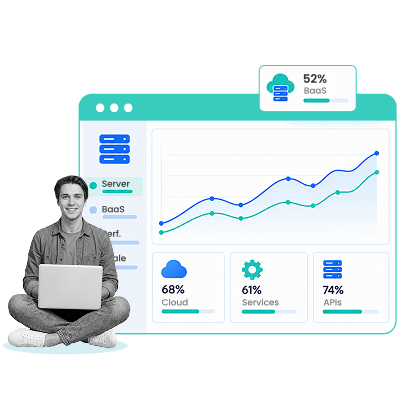
The global backend-as-a-service (BaaS) market is undergoing a transformation. Across organizations of every size and industry, teams are making a deliberate shift away from building custom backend infrastructure toward adopting managed, cloud-native solutions. This transition isn't happening in isolation, though. It's being driven by concrete market forces like the proliferation of mobile applications, the acceleration of cloud-native development practices, and the growing recognition that backend infrastructure is best left to specialized providers.
These shifts are reflected in the numbers, with backend and BaaS statistics expanding across segments, use cases, and regions. The backend market statistics below provide a view of market size, growth, adoption, and segmentation across backend infrastructure, BaaS, and mBaaS markets worldwide.
Note: Market-size estimates across BaaS and mBaaS statistics vary significantly across research firms depending on how each defines the scope, so each statistic below is labeled with its source. This context matters when interpreting the numbers.

| Term | What it means in this article |
|---|---|
| Backend | Broad application-server/backend infrastructure |
| BaaS | Managed backend capabilities delivered through APIs/SDKs |
| mBaaS | BaaS specifically focused on mobile applications |
| Backend cloud services | Broader category that may include services outside conventional BaaS |
Also Read: The Complete Guide to Understanding Frontend vs. Backend
BaaS is a managed application-backend model that abstracts common backend capabilities such as authentication, databases, storage, APIs, notifications, and server-side logic behind hosted services, APIs, and SDKs. It is distinguished by its use of customized APIs and SDKs to deliver backend capabilities as consumed services rather than managed infrastructure or application software.
BaaS statistics provides a broader view of the infrastructure supporting today's digital applications. These figures help put the growth of managed backend services into perspective as organizations reconsider how much infrastructure they should build and operate internally.
The BaaS market is measured differently across research firms depending on whether they scope to mobile-only BaaS, general BaaS covering web and mobile, or broader cloud backend infrastructure. The figures below each carry a source label, so the scope is clear. Figures in the $4-12 billion range typically reflect mobile BaaS only, while figures above $25 billion typically reflect broader backend cloud services.
The difference between these estimates is largely a matter of market definition. Regardless of the methodology, the broader trend is clear: organizations are increasingly evaluating managed backend capabilities as part of their application development strategy.
Market reports offer more than headline revenue estimates. Looking at deployment models, enterprise size, service categories, and adoption patterns provides a clearer picture of where BaaS demand is concentrated and which areas are changing the fastest.
The segment review below organizes the BaaS market across the standard dimensions used in analyst reporting. These segments show that BaaS adoption is no longer tied to a single application type or development model. Platform choice, enterprise scale, compliance requirements, and service expectations increasingly shape how organizations evaluate backend infrastructure.
The BaaS market is segmented across several dimensions per Allied Market Research and Mordor Intelligence reports:
Android captured 59.60% of platform share in 2025, driven by the widespread deployment of Android devices globally. Cross-platform frameworks are growing at a 23.85% CAGR through 2031, reflecting the shift toward frameworks like React Native and Flutter that share a single backend across iOS and Android. (Mordor Intelligence, 2026)
The iOS segment is projected to be the fastest-growing platform segment in percentage growth terms, driven by the rising complexity of iOS app development and demand for BaaS solutions tailored to the Apple ecosystem.

Regional adoption reveals where BaaS investment is already concentrated and where demand is accelerating. Comparing mature markets with emerging technology ecosystems also highlights how application development priorities differ geographically.
| Country | Market Share (2023) |
|---|---|
| United States | 19.3% |
| Germany | 10.1% |
| Japan | 7.7% |
| Australia | 3.2% |
North America retained approximately 42.10% of the mBaaS market share in 2025 per Mordor Intelligence, and between 33-38% share of the broader BaaS market per other firms. The variation reflects scope differences rather than disagreement on North America's dominant position. The region benefits from dense concentration of technology companies, advanced cloud infrastructure, high smartphone penetration, and significant enterprise digital transformation investment in BFSI, healthcare, retail, and media.
The United States holds the largest share within North America. The presence of major cloud providers (AWS, Google, Microsoft Azure) and a mature developer ecosystem make the US the primary BaaS innovation and adoption market. AT&T's 2017 agreement with Oracle to migrate hundreds of internal databases to Oracle Cloud is an early enterprise-scale example of this pattern; the subsequent decade has seen substantial expansion of managed backend adoption among US enterprises.
Europe held approximately 21.9% of global BaaS market share in 2022, with broader BaaS reporting placing European share at approximately 30% in more recent estimates. European BaaS adoption is shaped by GDPR and data sovereignty requirements that influence platform selection, teams building for European users increasingly prefer platforms with EU data residency options, which has driven Firebase, Supabase, and AWS Amplify to expand European infrastructure.
| Country | Market CAGR (2025 to 2035) |
|---|---|
| China | 26.8% |
| India | 24.9% |
Asia-Pacific is the fastest-growing region for BaaS and mBaaS adoption. The combination of rapidly expanding mobile-first markets in China, India, and Southeast Asia, where smartphone penetration is high and mobile apps are often the primary digital interface, means that application development volume in the region is growing faster than in mature Western markets. Large enterprises account for over 50% of the Asia-Pacific BaaS market, as established businesses invest in digital transformation to serve tech-savvy mobile users.
The region's growth points toward a broader shift in application infrastructure. As digital products become central to customer interactions across emerging markets, scalable backend capabilities become increasingly important to support growing application volumes.
Industry adoption-related BaaS statistics explain where it creates the most immediate value. Verticals with high transaction volumes, mobile engagement, real-time data requirements, and authentication needs naturally have strong reasons to adopt managed backend capabilities.
While segmenting BaaS by application, the banking, financial services, and insurance (BFSI) sector leads the market.
Applications across industry verticals:
BFSI leads because mobile banking applications require the features BaaS provides at volume: real-time data synchronization, user authentication, push notifications for transaction alerts, and secure cloud storage for financial records. BaaS adoption in BFSI has also contributed to measurable operational improvements, including faster payment processing and reduced human error in transactions.
Healthcare is a growing vertical with compliance constraints specific to the BaaS context. But, not all BaaS providers offer HIPAA-eligible configurations.
Some backend platforms and underlying cloud services can support HIPAA-regulated workloads when the specific services are covered, a BAA is in place where required, and the environment is configured appropriately. Organizations should verify service-level eligibility rather than treating an entire BaaS platform as HIPAA compliant.
Retail and e-commerce represent the third major vertical, driven by mobile commerce applications that need real-time inventory data, personalization, and push notification capabilities.
Also, 38% of entertainment applications are using BaaS platforms with embedded real-time analytics and cross-device synchronization in 2024. (industryresearch.biz, 2025)
The application-level BaaS statistics show that adoption tends to follow business requirements rather than just being based on the top backend technologies. Industries with high-frequency digital interactions have stronger incentives to standardize backend capabilities that can scale with demand.
Mobile Backend as a Service focuses specifically on the backend capabilities required to support mobile applications. Its growth provides a more focused view of how organizations are handling authentication, data, storage, notifications, and other mobile workloads.
The range across these mBaaS statistics ($4.1 billion to $12.61 billion for 2025-2026) reflects differences in whether the scope includes web application backends alongside mobile, and whether managed database and identity services consumed alongside core mBaaS platforms are counted in the total. All sources agree on the directional story: strong double-digit growth driven by mobile app proliferation, enterprise mobility investment, and serverless architecture adoption.
The BFSI sector leads the mBaaS market due to stringent security and compliance requirements that favor managed infrastructure, plus the high volume of mobile banking applications requiring scalable backend services. The mobile app backend development guide covers the technical architecture decisions behind mobile app backend selection.
The underlying market signals point toward a broader change in how organizations approach backend engineering. Teams are increasingly balancing custom development with managed capabilities, particularly where standard backend functions can be consumed without maintaining the underlying infrastructure themselves.
The latest mBaaS statistics around adoption provide a snapshot of where the market stands today. Taken together, these indicators show which regions, platforms, enterprise segments, and service categories are shaping adoption in 2026.
Key growth drivers shaping the 2026 mBaaS market include rising investment in serverless architectures, 5G-driven edge requirements, AI-augmented application workloads, and cost-avoidance pressure on in-house backend development teams.
The IoT expansion is also a structural driver. With connected devices projected in the tens of billions globally, demand for scalable backend services to manage device data and connectivity continues to grow.
The 2026 mBaaS statistics and indicators suggest the market is evolving alongside the applications it supports. AI workloads, connected devices, cross-platform development, and distributed architectures will increasingly influence what organizations expect from backend platforms.
Segmentation across operating systems, service types, verticals, and geographies provides a more detailed view of how cloud and mobile backend demand is distributed across the market.
Android remains the dominant platform by share due to global device volume. Cross-platform frameworks are the fastest-growing segment as development teams standardize on React Native, Flutter, and similar frameworks that share a single backend across iOS and Android, reducing the relevance of platform-specific segmentation.
Others:
Identity and access management as a service (IDaaS) is among the fastest-growing service types, driven by enterprise requirements for secure, scalable authentication across mobile and web applications.
BFSI leads across all market scopes because mobile banking, payment processing, and insurance applications require the authentication, real-time data, and push notification capabilities that BaaS provides, at volumes that justify managed infrastructure over custom builds.
North America's dominance reflects the concentration of major cloud providers, high smartphone penetration, and enterprise digital transformation investment. Asia-Pacific's growth trajectory reflects mobile-first market development where BaaS adoption is accelerating from a lower base.
The current BaaS and mBaaS market includes active participants across commercial cloud platforms, open-source platforms, and enterprise software providers. The active vendor landscape in 2026 includes:
A lot of no-code and low-code backend platforms are also gaining ground today. With that and other market shifts, the vendor landscape has also changed considerably over time. Earlier market reports listed Appcelerator, Kony, and CloudMine as key players, all three were acquired or discontinued between 2016 and 2020 and are no longer independent market participants.
The range of active platforms gives enterprises more flexibility, but it also makes architecture evaluation more important. Vendor lock-in, data portability, security, compliance, integration requirements, and long-term operating costs should be considered alongside the immediate development benefits.

Where Backend Infrastructure Is Headed Next
The next phase of backend infrastructure will be shaped by AI-enabled applications, serverless architectures, edge computing, real-time workloads, connected devices, and increasingly distributed application environments. Organizations will need to build solid backend architectures that can accommodate these workloads without creating unnecessary operational complexity. The focus will increasingly move from simply choosing a BaaS platform to designing the right combination of managed services, custom backend components, APIs, data infrastructure, security controls, and cloud resources for each application.Radixweb helps enterprises and software product companies design, build, modernize, and scale backend infrastructure across cloud, mobile, web, AI, data, and enterprise application environments. Our teams work across backend development, cloud engineering, application modernization, AI integration, data engineering, and scalable application architecture to align infrastructure decisions with business and product requirements. Schedule a call with our experts to discuss the backend architecture and engineering approach for your next application.
Ready to brush up on something new? We've got more to read right this way.

